Digital Transformation Consultant Resume Examples: free
Create a Digital Transformation Consultant Resume That Proves Innovation Impact
By Mustafa Tarabya, founder of CVBooster · Published · Updated
Build a compelling digital transformation consultant resume showcasing technology-driven business change, agile delivery, and measurable innovation outcomes.
Sample resumes for a digital transformation consultant
The same digital transformation consultant content laid out in three CVBooster templates, so you can see what the finished document looks like before you write a word.
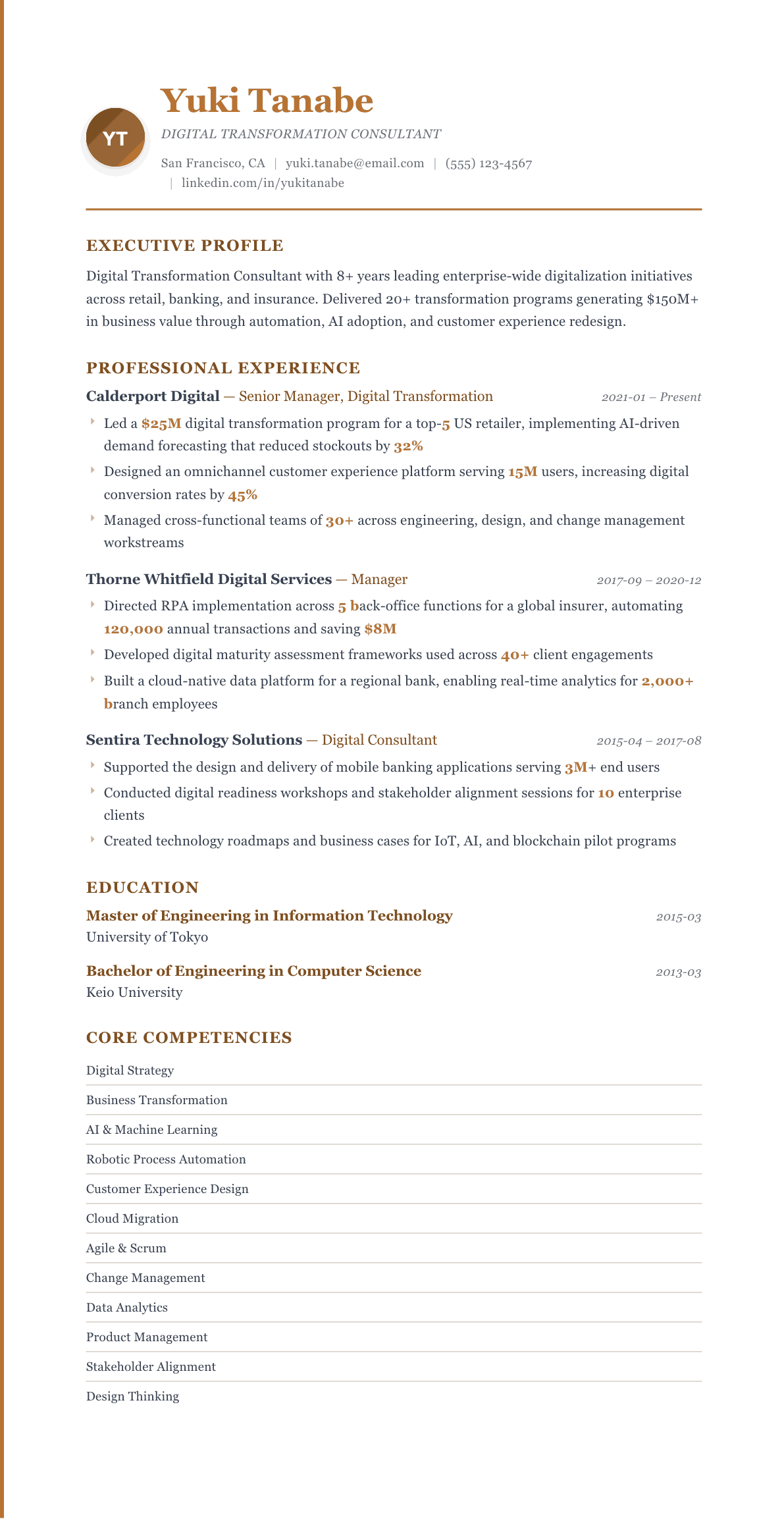
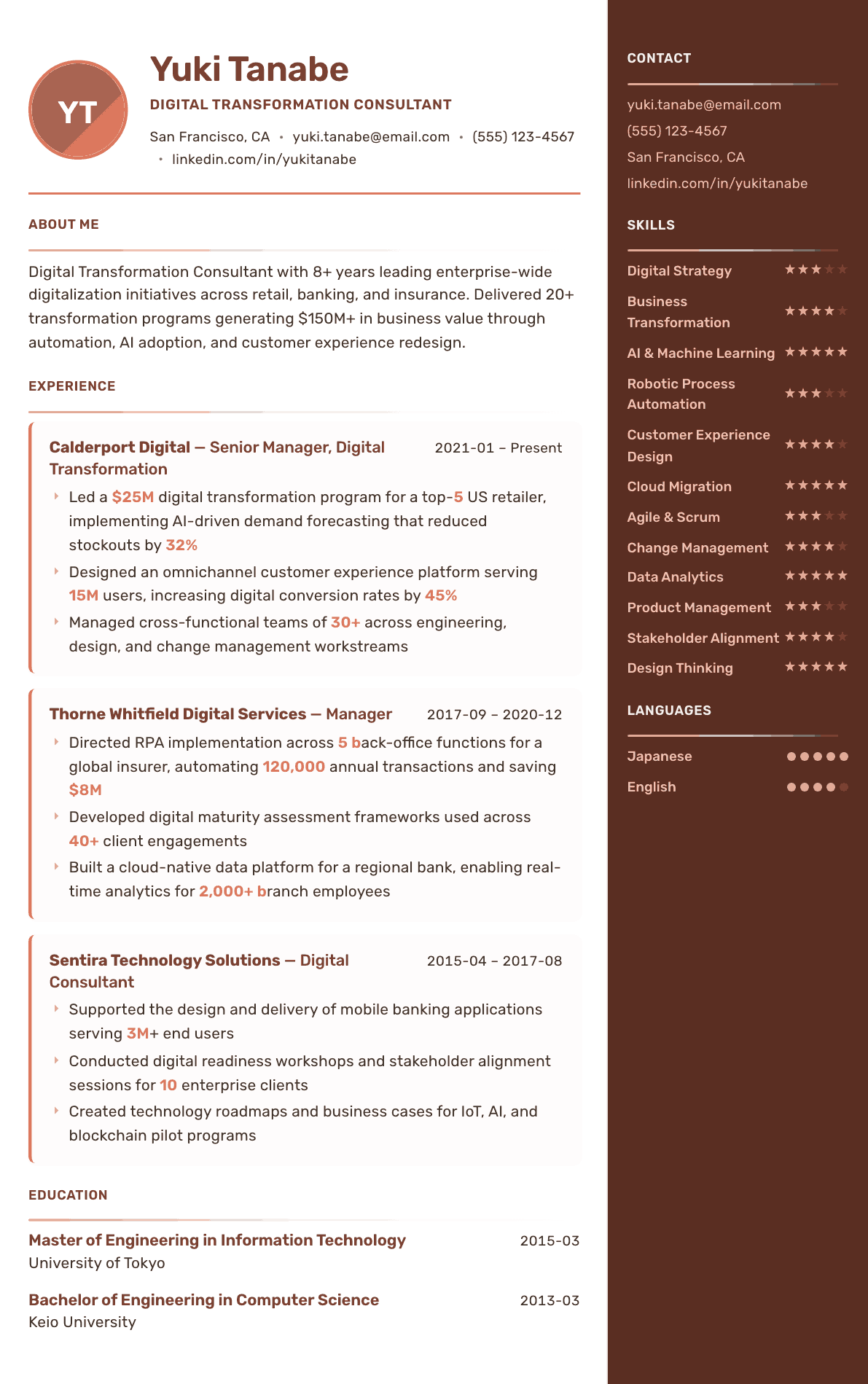
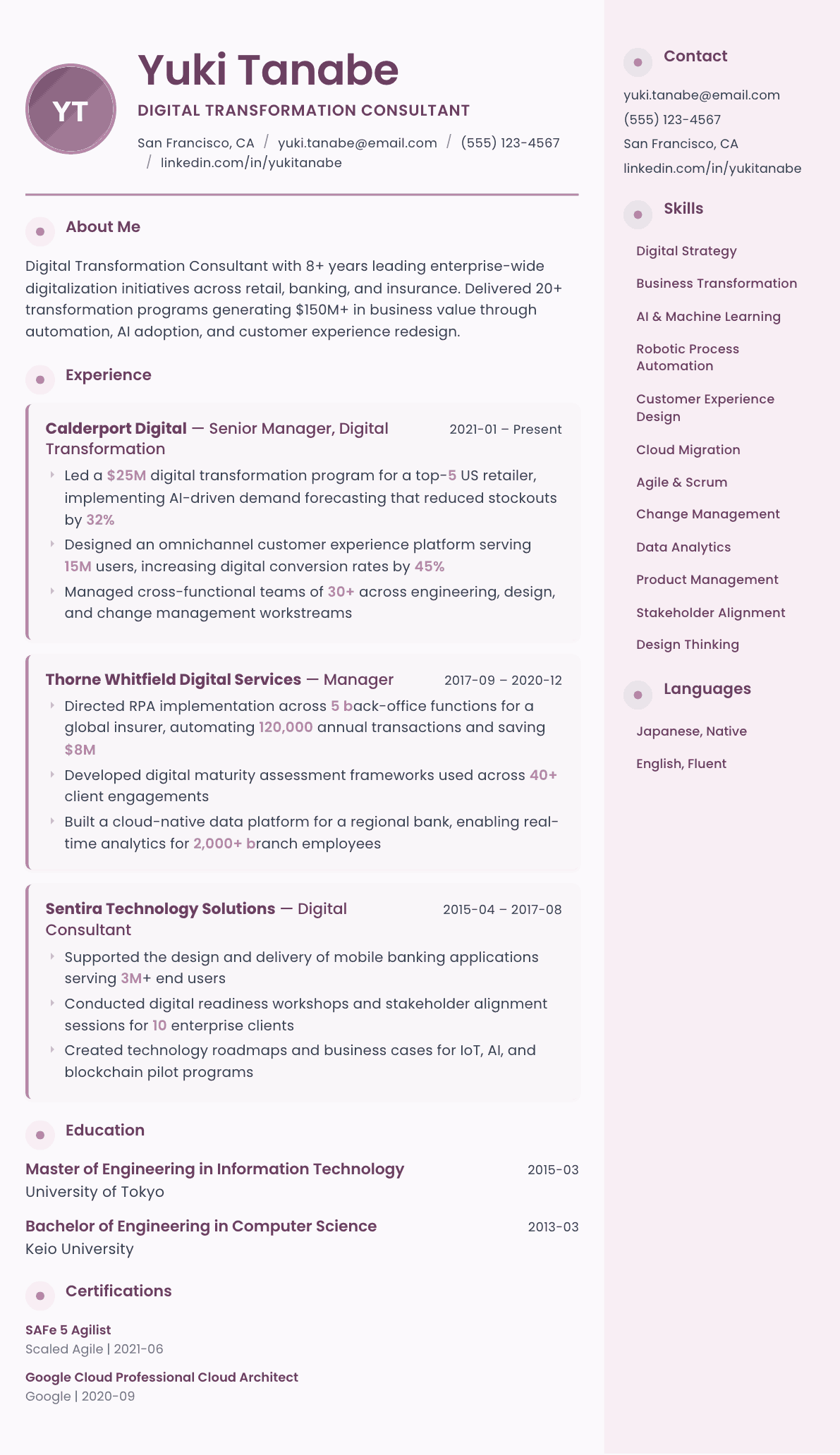
Example Digital Transformation Consultant summary
Digital Transformation Consultant with 8 years of experience leading enterprise digitalization across retail, banking, and insurance. Track record of delivering $150M+ in business value through AI, RPA, and customer experience innovation. Equally skilled in technology delivery and organizational change.
Skills to list on a Digital Transformation Consultant resume
- Digital Strategy
- Business Transformation
- AI & Machine Learning
- Robotic Process Automation
- Customer Experience
- Cloud Architecture
- Agile Delivery
- Change Management
- Data & Analytics
- Product Management
- Design Thinking
- IoT & Emerging Tech
What actually gets this resume read
- Quantify transformation impact: revenue generated, costs automated, user adoption rates, and time-to-market improvements.
- Showcase both business acumen and technical fluency. Digital transformation bridges both worlds.
- Highlight specific technologies deployed: RPA, AI/ML, cloud platforms, CX tools, and data platforms.
- Include change management and stakeholder alignment as core competencies. Technology alone does not drive transformation.
- Reference agile certifications and delivery methodologies to demonstrate execution capability.
How to write a digital transformation consultant resume
The digital transformation consultant resume sits in an awkward middle. Technology leaders suspect you are a slide writer who has never run a cutover. Strategy partners suspect you are an implementer who cannot frame a business case. The file that gets interviews proves both at once: a defensible commercial case on one side, and a named platform that went live on a date with users on it on the other.
Reviewers in this field are unusually alert to inflated language because so many resumes are built from program marketing decks. Words like reimagined, journey and enterprise wide agility appear constantly and mean nothing on their own. What survives scrutiny is a system named, a process changed, adoption measured, and an old way of working actually switched off.
This guide covers the structure a consulting screener expects, how to write a program entry that shows both the case and the delivery, three summary examples across the path from analyst to program lead, before and after bullets, and the questions transformation consultants ask when they update this resume between programs.
Format: program blocks, not a wall of responsibilities
Reverse chronological by employer, with programs nested under each. Each program gets four lines of context before any achievement: client sector and size, the business problem, the technology footprint involved, and your role with team size and duration. A reviewer cannot judge a transformation claim without knowing whether it was an eight week diagnostic or a three year core system replacement.
Two pages once you have run programs. Keep a short methods and platforms block near the top listing the frameworks and technologies you have genuinely used, so a keyword screen finds them without you burying tool names in prose.
- Header: name, city, phone, email, and professional profile link.
- Order: summary, methods and platforms, consulting experience with nested programs, industry sectors, education, certifications.
- Name the operating model change, not only the technology: which team stopped doing what.
- State whether you sat on the client side, the vendor side, or the advisory side of the program.
Summary: the transformation type you actually run
Transformation is a category, not a job. Say which type you do: core platform replacement, customer experience redesign, process automation at scale, data and analytics foundation, cloud migration, or operating model and ways of working. A director hiring for a warehouse management replacement is not looking for the person who redesigned an onboarding journey, and the summary is where that gets decided.
Add the industries where you have delivered rather than advised. Regulated environments count for more, because a consultant who has run a change through banking supervision, pharmaceutical validation, or public procurement has absorbed constraints that generalists discover late and expensively.
Experience: case, delivery, adoption, and what got retired
Structure the strongest bullets in four beats. The business case you built or inherited, the thing that went live, the adoption you measured, and the legacy process or system that was decommissioned as a result. That last beat is the one almost nobody writes, and it is the strongest proof of a real transformation, because parallel running forever is the standard failure mode.
Be concrete about technology. Name the enterprise resource planning suite, the customer relationship platform, the automation tool, the cloud provider, the integration layer. Writing that you deployed automation says nothing; writing that you deployed 40 attended and unattended bots across accounts payable and claims intake, and retired two offshore keying teams, is a fact someone can check in an interview.
Change management belongs in the same bullets rather than a separate soft section. Number of people trained, the champion network you built, the resistance you hit and how you moved it, the adoption curve after go live. Technology programs fail on adoption far more often than on code, and reviewers know it.
Methods, and how to claim them honestly
List the delivery methods you have worked inside: agile at scale, stage gate, design thinking discovery, lean process mapping, product operating models, or a hybrid where a regulated core runs waterfall while the front end iterates. Say which one each program used, because pretending everything was agile is transparent to anyone who has delivered a general ledger migration.
Give the governance detail too. Steering committee cadence, program board reporting, benefit tracking against the business case, a value realization office. Clients buy the ability to keep a multi workstream program honest, and that capability is easiest to see through the mechanisms you ran.
Keywords the screener searches on
Recurring terms in postings for this role are digital strategy, operating model, process automation, robotic process automation, cloud migration, customer experience, enterprise resource planning, change management, agile delivery, business case, benefits realization, stakeholder management and vendor selection. Use the ones that are true and put each near the evidence.
Cut the abstractions that carry no information. Holistic, end to end, synergies and next generation are filler that a partner reads past. If a phrase would still be true after you deleted the client, the technology and the year, it is not doing work on the page.
Digital Transformation Consultant resume summary examples
Analyst on transformation programs
Transformation analyst with 3 years on banking and insurance programs, running process mapping, requirements workshops and benefit tracking. Mapped 60 back office processes for an automation assessment that produced a business case adopted by the client operations board.
Six years in
Digital transformation consultant with 6 years delivering process automation and cloud migration in regulated industries. Led a 14 person workstream that moved claims intake to a low code platform, cut handling time by 38%, and retired two legacy applications after go live.
Program lead
Transformation lead with 13 years running enterprise programs across manufacturing and utilities, including a 4 year core system replacement in 9 countries with a team of 120. Owns the business case, the steering committee and benefit realization, not just delivery.
Work experience bullets: before and after
Before: Led digital transformation initiatives across the business.
After: Led a 3 year finance and supply chain platform replacement across 9 countries, 120 people across client and vendor teams, and moved the client off two legacy systems at the final wave.
Duration, geography, team composition and decommissioning give the reader something to verify instead of a category.
Before: Implemented RPA to automate manual processes.
After: Deployed 40 attended and unattended bots across accounts payable, claims intake and customer onboarding, redeploying 18 staff into exception handling rather than backfilling their roles.
Bot count, the specific processes and what happened to the people make the automation claim concrete and credible.
Before: Managed change management activities for the program.
After: Built a 60 person champion network across 14 sites, trained 900 users before go live, and tracked weekly adoption until the legacy workflow was switched off in month four.
Adoption tracked to a shutdown date proves the change landed, which a training count alone does not.
Before: Developed the business case for the transformation.
After: Built the business case from a bottom up process baseline of 220 activities, secured board approval, and tracked realized benefit quarterly against the original assumptions for two years.
Tracking benefits after approval separates a consultant who delivers value from one who only sells it.
Before: Worked with vendors to select the right technology.
After: Ran a vendor selection across 6 platforms with weighted scoring on integration effort, total cost and regulatory fit, and defended the recommendation to a steering committee that had a preferred incumbent.
A named process and an uncomfortable recommendation show independent judgment rather than procurement admin.
Hard skills
- Business case development
- Operating model design
- Process mapping and lean analysis
- Robotic process automation
- Cloud migration planning
- Enterprise resource planning programs
- Customer relationship platforms
- Integration and application architecture
- Vendor selection and evaluation
- Benefits realization tracking
- Agile delivery at scale
- Program governance and steering committees
- Data and analytics foundations
- Regulatory and compliance constraints
Soft skills
- Executive stakeholder alignment
- Handling resistance to change
- Facilitating cross-functional workshops
- Negotiating scope under pressure
- Translating technical risk for business leaders
- Coaching client teams to self-sufficiency
Certifications worth listing
- Project Management Professional (PMP) (Project Management Institute)
- Prosci Change Practitioner (Prosci)
- Certified SAFe Agilist (Scaled Agile)
- Certified ScrumMaster (Scrum Alliance)
- TOGAF Enterprise Architecture Practitioner (The Open Group)
- Microsoft Certified: Azure Solutions Architect Expert (Microsoft)
- AWS Certified Solutions Architect, Associate (Amazon Web Services)
- UiPath Certified RPA Associate (UiPath)
Mistakes that cost digital transformation consultant candidates the interview
- Writing in program deck language, so every bullet sounds like a slide title and none of it can be checked.
- Never naming a platform, which leaves the reader unable to tell strategy advice from delivery.
- Omitting what was decommissioned, the clearest evidence that the transformation actually replaced something.
- Claiming agile on programs that ran stage gate, which collapses in the first delivery interview.
- Leaving out team size and duration, so an eight week diagnostic reads the same as a multi year rollout.
- Treating change management as a soft skill bullet instead of showing trained users, champions and adoption.
- Filling the summary with filler such as holistic and next generation that a partner scans straight past.
Digital Transformation Consultant resume questions
How do I show transformation results when benefits appear after I leave?
Report what was true at handover and label it honestly: forecast benefit approved by the steering committee, adoption at the point of exit, and any milestone already banked. Reviewers respect a consultant who separates realized results from projected ones.
Should I list every technology I have touched?
No. Keep the platforms you could be questioned on for thirty minutes without notes. A long list including tools you saw once weakens the credible entries, and interviewers routinely pick the least likely item on the list to probe.
Do I need a technical background for this role?
Not a developer background, but you do need enough fluency to challenge an architect and read an integration diagram. Show it through platform decisions you influenced, migration sequencing you planned, or technical risks you escalated with a recommendation attached.
How do I move from an internal transformation role into consulting?
Turn each internal program into an engagement entry with a sponsor, a scope, a duration and a measured outcome, and add anything that shows you can work across business units. Firms screen for the ability to enter an unfamiliar organization and be useful within weeks.
What length should this resume be?
One page under five years, two pages after that. Give the last two or three programs full detail with case, delivery and adoption, and compress earlier ones to a line each naming the client sector, the platform and your role.
Related resume examples
- IT Consultant Resume example
- Product Manager Resume example
- Chief Digital Officer Resume example
- Data Analytics Consultant Resume example
- Consultant Resume example
- Management Consultant Resume example