Data Engineer Resume Examples: free ATS score and gap list
Pipeline a Data Engineer Resume That Flows to the Top
By Mustafa Tarabya, founder of CVBooster · Published · Updated
Create a data-driven data engineer resume showcasing ETL pipeline design, data warehouse architecture, and big data processing expertise.
Sample resumes for a data engineer
The same data engineer content laid out in three CVBooster templates, so you can see what the finished document looks like before you write a word.
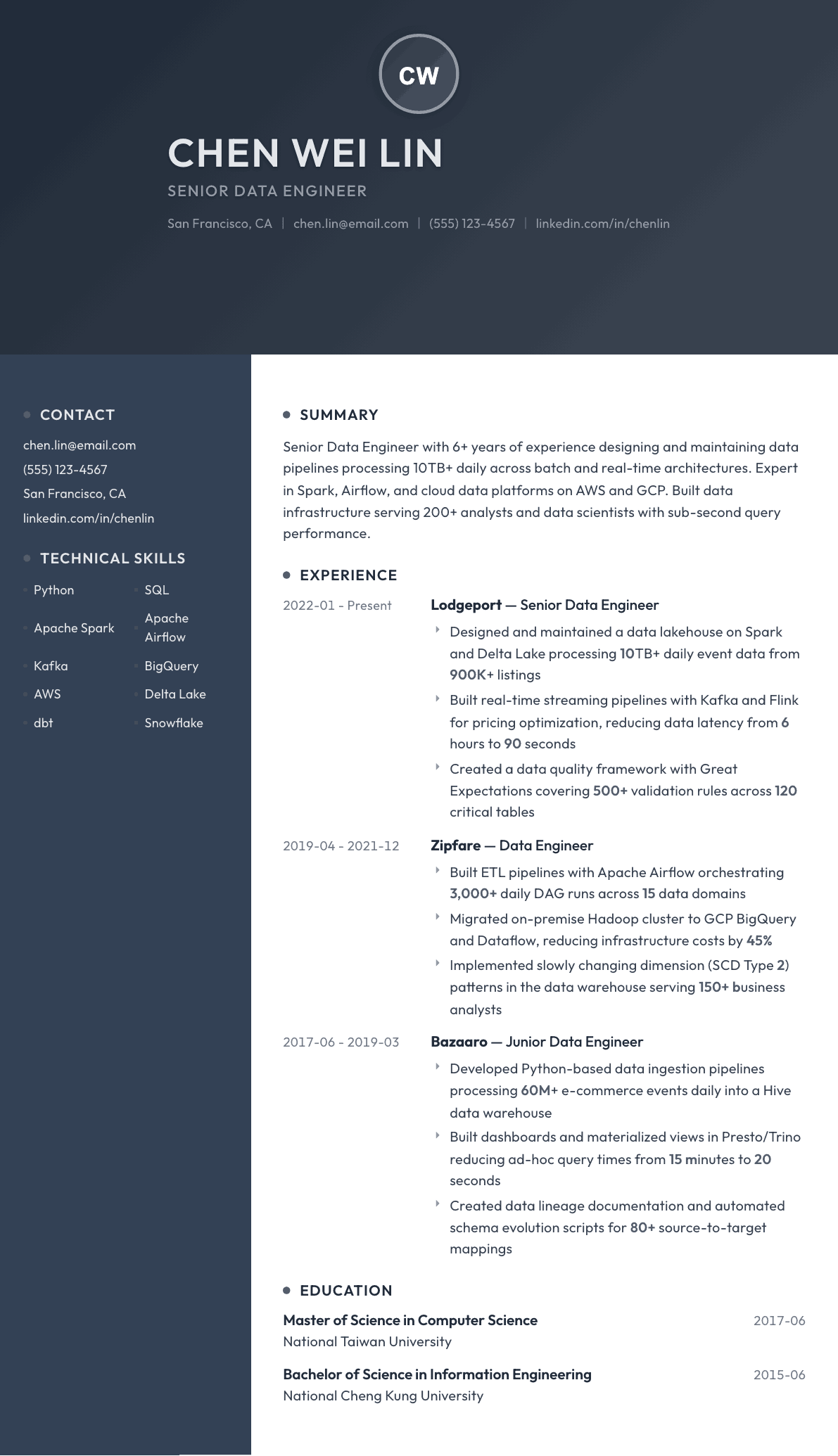
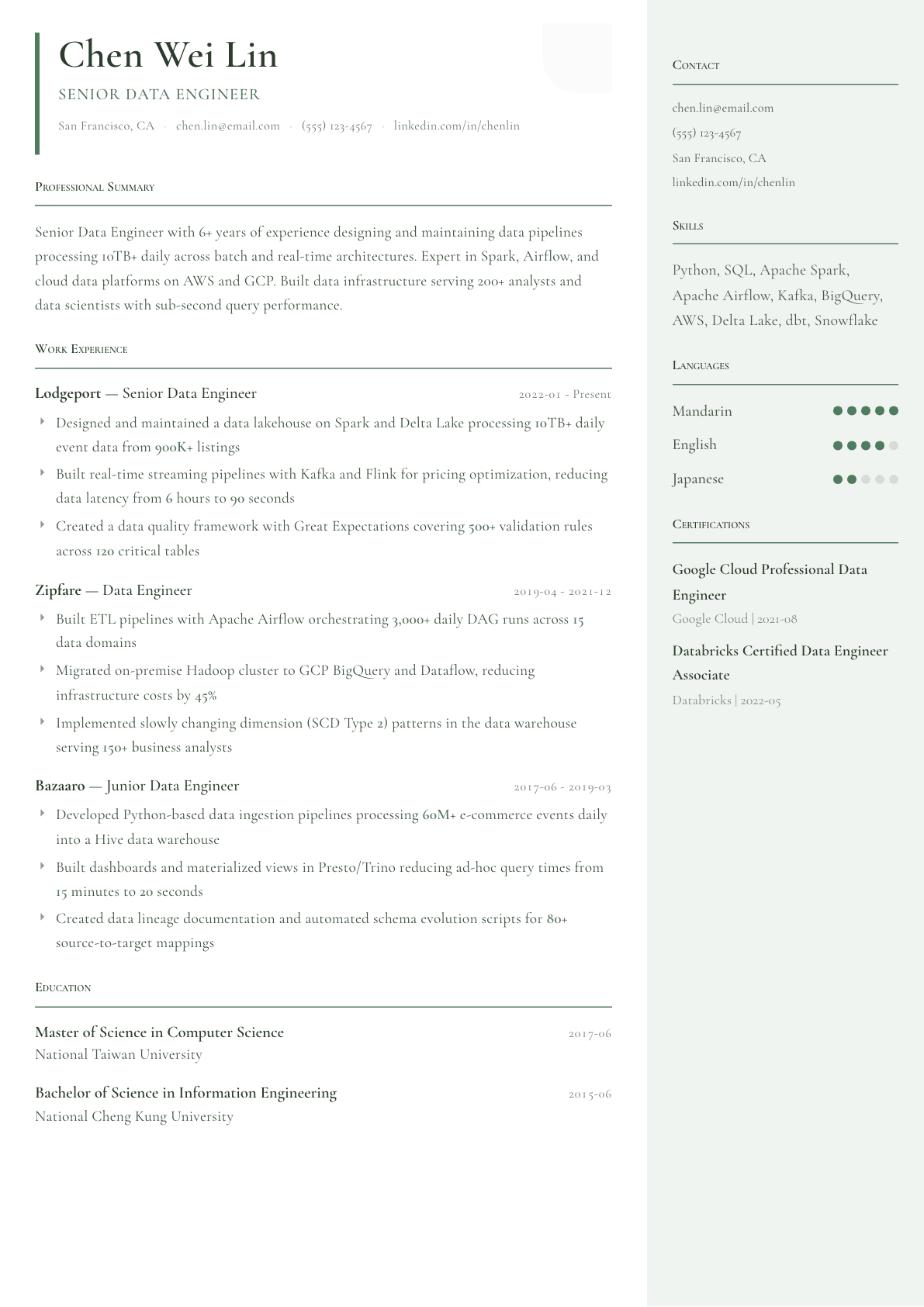
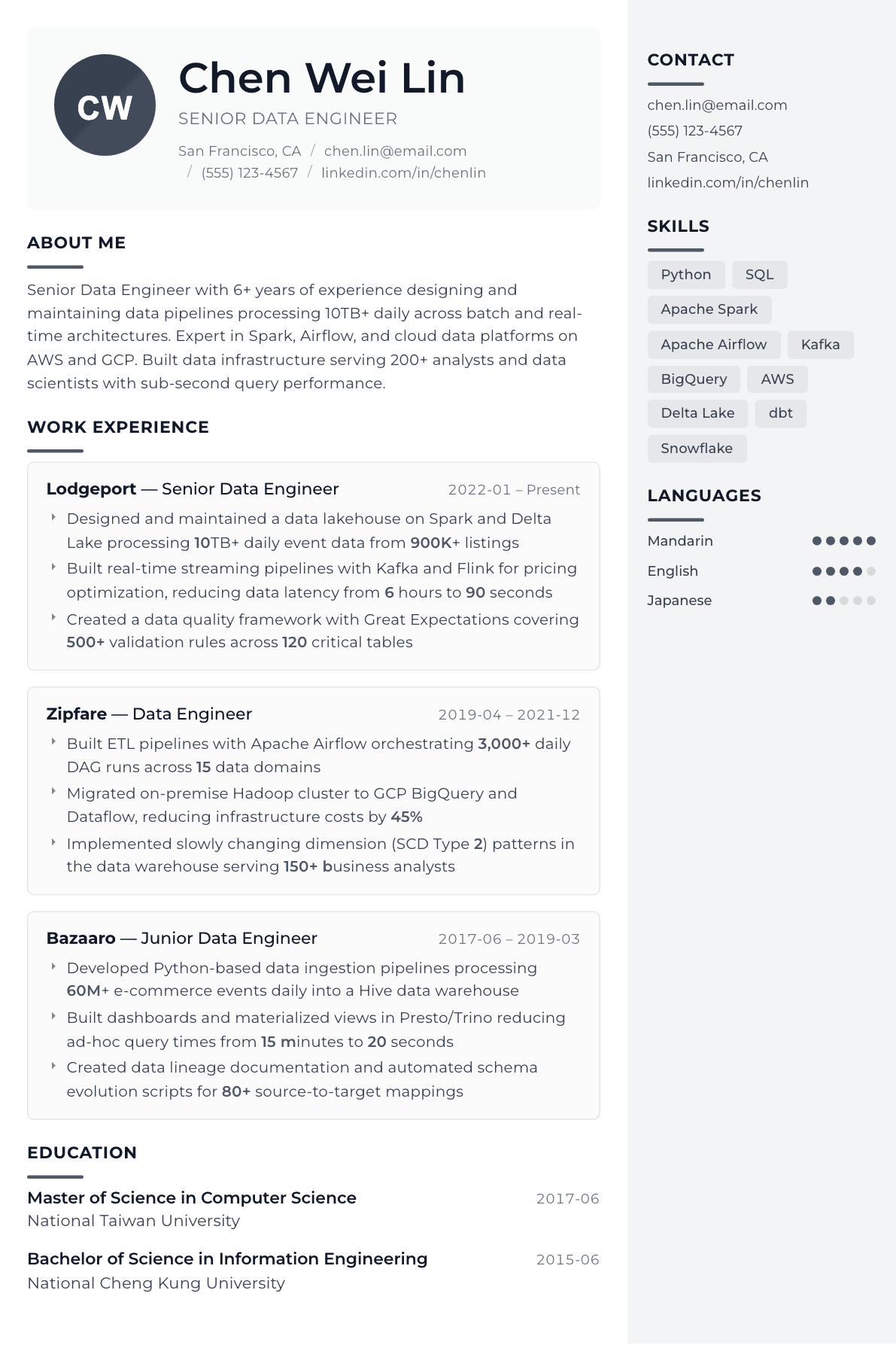
Example Data Engineer summary
Data Engineer with 6 years of experience building batch and real-time data pipelines processing 10TB+ daily. Expert in Spark, Airflow, and cloud data platforms with a track record of reducing data latency by 99% and infrastructure costs by 45%. Google Cloud and Databricks certified, with a data quality framework covering 500+ validation rules in production.
Skills to list on a Data Engineer resume
- Python
- SQL
- Apache Spark
- Apache Airflow
- Kafka
- BigQuery
- Snowflake
- Delta Lake
- dbt
- AWS
- GCP
- Data Modeling
What actually gets this resume read
- Quantify data volumes: terabytes processed, events ingested, and pipeline run counts to show scale.
- Highlight both batch and streaming experience: Spark, Flink, Kafka, Airflow, and cloud-native tools.
- Include data quality and governance practices: Great Expectations, dbt tests, or custom validation frameworks.
- Mention cloud data platform expertise: Snowflake, BigQuery, Redshift, Databricks, or Synapse.
- Show cost optimization achievements: infrastructure savings from migrations, query optimization, or storage tiering.
How to write a data engineer resume
A data engineer resume is read by someone who has been paged at three in the morning because a pipeline failed silently and finance closed the books on wrong numbers. That reader is not impressed by a list of technologies. They want to know what you have built that runs unattended, how it fails, and how you find out that it failed.
The field also splits into two distinct jobs that share a title. One builds and operates the platform: ingestion, orchestration, storage layout, cost and reliability. The other models the warehouse: sources into staging, staging into facts and dimensions, tests and documentation on top. Strong candidates say which side of that line they live on, and the ones who hide it get screened out by both.
This guide covers each section as a data platform lead reads it, with three summaries at recognizable levels, before-and-after bullets that turn pipeline lists into engineering evidence, and the questions engineers ask when moving in from analytics or from backend work.
Format: one to two pages, stack visible in the first six lines
One page under five years, two after. Reverse chronological, single column. Data teams hire into a specific stack, so a technical block right under the summary that names the warehouse, the orchestrator, the processing engine and the cloud saves the reader from hunting for it.
Do not bury the scale. Volume, frequency and number of pipelines belong in the environment line under each job title, not scattered through bullets.
- Header: name, title, location, email, GitHub if you have public work.
- Order: summary, technical stack, experience, selected pipelines or platforms, certifications, education.
- Under each job: the warehouse, the orchestrator, the daily volume, and how many pipelines you were on call for.
Summary: batch or streaming, the platform, and the scale
Three lines. Say whether your center of gravity is batch or streaming, name the warehouse or lakehouse, the orchestrator and the processing engine, and give one scale figure the reader can hold onto: daily volume, event rate, table count or number of production pipelines.
Then say what you own beyond building. On-call for the pipelines, the data contract with source teams, the cost of the warehouse, or the modeling standards other people follow. Ownership is the difference between a mid-level engineer and a senior one on paper.
Experience: ingestion, transformation, reliability, cost
Cover all four, because a data engineer who only writes transformations is really an analytics engineer, and one who only moves bytes has no view of whether the numbers are right. Ingestion bullets name the sources and the mechanism: change data capture off a transactional database, an event stream through Kafka, a vendor API with rate limits and backfill.
Transformation bullets name the model and the engine. Spark jobs, dbt models, incremental strategies, partitioning and clustering choices, and the slowly changing dimension pattern you used when history mattered. Say what the choice bought you.
Reliability is where senior engineers separate themselves. Retries and idempotency, backfill that does not double count, freshness and volume tests, alerting that pages a human only when downstream users would notice, and a runbook. Then cost: warehouse credits, storage tiering, file compaction, and what a query rewrite saved.
Data quality and contracts: name the failures you prevented
Every experienced data engineer has a story about a schema change upstream that broke a report a week later. Write yours as a bullet: the detection you added, the contract you agreed with the producing team, and the test that now fails loudly instead of quietly.
Name the tooling if you used it, whether that is dbt tests, Great Expectations, or assertions you wrote yourself. What matters more is the class of check: freshness, row counts, uniqueness, referential integrity and distribution drift on the columns that matter.
Skills: group by layer so the stack is legible at a glance
Five groups read best. Languages: Python, SQL, Scala or Java if you write Spark in it. Processing: Spark, Flink, or warehouse-native compute. Orchestration: Airflow, Dagster or Prefect. Storage and formats: the warehouse, Parquet, Delta or Iceberg, and the partitioning approach. Platform: the cloud, containers, infrastructure as code, and CI for data.
Skip the list of every database you have connected to once. A reader assumes any competent engineer can read from a new source. What they cannot assume is that you have operated a streaming job or managed a table format migration.
Data Engineer resume summary examples
Moving in from analytics
Analyst turned data engineer with 2 years in SQL reporting and 1 year building pipelines. Migrated 30 scheduled queries into version-controlled dbt models with freshness and uniqueness tests, and built the first Airflow deployment for a 5-person analytics team.
Four years building pipelines
Data engineer with 4 years on a Snowflake and Airflow platform ingesting from 40 sources. Owns 120 production pipelines and the on-call rotation for them, built the change data capture ingestion off the core transactional database, and cut warehouse spend 33% through clustering and query rewrites.
Lead or staff engineer
Staff data engineer with 10 years across batch and streaming. Designed a lakehouse on Iceberg handling 12 TB per day, led the migration off a legacy Hadoop cluster with no reporting downtime, and set the data contract standard now used by 8 producing service teams.
Work experience bullets: before and after
Before: Built ETL pipelines to move data into the warehouse.
After: Built change data capture ingestion from 14 transactional databases into Snowflake through Kafka and Debezium, landing raw events within 2 minutes and rebuilding current-state tables on a 15-minute cadence.
Source count, mechanism and latency describe an architecture rather than a category of work.
Before: Used Apache Spark for big data processing.
After: Rewrote the nightly sessionization job in Spark with a broadcast join and salted keys to fix a skewed partition, bringing a 6-hour run down to 40 minutes on the same cluster size.
Naming the skew fix shows you understand why the job was slow, not just that you used the engine.
Before: Ensured data quality across our pipelines.
After: Added freshness, row count and uniqueness tests to 90 dbt models and routed failures to the owning team with the offending rows attached, which caught an upstream schema change before the finance dashboard used it.
A specific caught failure proves the tests work, and routing to owners shows the process behind them.
Before: Reduced cloud costs for the data platform.
After: Cut monthly warehouse credits 38% by compacting small files into daily partitions, moving three heavy dashboards onto pre-aggregated tables, and adding auto-suspend to development compute.
Three named mechanisms make the saving reproducible instead of a one-line claim.
Before: Migrated data from an on-premises system to the cloud.
After: Led the migration of 400 tables off a Hadoop cluster to a lakehouse on Iceberg, running both systems in parallel for 6 weeks with automated row and checksum comparison before cutting over reporting.
Parallel running and reconciliation are what a lead does; the weak version could describe a copy script.
Hard skills
- SQL and query optimization
- Python
- Apache Spark
- Apache Airflow
- dbt
- Apache Kafka
- Change data capture
- Snowflake and BigQuery
- Delta Lake and Apache Iceberg
- Dimensional modeling
- Data quality testing
- Terraform and CI for data
- Partitioning and file layout
- Cost management in the warehouse
Soft skills
- Negotiating data contracts with source teams
- On-call composure
- Documenting lineage and ownership
- Explaining latency trade-offs to analysts
- Prioritizing platform work against requests
- Reviewing other people models
Certifications worth listing
- Professional Data Engineer (Google Cloud)
- AWS Certified Data Engineer Associate (Amazon Web Services)
- Microsoft Certified: Azure Data Engineer Associate (Microsoft)
- Databricks Certified Data Engineer Professional (Databricks)
- SnowPro Advanced: Data Engineer (Snowflake)
- dbt Analytics Engineering Certification (dbt Labs)
Mistakes that cost data engineer candidates the interview
- Listing twenty technologies with no indication which ones you have run in production and been paged for.
- Writing pipeline counts with no volume, frequency or source complexity behind them.
- Leaving out reliability entirely, which reads as someone who built pipelines but never operated them.
- Claiming streaming experience from one proof of concept. The first interview question is about exactly-once semantics and late arrivals.
- Describing modeling work without naming the pattern, so the reader cannot tell a normalized warehouse from a pile of wide tables.
- Ignoring cost, when warehouse spend is one of the loudest conversations on a data team.
- Presenting analytics work as engineering. If every bullet ends in a dashboard, apply as an analyst and be strong there instead.
Data Engineer resume questions
What is the difference between a data engineer and an analytics engineer on a resume?
A data engineer resume leads with ingestion, orchestration, reliability and platform cost. An analytics engineer resume leads with modeling, testing, documentation and the semantic layer. Pick the one the posting describes and reorder your bullets to match it.
How much SQL depth should I show as a data engineer?
Enough that a reviewer sees you can debug a slow query, not just write one. Mention execution plan work, partition pruning, incremental strategies and skew handling. Those specifics are read as senior signals in every data platform interview.
Do I need a cloud certification to get hired as a data engineer?
It rarely decides the hire, but it helps a resume clear recruiter screening at consultancies and larger enterprises. If your experience is on one cloud and the posting is on another, the certification is a reasonable bridge to show intent.
How do I move from backend engineering into data engineering?
Highlight the parts of your backend work that already are data work: event publishing, batch jobs, database schema design, idempotent processing and queue consumers. Then add one substantial pipeline project with a warehouse and an orchestrator so the stack matches.
Should I list the data volumes I worked with?
Yes, because scale changes which techniques you have needed. Give daily volume or event rate rather than a total lake size, since a large but idle store impresses nobody. Round the numbers and keep them defensible in interview.
Related resume examples
- Data Scientist Resume example
- Data Analyst Resume example
- Big Data Engineer Resume example
- Analytics Engineer Resume example
- ETL Developer Resume example
- Data Architect Resume example