Physical Therapist Resume Examples: the lines they read
Physical Therapy Sample Resume and Physical Therapist Examples
By Mustafa Tarabya, founder of CVBooster · Published · Updated
Physical therapy sample resume and physical therapist examples: license, setting, caseload and outcome bullets, with summaries from new graduate to clinic lead.
Sample resumes for a physical therapist
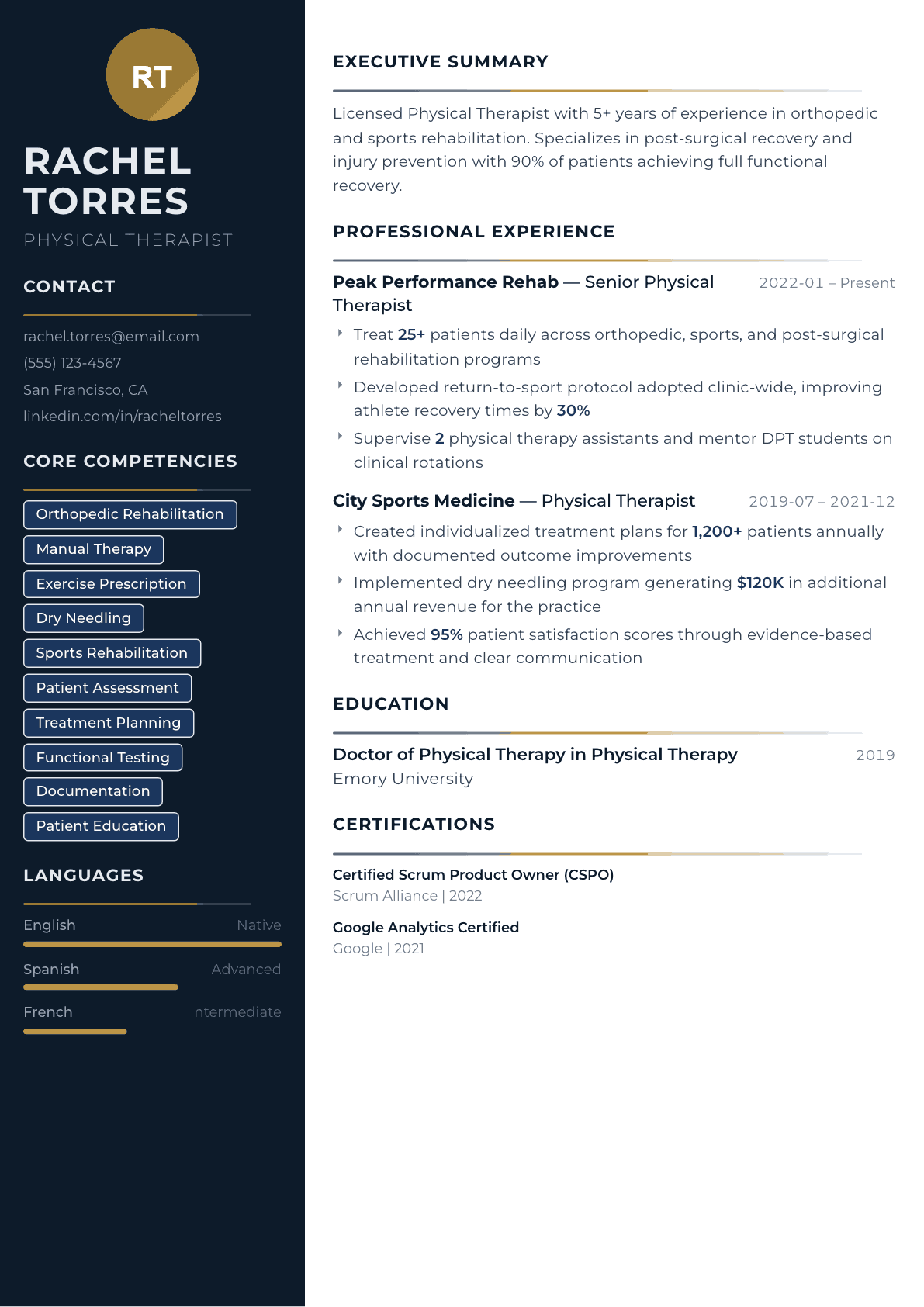
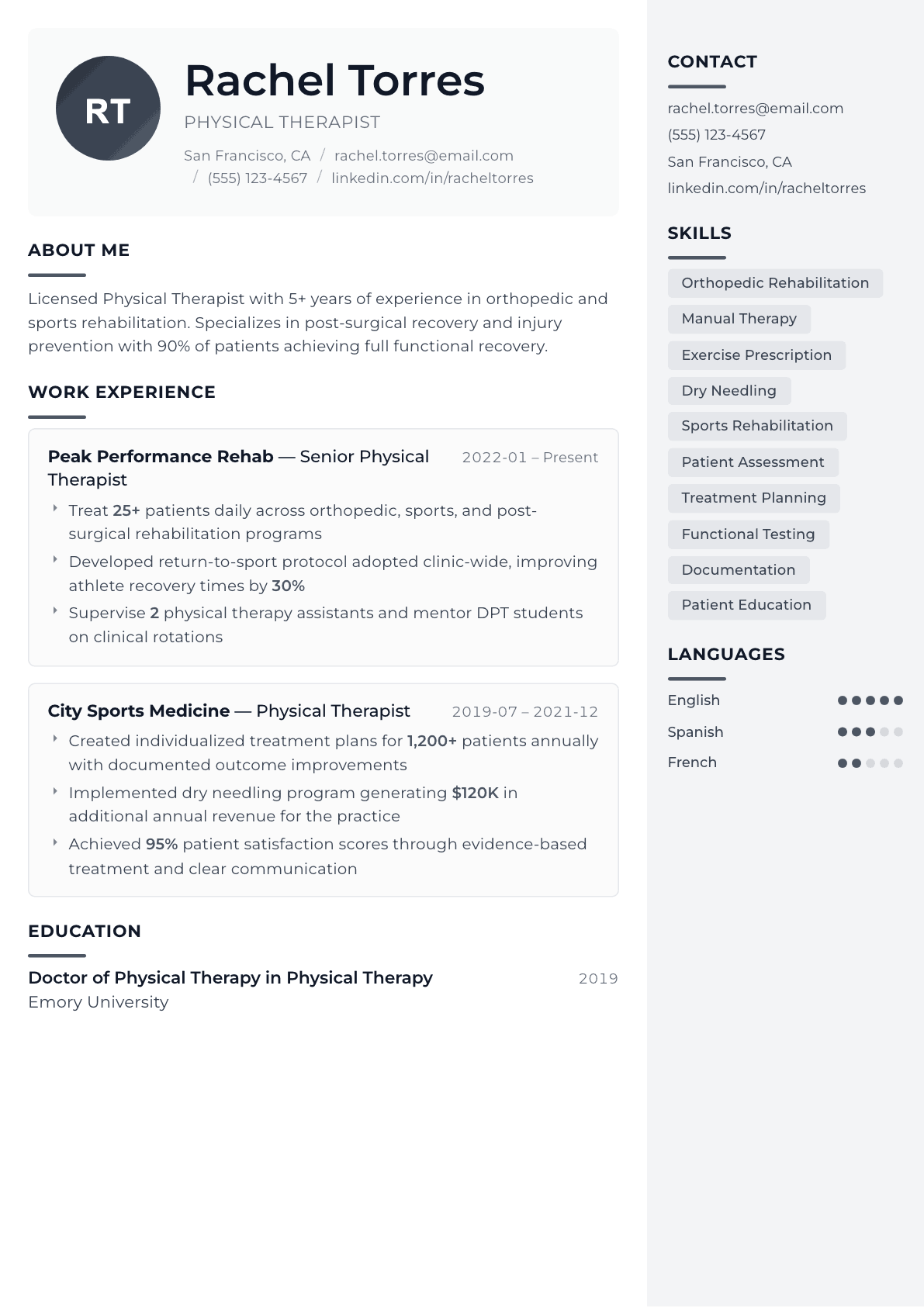
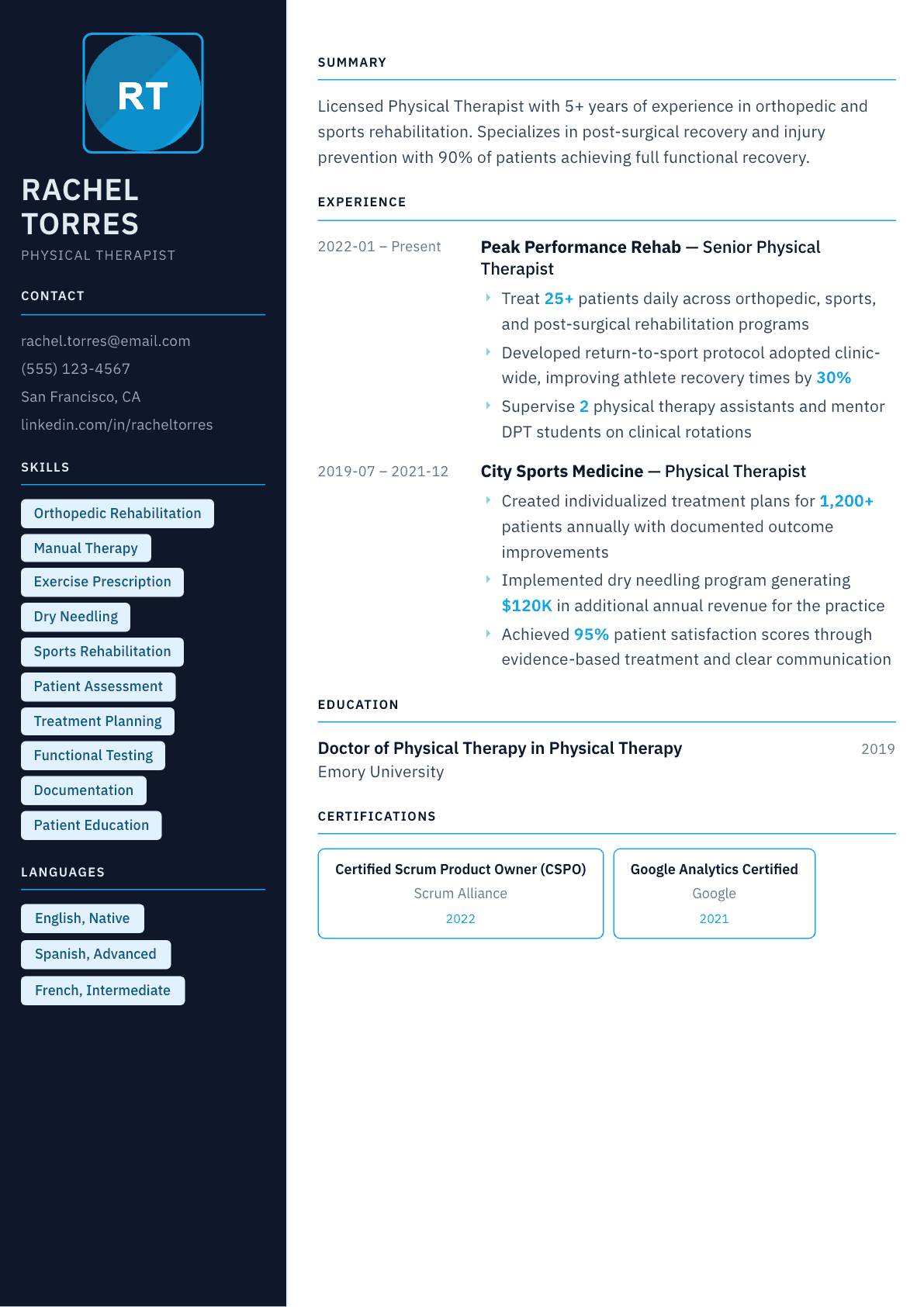
The same physical therapist content laid out in three CVBooster templates, so you can see what the finished document looks like before you write a word.
Example Physical Therapist summary
DPT with 5 years in orthopedic and sports rehabilitation, carrying 25 patients a day and supervising two assistants and student rotations. Wrote the return-to-sport protocol now used clinic-wide, and built a dry needling service worth $120K a year to a previous practice.
Skills to list on a Physical Therapist resume
- Orthopedic Rehabilitation
- Manual Therapy
- Exercise Prescription
- Dry Needling
- Sports Rehabilitation
- Patient Assessment
- Treatment Planning
- Functional Testing
- Documentation
- Patient Education
What actually gets this resume read
- List your DPT degree, state license, and specialty certifications (OCS, SCS).
- Quantify patient outcomes: recovery rates, satisfaction scores, caseload volumes.
- Highlight specialized techniques and treatment approaches you use.
- Include any programs or protocols you've developed.
- Mention experience with specific patient populations (athletes, geriatric, pediatric).
How to write a physical therapist resume
A physical therapist resume is screened by a clinic director, a rehabilitation manager or a regional therapy lead, and the first questions are always the same: is the license current in this state, which setting have you worked in, what caseload do you carry, and can you evaluate independently and defend a plan of care to a payer. Those four answers should be visible without hunting.
The weakness in most of these files is that they describe the profession rather than the therapist. Every physical therapist evaluates, treats and documents. What separates candidates is the setting, the diagnoses and post-surgical protocols they know cold, the manual and exercise interventions they use, the outcome measures they collect, and whether they can hold a full schedule while keeping documentation and authorizations current.
This guide works as a physical therapy sample resume broken into parts: the section order therapy employers expect, how to present licensure and specialty certification, how to write caseload, productivity and functional outcomes accurately, and the questions physical therapists ask when moving between outpatient orthopedics, acute care, inpatient rehabilitation, skilled nursing, home health and sports settings.
Format: license at the top, setting in every job heading
Reverse chronological, one page for the first few years and two once you have several settings, a residency or supervisory work. Put the doctoral or master degree and the licensure designation after your name, then a licensure block with the state, number and expiration, plus any compact privilege you hold.
Write the setting into every job heading. Outpatient orthopedics, acute care, inpatient rehabilitation, skilled nursing, home health, pediatrics and sports performance share the title and share very little else, and the reader is matching your history against the opening in front of her.
Read a physical therapy sample resume from top to bottom and it should answer the director in order: licensed where, trained in what, worked in which setting, with which patients and what result. A new graduate sample puts clinical rotations under education with the setting and weeks of each one. A five-year sample leads with caseload and the diagnoses seen most often. A clinic lead sample adds supervision of assistants, students and scheduling.
- Header: name with the doctoral and licensure designations, city, state, phone, email, and every state license you hold.
- Sections in this order: summary, licensure and certification, clinical experience, interventions and outcome measures, clinical education for new graduates, education.
- Residency or fellowship trained candidates give the program its own entry with the site and the specialty focus.
Summary: setting, caseload, diagnoses, specialty
Three lines. Give the years, the setting, the daily or weekly caseload and one area of depth. "Physical therapist with five years in outpatient orthopedics treating twenty five patients daily, with post-surgical protocols for knee and shoulder reconstruction and a return to sport testing program" fits a clinic director's opening immediately.
If you are changing settings, name the transferable competence rather than hoping it is inferred. A skilled nursing therapist moving to outpatient should lead with gait training, balance and fall risk assessment and functional testing, not with minutes billed.
Experience: caseload, protocols, and functional outcomes
Open each role with the clinic or facility type, the caseload per day, and the diagnoses. Then write bullets on evaluation, plan of care, and progression. A director wants to see that you evaluate independently, progress patients on evidence based criteria and discharge them when they meet goals rather than when the visits run out.
Name the interventions specific to your practice: manual therapy including joint mobilization and soft tissue work, therapeutic exercise progression, neuromuscular re-education, gait and balance training, vestibular rehabilitation, dry needling where your state permits it, blood flow restriction training, aquatic therapy, and modalities used as adjuncts rather than as the treatment.
Use outcome measures the setting reports. Outpatient clinics track functional outcome instruments and range of motion and strength progression; inpatient rehabilitation and skilled nursing settings score self-care and mobility performance; sports settings use return to sport testing batteries and limb symmetry. Report the measure your clinic actually used.
Protocols, supervision and the operational half of the job
Post-surgical protocol familiarity is a real hiring filter in orthopedic settings. Name the procedures you rehabilitate: anterior cruciate ligament reconstruction, rotator cuff repair, total knee and hip replacement, labral repair, Achilles repair, spinal fusion and lumbar decompression, and say which surgeon protocols you have worked under.
Supervision and teaching belong on the page. Directing physical therapist assistants, supervising aides, taking students on full clinical education rotations and serving as a clinical instructor all show the seniority a clinic needs when it grows.
Then the operational side that directors rarely see addressed: meeting a visit or productivity standard, completing documentation the same day, handling authorization requests and progress notes on schedule, and keeping the schedule full through cancellation and no show management. Naming this makes you a manager's easy hire.
The vocabulary therapy postings repeat
Physical therapy job descriptions recycle a narrow set of terms: initial evaluation, plan of care, therapeutic exercise, manual therapy, neuromuscular re-education, gait training, functional mobility, home exercise program, patient education, discharge planning, interdisciplinary team, documentation and productivity. Mirror the posting wording once in a skills block and once inside a bullet where it is demonstrated.
Name the documentation platform you use, because a clinic on the same system reads that as a faster start. Add any experience with denials, peer review or medical necessity documentation, since therapists who can defend a plan of care in writing are worth more than therapists who cannot.
Physical Therapist resume summary examples
New graduate therapist
Newly licensed doctor of physical therapy with three full time clinical education rotations in outpatient orthopedics, acute care and inpatient rehabilitation. Trained in manual therapy, therapeutic exercise progression and standardized functional testing, and seeking an outpatient position with structured mentorship.
Five years in outpatient
Physical therapist with five years in outpatient orthopedics and sports rehabilitation treating twenty five patients daily. Runs post-surgical protocols for knee and shoulder reconstruction, built the clinic return to sport testing battery, and supervises two physical therapy assistants and student rotations.
Clinic lead or specialist
Board certified orthopedic clinical specialist with eleven years across outpatient and hospital based rehabilitation, now leading a clinic of six therapists. Owns the mentorship program for new graduates, standardized outcome measure collection across the site, and manages payer documentation appeals.
Work experience bullets: before and after
Before: Treated patients with physical therapy.
After: Treated twenty five patients daily in an outpatient orthopedic clinic across post-surgical, spine, shoulder and lower extremity caseloads, completing every initial evaluation independently.
Daily volume, diagnosis mix and evaluation independence are what a clinic director compares.
Before: Created treatment plans for patients.
After: Built plans of care with criteria based progression for anterior cruciate ligament reconstruction and rotator cuff repair, advancing patients on strength and range of motion milestones rather than on elapsed weeks.
Criteria based progression is a clinical philosophy, and naming it separates you from protocol followers.
Before: Improved patient outcomes.
After: Collected functional outcome scores at evaluation, reassessment and discharge for every patient, and used the trend to support continued authorization when payers questioned medical necessity.
It ties outcomes to a real business consequence rather than asserting improvement.
Before: Developed a return-to-sport program.
After: Designed a return to sport testing battery with hop testing, strength symmetry and movement screening, then trained the whole clinic to run it before clearing any athlete.
The components and the clinic wide adoption prove you built a standard, not a single patient plan.
Before: Supervised assistants and students.
After: Directed two physical therapy assistants across a shared caseload and served as clinical instructor for four doctoral students through full time rotations, including midterm and final evaluations.
Counts, the supervision structure and the evaluation duties show real clinical leadership.
Hard skills
- Initial evaluation and differential screening
- Plan of care development
- Manual therapy and joint mobilization
- Therapeutic exercise progression
- Neuromuscular re-education
- Gait and balance training
- Post-surgical rehabilitation protocols
- Vestibular rehabilitation
- Functional outcome measure administration
- Return to sport testing
- Home exercise program design
- Clinical documentation and authorization support
Soft skills
- Motivating patients through slow progress
- Clear explanation of anatomy and prognosis
- Schedule discipline
- Mentoring assistants and students
- Collaboration with referring physicians
- Manual handling of difficult conversations about discharge
Certifications worth listing
- Orthopaedic Certified Specialist (OCS) (American Board of Physical Therapy Specialties)
- Sports Certified Specialist (SCS) (ABPTS specialty certification program)
- Neurologic Certified Specialist (NCS) (American Board of Physical Therapy Specialties neurology council)
- Geriatric Certified Specialist (GCS) (ABPTS geriatrics specialty council)
- Certified Strength and Conditioning Specialist (CSCS) (National Strength and Conditioning Association)
- Certified Lymphedema Therapist (CLT) (Lymphology Association of North America)
Mistakes that cost physical therapist candidates the interview
- Writing generic treatment language that would fit any therapist in any setting, so nothing on the page is yours.
- Leaving the setting out of the job heading when home health and outpatient orthopedics share a title and nothing else.
- Omitting daily caseload, which is the single number a clinic director uses to model whether you can hold the schedule.
- Claiming improvement without naming the outcome measure, which makes an honest result sound manufactured.
- Skipping post-surgical protocol experience in an orthopedic application where it is the main qualification.
- Ignoring documentation, authorization and productivity, which is exactly where new hires most often struggle.
- Listing modalities prominently while the manual therapy and exercise progression that carry the work sit below them.
Physical Therapist resume questions
How do I list my physical therapy license and specialty certification?
Put the degree and licensure designation after your name, then a block with each state license, its number and expiration, plus any compact privilege. Add board specialty certification with the certifying body, since employers verify the specialty separately from the license.
What should a new graduate physical therapist put in experience?
Full time clinical education rotations, written as clinical experience. Give the site, the setting, the weeks, the caseload you carried by the end and the interventions you delivered independently, then any technician or aide work that shows setting familiarity.
Should I include productivity numbers on a physical therapy resume?
Yes when you met the standard while keeping documentation current, because that combination is what a rehabilitation manager is actually trying to hire. State the visit volume you sustained rather than a percentage you cannot source.
How do I move from skilled nursing to outpatient orthopedics?
Rewrite the summary around orthopedic caseload and lead with gait, balance, functional testing and any post-surgical work you have done. Then address pace directly, since outpatient directors assume a skilled nursing therapist has not carried twenty five visits a day.
What should a physical therapy sample resume include?
License number and state at the top, the setting in every job heading, caseload per day, the diagnoses and post-surgical protocols you know, the outcome measures you use and your documentation system. New graduates add each clinical rotation with its setting. A residency or specialty certification goes in the licensure section, not buried under education.