Pathologist Resume Examples: free ATS score and gap list
Write a Pathologist Resume That Shows Sign-Out Volume and Subspecialty Depth
By Mustafa Tarabya, founder of CVBooster · Published · Updated
Build a pathologist resume with anatomic and clinical pathology examples, board certification placement, subspecialty keywords and a full writing guide.
Sample resumes for a pathologist
The same pathologist content laid out in three CVBooster templates, so you can see what the finished document looks like before you write a word.
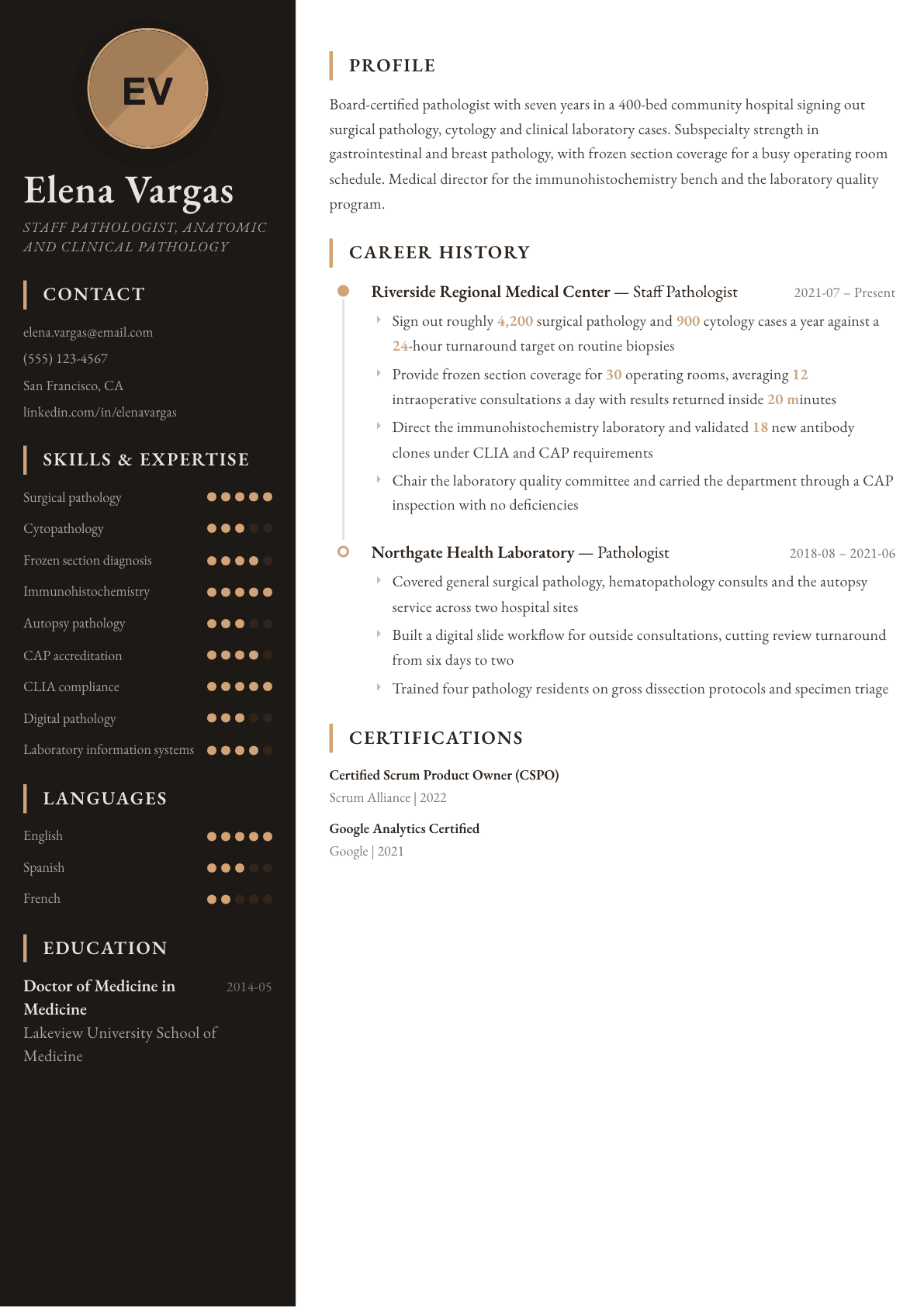
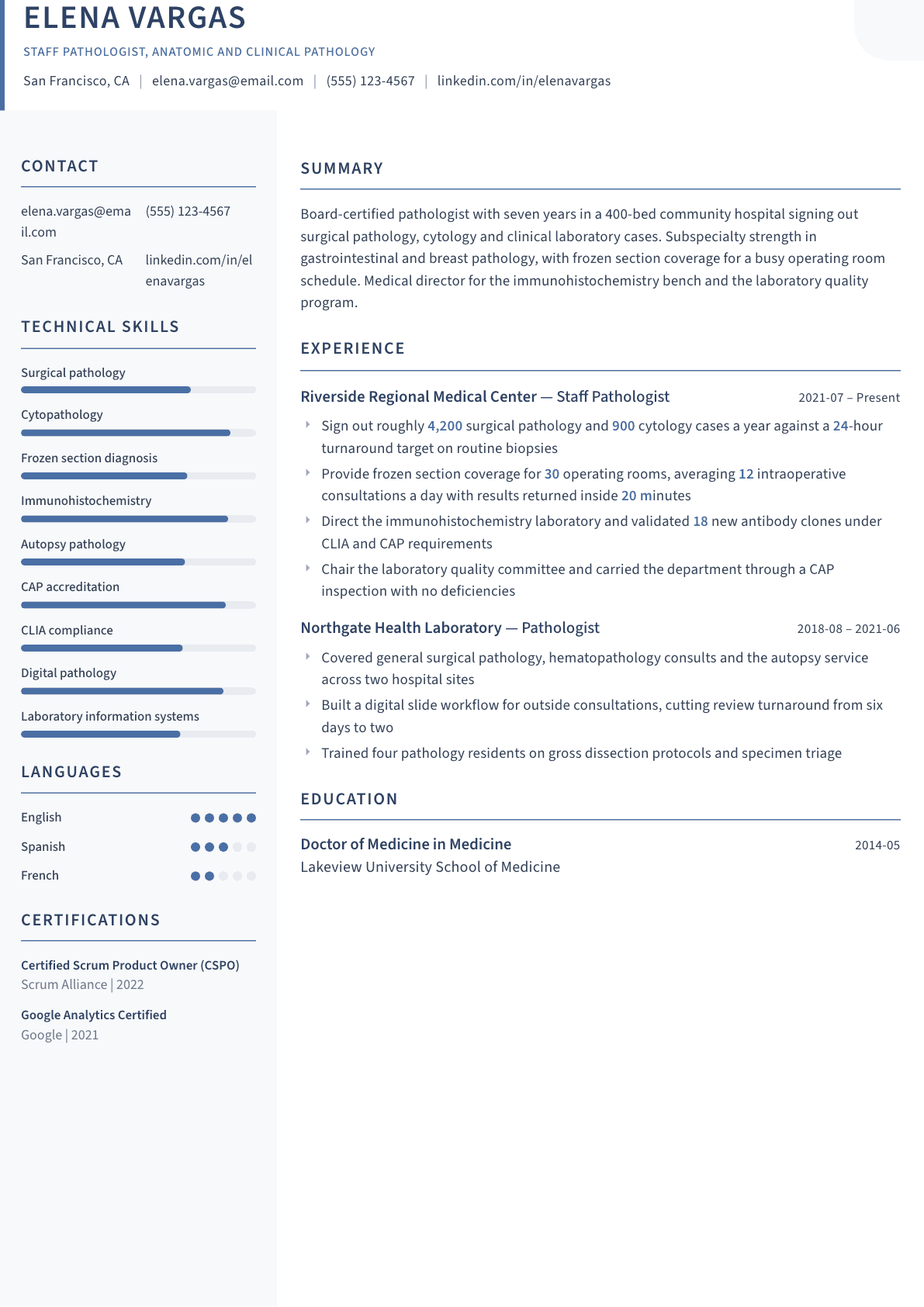
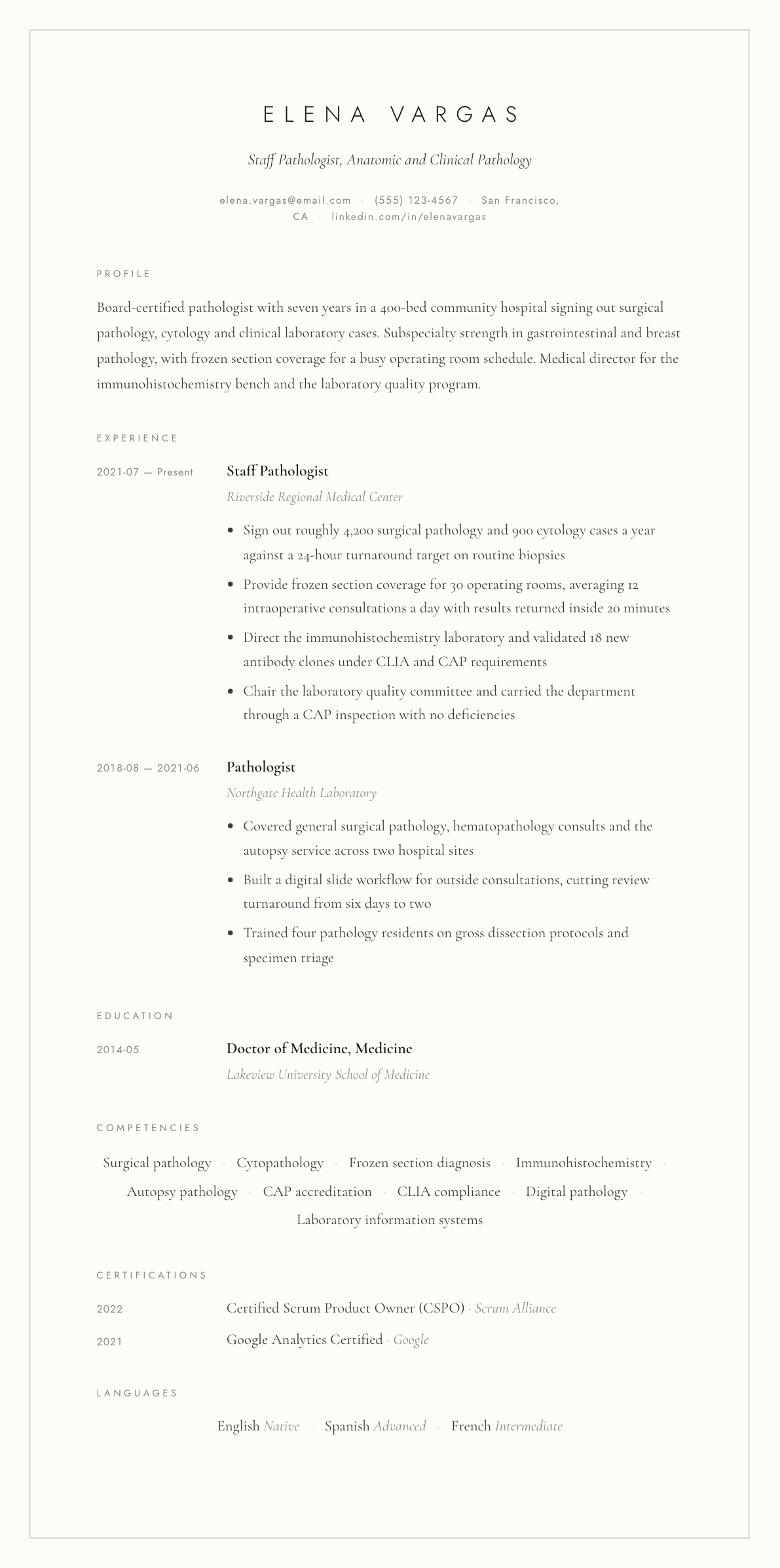
Example Pathologist summary
Board-certified pathologist with seven years of combined anatomic and clinical practice in a community hospital, signing out about 4,200 surgical and 900 cytology cases a year. Subspecialty strength in gastrointestinal and breast pathology, frozen section coverage for a 30-room surgical schedule, and medical direction of the immunohistochemistry bench. Seeking a group role with a subspecialty sign-out model and a digital pathology workflow.
Skills to list on a Pathologist resume
- Anatomic pathology
- Clinical pathology
- Surgical pathology sign-out
- Cytopathology
- Hematopathology
- Frozen section diagnosis
- Immunohistochemistry
- Molecular diagnostics
- Autopsy pathology
- Gross dissection
- CAP accreditation
- CLIA regulations
- Laboratory information systems
- Digital pathology
- Transfusion medicine
- Laboratory quality assurance
What actually gets this resume read
- Put board certification status and the certificate type, anatomic or clinical or combined, in the header where a screener finds it first.
- Give annual sign-out volume by specimen type: surgical cases, cytology, frozen sections and autopsies for each position you held.
- Name the subspecialty areas you cover, because most pathology groups are hiring against one specific coverage gap.
- List the laboratory information system and any digital pathology platform you have used, not only the microscope work.
- Include CAP inspection roles, quality committee service and medical directorship, since groups need someone who can sign as director.
- Keep publications and abstracts to a short block at the end unless you are applying to an academic department.
How to write a pathologist resume
A pathologist resume is judged by a group chair or a laboratory medical director who is trying to fill one gap: nobody left to sign out breast cases, no one credentialed for frozen sections at the second campus, or a directorship coming open when the current director retires. Everything on the page is read against that gap.
That makes volume and coverage the two things a reader hunts for first. How many surgical cases did you sign out last year, and of what type. Which frozen section call did you take. Whether you carry the clinical pathology half of the job, including blood bank, chemistry and microbiology oversight, or whether the group will need a second hire for it.
This guide covers the header credentials, the way to present sign-out volume without turning the resume into a spreadsheet, how to write the laboratory director and quality work that makes a pathologist promotable, and the questions that come up most when pathologists sit down to rewrite this document.
Format: credentials header, then practice, then academic material
Two pages is normal for a practicing pathologist and three is acceptable once fellowships, directorships and a publication record accumulate. Reverse chronological order, no columns, no icons. Laboratory groups often route resumes through a hospital applicant tracking system before a human sees them, and a two-column layout gets parsed out of order.
The header carries your name, the degree, and the board certification abbreviation the way credentialing offices write it. Underneath, a short credentials block: medical license states with expiration, board certification and certificate type, subspecialty certificates, and any state clinical laboratory director license you hold.
- Header: name, MD or DO, city and state, phone, email.
- Credentials block: licenses, board certification, subspecialty certificates, laboratory director qualification.
- Then: summary, practice experience, fellowship and residency, education, skills, selected publications.
Summary: certificate type, subspecialty, and what you cover on call
Four lines at most. Name the certificate you hold, combined anatomic and clinical or one of the two alone, then the practice setting and its size, then the subspecialty you sign out most, then the coverage you provide. A chair reading three candidates side by side is comparing exactly those four facts.
If you are moving from an academic department into private practice, or the other way, say it plainly and name the transferable part. An academic pathologist joining a community group should point at generalist breadth and frozen section speed rather than a research portfolio the group will never use.
Experience: volume by specimen type, then coverage, then direction
Every position needs the facility, its bed count or the annual accession volume of the laboratory, and how many pathologists were in the group. Those three numbers set the scale before any bullet is read. A pathologist signing out in a two-person laboratory carries a different job from one in a fifteen-person subspecialty group, and neither is obvious from a job title.
Then give volume by specimen type across a year: surgical pathology cases, cytology, frozen sections, autopsies, and bone marrow or hematopathology if you cover it. Write these as ranges or rounded figures. Nobody expects a certified count, and precision to the single case reads as invented.
Follow that with coverage: which campuses, which call rotation, whether you take intraoperative consultation and what the expected turnaround was. Close with direction and quality work, because that is what separates a staff pathologist from a candidate the group can promote into a medical director seat.
- Facility scale: beds, annual accessions, number of pathologists in the group.
- Annual volume by specimen type, rounded.
- Call and frozen section coverage, including turnaround expectations.
- Directorship, validations, accreditation inspections and quality committee roles.
Laboratory direction and regulatory work: the promotable half
Clinical pathology and laboratory direction is where community groups are thinnest, and where a resume gains the most from detail. Name the sections you have directed: chemistry, microbiology, hematology, transfusion medicine, molecular, immunohistochemistry. Say what you validated, how many assays or antibody clones, and under which regulatory framework.
Accreditation work belongs here too. If you have served as an inspector, prepared a laboratory for inspection, or carried a department through one with a clean result, write it as a bullet with the outcome. Groups read that as insurance.
Proficiency testing oversight, corrective action plans, critical value policies and test utilization committees all count. They are unglamorous and they are exactly what a director does most weeks.
Skills and keywords: the terms a laboratory posting repeats
Pathology postings reuse a narrow vocabulary: surgical pathology sign-out, cytopathology, frozen section, immunohistochemistry, molecular diagnostics, laboratory information system, accreditation, proficiency testing, transfusion medicine. Mirror the posting wording once in the skills block and once inside a bullet where it is demonstrated.
Name the systems, not just the disciplines. The laboratory information system you dictated into, the digital pathology platform, the voice recognition software, the molecular assays you have interpreted. A skills list of diagnostic categories alone tells a reader nothing about whether you can start work without six weeks of training.
Publications, teaching and the academic tail
For a community group, a long publication list at the top of page one is a warning sign, not a strength. Move it to the end under a heading that says selected, keep it to the handful that show subspecialty depth, and note review or editorial roles in one line.
For an academic department, invert this. Teaching, resident and fellow supervision, grand rounds, protocol authorship and grant involvement move up, and sign-out volume becomes context rather than the headline.
Pathologist resume summary examples
Finishing fellowship
Anatomic and clinical pathology board eligible, completing a surgical pathology fellowship with a gastrointestinal and hepatobiliary emphasis. Signed out roughly 3,000 accessions under supervision during fellowship plus frozen section call. Comfortable with immunohistochemistry interpretation and autopsy service. Seeking a generalist position in a community group with subspecialty backup.
Seven years in practice
Board-certified pathologist with seven years in a five-person community group, signing out about 4,200 surgical and 900 cytology cases a year alongside frozen section coverage for a 30-room surgical schedule. Medical director of the immunohistochemistry bench and chair of the laboratory quality committee.
Laboratory medical director
Pathologist and laboratory medical director with sixteen years across community and reference settings, holding director responsibility for chemistry, microbiology, hematology and transfusion medicine at two hospitals. Led three accreditation cycles without deficiency, built a subspecialty sign-out model, and recruited five pathologists into the group.
Work experience bullets: before and after
Before: Signed out surgical pathology and cytology cases.
After: Signed out roughly 4,200 surgical pathology and 900 cytology accessions a year, with routine biopsies released inside a 24-hour turnaround target.
Volume by specimen type plus a turnaround figure tells a chair how much of the backlog you would absorb.
Before: Provided frozen section coverage for the operating room.
After: Covered intraoperative consultation for 30 operating rooms, averaging 12 frozen sections a day with results returned to the surgeon inside 20 minutes.
The room count and the clock turn an ordinary duty into evidence you can hold a busy surgical schedule.
Before: Responsible for immunohistochemistry laboratory.
After: Directed the immunohistochemistry bench, validating 18 new antibody clones and rewriting the staining troubleshooting protocol after a reagent lot failure.
Naming the validations and a specific failure you handled shows directorship rather than a title.
Before: Participated in laboratory accreditation.
After: Prepared the department for its accreditation inspection, closed 11 prior-cycle findings, and carried the laboratory through the visit with no deficiencies cited.
An outcome and a count of closed findings prove you can protect the laboratory, which is what a director is hired for.
Before: Worked with clinicians on test ordering.
After: Chaired the test utilization committee, retired four low-yield send-out assays and introduced reflex testing rules that cut duplicate ordering on the medical floors.
The committee, the specific action and the effect replace a vague claim of collaboration.
Before: Used digital pathology for consultations.
After: Built a whole slide imaging workflow for outside consultations and second opinions, cutting review turnaround from six days to two across two hospital sites.
A before and after number makes the technology adoption a result instead of a tool mention.
Hard skills
- Surgical pathology sign-out
- Cytopathology
- Frozen section diagnosis
- Immunohistochemistry interpretation
- Hematopathology and bone marrow review
- Molecular diagnostics interpretation
- Autopsy pathology
- Gross dissection and specimen triage
- Transfusion medicine oversight
- Clinical chemistry and microbiology direction
- Laboratory accreditation and proficiency testing
- Laboratory information systems
- Whole slide imaging and digital pathology
- Assay validation
Soft skills
- Diagnostic judgment under uncertainty
- Clear reporting to clinicians
- Critical result communication
- Committee leadership
- Teaching residents and technologists
- Workload triage across a group
Certifications worth listing
- Anatomic Pathology and Clinical Pathology Certification (American Board of Pathology)
- Cytopathology Subspecialty Certification (American Board of Pathology)
- Hematopathology Subspecialty Certification (American Board of Pathology)
- Molecular Genetic Pathology Subspecialty Certification (American Board of Pathology)
- Basic Life Support (BLS) (American Heart Association)
Mistakes that cost pathologist candidates the interview
- Listing diagnostic categories with no volume attached, so the reader cannot tell a light week from a heavy one.
- Burying the certificate type, which forces a credentialing office to email you before the file can move.
- Leading a community group application with thirty publications and a grant history the practice will never use.
- Omitting the clinical pathology half entirely, which reads as a candidate who cannot cover laboratory direction.
- Writing precise case counts to the single specimen, which reads as reconstructed rather than reported.
- Skipping the laboratory information system and digital platforms, leaving a reader to assume a long onboarding.
- Using a designed two-column template that hospital parsers scramble, dropping the dates from your practice history.
Pathologist resume questions
How do I show sign-out volume without exaggerating?
Use rounded annual figures and say what they cover. Something like about four thousand surgical cases and nine hundred cytology specimens a year reads as honest reporting. Exact counts to the single accession invite doubt because almost nobody tracks that closely.
Should a pathologist resume include a publication list?
Only a selected list for community practice, placed at the end and limited to work that shows subspecialty depth. Academic departments want the full record, so keep a separate long version of the document for those applications and send the short one everywhere else.
How much does frozen section experience matter?
A great deal in any hospital-based group, because it is the coverage a practice cannot outsource. Give the number of operating rooms you supported, the daily average of intraoperative consultations, and the turnaround time the surgeons expected from you.
Do I need to list laboratory director qualification?
Yes if you hold it, in its own line in the credentials block. Many community positions exist precisely because a director seat is opening, and a candidate who already qualifies to sign as director moves to the top of the list immediately.
How do I write a pathologist resume for a subspecialty group?
Lead the summary with the subspecialty and the share of your annual volume that sits inside it, then order your bullets so the subspecialty work appears first in every position. Keep generalist coverage on the page, because most groups still need weekend and holiday breadth.