Driving Instructor Resume Examples: the lines they read
Write a Driving Instructor Resume Schools Trust With New Drivers
By Mustafa Tarabya, founder of CVBooster · Published · Updated
Driving instructor resume examples with license and endorsement keywords, pass rate proof points, and a guide to every section of the page.
Sample resumes for a driving instructor
The same driving instructor content laid out in three CVBooster templates, so you can see what the finished document looks like before you write a word.
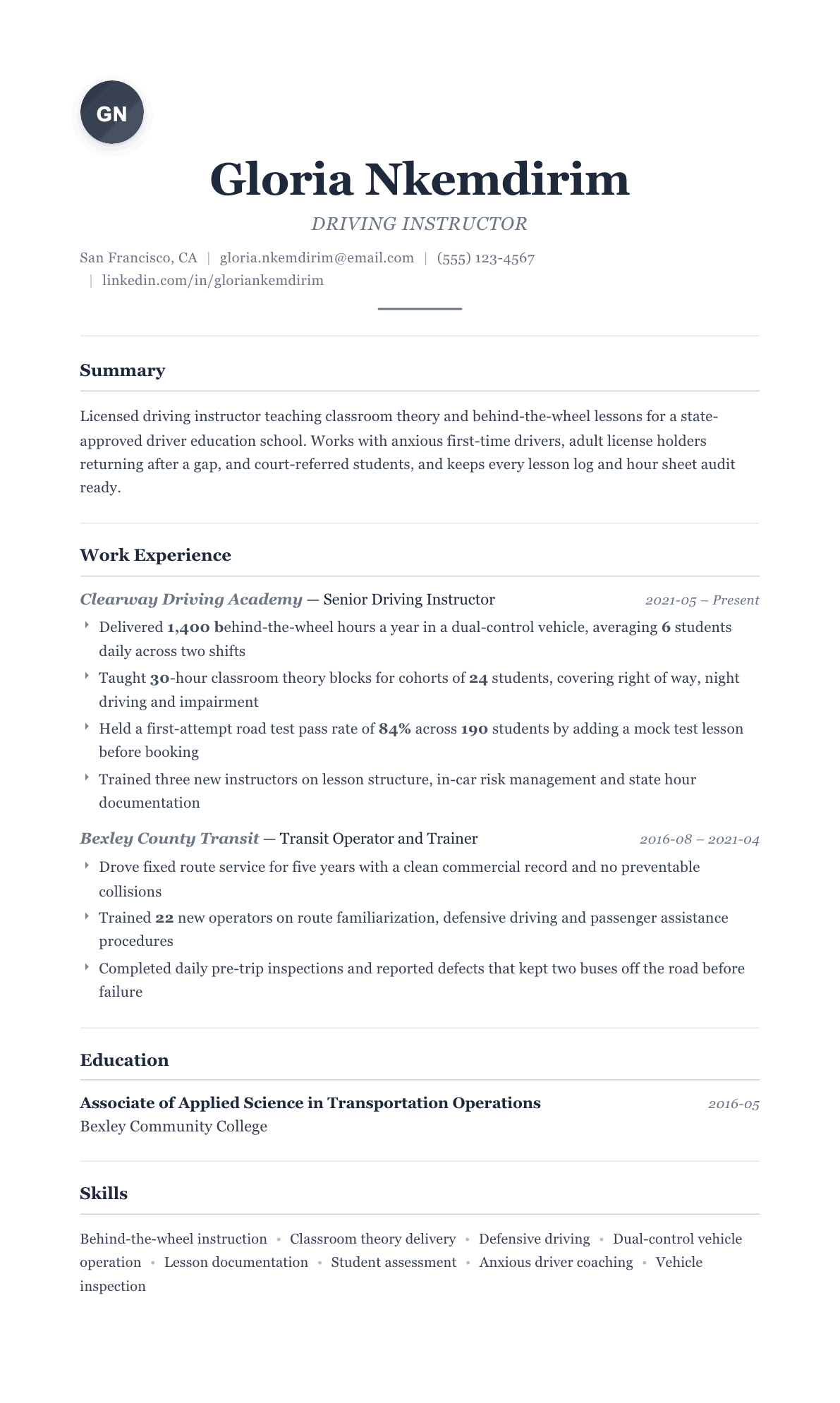
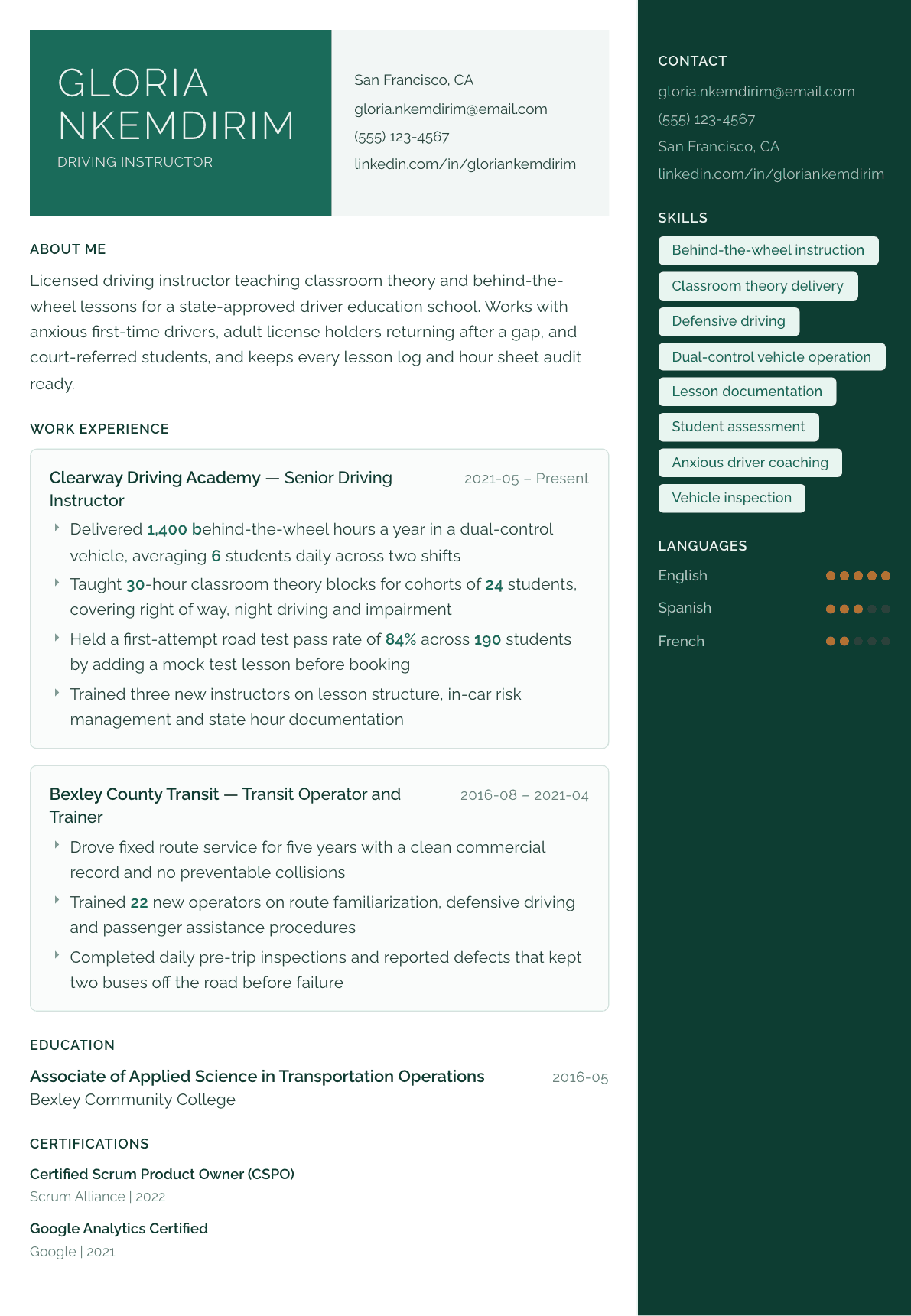
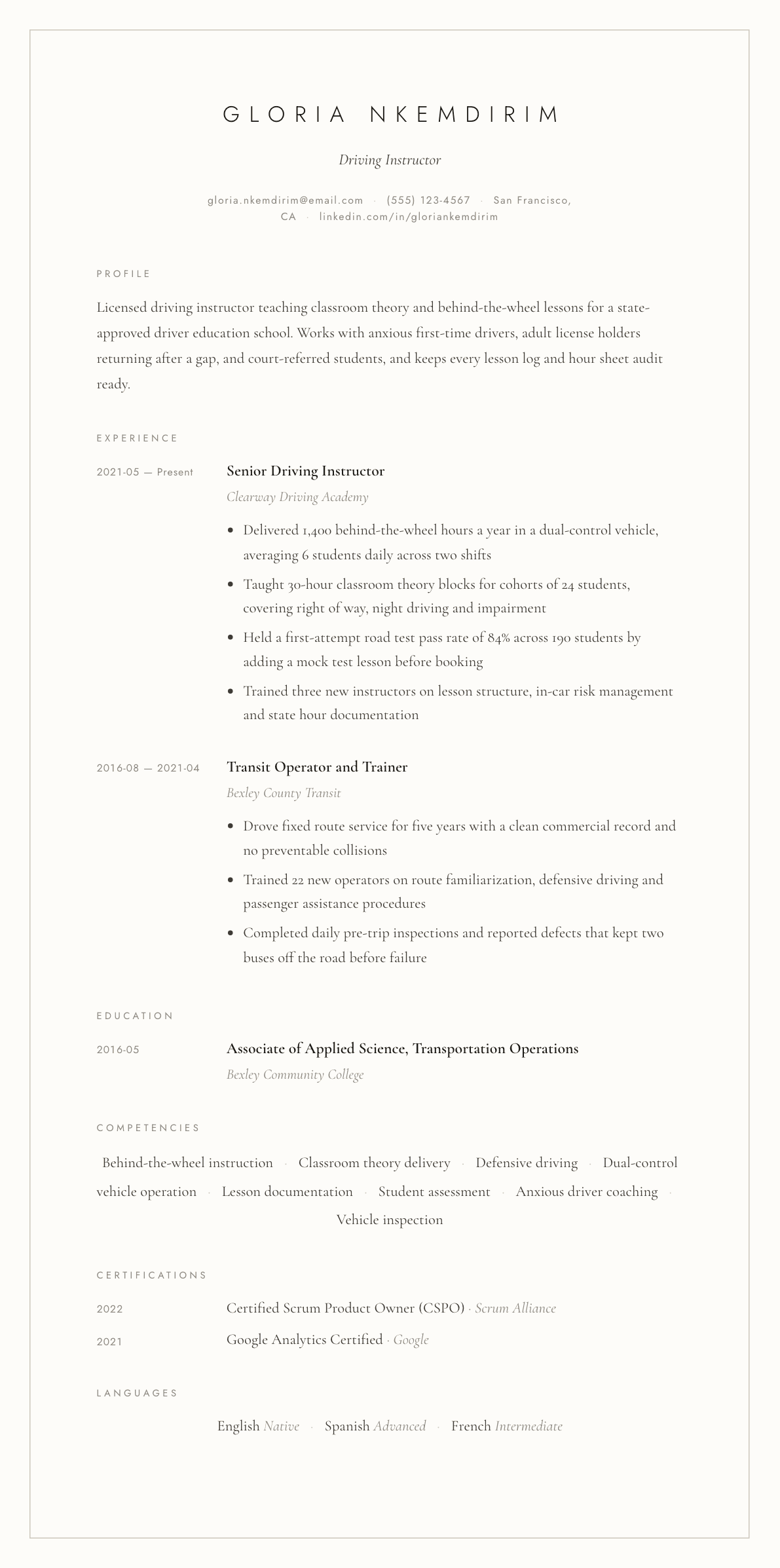
Example Driving Instructor summary
Licensed driving instructor with five years teaching classroom theory and behind-the-wheel lessons at a state-approved school. Delivers roughly fourteen hundred in-car hours a year in a dual-control vehicle and teaches thirty hour theory blocks to cohorts of two dozen students. Specializes in anxious first-time drivers and adult returners, and keeps lesson logs and hour sheets ready for state audit at any time.
Skills to list on a Driving Instructor resume
- Behind-the-wheel instruction
- Classroom driver education
- Defensive driving techniques
- Dual-control vehicle operation
- Road test preparation
- Student progress logs
- Traffic law instruction
- Anxious driver coaching
- Hazard perception training
- Parallel parking and maneuvers
- Vehicle pre-trip inspection
- Scheduling and route planning
- Parent and guardian communication
What actually gets this resume read
- Put your instructor license, state and expiry in the header area, since a school cannot interview you without it.
- State your driving record plainly, including years licensed and a clean record, because insurers set the hiring bar.
- Give lesson volume in hours per week or year rather than a general claim about teaching many students.
- Report a first-attempt road test pass rate only if you track it, and say how many students the number covers.
- Name the student groups you handle: teens, adult beginners, nervous drivers, refresher clients or court-referred cases.
- Add any classroom teaching, curriculum hours or examiner endorsements, because schools value instructors who can do both.
How to write a driving instructor resume
A driving school owner reads this resume with two questions in mind, and neither is about teaching philosophy. Can this person be added to the school insurance policy, and will parents trust them in a car with a sixteen year old. Everything else is secondary, so the license, the endorsement and the driving record belong at the top of the page rather than in a footnote.
After that, the owner is filling shifts. Availability, the hours you can carry each week, whether you can teach classroom theory as well as in-car lessons, and whether you can handle the students nobody else wants: the very anxious, the adult returner, the court-referred driver. Those details fill schedules and they are what get you called.
This guide covers the credential block, how to report lesson volume and pass rates honestly, the student populations worth naming, the safety and documentation record schools audit, and the questions instructors ask when moving between states or from commercial driving into instruction.
Credentials first: license, endorsement, record
Build a short block directly under your contact details with your driver license class and state, your driving instructor certification or endorsement with its issuing agency and expiry, any classroom instructor permit, and a plain statement of your driving record and years licensed. Schools cannot proceed without these, and burying them adds a phone call before an interview.
Add background clearance status if your state or the school requires it, along with first aid and cardiopulmonary resuscitation training. Working with minors makes clearances a condition of employment rather than a nice extra.
- Driver license class, state and years held.
- Instructor certification, issuing agency and expiry date.
- Driving record summary, background clearance, first aid and resuscitation training.
In-car instruction: hours, students and vehicle
Give lesson volume in hours rather than students alone, since a school builds its schedule in hours. Weekly or annual behind-the-wheel hours, students taught per day, and lesson length let an owner map you onto an existing route immediately.
Name the vehicle setup you have used: dual-control sedan, automatic and manual transmission, and any larger vehicle or trailer work. Manual transmission instruction is scarce and worth its own line if you can do it, because it opens a market segment most schools cannot serve.
Classroom theory and curriculum hours
Many states require a set number of classroom or online theory hours before a road test, and instructors who can deliver both halves are far more employable. Say how many hours of theory you have taught, the cohort size and the topics: right of way, speed management, night and adverse weather driving, impairment, distraction and sharing the road with cyclists and pedestrians.
If you have written or updated curriculum, taught an online cohort, or delivered a parent orientation session, add it. Schools value instructors who can carry a class when the theory teacher calls out sick.
Outcomes and student populations
The number that matters is first-attempt road test pass rate, and it only means something with the count behind it. Report both, or leave the rate off. An honest instructor who says the rate is not tracked reads better than one whose number falls apart under a follow-up question.
Then name your populations. Teens in a state-approved course, adult beginners, license holders returning after years away, drivers with test anxiety, students with attention or processing differences, and court-referred or remedial cases. Every school has students it struggles to place, and this line is often what earns the offer.
- First-attempt pass rate with the number of students it covers.
- Retention and rebooking, since referrals drive small school revenue.
- Any specialized training in working with anxious or neurodivergent learners.
Safety, documentation and the audit trail
State-approved schools are inspected, and the inspection lands on paperwork. Say that you maintain student progress logs, hour sheets, certificates of completion and vehicle inspection records to the state standard, and mention any inspection you have been through.
Add your in-car safety practice: pre-lesson vehicle checks, route selection matched to skill level, the intervention protocol you follow with the dual controls, and incident reporting. An instructor who can describe how they take control of a car calmly is describing the core of the job.
Driving Instructor resume summary examples
Newly certified
Newly certified driving instructor with a clean record over twelve years of licensed driving and a background in transit operations. Completed the state instructor course and 40 supervised observation hours. Comfortable with dual-control vehicles, manual transmission and nervous first-time drivers, and available for evening and weekend lessons.
Three years instructing
Driving instructor delivering about 1,400 behind-the-wheel hours a year at a state-approved school, plus 30-hour classroom theory blocks for cohorts of two dozen. Holds a first-attempt road test pass rate of 84% across 190 students and specializes in anxious and adult returning drivers.
Senior instructor or trainer
Senior driving instructor and instructor trainer for a two-branch school, teaching in-car and classroom while mentoring new hires on lesson structure and risk management. Owns state documentation compliance, has cleared two agency inspections, and handles court-referred and remedial referrals for both branches.
Work experience bullets: before and after
Before: Taught students how to drive.
After: Delivered roughly 1,400 behind-the-wheel hours a year in a dual-control sedan, averaging six students daily across a morning and an evening shift.
Hours, vehicle type and daily load let a school owner slot you into a route without an extra call.
Before: Helped students pass their road test.
After: Held a first-attempt road test pass rate of 84% across 190 students by adding a full mock test lesson on the actual test route before booking.
The rate is paired with a student count and a specific practice, which makes the claim credible.
Before: Taught classroom driver education.
After: Taught 30-hour theory blocks to cohorts of 24 students, covering right of way, night driving, impairment and hazard perception with scenario discussion.
Hours, cohort size and topics show you can carry the classroom half of a state-approved course.
Before: Good with nervous drivers.
After: Built a graduated route plan for anxious students, starting in an empty lot and adding one traffic complexity per lesson with a written checkpoint each time.
A described method turns a claim about temperament into a teachable, repeatable practice.
Before: Kept student records up to date.
After: Maintained student progress logs, hour sheets and completion certificates to state standard, with records passing two agency inspections without correction requests.
Naming the documents and the inspection outcome shows the paperwork side that schools are audited on.
Hard skills
- Behind-the-wheel instruction
- Classroom driver education
- Dual-control vehicle operation
- Manual transmission instruction
- Defensive driving techniques
- Hazard perception training
- Road test preparation and mock testing
- Traffic law instruction
- Student progress documentation
- Vehicle pre-trip inspection
- Route planning by skill level
- Incident reporting
Soft skills
- Staying calm during a near miss
- Giving corrections without rattling a student
- Working with anxious learners
- Communicating with parents and guardians
- Punctuality across a full lesson route
- Patience across repeated practice
Certifications worth listing
- State driving instructor certification (State department of motor vehicles or licensing agency)
- Driver Education Instructor Certification (American Driver and Traffic Safety Education Association)
- Heartsaver First Aid CPR AED (American Heart Association)
- Defensive Driving Course Instructor (National Safety Council)
Mistakes that cost driving instructor candidates the interview
- Leaving the instructor certification and driving record off the top, so the school has to ask before scheduling anything.
- Reporting a pass rate with no student count behind it, which an experienced owner discounts immediately.
- Describing lessons in students rather than hours, when hours are the unit a school builds its schedule from.
- Omitting classroom teaching hours, which halves the shifts you can be assigned to.
- Skipping the documentation side, even though state inspections turn almost entirely on records.
- Failing to state availability, since evening and weekend coverage is what most schools are short of.
Driving Instructor resume questions
What license and certification does a driving instructor resume need to show?
A valid driver license with class and state, your state instructor certification with the issuing agency and expiry, any classroom instructor permit, and a clear statement of your record. Most schools also require background clearance and current first aid training.
How do I become a driving instructor with no teaching experience?
Complete the state instructor course and observation hours, then lead with your driving record and any coaching, transit, military or commercial vehicle background. Schools frequently hire experienced drivers with clean records and train the instruction side themselves.
Should I put my road test pass rate on my resume?
Only if you track it and can state the number of students behind it. A rate without a denominator invites doubt, and an interviewer will ask how it was calculated. If you have never tracked it, describe your test preparation practice instead.
Does a driving instructor resume need to mention insurance eligibility?
It helps. Stating years licensed, a clean record and no at-fault collisions answers the underwriting question the owner will ask anyway, and it removes a barrier that quietly eliminates candidates before the interview stage.
How do I move my driving instructor career to another state?
Say your current certification, its state and expiry, and add a line that you are pursuing the destination state credential with an expected completion window. Requirements differ by state, so showing you understand the process reassures the school reviewing you.