Tutor Resume Examples: what a hiring manager reads first
Build a Tutor Resume That Wins Students and Contracts
By Mustafa Tarabya, founder of CVBooster · Published · Updated
Tutor resume samples written out for a peer tutor, private tutor and lead tutor, with how to put tutoring on a resume, results bullets and keywords.
Sample resumes for a tutor
The same tutor content laid out in three CVBooster templates, so you can see what the finished document looks like before you write a word.
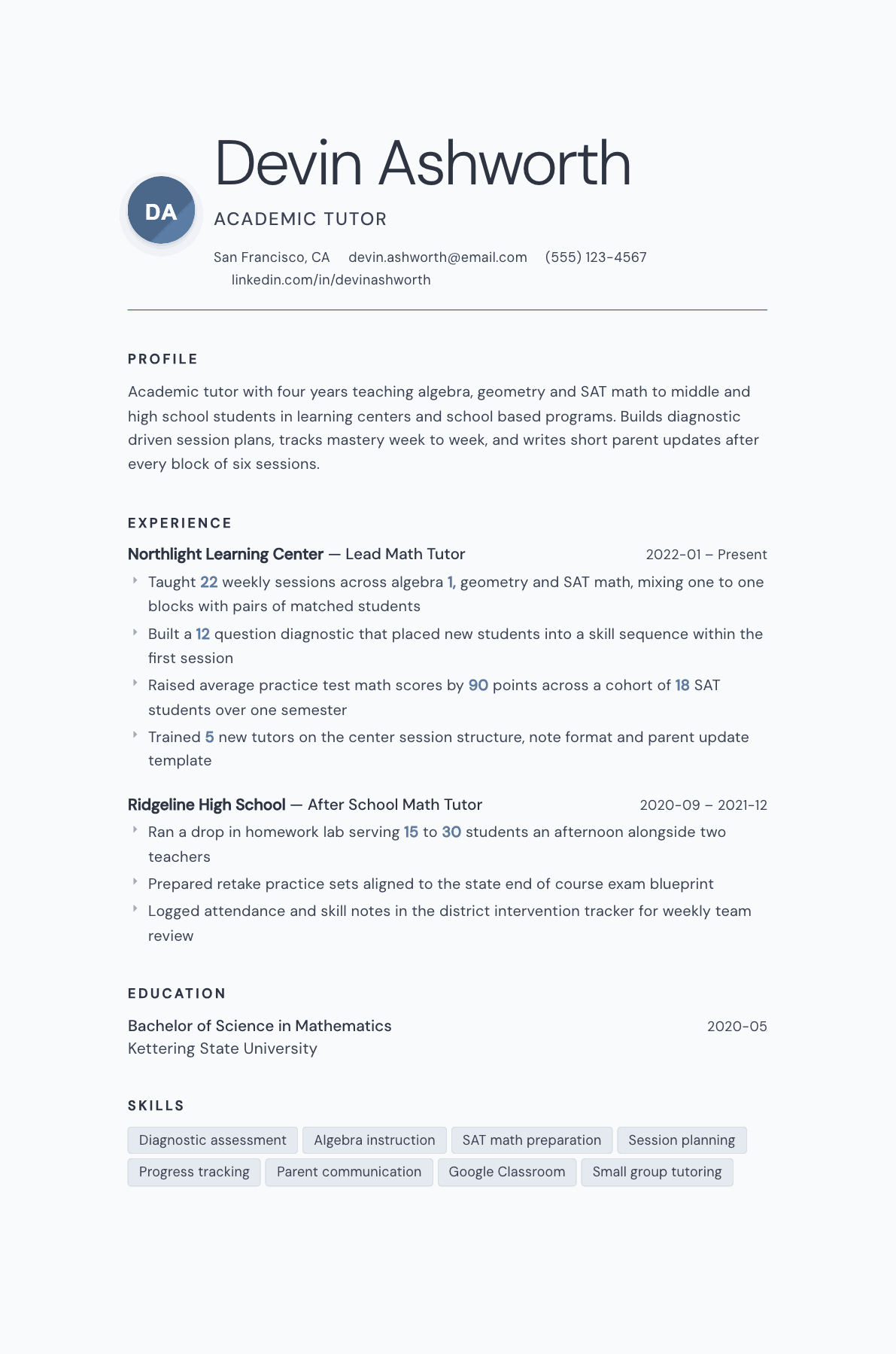
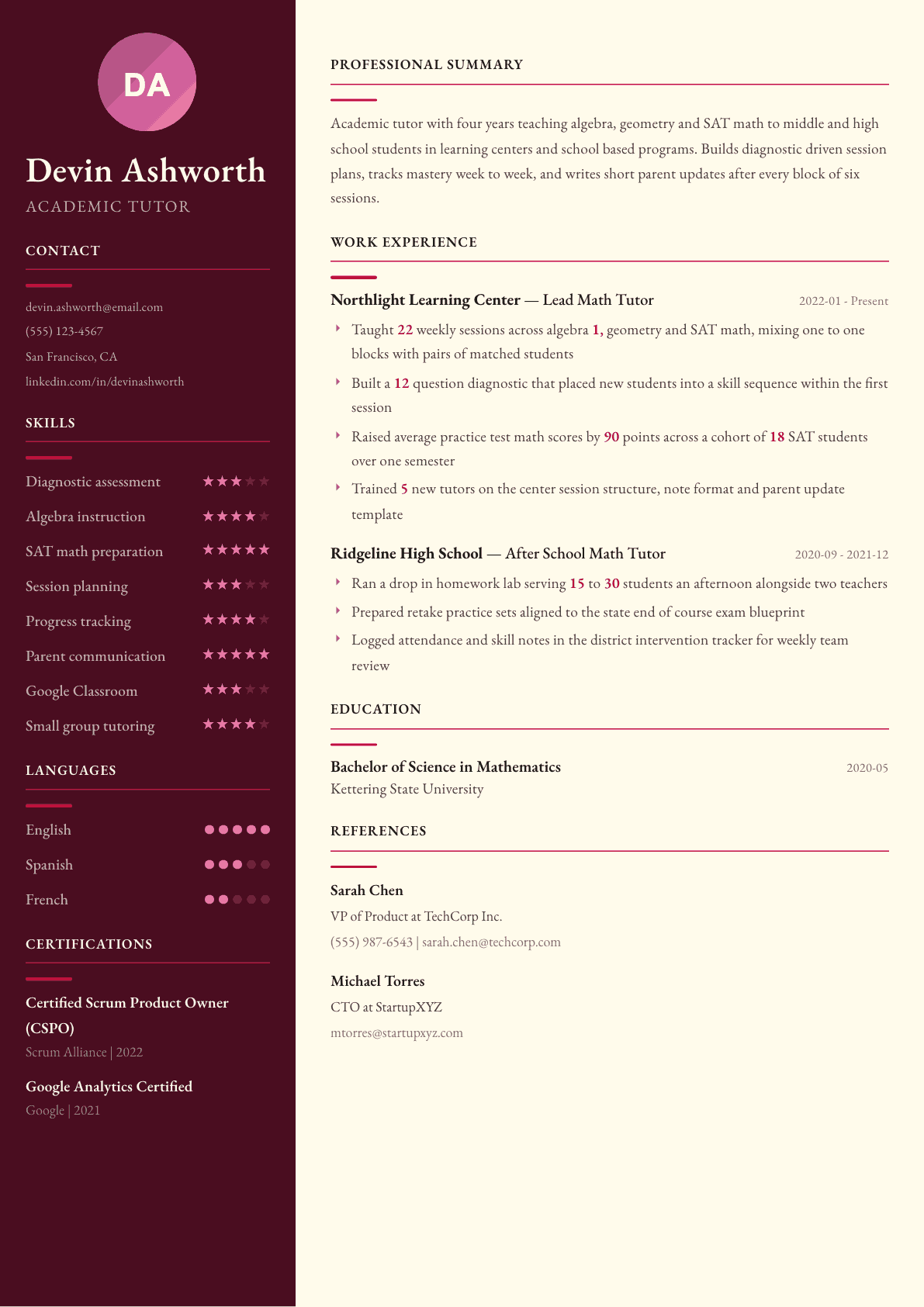
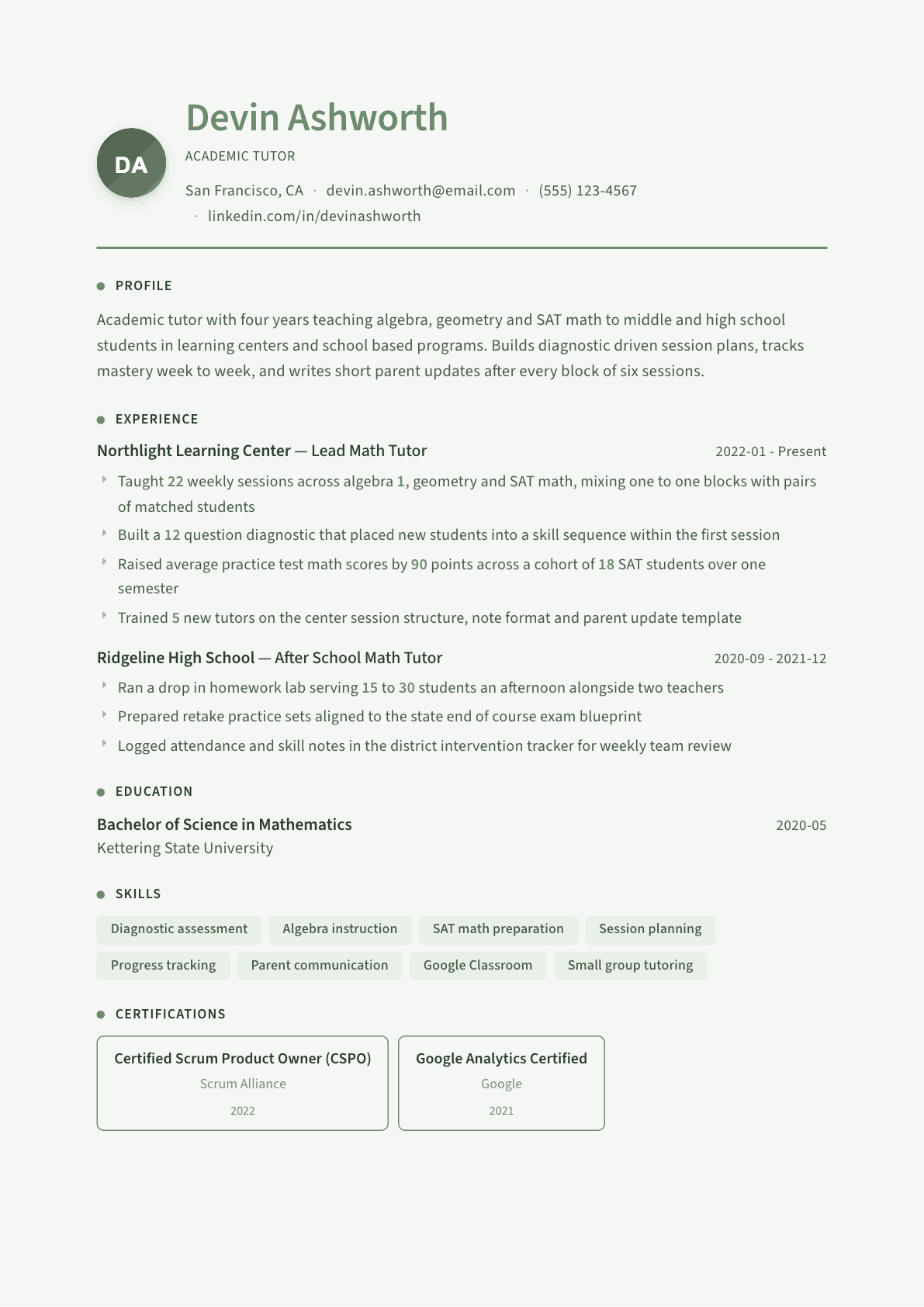
Example Tutor summary
Tutor with three years teaching middle and high school math and science in a learning center and a school based homework lab. Runs a diagnostic in the first session, plans a skill sequence, and reports progress to parents every few weeks. Comfortable in person and on a shared whiteboard. Seeking a lead tutor role with a center that keeps students for a full year.
Skills to list on a Tutor resume
- Diagnostic assessment
- Lesson planning
- Algebra and geometry
- Reading comprehension
- Test preparation
- Progress tracking
- Session notes
- Parent updates
- Small group instruction
- Online whiteboard tools
- Google Classroom
- Scheduling
- Differentiation
- Study skills coaching
What actually gets this resume read
- Name your subjects and the exact levels you teach, because algebra 2 and calculus are hired as different jobs.
- Give the shape of your caseload: sessions per week, group size, grade bands, and how long students stay.
- Show one measurable outcome per role, such as grade movement, test score gains, or retention across a term.
- Say how you diagnose, plan and record, since centers hire tutors who leave usable notes for the next session.
- Add the platforms you tutor on and the tools you use, from a document camera to a shared whiteboard.
- Move your degree, coursework and any exam scores near the top when the subject is your main credential.
How to write a tutor resume
Tutoring resumes are read by three different buyers. A learning center director wants someone who can hold a schedule, follow the center session format and keep families rebooking. A school or district hiring an intervention tutor wants alignment with the curriculum and clean documentation for the intervention team. An online platform wants subject depth, a reliable connection and a trial lesson that converts. The same facts serve all three, but the order changes.
What none of them want is a page of teaching philosophy. The reader is scanning for subjects, levels, hours, group sizes and any number that suggests students got better while sitting with you.
This guide sets out how to present a tutoring caseload, how to show results without inventing them, three summaries from a first tutoring job through a lead tutor role, five rewritten bullets, and the questions tutors ask when they move from casual work to a formal position.
Format: one page, subjects visible in the first six seconds
Reverse chronological with a subject line near the top. A director scanning a stack of applications is sorting by subject before anything else, because the open slots are for specific courses. If your resume forces her to hunt for whether you can cover precalculus, it goes in the maybe pile.
Keep education high when your degree is the credential for the subject you teach, which is true for most academic tutoring. Move it below experience only once you have several years of paid tutoring with real outcomes attached.
- Header: name, city and state, phone, email, and a note on whether you tutor in person, online or both.
- A subject and level line under the summary: the exact courses and exams you cover.
- Sections: summary, subjects and levels, experience, education, skills, certifications if any.
Describe the caseload, not just the job title
A tutoring job is defined by its shape. Sessions per week, session length, one to one or small group, group size, grade bands, and how long students typically stay with you. Two tutors with the same title can have completely different weeks, and the shape is what tells a director whether you can carry the schedule she needs to fill.
Add the setting, because it changes the work. A center with a fixed curriculum, a school homework lab with open attendance, a district intervention block during the school day and a private platform are four different jobs. Say which one you did.
Results: use the evidence you actually have
Tutors rarely control grades outright, so pick evidence you can defend. Practice test movement across a cohort, course grade changes over a term, mastery checks passed within a skill sequence, retention of students across a school year, and rebooking rates are all defensible. Made up score jumps are not, and an interviewer who tutors for a living will test the number.
When you have no numbers at all, describe the system instead. A diagnostic in session one, a skill sequence built from it, a mastery check every few sessions, and a written recap to the parent is a process a director can evaluate on its own merits.
- Cohort level results are safer and more credible than a single dramatic student story.
- Retention and rebooking are the metrics center directors care about most, because they pay the rent.
- Say how you know a student improved: a mastery check, a released exam item set, a teacher report, a graded unit test.
Skills and tools: the ones that shorten your onboarding
List the software a center or platform would otherwise train you on. Scheduling and session note systems, a shared whiteboard tool, screen sharing with a document camera, a graphing tool such as Desmos or GeoGebra, and the learning management system the school uses for assignments.
For test preparation, name the exams and the materials: released College Board practice tests, ACT official practice, state end of course blueprints, or Advanced Placement free response sets. Specific material names read as experience because a person who has not taught the test does not know them.
Certifications and background checks
Tutoring has no universal credential, so anything real carries weight. A teaching license, a subject endorsement, a college level tutor certification through the College Reading and Learning Association, and a current background check are the four lines that matter. If a center requires fingerprinting for its school contracts, saying you are already cleared can move you ahead of an equally qualified candidate.
Resume for tutoring: three samples, written out
A resume for tutoring work puts the subjects and levels in the first lines, then one tutoring entry per setting with the session shape and the evidence of progress. The three tutoring resume samples below show a college student tutoring part time, a former teacher tutoring privately and a lead tutor at a learning center, written the way the experience section reads on the page.
If tutoring is a side job next to another career, put it on your resume as its own entry under Experience with its own dates, not as a line under your main job. Private clients count: list yourself as a self employed tutor and give the subjects, the number of students and the hours per week.
- Sample one, college student: Peer Tutor, university learning center. Tutors college algebra and introductory statistics in scheduled one to one sessions and a weekly drop in table of up to six students, about twelve hours a week. Completed the center tutor training program and keeps session notes in the center scheduling system.
- Sample one, second bullet: Built a set of worked practice problems for the statistics midterm that the center now hands out to every student who books a review session.
- Sample two, former teacher: Private Tutor, self employed. Tutors eight middle and high school students a week in algebra, geometry and SAT math, in person and online. Starts each student with a diagnostic, sets a skill sequence from it and sends parents a short written recap after every session.
- Sample two, second bullet: Five of eight current students have stayed for a full school year, and four were referred by existing families.
- Sample three, lead tutor: Lead Tutor, learning center. Schedules and supervises a team of nine tutors across reading, math and test preparation, runs new tutor training and observes two sessions per tutor each month.
- Sample three, second bullet: Rebuilt the reading intervention sequence around mastery checks every fourth session and set up the parent progress report the center now sends each term.
Tutor resume summary examples
First tutoring job
Mathematics major with two years of campus tutoring center experience covering college algebra, precalculus and introductory statistics. Comfortable with drop in tables of six students and with scheduled one to one appointments. Certified through the campus tutor training program and looking for afternoon and evening center hours.
Three years in
Tutor carrying 20 weekly sessions in middle and high school math, mixing one to one blocks with matched pairs. Opens every new student with a diagnostic, builds a skill sequence from it, and sends a written recap to families after every few sessions. Experienced with in person and shared whiteboard formats.
Lead tutor
Lead tutor responsible for the math roster at a learning center, including scheduling, placement and quality checks on session notes. Trains new tutors on the center session structure and handles the families who arrive frustrated after a bad experience elsewhere. Teaches algebra through calculus and college entrance exam math.
Work experience bullets: before and after
Before: Tutored students in math.
After: Taught 22 weekly sessions across algebra 1, geometry and entrance exam math, mixing one to one blocks with pairs of students matched by skill level.
The volume, the courses and the grouping model give the director everything she needs to slot you into a schedule.
Before: Helped students improve their test scores.
After: Raised average practice test math scores by 90 points across a cohort of 18 students over one semester of weekly sessions.
A cohort average with a time frame is checkable, while a claim about improvement is not.
Before: Assessed students before starting.
After: Built a 12 question diagnostic that placed each new student into a skill sequence during the first session instead of the third.
It shows a system you created and the operational gain it produced for the center.
Before: Communicated with parents.
After: Sent a written progress recap to each family after every block of six sessions, listing mastered skills and the next two targets.
The cadence and the content turn a soft claim into a routine a manager can adopt.
Before: Trained other tutors.
After: Trained 5 new tutors on the center session structure, note format and parent update template, then reviewed their first month of session notes.
Naming what you trained and the follow up review shows real responsibility rather than an informal handoff.
Hard skills
- Diagnostic assessment design
- Skill sequencing
- Algebra and geometry instruction
- Reading comprehension strategies
- College entrance exam preparation
- Mastery checks
- Session note documentation
- Learning management systems
- Shared whiteboard tools
- Desmos and graphing tools
- Small group facilitation
- Study skills instruction
Soft skills
- Explaining a concept three different ways
- Reading student frustration
- Scheduling discipline
- Parent updates
- Encouragement without flattery
- Note taking under time pressure
Certifications worth listing
- Certified Tutor, Levels 1 to 3 (College Reading and Learning Association)
- Heartsaver First Aid CPR AED (American Heart Association)
Mistakes that cost tutor candidates the interview
- Listing tutoring as one undated block instead of separate roles with dates, hours and subjects for each employer.
- Claiming score gains that no record supports, which collapses the moment an interviewer asks how the number was measured.
- Hiding the subjects at the bottom of the page when subject coverage is the first filter a director applies.
- Writing about a love of helping students learn instead of the caseload, the diagnostic and the documentation.
- Leaving out group size, so a reader cannot tell one to one work from a room of twenty students at open tables.
- Omitting a current background check when the center holds school contracts that require one before you can start.
Tutor resume questions
How do I show tutoring results if I never tracked scores?
Describe the process and the checkpoints instead. Say how you diagnose, how you sequence skills, how often you run a mastery check and what you send families. A director can evaluate a defensible system, and inventing a score gain is the fastest way to lose an interview.
Do I need a teaching license to be hired as a tutor?
Not usually for a learning center or an online platform, where subject knowledge and a background check matter more. District intervention tutor positions sometimes require a license or a paraprofessional qualification, so read the posting and put whichever credential you hold near the top.
How do I put tutoring on my resume?
Give tutoring its own entry under Experience: the title, the organization or self employed, the dates, the subjects and levels, the session format and the hours per week. Add one or two bullets with evidence such as retention, mastery checks or teacher feedback. If you tutor next to another job, keep the two entries separate so the dates stay clear.
How do I present volunteer or unpaid tutoring?
The same way as paid work, with the organization, the dates, the hours per week and the subjects, then label it volunteer. Peer tutoring at a campus center, library homework help and school based mentoring all count as real experience when they are described with the same specifics.
What belongs on a resume for an online tutoring platform?
Subject depth, your equipment and connection, the whiteboard and screen share tools you use fluently, your available hours across time zones, and any recorded trial lesson experience. Platforms are hiring for a session that works technically on the first attempt as much as for teaching skill.