Swim Instructor Resume Examples: the lines they read
Build a Swim Instructor Resume Aquatic Programs Take Seriously
By Mustafa Tarabya, founder of CVBooster · Published · Updated
Swim instructor resume examples covering certifications, class levels and water safety keywords, with a section by section writing guide.
Sample resumes for a swim instructor
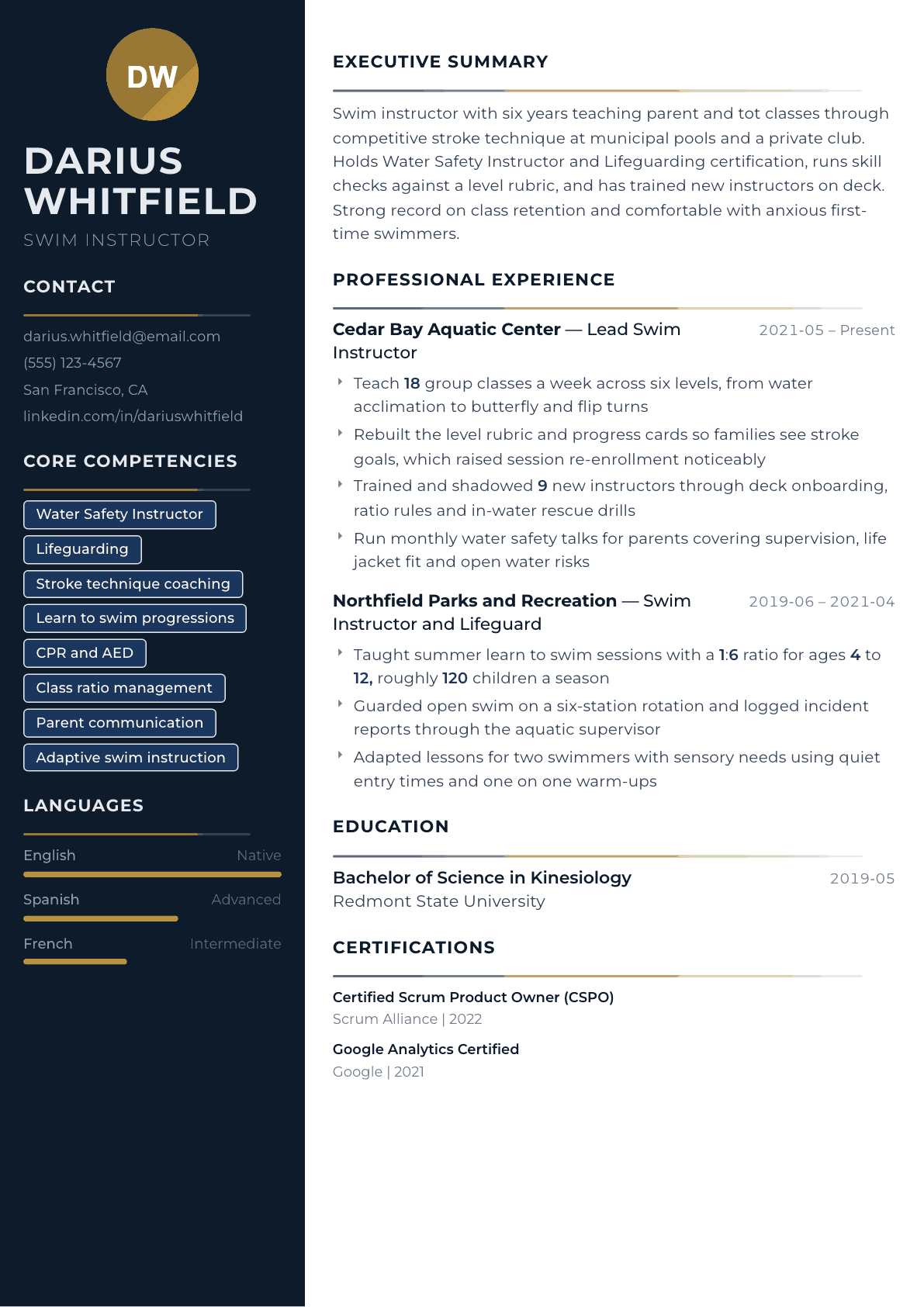
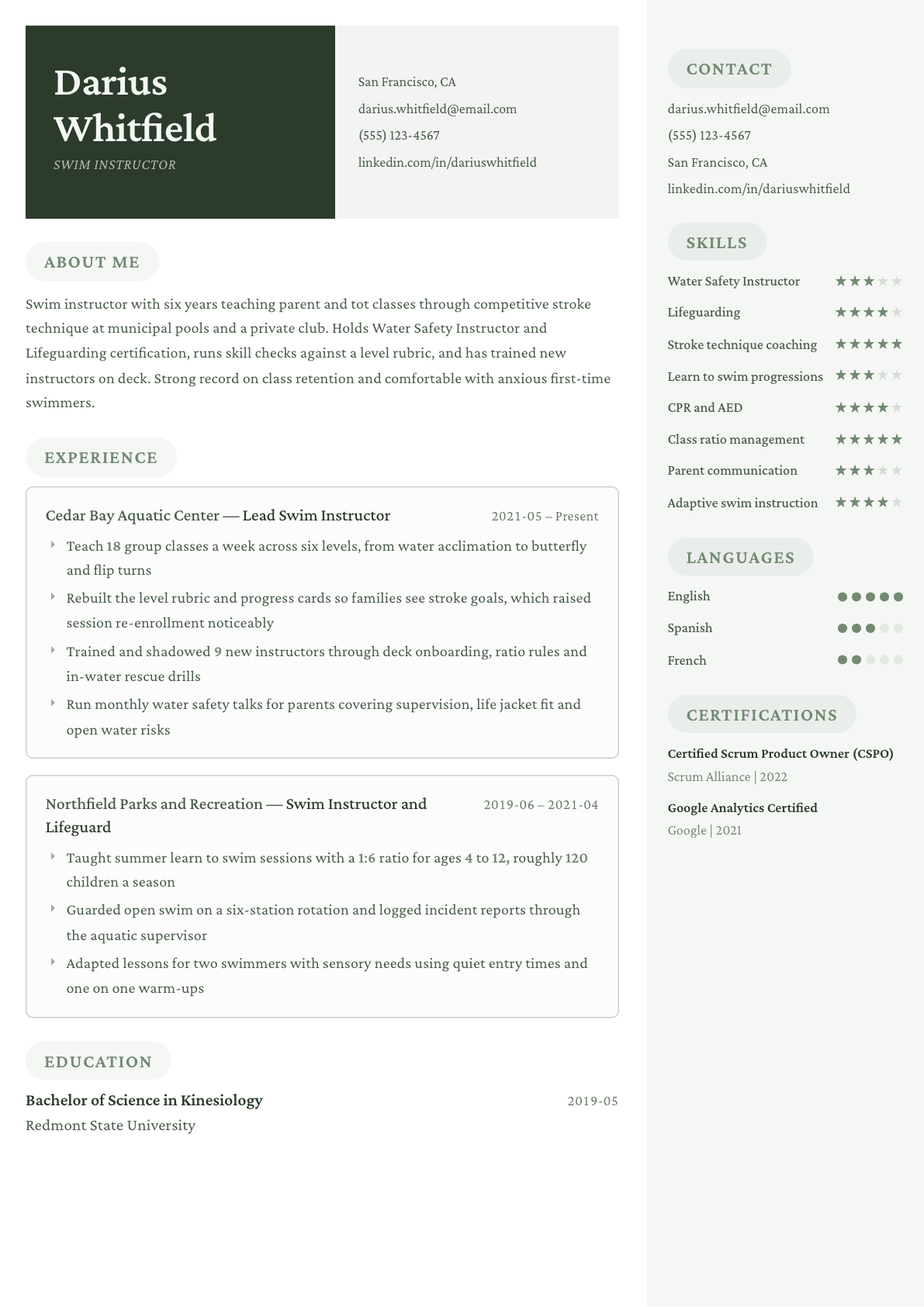
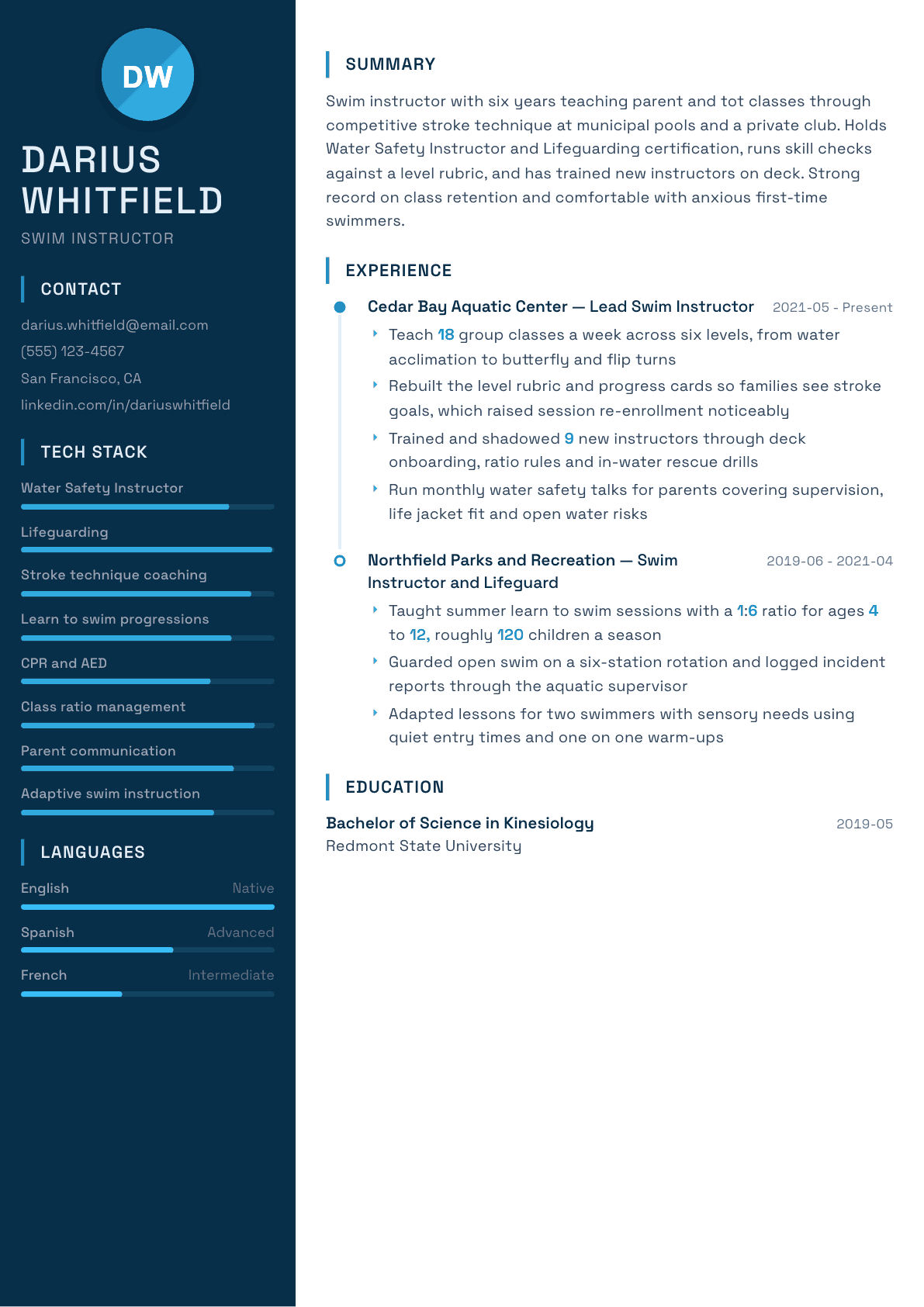
The same swim instructor content laid out in three CVBooster templates, so you can see what the finished document looks like before you write a word.
Example Swim Instructor summary
Swim instructor with six years across municipal and club pools, teaching water acclimation through competitive stroke work. Certified in Water Safety Instruction and lifeguarding, carrying 18 classes a week and mentoring new instructors on deck. Known for settling anxious beginners quickly and for progress cards that keep families enrolled through the next session.
Skills to list on a Swim Instructor resume
- Water Safety Instruction
- Lifeguarding and rescue
- CPR, AED and first aid
- Learn to swim progressions
- Stroke technique correction
- Freestyle and backstroke coaching
- Breaststroke and butterfly drills
- Parent and tot classes
- Adult beginner instruction
- Adaptive aquatics
- Class ratio and deck supervision
- Progress assessment and rubrics
- Pool chemistry awareness
- Instructor training and mentoring
What actually gets this resume read
- Put your Water Safety Instructor and lifeguarding certifications in the header area where a screener sees them first.
- State the age bands and skill levels you teach, because a toddler class and a stroke clinic are different jobs.
- Give class sizes and instructor to swimmer ratios, since aquatic supervisors staff their schedules around those numbers.
- Show retention or progression outcomes: how many swimmers moved up a level or returned for the next session.
- Name any adaptive, special needs or adult beginner work, because those assignments are hard to staff.
- List rescue and emergency experience separately from teaching, including in-water drills and incident reporting.
How to write a swim instructor resume
An aquatic supervisor hiring a swim instructor is solving a scheduling problem with a safety constraint attached. She has a grid of class times, a set of levels that must be covered, and a legal requirement that every person on deck holds the right card. Your resume either fits into that grid or it does not, and she decides in under a minute.
That means the two things she checks first are your certifications and the levels you can teach. Water Safety Instructor status, current lifeguarding, CPR for the professional rescuer and first aid are pass or fail items. After that she looks for the age bands: parent and tot, preschool aquatics, school age levels, adult beginners, stroke technique for older swimmers.
This guide walks through the sections in the order a facility reads them, with example summaries at three stages of a swim teaching career, before and after bullets that replace vague deck language with the specifics, and answers to the questions that come up when a seasonal instructor tries to turn a summer job into a year round one.
Format: certifications high, one page, no decorative layout
Put a certifications block directly under the summary, before experience. Every credential gets its name, the issuing body and the expiry, because an expired card makes you unschedulable and a supervisor will not guess. This is the one section that outranks your teaching history.
Keep the whole thing to one page. Municipal parks departments and school districts often run applications through a system that strips formatting, so avoid columns, icons and shaded boxes. A clean single column survives the parser and prints well on a clipboard at the front desk.
- Header: name, city, phone, email, and availability by day part if you are applying for a seasonal schedule.
- Sections: summary, certifications, aquatic experience, related work with children, education, skills.
- State your availability plainly, because early mornings, after school and weekend blocks are the hard ones to staff.
Summary: levels, ages, ratio and setting
Name the setting first, since a municipal pool, a private club, a swim school franchise and a school district program run different curricula and different class sizes. Then the age bands and the highest skill you teach: a candidate who can take a swimmer from bubble blowing through flip turns and butterfly covers far more of the grid than one who only teaches beginners.
Add a strength the facility is short of. Anxious first-time swimmers, adult beginners, adaptive lessons for swimmers with disabilities, and instructor training are all real staffing gaps. Saying you love working with kids does not separate you from anyone else in the pile.
Experience: classes per week, ratio, level range, outcome
Lead each job with the shape of the work: how many classes a week, the instructor to swimmer ratio, the age range and the levels. A line reading eighteen group classes weekly across six levels at a one to six ratio tells a supervisor what you can carry without a single adjective.
Then bullets on the teaching itself. Name the curriculum you worked from and the skills at each end of it: water acclimation, front float, rhythmic breathing, streamline, freestyle with side breathing, backstroke, elementary backstroke, breaststroke kick, butterfly, flip turns, treading and deep water entry. These are the words the posting uses.
Include the guarding side separately. Rotations covered, rescues performed, incident reports filed, and in-water drills run with the team. A person who can both teach and guard is worth two lines on the schedule, and facilities pay attention to that.
End with progression. How many swimmers moved up a level, how many families re-enrolled for the next session, or what you changed about assessment so parents could see progress. Session to session retention is what pays for the program.
Certifications: the block that decides the interview
List Water Safety Instructor status first if you hold it, since it is the credential that lets a facility put you in front of a class rather than only on a chair. Then lifeguarding, CPR for the professional rescuer, AED and first aid, each with the issuer and the expiry month.
Add anything that widens where you can be scheduled: a pool operator certificate, an adaptive aquatics workshop, a coaching credential for a summer league, or instructor trainer status if you have reached it. If a card is close to expiring, say when your recertification is booked instead of leaving a supervisor to worry about it.
Skills, keywords and the safety vocabulary
Aquatic postings recycle a small set of phrases: learn to swim, water safety, stroke development, ratio compliance, deck supervision, progressive skill assessment, rescue readiness and lesson planning. Mirror the ones that are true of you, once in the skills list and once inside an experience bullet where they are demonstrated.
Do not skip the unglamorous items. Chemical awareness, chlorine and pH checks, equipment inventory, locker room supervision policy and the facility's own rule set are things a supervisor has to train into every new hire, and a candidate who already knows them starts earning sooner.
Swim Instructor resume summary examples
First season on deck
Certified lifeguard and Water Safety Instructor with 1 summer season teaching learn to swim at a municipal pool, covering ages 4 to 12 at a 1:6 ratio. Current in CPR for the professional rescuer, AED and first aid, and available for weekday evening and weekend blocks.
Year round instructor
Swim instructor with 6 years across municipal and club pools, teaching 18 group classes a week from water acclimation through butterfly and flip turns. Rebuilt the level rubric and progress cards, lifting session re-enrollment, and holds current Water Safety Instructor and lifeguarding certification.
Lead instructor and trainer
Lead swim instructor with 11 years of aquatics experience, running the lesson schedule for 6 levels and training 9 new instructors a year on ratios, progressions and in-water rescue drills. Experienced with adaptive lessons, adult beginners and parent water safety education.
Work experience bullets: before and after
Before: Taught swimming lessons to children of different ages.
After: Taught 18 group classes a week across 6 levels for ages 3 to 14, running a 1:6 ratio in the shallow end and 1:4 in deep water.
Class count, level range and both ratios show a supervisor exactly how much of the schedule you can cover.
Before: Helped kids who were afraid of the water.
After: Settled first-time swimmers using stair entry, blowing bubbles at the wall and a hand-held front float before any face submersion, moving 12 anxious beginners into the level 1 group within one session.
Naming the actual progression proves technique rather than sympathy, and the outcome shows it worked.
Before: Worked as a lifeguard during open swim.
After: Guarded open swim on a 6 station rotation with 10 minute scans, completed 2 assists and filed the incident reports through the aquatic supervisor the same shift.
Rotation detail, scan discipline and documentation show a guard who follows protocol under a real bather load.
Before: Trained new instructors at the pool.
After: Onboarded 9 new instructors through deck shadowing, ratio rules, lesson plan templates and in-water rescue drills, then observed each one teaching before clearing them for a solo class.
The steps and the clearance decision turn vague mentoring into a repeatable training role.
Before: Talked to parents about their children's progress.
After: Introduced end of session progress cards listing the specific skills passed and the 2 goals for the next level, and ran a monthly water safety talk for parents on supervision and life jacket fit.
A concrete communication practice is more convincing than a claim of being good with parents.
Hard skills
- Water Safety Instruction
- Lifeguarding and in-water rescue
- CPR for the professional rescuer
- AED and first aid
- Learn to swim level progressions
- Stroke technique correction
- Parent and tot class delivery
- Adult beginner instruction
- Adaptive aquatics
- Ratio compliance and deck supervision
- Skill assessment and rubrics
- Lesson planning for mixed ability groups
- Pool chemistry and safety checks
- Instructor onboarding
Soft skills
- Calm under a crowded deck
- Clear demonstration
- Building trust with nervous swimmers
- Parent communication
- Voice projection over pool noise
- Punctuality across shift blocks
Certifications worth listing
- Water Safety Instructor (American Red Cross)
- Lifeguarding, First Aid and CPR/AED for Professional Rescuers (American Red Cross)
- Basic Life Support for Healthcare Providers (American Heart Association)
- Certified Pool Operator (Pool and Hot Tub Alliance)
Mistakes that cost swim instructor candidates the interview
- Burying certifications at the bottom, when they are the first thing an aquatic supervisor checks for schedulability.
- Leaving expiry dates off cards, which forces the facility to chase you before it can put you on the grid.
- Writing lessons taught without the level range, so nobody can tell whether you can take a stroke clinic.
- Ignoring the guarding half of the job when you hold the credential, since dual coverage is what gets you hours.
- Skipping availability, which is the detail that decides seasonal hiring more often than any teaching skill.
- Describing yourself as a strong swimmer instead of describing what your swimmers learned to do.
Swim Instructor resume questions
Do I need Water Safety Instructor certification to teach swimming?
Most municipal pools, school districts and clubs require it or an equivalent instructor credential before you can lead a class alone. Some private swim schools train instructors in their own curriculum, but the recognized card makes you employable anywhere.
How do I list swim levels on a resume when programs use different names?
Give the skill at each end rather than only the level number. Water acclimation through freestyle with side breathing, or streamline through butterfly and flip turns, reads correctly to a supervisor whichever curriculum her facility uses.
Can I put lifeguarding and instructing on the same resume?
Yes, and you should when you hold both. Keep the teaching experience as your main section and add a short guarding block with rotations, assists and drills, because a facility can schedule a dual credential person into far more hours.
What if all my experience is seasonal summer work?
Show the seasons stacked with the same facility if you were asked back, since returning staff is a strong signal. Then add off season work with children such as coaching, tutoring or camp counseling, and state your availability for the coming year.
How do I show results as a swim instructor?
Use progression and retention. Number of swimmers who passed to the next level, families who re-enrolled for the following session, beginners moved out of the fear stage, and any assessment change you introduced that made progress visible to parents.