Corporate Trainer Resume Examples: the lines they read
Develop Talent with a Corporate Trainer Resume
By Mustafa Tarabya, founder of CVBooster · Published · Updated
Create a corporate trainer resume showcasing your instructional design expertise, facilitating engaging learning programs, and measuring training ROI across organizations.
Sample resumes for a corporate trainer
The same corporate trainer content laid out in three CVBooster templates, so you can see what the finished document looks like before you write a word.
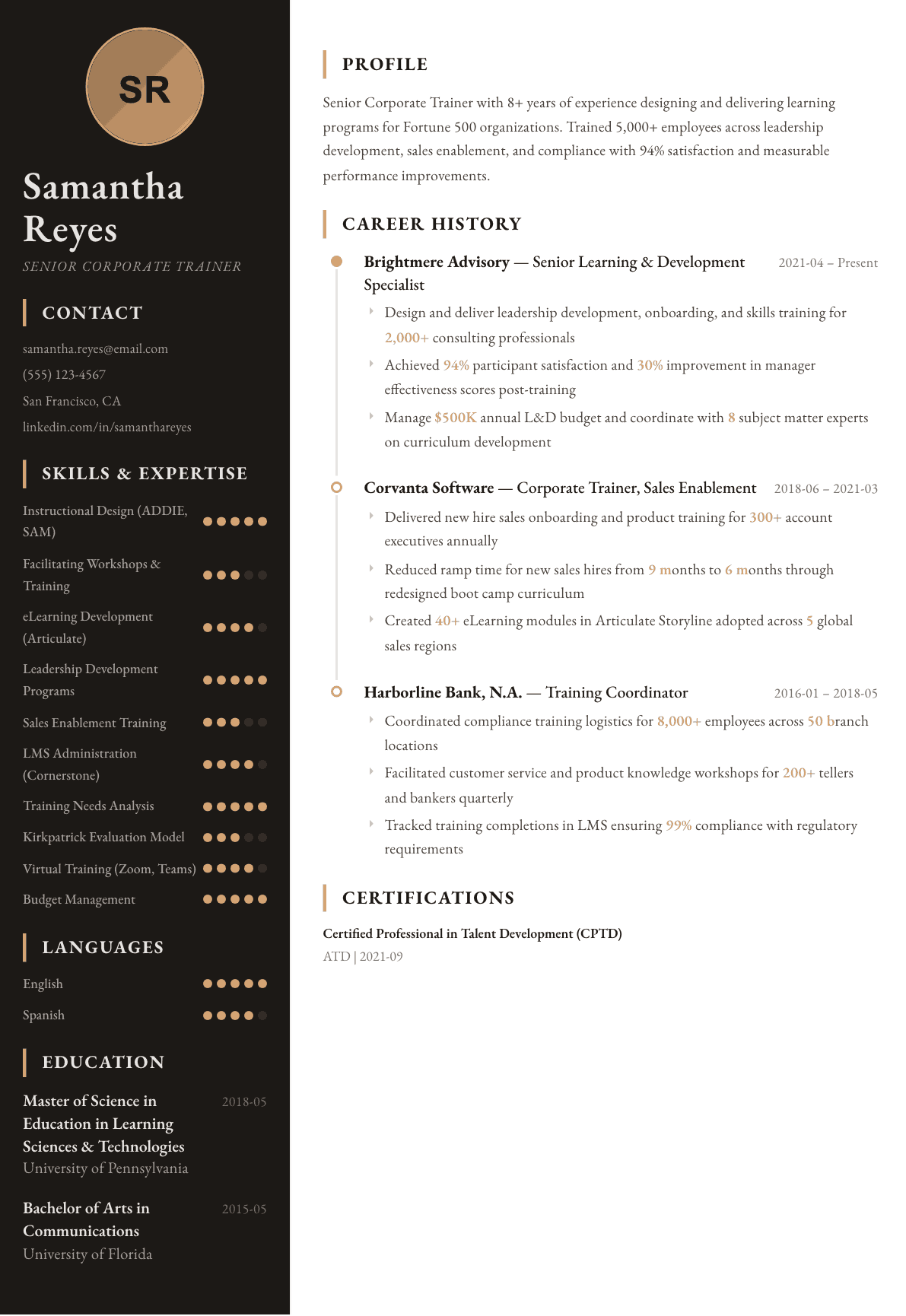
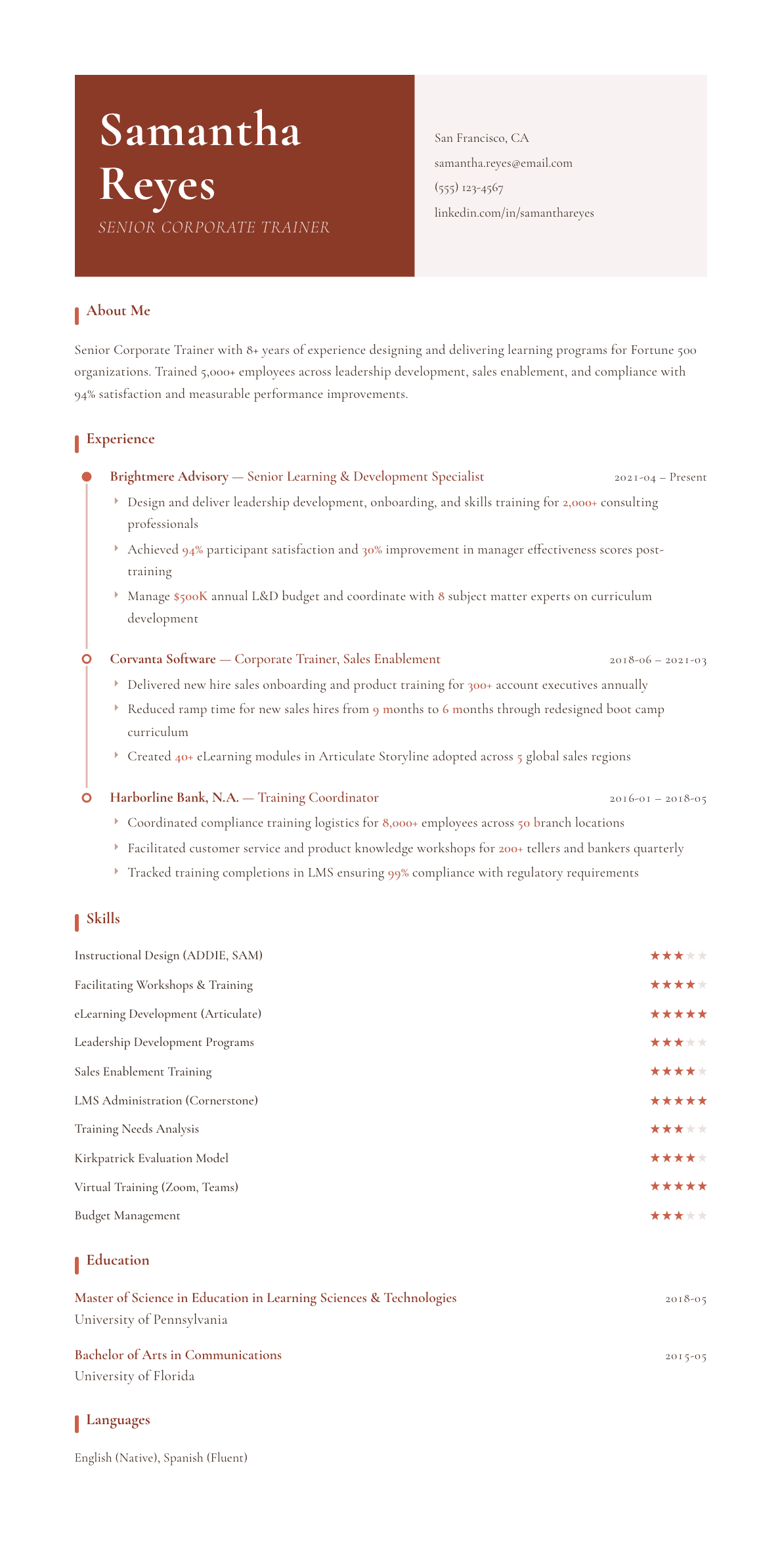
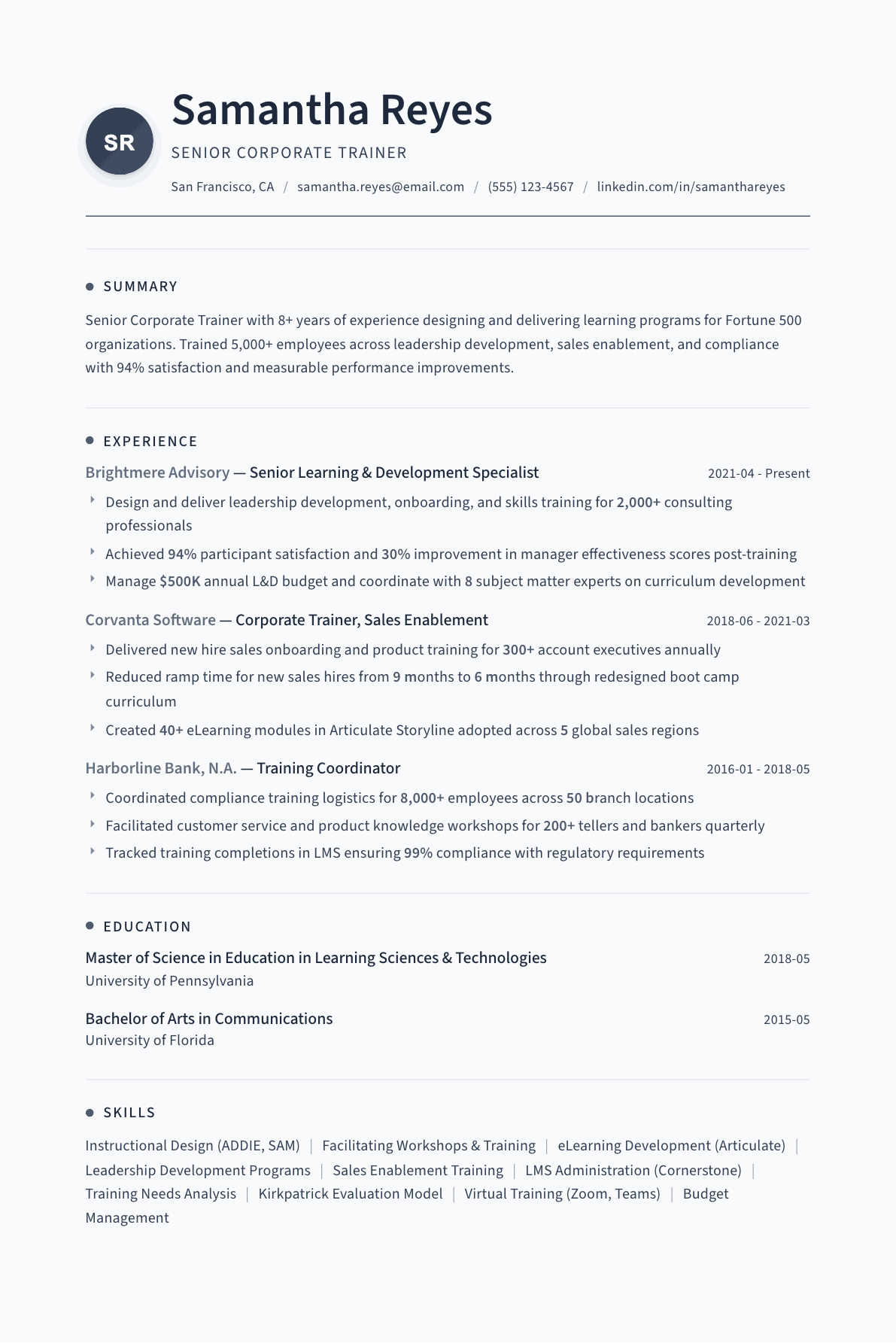
Example Corporate Trainer summary
Corporate Trainer with 8 years of experience training 5,000+ employees in leadership, sales, and compliance across Fortune 500 organizations. Reduced new hire ramp time by 33% and achieved 94% training satisfaction with measurable ROI.
Skills to list on a Corporate Trainer resume
- Instructional Design (ADDIE/SAM)
- Workshop Facilitation
- eLearning (Articulate Storyline/Rise)
- Leadership Development
- Sales Enablement
- LMS Administration
- Training Needs Analysis
- Kirkpatrick Evaluation
- Virtual Training Delivery
- Budget Management
- Curriculum Development
- Change Management
What actually gets this resume read
- Quantify the number of employees trained and satisfaction scores to demonstrate reach and quality.
- Include measurable business outcomes: ramp time reduction, performance improvement, compliance rates.
- List instructional design methodologies: ADDIE, SAM, Bloom's Taxonomy, Kirkpatrick evaluation.
- Mention eLearning tools: Articulate Storyline/Rise, Adobe Captivate, Camtasia, Canva.
- Highlight L&D budget management and stakeholder collaboration to show strategic business partnership.
How to write a corporate trainer resume
A corporate trainer resume is screened by a learning and development manager who has one recurring problem: business leaders keep asking for training and rarely say what they want to change. So the manager is reading for a candidate who can turn a vague request into a needs analysis, build something, deliver it to a room or a video call full of skeptical adults, and then show a business measure that moved. Delivery skill alone is common. Delivery plus analysis plus measurement is what gets hired.
The second filter is what you can build without help. Many teams no longer have a separate instructional designer, so the posting quietly expects a trainer who can author a course in Articulate Storyline or Rise, load it into the learning management system, set up the enrollment and reporting, and record clean audio. A resume that lists only facilitation reads as half the job.
This guide covers how to frame audience and volume, which design and authoring tools to name, how to write evaluation results without inventing them, and the questions trainers ask when they move between compliance, sales enablement, leadership development and technical training.
Format: one to two pages, audience and modality up front
Reverse chronological, one page under eight years. The reader is trying to place you against their audience, so make it easy: employee population size, the functions you trained, and the modalities you deliver in, whether classroom, virtual instructor led, self-paced digital, blended or on the floor beside the work.
Put a tools line high on the page. Authoring platforms, the learning management system, the virtual classroom platform and the video tools are all filtered on, and a hiring manager who cannot find them assumes you facilitate other people's content.
- Header: name, city and state, phone, email, and a link to a portfolio of course samples or recorded facilitation if you have one.
- Section order: summary, training and development experience, tools and platforms, certifications, education.
- Trainers moving in from a frontline role should lead with the training they did inside that role, not the frontline duties.
Summary: audience, subject, modality, and one business result
Name the population, the subject matter and the modality in the first line, then a business result in the second. A trainer who has built onboarding for a distributed contact center is solving a different problem from one running leadership cohorts for directors, and both should say which one they are.
Choose results that a business leader would recognize: time to productivity for new hires, certification pass rates, quality or error scores, safety incidents, sales attainment for the trained group, or completion rates on required training. Satisfaction scores alone are the weakest evidence you can offer.
Experience: needs analysis, build, delivery, measurement
Structure each role around the full cycle rather than delivery alone. Start with how work arrived: stakeholder intake, performance consulting conversations, job task analysis, observation on the floor, or a review of quality and error data. Trainers who show the analysis step get read as partners rather than order takers.
Then the build. Say how many hours of content you authored, in what tool, and to what design model, whether ADDIE, successive approximation or action mapping. Include the assets: facilitator guides, participant workbooks, job aids, knowledge checks, scenario branching, video and screen recording, and translated or localized versions.
Then delivery volume and format. Sessions per month, participants per session, classroom and virtual splits, travel to sites, and whether you certified other facilitators to deliver your material. Train-the-trainer work signals that your content was good enough to scale beyond you.
Close each role with measurement. Reaction and knowledge check data, on-the-job application checked by manager observation, and the business measure where you have it. Use the Kirkpatrick levels or the Phillips return on investment framework by name if your team worked in them.
Tools and platforms the posting will filter on
Name authoring tools precisely, because Storyline and Rise are different skills and hiring managers know it. Add Adobe Captivate, Camtasia, Vyond or another video tool, and design tools such as Canva or the Adobe suite where you use them.
Then the learning management or learning experience platform: Cornerstone, Workday Learning, SAP SuccessFactors, Docebo, Absorb, TalentLMS or Litmos. Say what you did in it rather than only that you used it, such as building curricula, automating assignment rules, configuring compliance recertification, or pulling completion reporting for an audit.
Add the virtual classroom platform and the features you use for engagement, including breakout rooms, polling, whiteboards and annotation. Virtual facilitation is a distinct craft, and specifics show you have done more than share a slide deck.
Specialty language: compliance, sales, leadership and technical training
Each specialty has its own vocabulary and a hiring manager will look for the right one. Compliance training turns on regulator names, audit evidence, completion tracking and attestation. Sales enablement turns on ramp time, methodology such as consultative or solution selling, call coaching, role play certification and quota attainment for the trained cohort.
Leadership development turns on cohort programs, assessment instruments, coaching, action learning projects and succession pipelines. Technical and systems training turns on release cycles, sandbox environments, user acceptance testing knowledge, super user networks and go-live support. Write to the one in the posting rather than a general list.
Corporate Trainer resume summary examples
Moving in from the frontline
Contact center team lead moving into learning and development, with three years certifying new agents on systems and quality standards. Built the onboarding job aid set now used across two sites and cut new agent time to first solo call from six weeks to four. Trained in Articulate Rise.
Five years in learning and development
Corporate trainer with five years delivering leadership and systems training to 1,200 employees across classroom and virtual formats. Authored 40 hours of self-paced content in Storyline, administers Docebo curricula and reporting, and raised required training completion from 71% to 96% in one year.
Senior trainer and program owner
Senior corporate trainer owning the sales enablement program for a 300-person commercial organization across four regions. Rebuilt onboarding around call coaching and role play certification, reducing ramp to full quota from seven months to five, and certified 12 field facilitators to deliver the curriculum.
Work experience bullets: before and after
Before: Delivered training sessions to employees across the company.
After: Facilitated 14 sessions a month for groups of 12 to 25, splitting classroom delivery at three sites with virtual instructor-led cohorts for remote teams across four time zones.
Frequency, group size, sites and modality mix let a manager judge whether you can carry their delivery load.
Before: Created eLearning courses for the learning management system.
After: Authored 40 hours of self-paced content in Articulate Storyline with branching scenarios and knowledge checks, published to Docebo with automated assignment rules by role and annual recertification.
Volume, tool, design features and the platform configuration show the whole build, not just the idea of a course.
Before: Improved onboarding for new hires.
After: Rebuilt onboarding around a job task analysis of the first 30 days, adding a shadowing schedule and a skills checklist signed off by supervisors, which cut time to full productivity from nine weeks to six.
The analysis, the specific design changes and the productivity measure connect the work to a business outcome.
Before: Measured training effectiveness with surveys.
After: Evaluated each program at all four Kirkpatrick levels, pairing post-session knowledge checks with 60-day manager observations and quality scores from the operations dashboard.
Naming the framework and the actual data sources moves evaluation past a satisfaction survey.
Before: Worked with managers to identify training needs.
After: Ran quarterly needs analysis interviews with eight department leaders, mapped requests against error and quality data, and declined two requests where the root cause was a process gap rather than a skill gap.
Declining a request on evidence is the clearest possible signal of a performance consultant rather than an order taker.
Hard skills
- Training needs analysis
- Instructional design with ADDIE and action mapping
- Articulate Storyline and Rise
- Adobe Captivate and Camtasia
- Learning management system administration
- Virtual instructor-led facilitation
- Facilitator and participant guide writing
- Job aid and performance support design
- Knowledge check and assessment writing
- Kirkpatrick evaluation
- Train-the-trainer certification
- Onboarding program design
- Compliance training and audit reporting
- Learning analytics and completion reporting
Soft skills
- Reading a room and adjusting pace
- Handling resistant participants
- Stakeholder consulting
- Coaching after observation
- Writing plainly for adult learners
- Managing multiple program deadlines
Certifications worth listing
- Certified Professional in Talent Development (CPTD) (Association for Talent Development)
- Associate Professional in Talent Development (APTD) (Association for Talent Development)
- Certified Professional in Training Management (CPTM) (Training Industry)
- Kirkpatrick Bronze Level Certification (Kirkpatrick Partners)
Mistakes that cost corporate trainer candidates the interview
- Describing delivery only, with no needs analysis and no measurement, which reads as a presenter rather than a training professional.
- Reporting satisfaction scores as the headline result when the manager wants ramp time, quality or completion.
- Listing tools generically as eLearning software instead of naming the authoring platform and the learning management system.
- Leaving out audience size and session frequency, so the reader cannot tell whether you trained a department or an enterprise.
- Writing a general learning resume when the posting is clearly for compliance, sales enablement or systems training.
- Claiming return on investment without saying what was measured, over what period, and against what baseline.
Corporate Trainer resume questions
How do I move into corporate training from a frontline job?
Rewrite your current role around the training you already do: certifying new hires, writing job aids, running huddles and coaching after quality reviews. Then build one real artifact, a short course in an authoring tool with a knowledge check, so you have something to show in the interview.
Do I need a certification to work in learning and development?
No posting requires one, but the talent development credentials signal seriousness when you are competing against candidates with more years. A tool certification in an authoring platform is often more persuasive early on, because it directly answers whether you can build without help.
How do I show training results when nobody tracks the business data?
Use the measures you can reach: knowledge check scores before and after, completion and recertification rates, time to first independent task, error rates from quality reviews, and manager observations at 30 or 60 days. State the source so the figure reads as measured rather than assumed.
Should I include a portfolio with a corporate trainer resume?
Yes when you build content. Two or three samples are enough, such as a short published course, a facilitator guide excerpt and a job aid, with any confidential material rebuilt using neutral content. Link it from the header rather than attaching large files.
What is the difference between a corporate trainer and an instructional designer resume?
A trainer resume leads with delivery volume, audience and facilitation results, then shows build capability. A designer resume leads with authored hours, design models, media production and stakeholder review cycles. Many roles want both, so read which word appears in the job title and order the page to match.
Related resume examples
- School Administrator Resume example
- Admissions Counselor Resume example
- STEM Educator Resume example
- Learning & Development Manager Resume example
- Learning and Development Specialist Resume example
- Training and Development Manager Resume example