Flight Instructor Resume Examples: the lines they read
Build a Flight Instructor Resume That Reads Like a Logbook
By Mustafa Tarabya, founder of CVBooster · Published · Updated
Flight instructor resume examples with certificate and hour breakdown keywords, checkride results, and a full guide to writing each section.
Sample resumes for a flight instructor
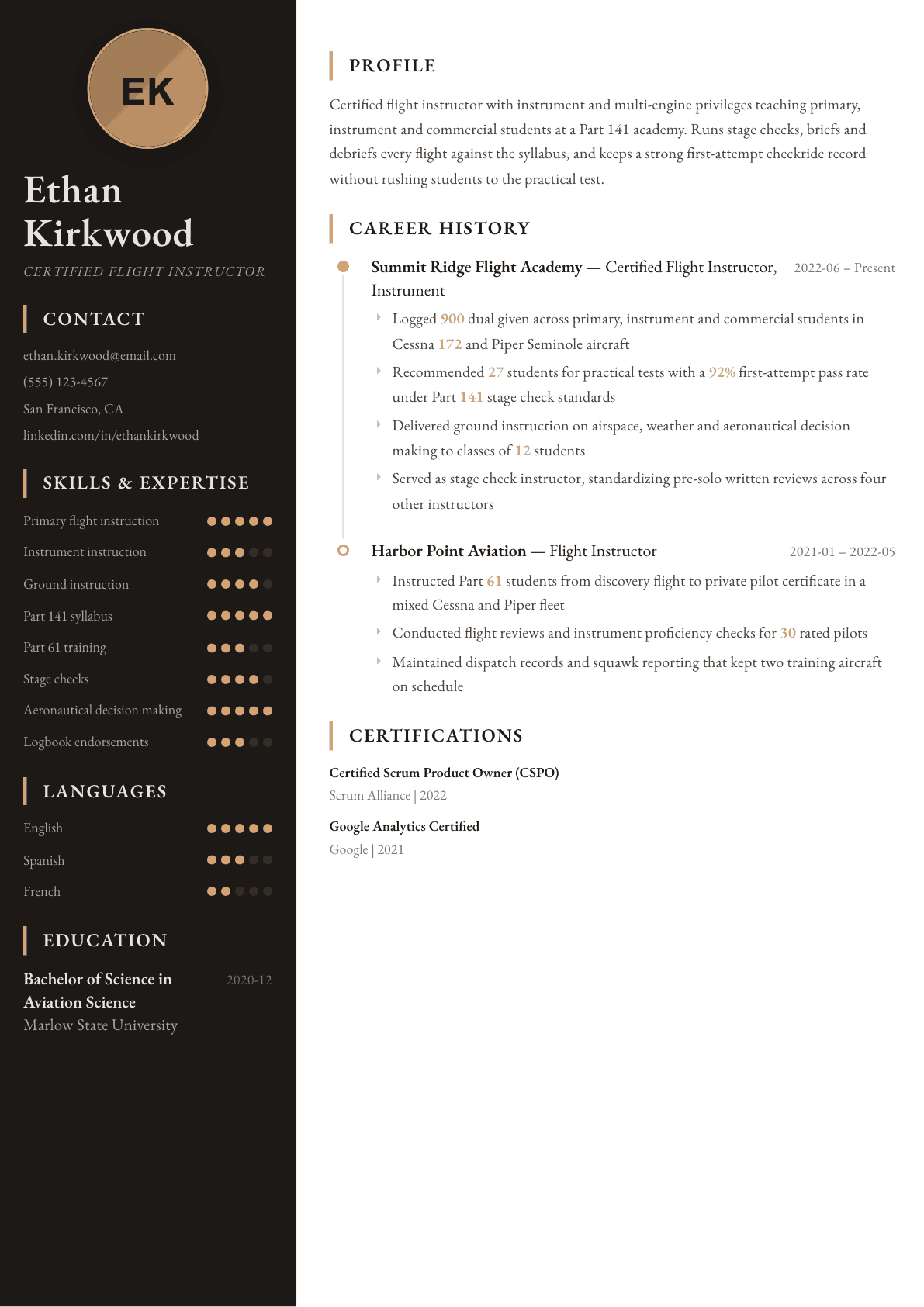
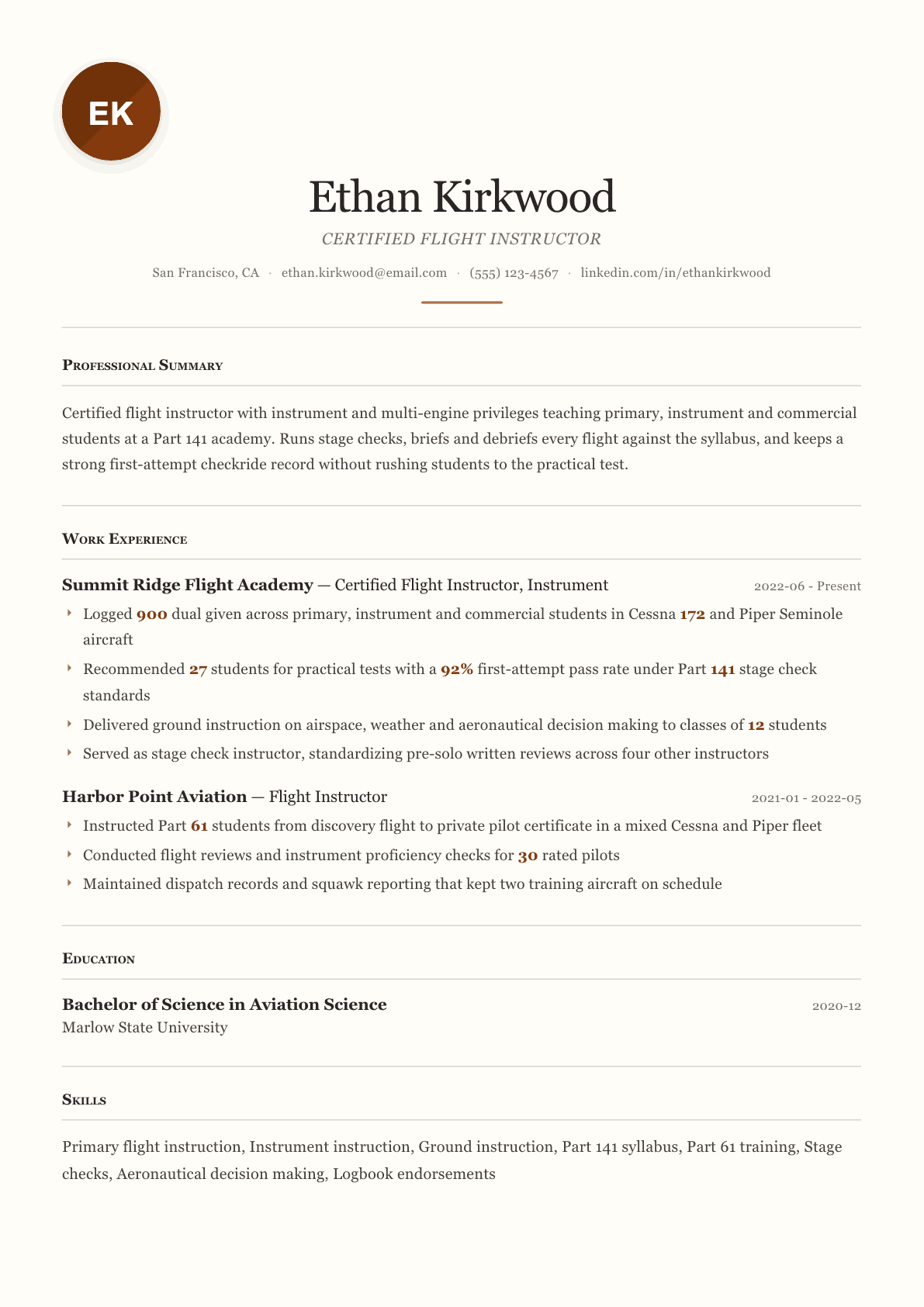
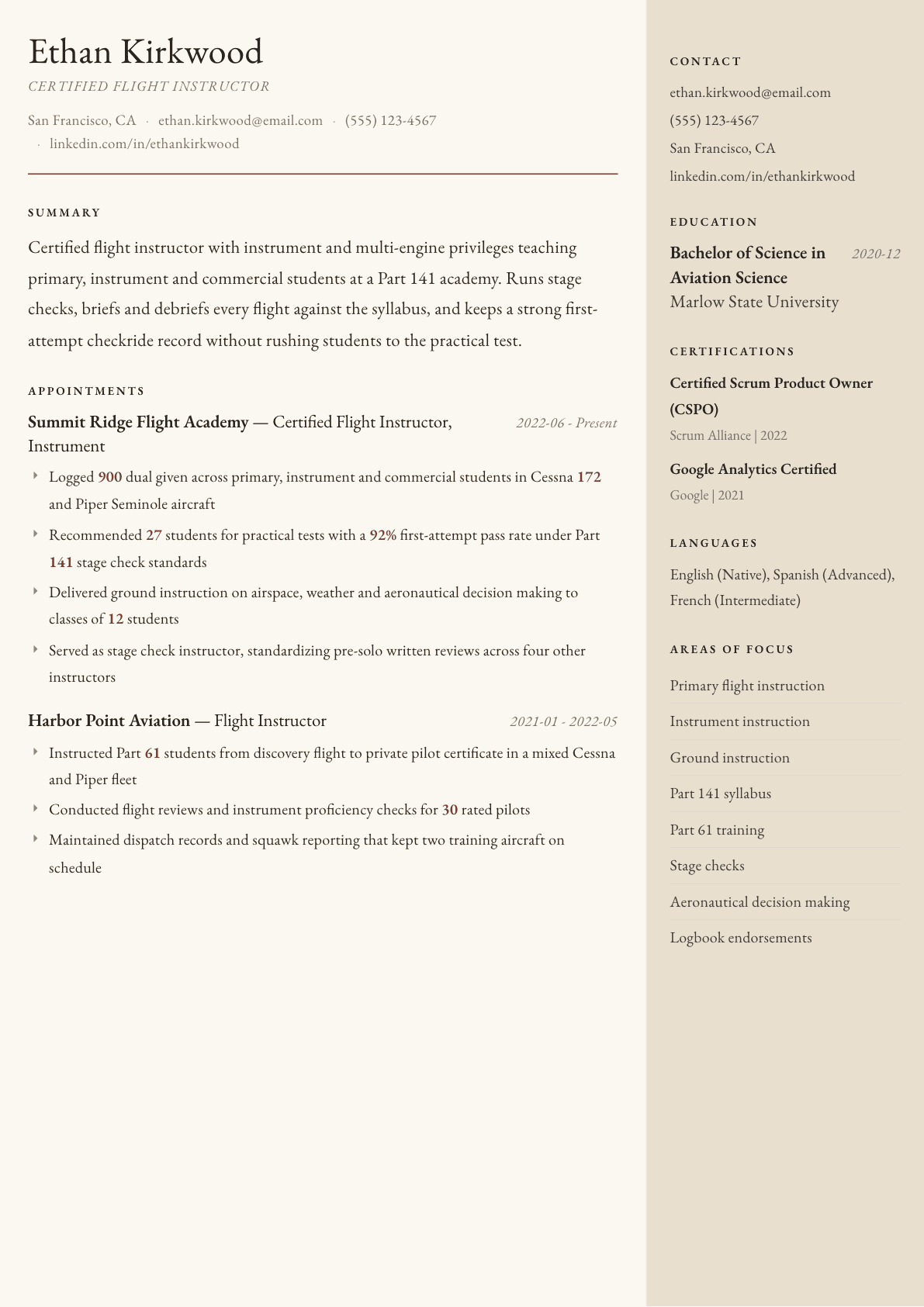
The same flight instructor content laid out in three CVBooster templates, so you can see what the finished document looks like before you write a word.
Example Flight Instructor summary
Certified flight instructor with instrument and multi-engine privileges and roughly nine hundred hours of dual given at a Part 141 academy. Teaches primary, instrument and commercial students in Cessna and Piper aircraft, delivers ground instruction on airspace and weather, and serves as a stage check instructor. Recommends students for the practical test only when they meet standards, which shows in a strong first-attempt pass record.
Skills to list on a Flight Instructor resume
- Primary flight instruction
- Instrument flight instruction
- Multi-engine instruction
- Ground instruction
- Part 141 syllabus delivery
- Part 61 training
- Stage checks and standardization
- Aeronautical decision making
- Logbook endorsements
- Cross-country flight planning
- Weather analysis
- Flight reviews
- Instrument proficiency checks
- Risk management briefings
What actually gets this resume read
- Put certificates and ratings in a block near the top: CFI, CFII, MEI, commercial, medical class and any ground instructor rating.
- Give an hour breakdown table style: total time, dual given, instrument given, multi-engine, complex and night.
- Report first-attempt checkride pass rates with the number of recommendations behind them, since one number alone means little.
- Name aircraft by type rather than saying single-engine trainers, because chief pilots screen on the fleet they operate.
- Show whether you have taught under Part 61, Part 141 or both, and mention stage check or standardization duties.
- Add safety record and any dispatch, maintenance squawk or scheduling responsibility you carried at the school.
How to write a flight instructor resume
A chief flight instructor reads this resume the way they read a logbook summary. Certificates and ratings first, then the hour breakdown, then the aircraft, then whether you have taught under the training rules their school operates. If those four things are not findable in ten seconds, the file goes to the bottom of the stack regardless of how well the rest is written.
The second half of the read is about judgment. Instruction is a safety job, and schools want evidence you recommend students for the practical test when they are ready rather than when the calendar says so. Checkride outcomes, stage check duties and standardization work all speak to that, and they carry more weight than total time once you are past the entry threshold.
This guide covers the certificate and hour blocks, how to present dual given by category, what to say about pass rates, the ground instruction and standardization work that separates career instructors from time builders, and the questions pilots ask when using this job as a bridge to an airline seat.
Certificates and ratings block at the top
Directly under your contact details, list your certificates and ratings on their own lines: commercial or airline transport pilot, the instructor certificates you hold, any ground instructor rating, your medical class and its date, and any type ratings. This block is the first filter and it should never require scrolling.
Spell out instructor certificates rather than relying on abbreviations alone, because a human resources screener at a larger academy may not know them. Write the full name once with the abbreviation beside it, then use the short form afterward.
- Certificates: commercial pilot, flight instructor, instrument instructor, multi-engine instructor, ground instructor.
- Medical certificate class and issue date.
- Any tailwheel, high performance, complex or type-specific endorsements.
The hour breakdown, laid out like a table
Give total time, then split it: pilot in command, dual given, dual given instrument, dual given multi-engine, cross-country, night, actual and simulated instrument, and time in the aircraft types the school operates. A chief instructor uses this block to check both insurance eligibility and whether you can start teaching in their fleet without extra training.
Keep the numbers current and honest to your logbook, because they will be verified against it. Round only in one direction: down. An hour figure that shrinks during verification is a hiring stop, not a rounding disagreement.
Teaching experience: rules, syllabus, aircraft
For each school, say whether training was conducted under the certificated academy rules or the general instruction rules, and name the syllabus if it was a published one. An academy running structured stage checks wants instructors who have worked inside that discipline, and an independent operation wants someone who can build a lesson plan without one.
Name aircraft by type. Cessna 172, Piper Archer, Diamond DA40, Piper Seminole, Cirrus SR20 and the avionics suite you instruct in, since glass cockpit instruction is a distinct qualification from steam gauge instruction and hiring managers screen on it.
- Student mix: discovery flights, private, instrument, commercial, multi-engine, flight reviews, proficiency checks.
- Ground instruction delivered, class size and topics.
- Simulator or flight training device instruction if you have it.
Outcomes: recommendations, checkrides, standardization
Report how many students you recommended for a practical test and the first-attempt pass rate for those recommendations. Both numbers together are meaningful, and the count matters as much as the rate. If your record includes a failure, do not hide it in a way that surprises the interviewer, since the debrief you gave afterward is often a stronger answer than a clean record with no reflection.
Stage check duties, assistant chief instructor responsibilities and standardization work all belong here. Being trusted to check another instructor student is a direct statement about your judgment and your knowledge of the syllabus.
Safety record and the professional details
Include a plain line on your safety record: no accidents, no incidents, no enforcement actions. It is expected and its absence is noticed. Add any safety program participation, aviation safety reporting practice, or a school safety committee role.
Then the operational contributions: dispatch, maintenance squawk reporting, scheduling, curriculum revision, or mentoring newer instructors. Schools run on thin margins and instructors who keep aircraft available and schedules intact are retained longer, which matters to an employer that expects turnover toward the airlines.
Flight Instructor resume summary examples
Newly certificated
Newly certificated flight instructor with 280 total hours, commercial and instrument privileges, and a first class medical. Trained under a published syllabus at a certificated academy and completed the instructor course with a first-attempt pass. Seeking a primary instruction position building toward instrument privileges.
Building toward the airlines
Flight instructor with 1,100 total hours and 900 dual given across primary, instrument and commercial students in Cessna 172 and Piper Seminole aircraft. Recommended 27 students for practical tests with a 92% first-attempt pass rate, and delivers ground instruction on airspace and weather.
Assistant chief instructor
Career flight instructor and assistant chief with more than 2,000 hours dual given, serving as stage check instructor and standardization lead for a nine-instructor academy. Runs instructor onboarding, maintains syllabus revisions, and holds a clean record across primary, instrument and multi-engine training.
Work experience bullets: before and after
Before: Taught students to fly at a flight school.
After: Logged 900 hours of dual given across primary, instrument and commercial students in Cessna 172 and Piper Seminole aircraft under a published academy syllabus.
Dual given, student categories, aircraft and training structure are the four facts a chief instructor screens on.
Before: Had a good checkride pass rate.
After: Recommended 27 students for practical tests with a 92% first-attempt pass rate, including 9 instrument and 4 commercial applicants.
The rate is anchored to a recommendation count and a category split, which makes it verifiable rather than a boast.
Before: Gave ground school lessons.
After: Delivered ground instruction on airspace, weather products and aeronautical decision making to classes of twelve, with a written progress check before each stage.
Topics, class size and the progress check show structured ground teaching instead of informal briefings.
Before: Helped standardize training at the school.
After: Served as stage check instructor and rewrote the pre-solo written review, standardizing evaluation criteria across four other instructors.
Being trusted to evaluate another instructor student is a judgment signal that raw hours cannot convey.
Before: Kept the training aircraft flying.
After: Tracked squawks and coordinated with maintenance on two training aircraft, keeping both on the schedule through a busy summer training season.
Operational contribution shows you protect school revenue, which matters to an employer expecting turnover.
Hard skills
- Primary flight instruction
- Instrument flight instruction
- Multi-engine instruction
- Ground instruction
- Structured syllabus delivery
- Stage checks and standardization
- Logbook endorsements
- Cross-country flight planning
- Weather product interpretation
- Glass cockpit instruction
- Flight reviews and proficiency checks
- Risk management and decision making briefings
Soft skills
- Calm intervention at the controls
- Clear preflight and postflight briefings
- Assessing readiness honestly
- Adapting to different learning speeds
- Communicating with anxious students
- Professional conduct on the radio and the ramp
Certifications worth listing
- Certified Flight Instructor (CFI) (Federal Aviation Administration)
- Certified Flight Instructor Instrument (CFII) (Federal Aviation Administration)
- Multi-Engine Instructor (MEI) (Federal Aviation Administration)
- Advanced Ground Instructor (AGI) (Federal Aviation Administration)
- Instrument Ground Instructor (IGI) (Federal Aviation Administration)
Mistakes that cost flight instructor candidates the interview
- Hiding certificates and the hour breakdown below the experience section, where a chief instructor will not look first.
- Giving total time only, so a reader cannot see dual given, instrument given or multi-engine instruction.
- Rounding hours upward, which turns a verification step into a hiring stop.
- Writing single-engine trainers instead of naming the aircraft types the school actually operates.
- Leaving out whether training was conducted under academy or general instruction rules.
- Omitting the safety record line, whose absence is read as an answer in itself.
Flight Instructor resume questions
How should a flight instructor resume present flight hours?
As a compact block near the top with total time broken into pilot in command, dual given, instrument given, multi-engine, cross-country and night. Keep it current to your logbook, because every number will be checked before an offer is confirmed.
Is one page enough for a flight instructor resume?
Yes for most instructors. Certificates, hours, two or three schools, ground instruction and a safety line fit comfortably. A second page is only warranted for career instructors with chief instructor duties, curriculum work and long standardization histories.
Should I mention that I plan to move to an airline?
Not on the resume. Schools know it and budget for it. Instead, show contributions that outlast you, such as syllabus revisions, instructor mentoring and standardization work, which reassure an employer that your time there will be productive.
How do I write a flight instructor resume with low total time?
Lead with training quality rather than quantity: the academy you trained at, the syllabus you know, first-attempt passes on your own checkrides, and any ground instructor rating. New instructors are hired on discipline and teachability more than accumulated hours.
Do simulator and flight training device hours belong on the resume?
Yes, listed separately from aircraft time and labeled by device type. Instructing in a training device is a distinct skill, and schools with an approved device in their program screen for instructors who can already use it effectively.