Merchandising Manager Resume Examples: read this first
Write a Merchandising Manager Resume Buyers Take Seriously
By Mustafa Tarabya, founder of CVBooster · Published · Updated
Merchandising manager resume examples with planogram, sell-through and assortment keywords, plus a guide to proving commercial judgment.
Sample resumes for a merchandising manager
The same merchandising manager content laid out in three CVBooster templates, so you can see what the finished document looks like before you write a word.
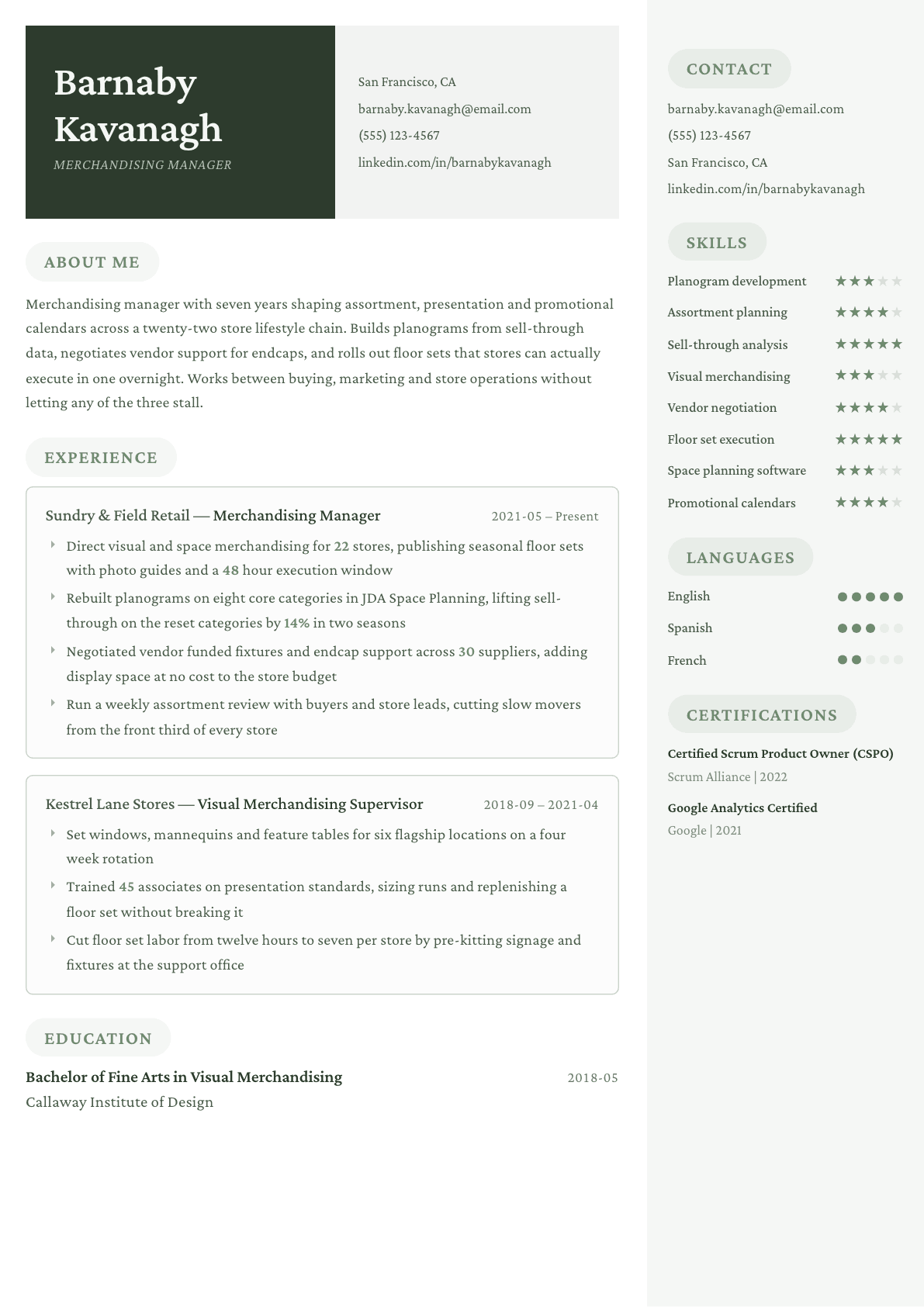
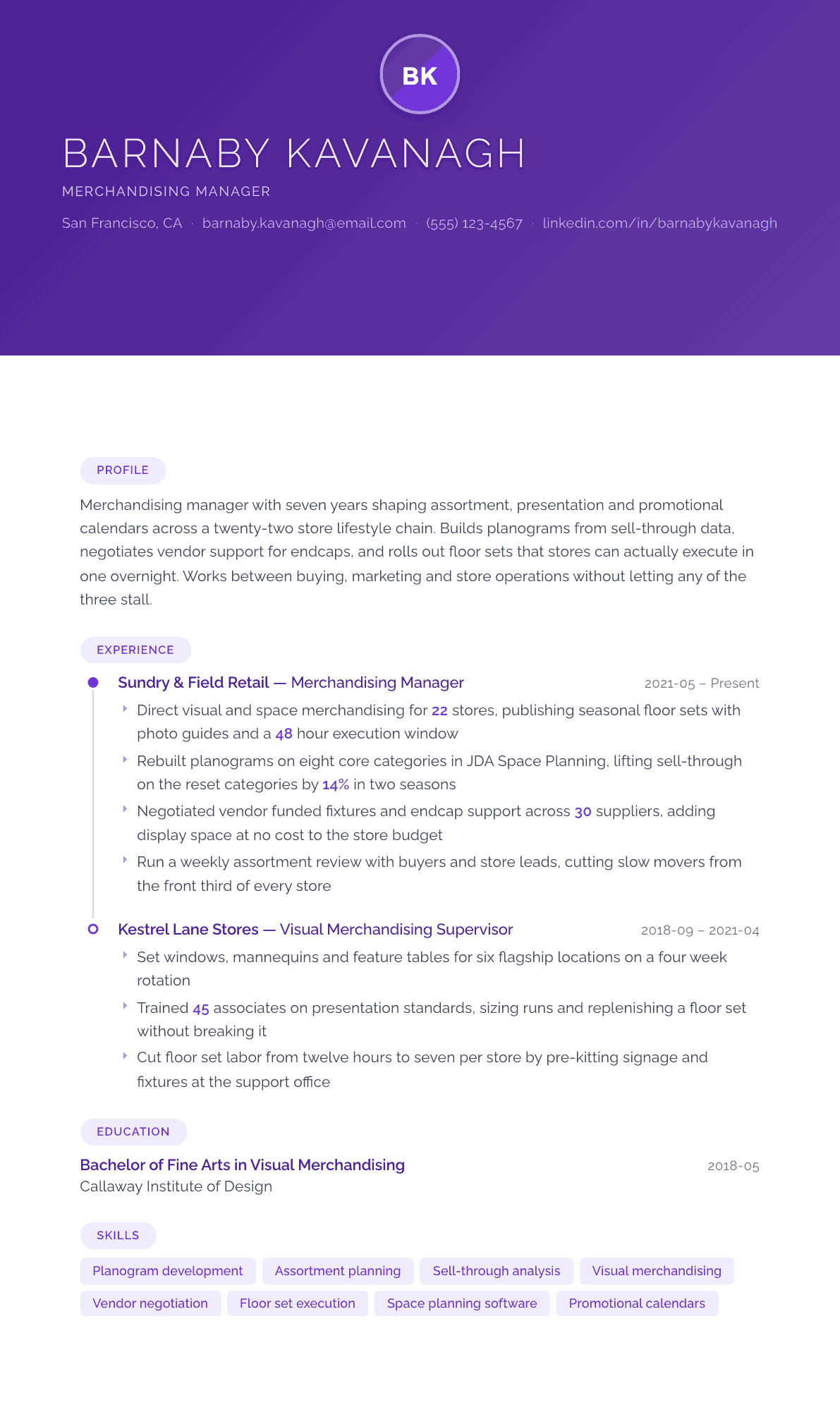
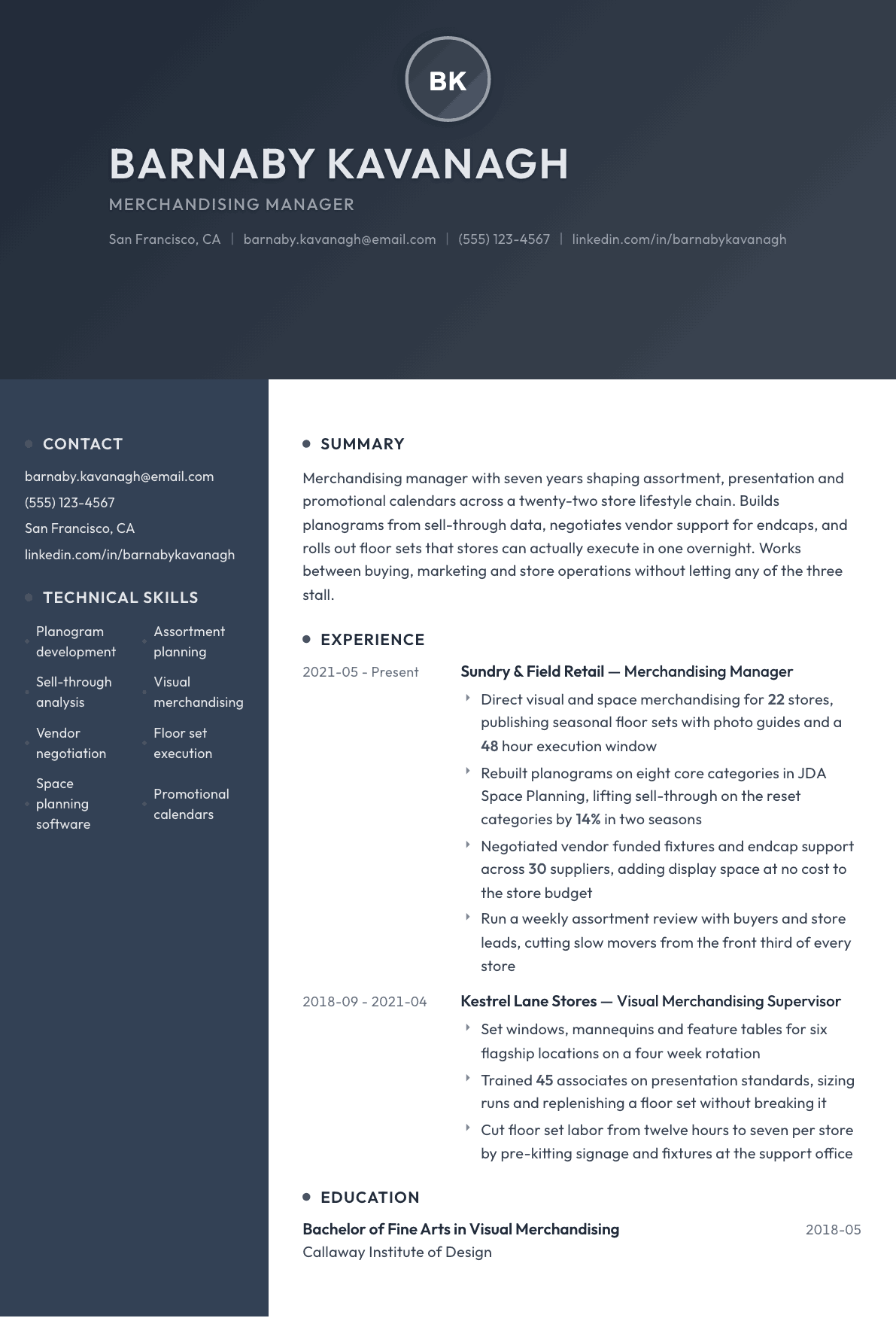
Example Merchandising Manager summary
Merchandising manager with seven years directing assortment, space and presentation for a multi-store lifestyle retailer. Rebuilt core category planograms from sell-through data, negotiated vendor funded displays across thirty suppliers, and cut floor set labor by pre-kitting signage before it reached the store. Comfortable between buyers, marketing and store operations, and known for floor sets that hold their standard past week one.
Skills to list on a Merchandising Manager resume
- Assortment planning
- Planogram development
- Space planning software
- Sell-through analysis
- Visual merchandising
- Floor set rollout
- Promotional planning
- Vendor negotiation
- Category management
- Markdown strategy
- Store communication
- Fixture and display design
- Cross-functional leadership
- Retail analytics
What actually gets this resume read
- Open with store count and category scope, because a merchandising job is sized by how much floor you own.
- Attach a sell-through or unit lift figure to every reset you describe, not just the fact you reset it.
- Name the space planning software you use, since JDA and Blue Yonder skills are screened for directly.
- Show how stores executed your floor set: hours, guides, and what you did to make it repeatable.
- Include vendor negotiation wins, because funded fixtures and displays are pure margin to a retailer.
- Keep visual craft and commercial analysis both on the page, since hiring managers rarely find them together.
How to write a merchandising manager resume
Merchandising manager is one of the few retail titles that means three different jobs depending on who wrote the posting. At some companies it is space and planogram work sitting next to the buying team. At others it is visual presentation across a fleet of stores. At a third it is category ownership with sales and margin attached. Your resume has to declare which one you are before the reader guesses wrong.
Whichever version it is, the hiring manager is testing for the same rare combination: someone with taste who reads a sell through report. Candidates who only bring the eye get filtered by the director of stores. Candidates who only bring the spreadsheet get filtered by the creative side. The resume that lands carries both in the same bullets.
What follows is the structure these files should take, three summaries covering a visual supervisor through a fleet wide manager, before and after bullets that put a number on presentation work, and the questions that come up when a merchandiser writes for a bigger job.
Format: two pages, with a portfolio link if the role is visual
Reverse chronological and single column. If the posting is visual merchandising heavy, add one line under your contact block with a portfolio link showing floor sets, windows and fixture work. Do not paste images into the resume itself, because the parser will drop them and the file size will bounce off some application systems.
Two pages is fine once you have run a fleet. Keep the first half of page one dense with scope: store count, category count, linear feet or square footage you set, and the size of any team or field crew you directed.
- Header: name, city and state, phone, email, portfolio link when the role is presentation led.
- Section order: summary, scope, experience, systems and software, education.
- Open each job with store count, categories owned and who executed your sets in the field.
Summary: which merchandising, at what scale
Say the flavor in the first clause. Space and planogram, visual presentation, or category and assortment. Then the scale, then the commercial result. A summary naming twenty two stores, eight core categories reset, and a sell through lift is doing the whole first screen by itself.
Avoid the word creative as a standalone claim. Everyone applying believes they are creative. What separates the file is a sentence showing you changed what a floor looked like and the register agreed with the decision.
Experience: the reset, the result, the execution
Structure the strongest bullets as a trio. What you changed on the floor, what happened to sell through, units or margin, and how the stores actually executed it. That last part is the one most candidates skip and the one field leaders care about most, because a beautiful floor set that takes an overnight crew twelve hours is a floor set that does not happen twice.
Include the vendor side. Funded fixtures, endcap support, display units and co-op contributions are margin a merchandiser creates without a discount, and describing a negotiation across a named number of suppliers reads as commercial ability rather than decoration.
Cover the analysis explicitly. Which report you worked from, how often you reviewed it, and what you cut. A merchandising manager who runs a standing assortment review and removes slow movers from the front of the store is describing a discipline that most stores lack.
Software and tools: the space planning stack
Name the planning software. Blue Yonder space planning, formerly known in many stores by the JDA name, plus Nielsen Spaceman and the retail specific tools are searched for directly. Add the design software you use for guides and mockups, since floor set communication is usually built in a layout tool rather than a slide deck.
List the reporting side too. Whatever business intelligence tool the sell through report lived in, and spreadsheet depth. Merchandising decisions are argued in front of buyers, and the merchandiser who arrives with the analysis prepared usually wins the space.
Keywords that appear in almost every posting
Assortment, planogram, space planning, sell through, floor set, category management, markdown, endcap, presentation standards, store communication and vendor negotiation. Use the posting wording exactly once in the summary and again attached to a fact. Three repetitions of category management with nothing behind them will not survive a human read.
Merchandising Manager resume summary examples
Visual supervisor
Visual merchandising supervisor with three years setting windows, mannequins and feature tables across six flagship locations on a four week rotation. Trained 45 associates on presentation standards and size runs, and cut floor set labor from twelve hours to seven per store by pre-kitting signage.
Fleet merchandising manager
Merchandising manager directing space and presentation for 22 stores, publishing seasonal floor sets with photo guides and a 48 hour execution window. Rebuilt planograms on eight core categories from sell through data and lifted sell through on the reset categories by 14% across two seasons.
Category and space lead
Senior merchandising manager owning assortment, space and promotional calendars across four regions and 60 stores. Runs the standing review with buying and store operations, negotiated vendor funded fixtures across 30 suppliers, and manages three field visual specialists covering the fleet.
Work experience bullets: before and after
Before: Created planograms for the store categories.
After: Rebuilt planograms on eight core categories in space planning software using unit velocity and linear foot productivity, lifting sell through on the reset categories by 14% over two seasons.
The method and the measured result show a commercial decision instead of a drawing exercise.
Before: Managed seasonal floor sets for all stores.
After: Published seasonal floor sets for 22 stores with photo guides, fixture lists and a 48 hour execution window, tracked through a compliance photo return from each location.
The execution detail proves the set landed on real floors rather than only in a plan.
Before: Worked with vendors on displays.
After: Negotiated vendor funded fixtures and endcap support across 30 suppliers, adding display space to the fleet at no cost to the store capital budget.
Framing the outcome as space gained without budget spend turns a relationship into a margin argument.
Before: Trained store teams on merchandising standards.
After: Trained 45 associates on presentation standards, size run maintenance and how to replenish a feature table without breaking the set, then audited on the next store visit.
Adding the audit step shows the training was enforced rather than delivered once and forgotten.
Before: Reviewed slow selling products with the buying team.
After: Ran a weekly assortment review with buyers and store leads, removing slow movers from the front third of every store and reallocating the space to proven sellers.
Naming the cadence and the exact space that changed hands makes the review a decision, not a meeting.
Hard skills
- Assortment planning
- Planogram development
- Space planning software
- Sell through and unit velocity analysis
- Visual merchandising and floor sets
- Category management
- Markdown and clearance planning
- Vendor negotiation and co-op funding
- Fixture and display specification
- Store communication packages
- Retail reporting tools
- Promotional calendar planning
Soft skills
- Commercial judgment
- Influence across buying and stores
- Clear written direction to field teams
- Design taste with a reason behind it
- Deadline management across seasons
- Coaching visual teams
Certifications worth listing
- Certified Professional in Supply Management (CPSM) (Institute for Supply Management)
- Certified Six Sigma Green Belt (CSSGB) (American Society for Quality)
- Project Management Professional (PMP) (Project Management Institute)
Mistakes that cost merchandising manager candidates the interview
- Leaving the reader unsure whether you are a visual merchandiser or a space and assortment merchandiser.
- Describing beautiful displays without a single sales, unit or margin figure attached to any of them.
- Omitting store count, which is the number a director uses to decide whether your scope matches the opening.
- Skipping execution detail, so the reader cannot tell whether stores could actually build what you designed.
- Naming no software at all, when space planning tools are among the most searched terms in these postings.
- Treating vendor funded fixtures as a favor rather than as margin you brought into the business.
Merchandising Manager resume questions
Should a merchandising manager resume include a portfolio?
Include a link when the role leans visual, and keep the portfolio to a dozen strong images with a caption naming the store, the season and the result. Skip it entirely for space planning and category roles, where the sell through numbers do the persuading.
How do I show merchandising results if my company never shared sales data?
Use the measures you did see: units moved off a feature, weeks of cover after a reset, compliance rates on floor sets, or labor hours saved in execution. These are honest, specific, and they tell a director you were tracking something.
Is visual merchandising experience enough to become a merchandising manager?
It can be, if you add the commercial layer to your resume. Show that you read a sell through report, argued for space with data, and worked to a margin or markdown target, because those are the skills the step up is actually testing.
What software should be on the resume?
Whatever you truly used, named exactly: the space planning tool, the reporting or business intelligence tool, the layout software for floor set guides, and your spreadsheet depth. Listing a tool you cannot open in an interview is the fastest way to lose the room.
How much should I write about store operations?
Enough to prove your sets can be executed. One or two bullets on labor hours, communication packages and compliance follow up show a field leader that you plan around a payroll budget, which is the concern that kills most ambitious floor sets.