Visual Merchandiser Resume Examples: what gets the call
Resume for Visual Merchandising Roles That Gets the Portfolio Opened
By Mustafa Tarabya, founder of CVBooster · Published · Updated
Resume for visual merchandising roles: a visual merchandiser example with a sample page, store estate and install bullets, portfolio advice and keywords.
Sample resumes for a visual merchandiser
The same visual merchandiser content laid out in three CVBooster templates, so you can see what the finished document looks like before you write a word.
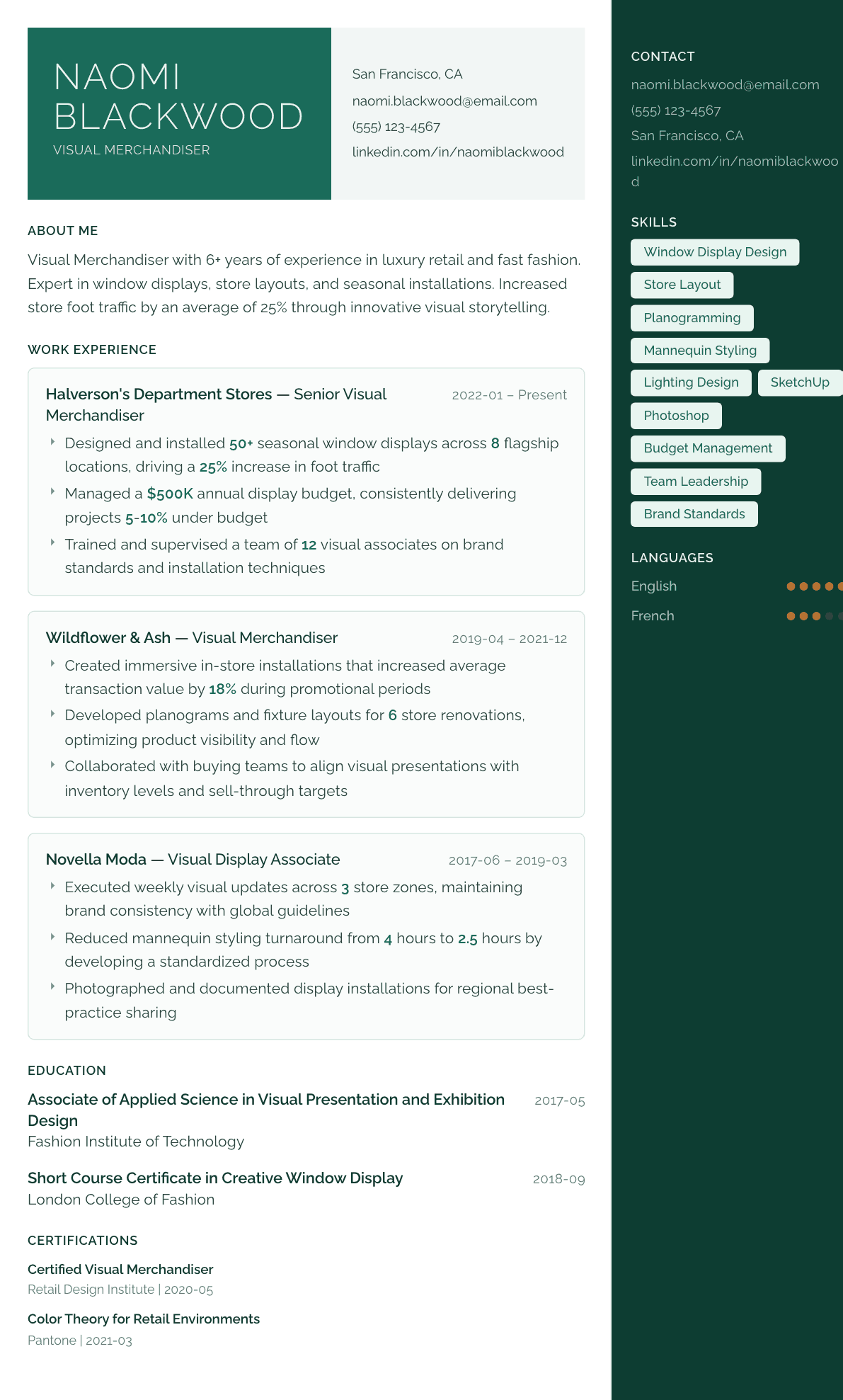
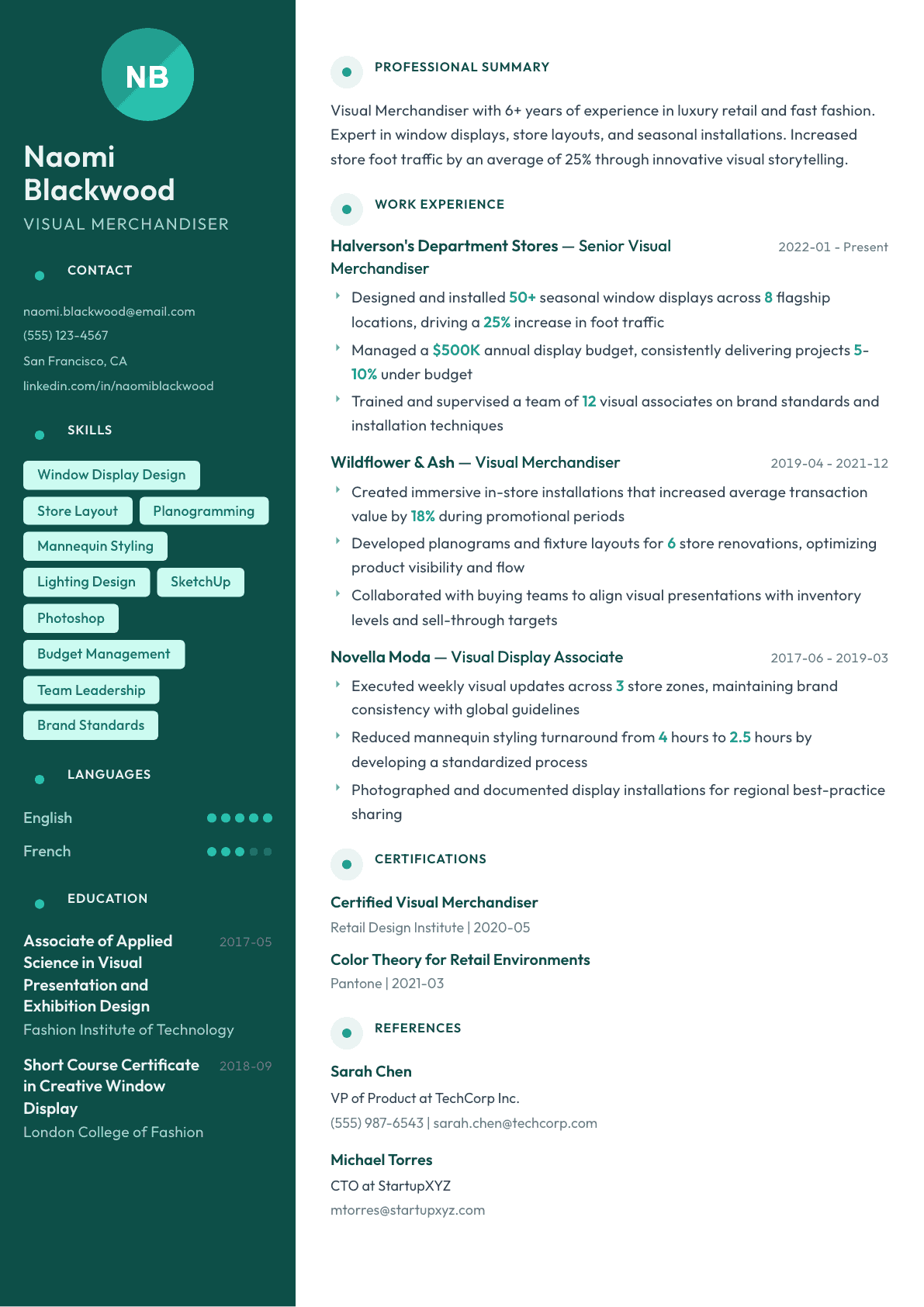
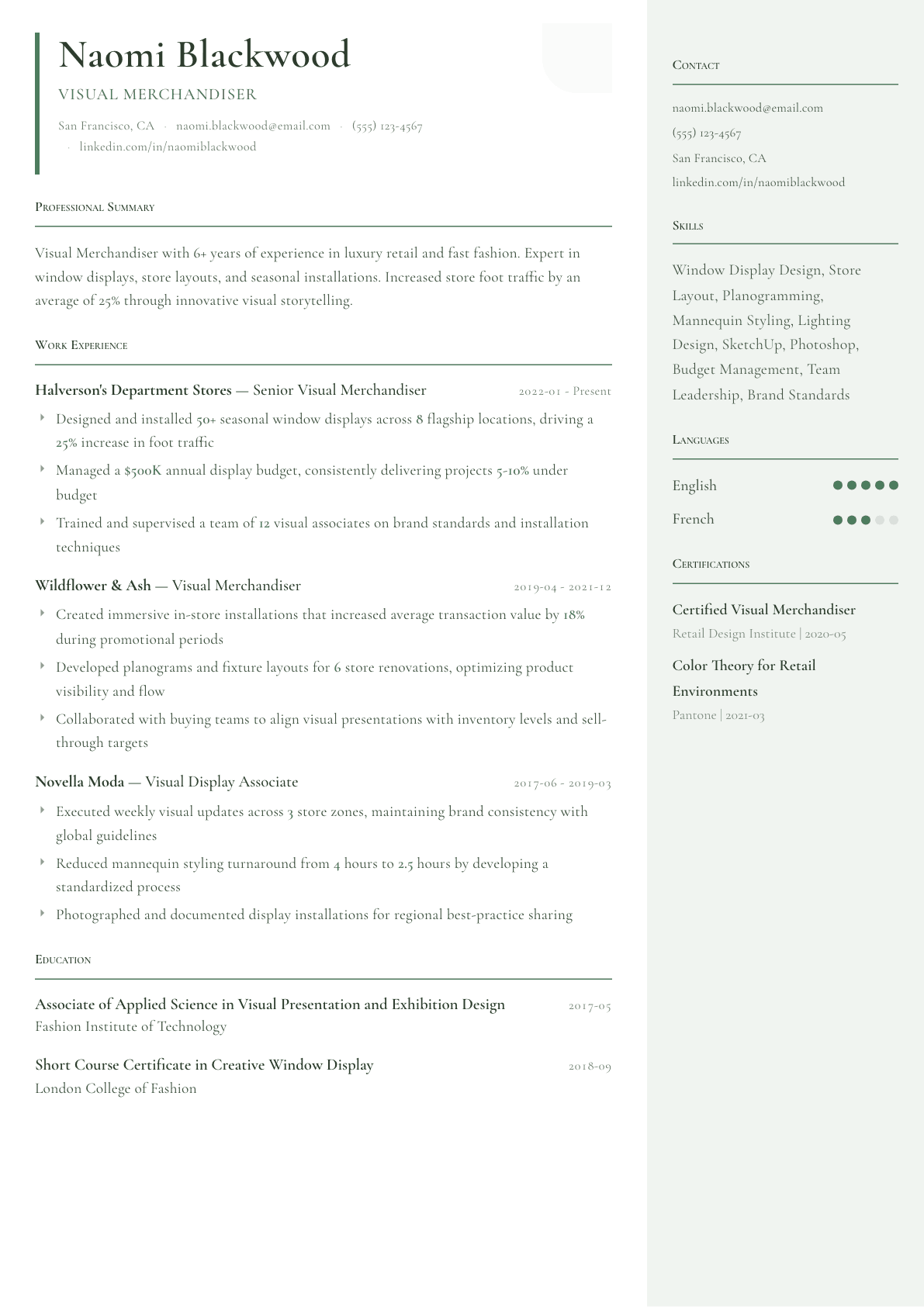
Example Visual Merchandiser summary
Visual Merchandiser with 6 years across luxury department stores and fast fashion. Installs 50+ seasonal windows a year across 8 flagship locations on a $500K budget, holding 5-10% under plan, and drove a 25% lift in foot traffic. Leads a team of 12 on planograms, lighting, and mannequin styling.
Skills to list on a Visual Merchandiser resume
- Window Display Design
- Store Layout
- Planogramming
- Mannequin Styling
- Lighting Design
- SketchUp
- AutoCAD
- Photoshop
- Budget Management
- Team Leadership
- Brand Standards
- Seasonal Installations
- Prop Fabrication
- Retail Analytics
What actually gets this resume read
- Include photos of your best installations in your portfolio -- visual proof is essential in this field.
- Quantify sales impact: foot traffic increases, conversion lifts, average transaction value improvements.
- Show budget management skills: display budgets managed, cost savings achieved.
- Mention the retail brands you have worked with -- luxury, fast fashion, or specialty carries different weight.
- Highlight seasonal range: holiday windows, spring launches, back-to-school, and promotional events.
How to write a visual merchandiser resume
A visual merchandiser resume is judged by people who spend their day looking at floors and windows. The regional visual manager who screens it wants to know what kind of retail you have installed in, how many doors you covered, and whether you can turn a directive from head office into a finished window overnight. The talent partner who reads it first is checking for the brand names, the software, and whether a portfolio link is attached.
That portfolio is the reason this resume is different from every other creative resume. Nobody hires a visual merchandiser on prose alone, so the document has one job beyond passing the screen: to make the reader open the link and to tell them what they are about to see. A resume with no portfolio URL in the header is usually set aside before the summary is finished.
This guide covers the header, the way to describe a store estate, how to write installation work so it reads as commercial rather than decorative, a complete resume for visual merchandising roles laid out line by line, and the questions merchandisers ask when they move between fashion, beauty, grocery and department store retail.
Format: one page, portfolio link in the header, no decorative template
Keep it to a single page unless you have run a region for a decade. The instinct to design the resume itself is strong in this field and it backfires: heavy graphics, a two-column grid and image thumbnails all confuse retail applicant tracking systems, and the design work belongs in the portfolio where it can be seen at full size.
The header is the most valuable real estate you have. Name, city, phone, email, and a short portfolio URL that opens to installation photography, not a general design site. If you also style for e-commerce or produce lookbooks, say so in one line under the link so the reader knows what the folder contains.
- Header: name, title, city, phone, email, portfolio link, and willingness to travel if the role covers multiple doors.
- Section order: summary, visual merchandising experience, tools and software, education, certifications.
- Name the retail segment in every job entry: luxury, premium, fast fashion, beauty, grocery, home, or footwear.
Summary: segment, door count, and what you install
Three lines. Give the retail segment, the years, the number and type of doors you covered, and the work you are known for: windows, in-store campaigns, fixture rollouts, or store openings. A summary built on the words creative and passionate reads as a candidate who has never had a floor of their own.
If you are moving between segments, address it directly. Grocery merchandising and luxury window work share the same principles and almost none of the same rhythm, so a candidate crossing over should name the transferable part: planogram discipline, seasonal cadence, or head office rollout experience.
Experience: the estate, the cadence, and the commercial result
Open every role with the shape of the job rather than the duties. The store count, the square footage or window count, the number of visual associates you directed, and how often the floor changed. A line such as flagship plus eight satellite doors, full window change every four weeks tells a regional manager exactly what workload you have carried.
Then write bullets that connect the install to trade. Visual merchandising is a selling function, so the strongest bullets pair a physical change with what happened to the product: a fixture move that lifted sell-through on a slow category, a window that supported a launch, a mannequin group that cleared end-of-season stock. Merchandisers who only describe the aesthetic get read as decorators.
Include the unglamorous operations, because managers screen for them: install schedules, prop storage and returns, contractor and joinery coordination, health and safety on ladders and rigging, overnight and out-of-hours installs, and budget tracking against a seasonal plan.
Tools and technical skills the posting will list
Name the software you actually work in. Retail visual teams run on Adobe Photoshop and Illustrator for concept boards, SketchUp or AutoCAD for fixture and window plans, InDesign for guideline packs, and a planogram system such as JDA or Blue Yonder space planning in grocery and big box. Add the photo and reporting platform your company used to collect compliance images from stores.
Add the physical craft alongside the software: lighting and track focusing, mannequin dressing and rigging, prop fabrication, vinyl and signage application, fixture assembly, and color and material sourcing. These are the skills a store manager watches on the first install day.
Portfolio and the brands you have dressed
List the brands and retailers by name unless a nondisclosure agreement prevents it. Segment matters more than prestige: a candidate who has run beauty gondolas is a different hire from one who has built luxury windows, and hiding the brand forces the reader to guess. Where you worked through an agency or as a freelancer, name the agency and the client accounts.
Keep the portfolio itself tight, around ten to fifteen projects, each with a before image where you have one, the brief in a sentence, and the commercial outcome. Reviewers open a portfolio for about a minute, so lead with the installation that most resembles the job you are applying for.
Resume for visual merchandising: a complete sample
A resume for visual merchandising follows the same order whether the job says visual merchandiser, visual associate, visual lead or visual merchandising manager. The header carries the portfolio link, the summary names segment and estate, and every job entry says what you installed, how often, and what changed on the floor. The sample below is invented; keep the order and replace every detail with your own.
- Header and summary: Leah Monroe, Visual Merchandiser, with a portfolio link. Visual merchandiser for a specialty fashion retailer covering twelve stores, installing seasonal windows and floor sets from head office guidelines and adapting them to each store layout.
- Experience: Visual Merchandiser, a specialty fashion retailer. Install a new floor set every month and a window change every six weeks across the district; train store managers on the visual guidelines; photograph every finished install for head office review.
- Earlier experience: Visual Associate, a department store. Dressed mannequins and focal tables, ran the overnight holiday install with a team of four, and moved stock to match the planogram.
- Skills and tools: planograms, fixture planning, lighting, mannequin styling, signage, Adobe Photoshop and Illustrator, SketchUp, and basic carpentry for props.
- Education: a degree or certificate in visual merchandising, fashion, design or a related field, or the retailer training programs you completed.
Visual Merchandiser resume summary examples
First visual role
Retail sales associate moving into visual merchandising, with two years supporting weekly floor sets and window changes in a large-format fashion store. Trained in mannequin dressing and planogram execution, comfortable in Photoshop and SketchUp, portfolio of eight in-store installations available.
Five years on the floor
Visual merchandiser with five years in premium apparel, covering a flagship and six satellite doors with a four-week window cycle. Built seasonal floor sets that raised sell-through on outerwear by 14% and trained nine associates on brand guideline packs. Fluent in Illustrator, InDesign and fixture planning.
Regional visual manager
Regional visual manager with eleven years across luxury and department store retail, directing visual standards for 38 doors and a team of four field merchandisers. Led 12 store opening installations, owned the seasonal display budget, and cut prop spend by 20% through a reusable fixture library.
Work experience bullets: before and after
Before: Created beautiful window displays for the store.
After: Designed and installed a six-window scheme for the spring launch across the flagship, working overnight to a two-night install schedule with a joinery contractor and a lighting technician.
The window count, the install window and the trades involved show scale and logistics, where beautiful shows only an opinion.
Before: Responsible for store layout and product placement.
After: Rebuilt the ground floor layout around a new fitting room entrance, moving accessories to the main aisle and lifting attachment rate on the category by 11% over the following quarter.
A layout change becomes credible when the reader can see the decision and the trading result.
Before: Followed brand guidelines from head office.
After: Translated head office directives into store-specific floor plans for eight doors with different footprints, then photographed and uploaded compliance sets within 24 hours of each change.
Adapting a directive to unequal spaces is the actual skill, and the compliance step proves reliability.
Before: Managed the display budget.
After: Owned the seasonal prop and fixture budget across the region, negotiated with two fabrication suppliers, and reduced per-window prop cost by 18% by building a reusable plinth and riser library.
Naming the levers, suppliers and reuse strategy turns budget custody into cost management.
Before: Trained new staff on visual standards.
After: Wrote a 14-page guideline pack covering mannequin dressing, folding standards and lighting focus, then ran hands-on install days for 12 store associates across three doors.
The artifact and the delivery method show you built training rather than explaining things once.
Hard skills
- Window display design
- Floor set and layout planning
- Planogram execution
- Mannequin styling and rigging
- Retail lighting and track focusing
- Adobe Photoshop and Illustrator
- InDesign guideline packs
- SketchUp and AutoCAD fixture drawings
- Prop sourcing and fabrication
- Signage and vinyl application
- Seasonal install scheduling
- Sell-through and category reporting
- Store opening installations
- Display budget management
Soft skills
- Working to overnight install deadlines
- Store manager relationship building
- Directing associates on install day
- Adapting a directive to an odd footprint
- Supplier negotiation
- Giving and taking creative critique
Certifications worth listing
- Adobe Certified Professional in Visual Design (Adobe)
- OSHA 10-Hour General Industry (OSHA Training Institute)
Mistakes that cost visual merchandiser candidates the interview
- Sending a heavily designed resume with image thumbnails that retail parsers strip, leaving the reader a page of orphaned captions.
- Leaving the portfolio link out of the header or pointing it at a general design site instead of installation photography.
- Describing displays as creative and eye-catching without a single commercial result attached to any of them.
- Hiding the retail segment, so the reader cannot tell whether you dressed luxury windows or built grocery end caps.
- Omitting door count and team size, which are the two numbers a regional visual manager scans for first.
- Listing every Adobe application while skipping the fixture drawing and planogram tools the posting names.
- Ignoring the operational side: install schedules, safety, prop logistics and budget tracking are what make a merchandiser employable at scale.
Visual Merchandiser resume questions
Do I need a portfolio to apply for a visual merchandising job?
Yes, and the link belongs in the header rather than at the end. Ten to fifteen installations is enough, each with a one-line brief and a photograph of the finished floor or window. Include before images where you have them, because the change is the story.
How do I show sales impact when the store does not share numbers with me?
Ask your store or area manager for category level figures, which are usually shareable even when company totals are not. Where nothing is available, use what you can observe: sell-through on a promoted line, stock cleared during a markdown window, or traffic to a relocated department.
Should a visual merchandiser resume be creatively designed?
Keep the resume clean and single column so it parses, and put the design work in the portfolio. Personality can come through one accent color and confident typography. A layout that breaks a parser costs you the interview where you would have shown the real work.
How do I move from retail sales into visual merchandising?
Volunteer for floor sets and window changes in your current store, then document each one with photographs and the brief you worked to. Retitle your experience around that work, list the guideline packs and planograms you executed, and build a portfolio from your own store before you apply.
What should a resume for visual merchandising include?
A header with your portfolio link, a summary naming the segment and the number of stores you cover, job entries that say what you installed, how often and what changed on the floor, then tools such as planograms, Adobe software and SketchUp. Group freelance or agency work under one name with the client retailers listed beneath it.