Economic Development Director Resume Examples: free score
Build an Economic Development Director Resume Around Deals Closed
By Mustafa Tarabya, founder of CVBooster · Published · Updated
Economic development director resume example with incentives, site selection and business retention keywords, plus a guide to proving real outcomes.
Sample resumes for a economic development director
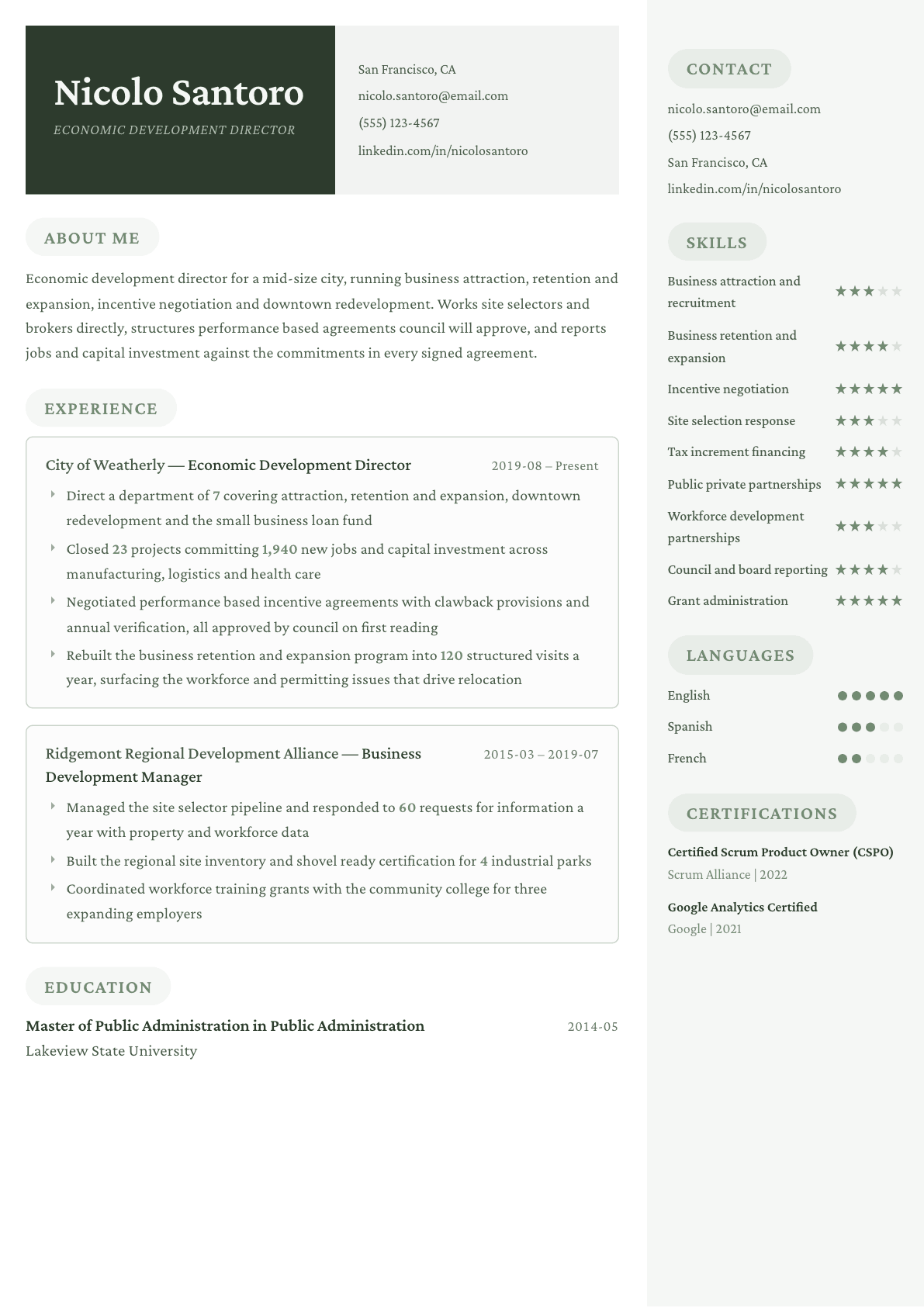
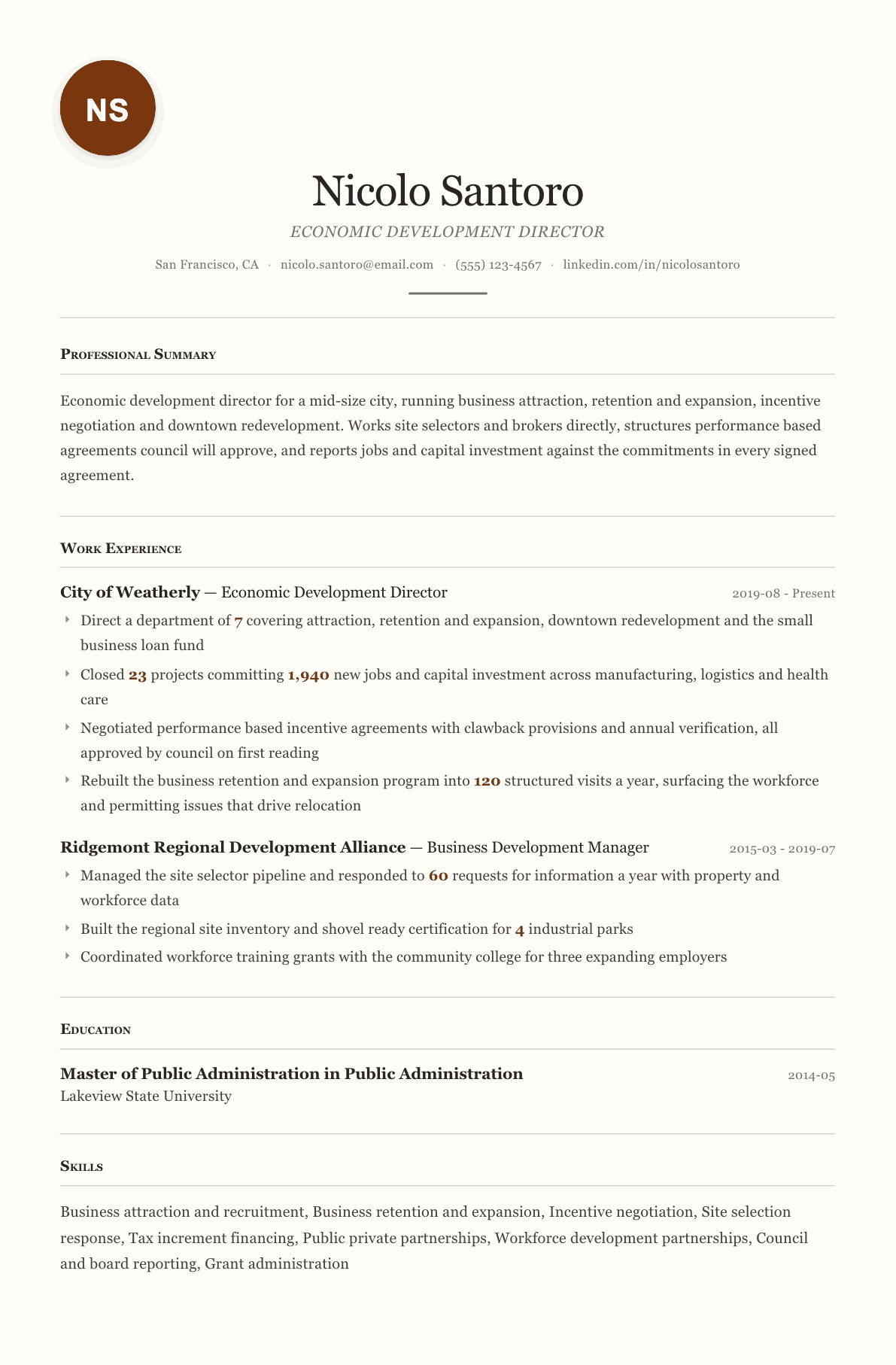
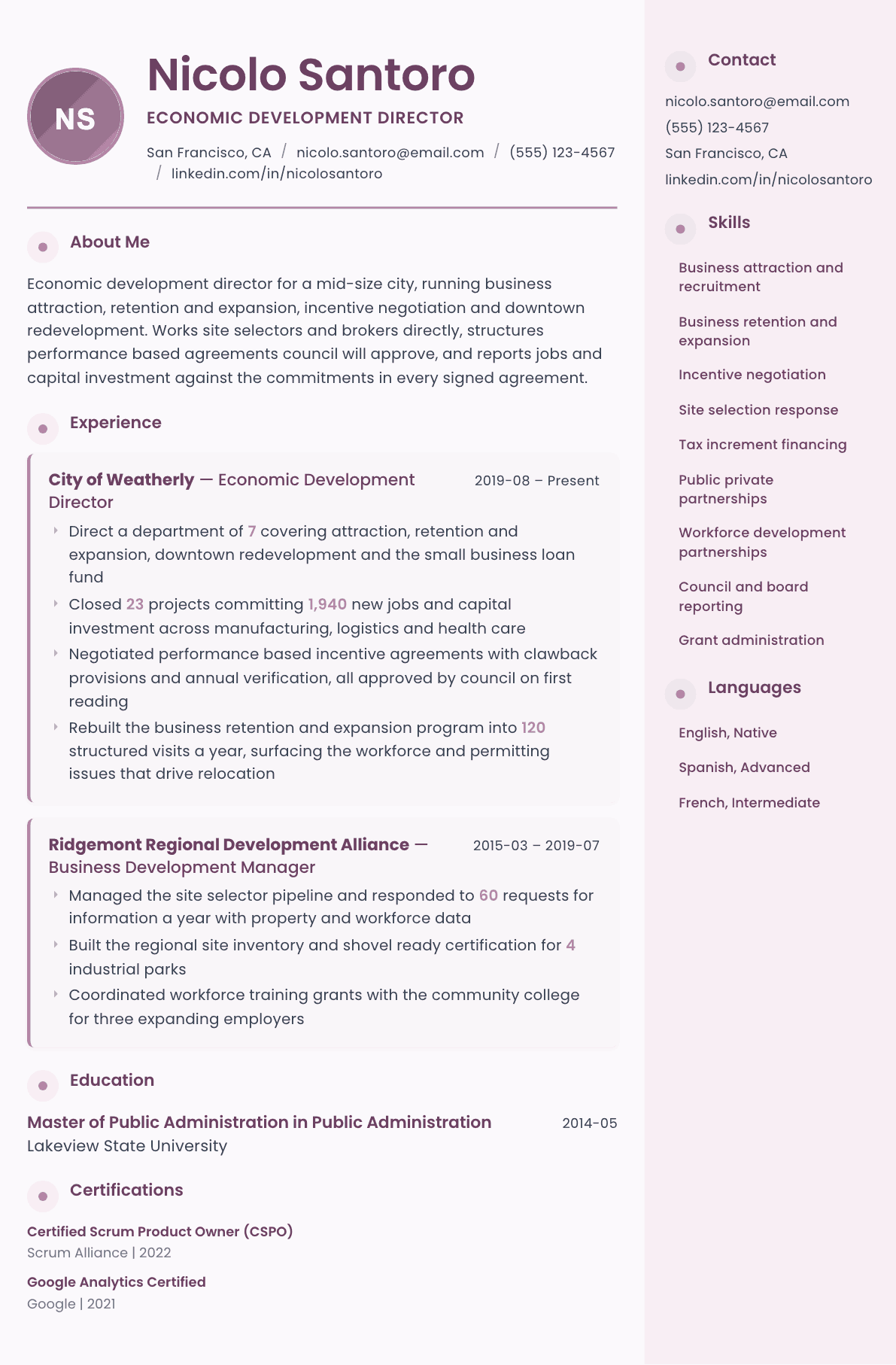
The same economic development director content laid out in three CVBooster templates, so you can see what the finished document looks like before you write a word.
Example Economic Development Director summary
Economic development director with a decade across city and regional organizations, leading attraction, retention and expansion, incentive negotiation and downtown redevelopment. Closed manufacturing, logistics and health care projects with performance based agreements carrying clawbacks and annual verification, and rebuilt a retention visit program that surfaces permitting and workforce problems early. Works site selectors directly and presents to council and planning commission. Master of Public Administration.
Skills to list on a Economic Development Director resume
- Business attraction and recruitment
- Business retention and expansion visits
- Incentive structuring and negotiation
- Performance agreements and clawbacks
- Tax increment financing
- Tax abatement programs
- Site selection and request for information response
- Site and building inventory management
- Public private partnership development
- Downtown and corridor redevelopment
- Small business lending programs
- Workforce development partnerships
- Grant writing and administration
- Council and commission presentation
- Market and labor shed analysis
What actually gets this resume read
- Lead with deals closed, jobs committed and capital investment, because this field is judged on the scoreboard.
- Say whether committed jobs were verified against the agreement, since directors who track compliance stand out.
- Name the incentive tools you have structured, from abatements to tax increment financing and revolving loans.
- Show the site selector side of the work: response times, data rooms and the property inventory you maintain.
- Give your retention visit count, because attraction wins headlines and retention keeps the tax base steady.
- Describe how you moved a project through council, planning commission and the state agency without losing it.
How to write a economic development director resume
Economic development is one of the few public sector jobs with a scoreboard everybody can see. Projects announced, jobs committed, capital investment, buildings occupied. A city manager or a board chair hiring a director is reading your resume as a track record, and vague language about fostering growth and building partnerships tells her you either do not have one or do not know how it is measured.
The harder truth is that the scoreboard alone is not enough. Anyone can list announcements. What separates a director who lasts is the discipline underneath: performance based agreements with clawbacks, annual verification of committed jobs, a retention program that surfaces problems before an employer starts a site search, and enough political skill to move a project through council without the incentive package becoming a headline.
This guide covers what belongs on an economic development director resume, how to write deals without overclaiming, summaries for three stages, before and after bullets, and the questions people ask when they move between city, chamber, utility and regional organizations.
Format: two pages with a project record that can be checked
Reverse chronological, two pages once you have a real project history. This is a role where the reader wants evidence, and compressing a decade of deals onto one page forces you to drop the specifics that make the deals believable. Keep the layout conventional so a search committee or a public human resources office can parse it.
Add a project block near the top listing your significant wins by sector, jobs committed and investment, without naming a company where the agreement or local practice keeps it confidential. Sector and scale carry the message. A reader who sees manufacturing, logistics and health care projects understands your range better than a paragraph describing your approach to business attraction.
- Positioning line: jurisdiction type and population, organization type, and whether you report to a manager, a mayor or a board.
- Project block: sector, jobs committed, capital investment and whether the commitments were verified afterward.
- Each role names the department or organization size, the budget you controlled and the programs you owned.
- Candidates coming from a chamber or a utility say clearly which side of the table they sat on.
Summary: jurisdiction, programs owned, deals closed, tools used
Four lines. The jurisdiction and its size, the programs you run, the scoreboard, and the incentive tools you have structured. Attraction, retention and expansion, redevelopment, small business lending and workforce partnerships are distinct programs, and a hiring authority wants to know which ones you have actually run rather than supervised loosely.
If you are applying across organization types, address it directly. A chamber director who is moving into a city role should say what changes: public transparency, council approval, procurement rules and open meeting requirements. Naming those tells a city manager you know why the same deal takes a different path inside a municipality.
Experience: deals, verification and the retention program
Open each position with the organization, the department size, the budget and the programs you owned. Then write deals in a form a reader can test. Projects closed, sectors, jobs committed and capital investment. Follow it immediately with verification, because a director who reports on commitments a year later is describing accountability that most candidates never mention.
Incentive work needs specifics about structure rather than size. Say what tools you have used and how you protected the public side: performance based payments rather than upfront grants, clawback provisions, annual employment verification, and a cost per job threshold the council agreed to in advance. That is what a finance director reads and what a skeptical council member asks about.
Business retention and expansion deserves equal weight with attraction. Give the visit count, how you structure the visits, and what the program actually surfaced: a permitting delay, a workforce gap, a utility capacity limit, a lease decision six months out. Retention is where most job growth happens and where an unattended employer quietly starts a site search, and a director who treats it as a real program stands out immediately.
Site selection, sites and the data room
Site selectors and corporate real estate advisors work on short timelines with hard information requirements. Show that you can meet them: how many requests for information you respond to in a year, your turnaround, and what your data package contains for buildings, sites, utilities, labor shed and incentives. A community that answers accurately and fast stays on lists.
Then show the inventory side. Maintaining a site and building database, moving parcels through a shovel ready or site certification program, and resolving the infrastructure and title problems that keep a site off the market are the unglamorous work that makes future deals possible. It also proves you can plan beyond the current announcement cycle.
Politics, boards and the keywords a search committee screens on
Say how projects moved through approval. Planning commission, council or county board, a state agency, a redevelopment authority and sometimes a public vote. A director who has taken an incentive package to a first reading and had it approved has done something that is genuinely difficult, and describing that process is more persuasive than calling yourself a relationship builder.
The screening vocabulary is consistent: business attraction, retention and expansion, site selection, request for information, incentive negotiation, performance agreement, clawback, tax increment financing, abatement, public private partnership, revolving loan fund, workforce development, labor shed analysis and redevelopment. Mirror the exact terms from the posting once each where the work is shown.
Economic Development Director resume summary examples
Project manager stepping up
Business development manager with four years handling a site selector pipeline and 60 requests for information a year, building the regional site inventory and moving four industrial parks through certification. Coordinated workforce training grants for three expanding employers, and seeking a director role in a small city or county organization.
City director
Economic development director for a mid-size city, leading a department of seven across attraction, retention and expansion, downtown redevelopment and a small business loan fund. Closed 23 projects committing 1,940 jobs, negotiated performance based agreements with clawbacks, and rebuilt the retention program into 120 structured visits a year.
Regional executive
Economic development executive with sixteen years across city and regional organizations, currently leading a five-county alliance with a board of twenty-two investors. Owns the site inventory, the incentive framework and the state agency relationship, and has taken projects from first contact through council approval in manufacturing, logistics and life sciences.
Work experience bullets: before and after
Before: Attracted new businesses to the community.
After: Closed 23 projects committing 1,940 new jobs and capital investment across manufacturing, logistics and health care, each with a signed performance based agreement.
Project count, jobs, sectors and the agreement type give a board the scoreboard it is actually hiring against.
Before: Negotiated incentive packages with companies.
After: Structured performance based incentive agreements with clawback provisions and annual employment verification, all approved by council on first reading with no amendments from the dais.
Naming the protections and the approval outcome shows deals that survive scrutiny rather than deals that were merely signed.
Before: Maintained relationships with existing employers.
After: Rebuilt the business retention and expansion program into 120 structured visits a year, surfacing the permitting and workforce issues that drive relocation decisions before a site search began.
Visit volume and the specific issues found describe a working program instead of occasional courtesy calls.
Before: Responded to site selection inquiries.
After: Answered 60 requests for information a year with a standing data package covering buildings, utilities, labor shed and incentives, keeping the community on shortlists with a two-day turnaround.
Volume, package contents and turnaround are exactly what a site selector uses to decide whether to keep you on a list.
Before: Worked on downtown revitalization.
After: Led a downtown redevelopment effort that returned four vacant upper floors to occupied use through a facade and code compliance program paired with the small business loan fund.
A specific outcome and the two tools that produced it turn a broad initiative into a demonstrable result.
Hard skills
- Business attraction and recruitment
- Business retention and expansion programs
- Incentive structuring and negotiation
- Performance agreements and clawback provisions
- Tax increment financing
- Tax abatement administration
- Site selection response and data packages
- Site and building inventory management
- Public private partnership development
- Downtown and corridor redevelopment
- Revolving loan fund management
- Workforce development partnerships
- Labor shed and market analysis
Soft skills
- Confidentiality during an active site search
- Reading a council room before a first reading
- Telling a prospect the community is not a fit
- Sustaining employer relationships with no deal in sight
- Working with a board that expects announcements
Certifications worth listing
- Certified Economic Developer (CEcD) (International Economic Development Council)
- Economic Development Finance Professional (EDFP) (National Development Council)
Mistakes that cost economic development director candidates the interview
- Listing announcements without verification, when committed jobs and delivered jobs are two very different numbers.
- Describing incentive work by size instead of structure, which hides whether the public side was protected at all.
- Treating retention as a courtesy activity rather than a program with visit volume and documented findings.
- Omitting the approval path through council, commission and state agency, which is where most projects actually stall.
- Claiming credit for a regional win your organization only participated in, a claim local readers can check in minutes.
- Filling the page with partnership language and no scoreboard, which reads as a director who has not closed anything.
Economic Development Director resume questions
How do I present projects when the deals were confidential?
Use sector, jobs committed and capital investment without naming the company. Search committees in this field understand confidentiality and will ask for detail in the interview. Naming a client who expected discretion tells a board exactly the wrong thing about you.
Should I claim jobs that were announced but never delivered?
Report both figures. Say what was committed under the agreement and what verification showed, including any clawback you executed. Directors who track delivered jobs are rare enough that being honest about a shortfall usually strengthens the page rather than weakening it.
How do I move from a chamber of commerce to a city role?
Name what changes and show you are ready for it: open meeting requirements, public records, procurement rules, council approval and the political exposure that comes with public money. Then map your existing programs onto the city functions they most resemble.
Is the Certified Economic Developer credential worth pursuing?
It is the recognized credential in this field and it appears as a preference in many director postings. It takes documented experience and an examination, so if you are working toward it, list your progress rather than waiting until it is complete.
What if my community lost a major employer during my tenure?
Address it as a fact and describe the response: the retention effort attempted, the transition and reemployment work, and the site reuse strategy that followed. Boards know closures happen. What they judge is whether the director saw it coming and worked the problem.
Related resume examples
- City Manager Resume example
- Urban Planner Resume example
- Community Development Manager Resume example
- City Planner Resume example
- Public Administrator Resume example
- Public Works Director Resume example