City Planner Resume Examples: free ATS score and gap list
City Planner Resume for Entitlements, Zoning and Long Range Work
By Mustafa Tarabya, founder of CVBooster · Published · Updated
City planner resume example, keyword list and writing guide covering entitlements, zoning code work, environmental review, GIS and AICP certification.
Sample resumes for a city planner
The same city planner content laid out in three CVBooster templates, so you can see what the finished document looks like before you write a word.
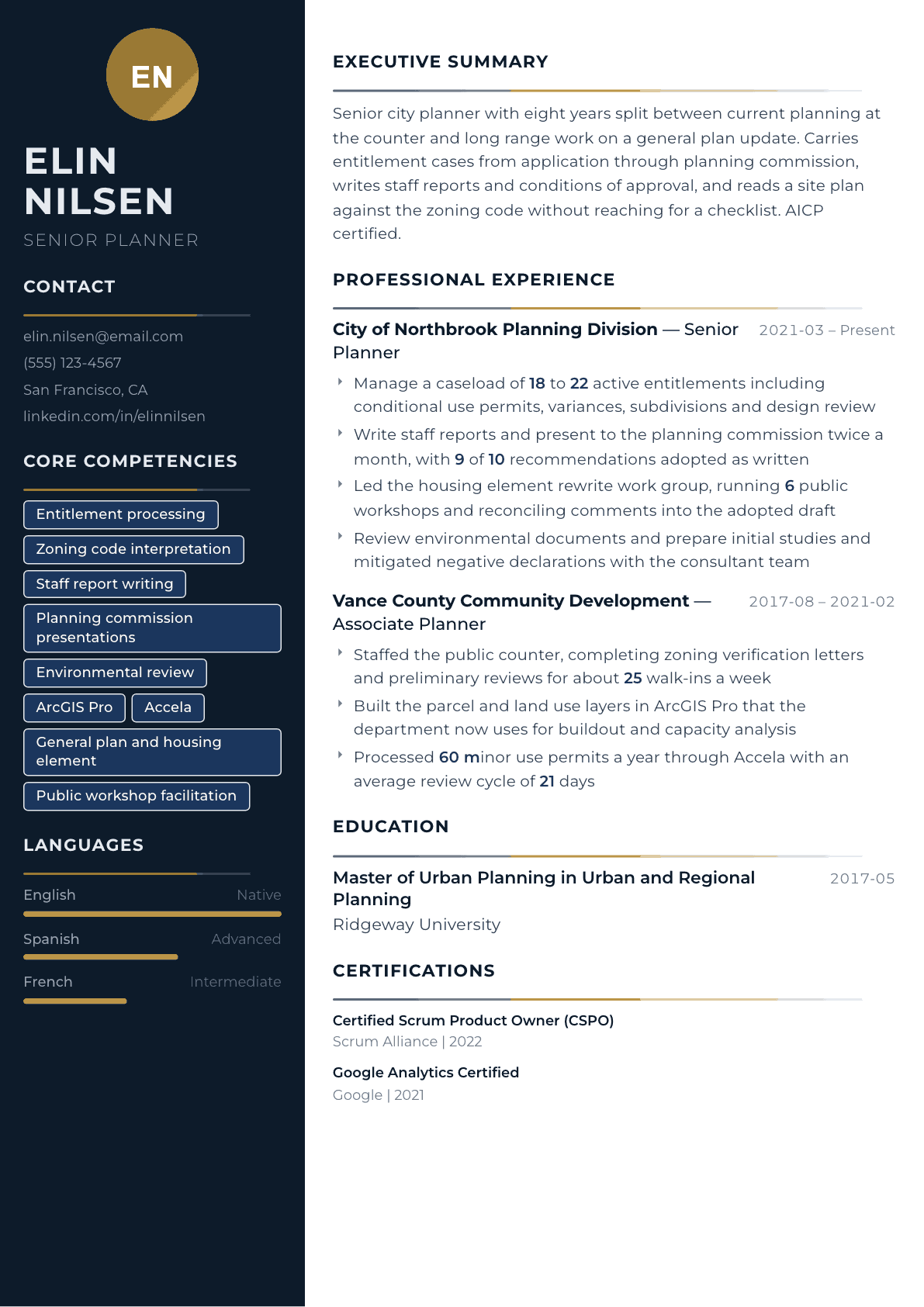
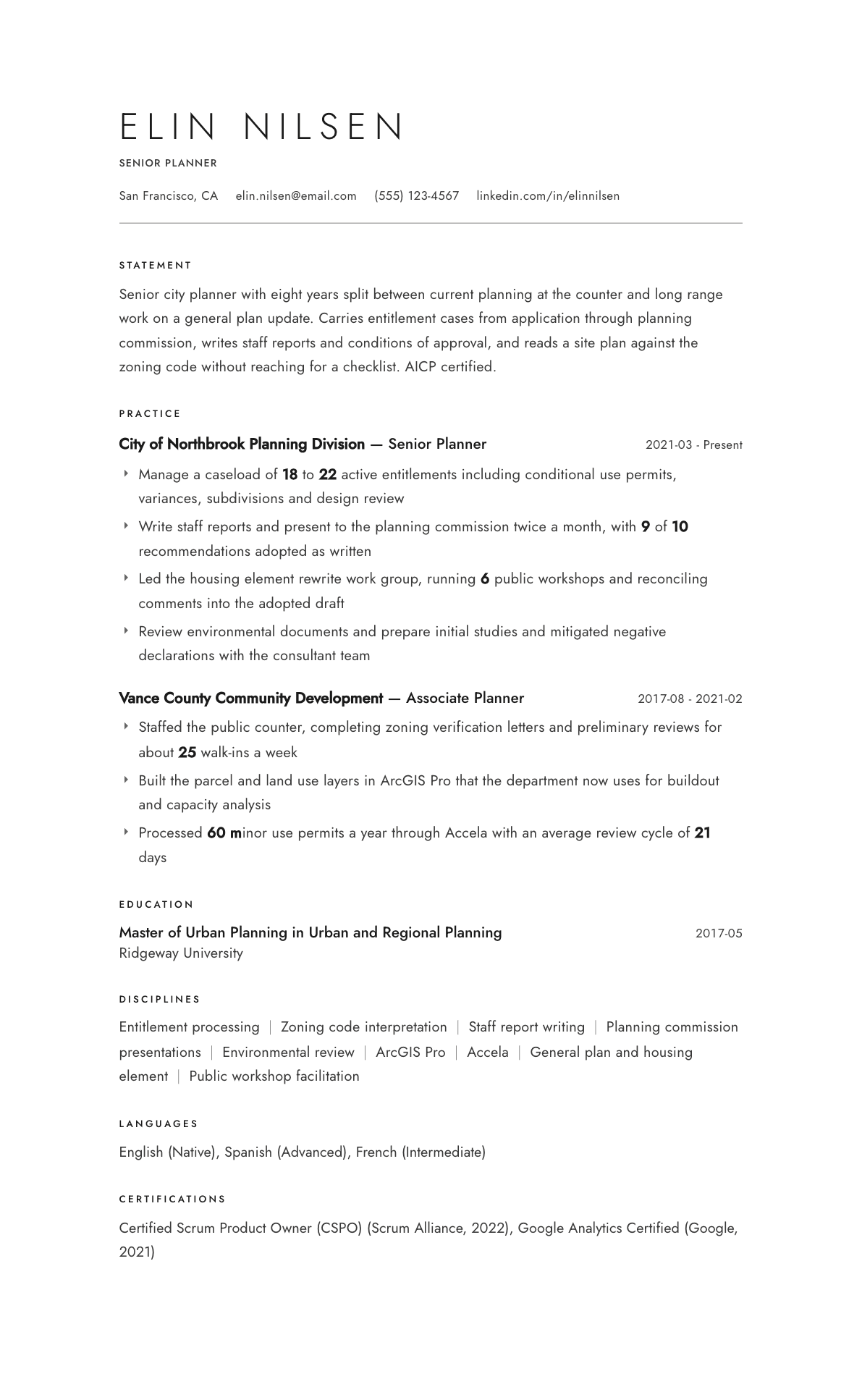
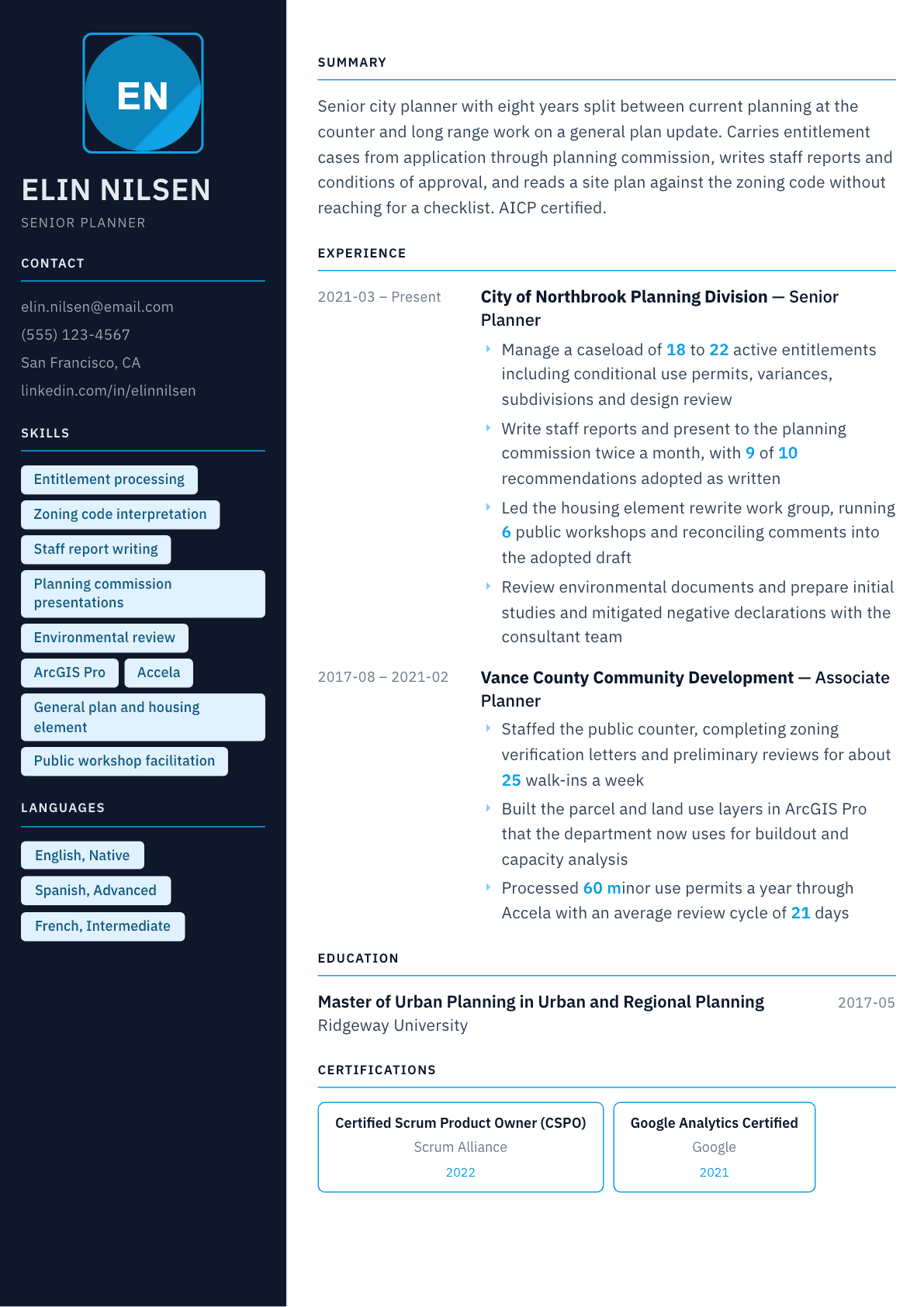
Example City Planner summary
City planner with eight years across county and municipal planning divisions, running entitlement caseloads and a general plan housing element update. Writes staff reports that survive commission hearings, interprets zoning code at the counter, and builds the GIS layers behind capacity analysis. AICP certified and looking for a principal planner opening in a growing city.
Skills to list on a City Planner resume
- Current planning and entitlements
- Long range and comprehensive planning
- Zoning code interpretation and amendments
- Conditional use permits and variances
- Subdivision map review
- Staff report writing
- Planning commission presentation
- Environmental review documents
- ArcGIS Pro
- Accela permitting
- Housing element and general plan updates
- Design review
- Public workshop facilitation
- Development impact fee analysis
What actually gets this resume read
- Split your experience into current planning and long range planning, because hiring managers staff those two desks separately.
- Give your active case count and the permit types, since that is how a planning manager sizes your workload.
- Say how often you present to the planning commission or council and what happened to your recommendations.
- Name the permitting system and the GIS software you work in, because a city rarely retrains an experienced planner.
- List your AICP certification with the American Planning Association, or say that you are exam eligible.
- Show one plan document you helped write, such as a housing element, specific plan or zoning code amendment.
How to write a city planner resume
Planning departments split into two desks, and a planning manager reads every resume trying to work out which desk you belong on. Current planning is the entitlement pipeline: applications, completeness reviews, conditions of approval, hearings, appeals. Long range planning is the document work: general plans, specific plans, housing elements, zoning code amendments, growth projections. Both are called city planner, and the daily work has almost nothing in common.
The second thing the manager checks is whether you can carry a hearing. A planner who writes a defensible staff report and holds up under questioning from a commissioner and an angry neighborhood group is worth more than one who can only process paperwork, and the resume has to show that difference.
This guide covers how to separate the two desks on the page, how to size an entitlement caseload honestly, how to write about environmental review without overclaiming, and where AICP and GIS belong.
Format: split current and long range explicitly
Reverse chronological, two pages once you are past associate level. Inside each job, group the bullets so current planning work and long range work are visibly separate, even if you did both at once. A manager filling a current planning vacancy will scan for caseload and hearing counts and skip past a paragraph that mixes them with plan drafting.
Use the classification titles the field uses, from assistant planner to associate, senior, supervising and principal planner. Those titles map to scope in most departments, so a private consultant applying to a city should also state the equivalent level rather than a firm-specific title nobody recognizes.
- Header line: name, city and state, contact, and AICP after your name if you hold it.
- A qualifications block naming your desk, your permit types and your plan document experience.
- Experience grouped by employer, with jurisdiction population and department structure.
- A technical block for GIS, permitting software and modeling tools, kept separate from planning skills.
Current planning: caseload, permit types and hearing outcomes
Give the number of active cases you carry and the mix of permit types: conditional use permits, variances, design review, tentative maps, lot line adjustments, temporary use permits, sign programs. Case count without type is meaningless, because twenty sign permits and twenty subdivisions are not the same job.
Add your hearing rhythm. How often do you present to the planning commission, the zoning administrator or the city council, and what happened? Recommendations adopted as written, appeals resolved, projects approved after redesign. Do not claim approvals as personal wins. Describe the process and let the reader draw the conclusion.
Include cycle time when you have it. Days from application to completeness determination, or from completeness to hearing, is the metric development services directors report upward, and a planner who tracks it is already speaking the manager language.
Long range: name the documents you actually wrote
Plan documents are public, so be precise. Name the element or chapter, your role on it, and what you produced: the land use inventory, the sites analysis, the policy language, the public engagement summary. A reader can look up the adopted document, and an inflated claim collapses in the first interview question.
Zoning code work belongs here too. Describe the amendment, the problem it solved and how it moved through commission and council. Objective design standards, accessory dwelling ordinances, parking reform and mixed use overlays are the amendments departments hire for, so use their real names.
Environmental review and technical tools
State your environmental review role honestly. Preparing an initial study is different from managing a consultant preparing an environmental impact report, which is different from writing a categorical exemption memo. Say which you have done and how many, and name the topic areas you have handled directly, such as traffic, noise or cultural resources.
For tools, name products: ArcGIS Pro, QGIS, Accela, Tyler EnerGov, SketchUp, Adobe Illustrator for graphics in a plan document. If you built layers or a dashboard the department still uses, say what it answers, because a planner who can produce a buildout map without waiting on the GIS division saves real time.
- Permit software and the modules you actually work in, not just the vendor name.
- GIS software plus the analyses you run: buffer notices, buildout capacity, parcel suitability.
- Environmental document types you have prepared or managed, with counts.
- Public engagement formats you have facilitated: workshops, pop-ups, study sessions, online surveys.
Certification, education and the outside credential
The American Institute of Certified Planners credential from the American Planning Association is the one search filters look for at senior level. If you hold it, put AICP after your name. If you are exam eligible or scheduled, say that instead of leaving a blank. A planning accredited master degree is worth naming by program title, and if your professional planning experience came before the degree, order the resume so the reader sees both.
City Planner resume summary examples
Assistant planner
Assistant planner with 2 years at a county community development counter, completing zoning verification letters and preliminary reviews for about 25 walk-ins a week. Processed 60 minor use permits a year in Accela and built the parcel layer used for buildout analysis. Master of Urban Planning, AICP exam eligible.
Senior planner
Senior city planner carrying 20 active entitlements including conditional use permits, variances, subdivisions and design review, presenting to the planning commission twice a month. Led a housing element rewrite through 6 public workshops to adoption. AICP certified with 8 years across county and city departments.
Principal planner
Principal planner supervising a 5-person current planning team and the department entitlement pipeline, with 13 years in growing jurisdictions. Owns the zoning code amendment program, objective design standards and the annual general plan progress report, and manages environmental consultants on major project reviews.
Work experience bullets: before and after
Before: Processed planning applications.
After: Managed a caseload of 20 active entitlements covering conditional use permits, variances, tentative maps and design review, from completeness determination through hearing and conditions of approval.
The permit mix and the pipeline stages tell a planning manager exactly which desk you can be dropped onto.
Before: Presented projects to the planning commission.
After: Wrote staff reports and presented at 24 planning commission hearings a year, with 9 of 10 recommendations adopted as written and 2 appeals resolved without council reversal.
Hearing frequency plus what happened to the recommendation is evidence the reports hold up under scrutiny.
Before: Worked on the general plan update.
After: Led the housing element rewrite work group, produced the sites inventory and capacity analysis, ran 6 public workshops and reconciled written comments into the adopted draft.
Naming the element, the deliverables and the engagement makes a verifiable claim instead of an association with a project.
Before: Used GIS for planning projects.
After: Built parcel, zoning and land use layers in ArcGIS Pro and automated the 300 foot noticing buffer, cutting notice preparation from a half day to minutes per case.
A specific analysis with a time saving proves the software skill instead of asserting familiarity with it.
Before: Handled environmental review.
After: Prepared 14 initial studies and mitigated negative declarations and managed a consultant team through an environmental impact report for a 300-unit mixed use project.
Document types and counts separate a planner who has run review from one who has only read the findings.
Hard skills
- Entitlement case management
- Zoning code interpretation and amendments
- Conditional use permits and variances
- Subdivision and tentative map review
- Staff report writing and findings
- Planning commission and council presentation
- General plan and housing element preparation
- Environmental review documents
- ArcGIS Pro
- Accela permitting
- Design review and objective standards
- Development impact fee analysis
Soft skills
- Public hearing composure
- Neighborhood meeting facilitation
- Negotiation with applicants
- Plain language explanation of code
- Consultant management
Certifications worth listing
- AICP (American Institute of Certified Planners) (American Planning Association)
- AICP Certified Urban Designer (AICP CUD) (American Planning Association)
- LEED Green Associate (US Green Building Council)
- Certified Floodplain Manager (CFM) (Association of State Floodplain Managers)
Mistakes that cost city planner candidates the interview
- Mixing current planning and long range bullets so a manager cannot tell which vacancy you fit.
- Giving a case count with no permit types, which hides whether the work was sign permits or subdivisions.
- Claiming a general plan without naming the element or the deliverable you personally produced.
- Overstating environmental review, which falls apart the moment an interviewer asks about the findings.
- Listing GIS as a skill with no analysis attached, when every planning applicant lists it.
- Leaving off AICP status entirely, so a search filter for the credential never surfaces the resume.
- Using consulting firm titles a public agency does not map to its own planner series.
City Planner resume questions
Do I need AICP to get a city planner job?
Not for entry or associate roles, where a planning degree and permit experience carry the file. It becomes close to expected at senior and principal level, and many postings list it as required or strongly preferred for supervisory positions.
How do I move from consulting into a public planning department?
Translate your project work into permit types and hearings. Cities want to know you can staff a counter, write findings that survive appeal and present at a commission, so lead with entitlement processing rather than with client deliverables.
Should I include a portfolio with a planning resume?
Include a link line if you have adopted documents, maps or graphics you produced. Keep it to public work you can share, and name the document and your role rather than posting a folder of unlabeled images.
What if my experience is all long range and the job is current planning?
Say so in the summary and lead with the transferable pieces: code interpretation, hearing presentations, environmental documents and public engagement. Then name the permit types you are ready to take on and any counter coverage you have done.
How much detail should I give about a contested project?
Describe the process and the outcome without editorializing about applicants or residents. Say what the application was, how many hearings it took, what changed in the conditions, and whether the decision was appealed and upheld.
Related resume examples
- Urban Planner Resume example
- City Manager Resume example
- Zoning Administrator Resume example
- Community Development Manager Resume example
- Health Inspector Resume example
- City Clerk Resume example