Selection Criteria Examples: 10 Full 250-Word Responses
By Mustafa Tarabya, founder of CVBooster · Published · Updated
20 min read
Ten complete selection criteria examples sit below, one for each criterion Australian employers ask for most, every one written at the 250-word limit that adverts usually set. The limit is the constraint that decides everything, because a panel scores each criterion separately and a thin answer costs you the interview rather than a mark. The rules quoted here come from Jobs and Skills WA, iworkfor.SA, JobAccess and the Australian Public Service Commission, named in full further down. Each response is annotated against criterion wording copied from a real advert, and four weak sentences are rewritten near the end. Written by Mustafa Tarabya, who hired for his own company, read every application himself and now writes CVBooster's guides. Checked September 2026.
How a panel actually marks your response
The Jobs and Skills WA guide Responding to selection criteria is blunt about the stakes.
Quoted: "If you are required to write a statement of claims against the selection criteria, then you must be aware this is likely to be the most important document in your application. It is used to assess you against other applicants, with scores often given for each criterion." (Jobs and Skills WA)
The South Australian public sector guide Addressing selection criteria explains why vague writing loses.
Quoted: "Many good applicants are overlooked because they don't clearly address the selection criteria" and assume the panel will read between the lines in their resume. (iworkfor.SA)
The four things every response must contain
JobAccess reduces a response to four moves, and the ten examples below all follow them.
- Where the example happened, including where you were working and when.
- The challenge you had to face.
- What you did about the challenge.
- What happened because of what you did.
The Australian Public Service Commission calls this the STAR model in Applying for an APS job.
Word budget inside 250 words: 40 for the situation, 30 for the task, 130 for your actions, 50 for the result.
Communication, teamwork and customer service
Communication skills
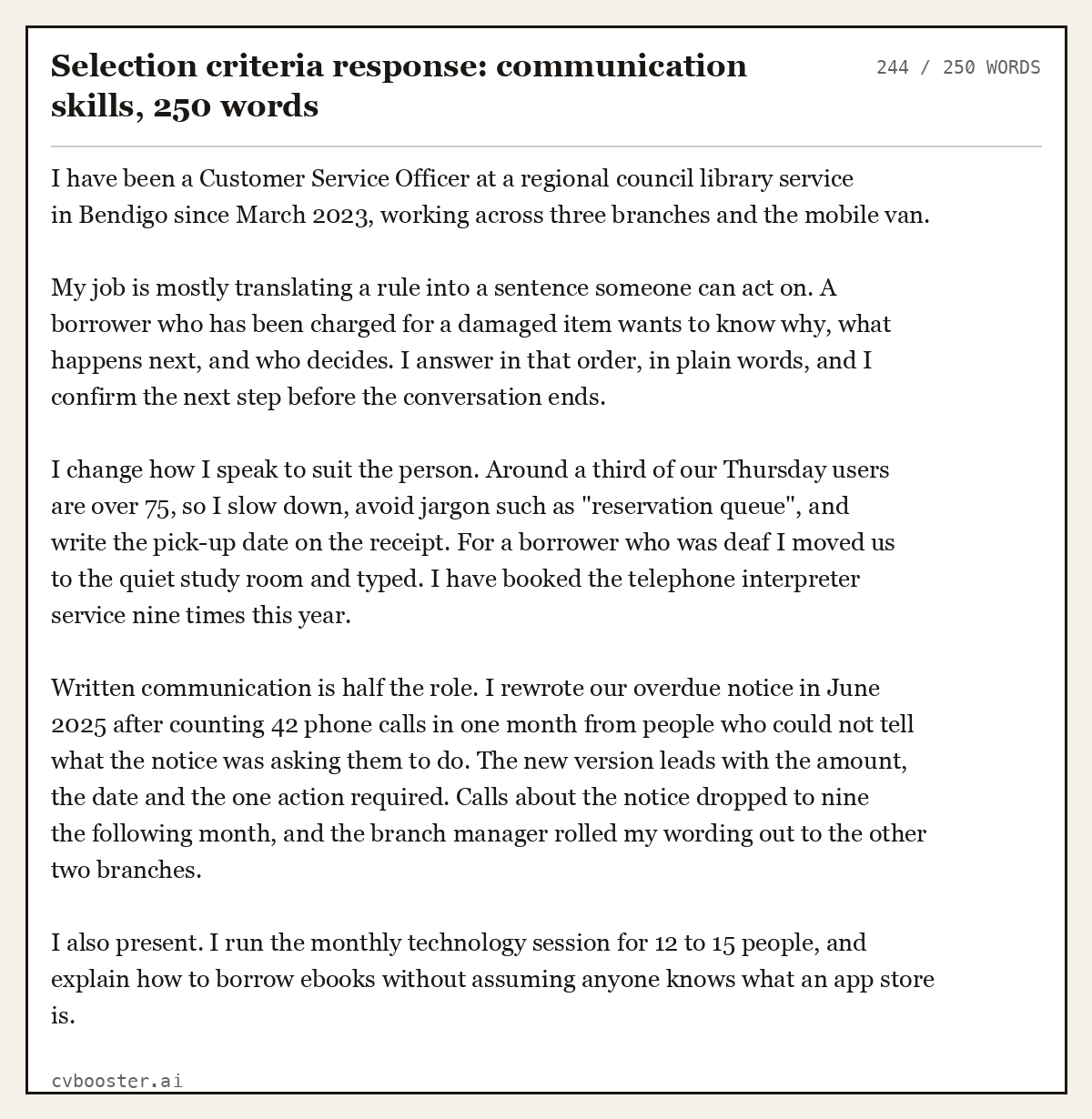
Selection criteria response: communication skills, 250 words (244 words)
I have been a Customer Service Officer at a regional council library service in Bendigo since March 2023, working across three branches and the mobile van.
My job is mostly translating a rule into a sentence someone can act on. A borrower who has been charged for a damaged item wants to know why, what happens next, and who decides. I answer in that order, in plain words, and I confirm the next step before the conversation ends.
I change how I speak to suit the person. Around a third of our Thursday users are over 75, so I slow down, avoid jargon such as "reservation queue", and write the pick-up date on the receipt. For a borrower who was deaf I moved us to the quiet study room and typed. I have booked the telephone interpreter service nine times this year.
Written communication is half the role. I rewrote our overdue notice in June 2025 after counting 42 phone calls in one month from people who could not tell what the notice was asking them to do. The new version leads with the amount, the date and the one action required. Calls about the notice dropped to nine the following month, and the branch manager rolled my wording out to the other two branches.
I also present. I run the monthly technology session for 12 to 15 people, and explain how to borrow ebooks without assuming anyone knows what an app store is.
What the sifter is scoring
- Advert wording quoted: "Demonstrated capacity to communicate effectively in a team environment, including high level oral and written communication skills" (Education Support advert, careers.vic.gov.au, reference 1543253 series). Proof in the response: the three-part answer at the desk, the interpreter bookings, the rewritten notice and the monthly session.
- Official instruction quoted: "Tell the employer what happened because of what you did" (JobAccess). Proof in the response: 42 calls falling to nine, and the wording adopted at three branches.
- Wording to avoid, quoted: "I am well versed in the provision of superior administrative support" is named by Jobs and Skills WA as the mistake of claiming without evidence.
Teamwork
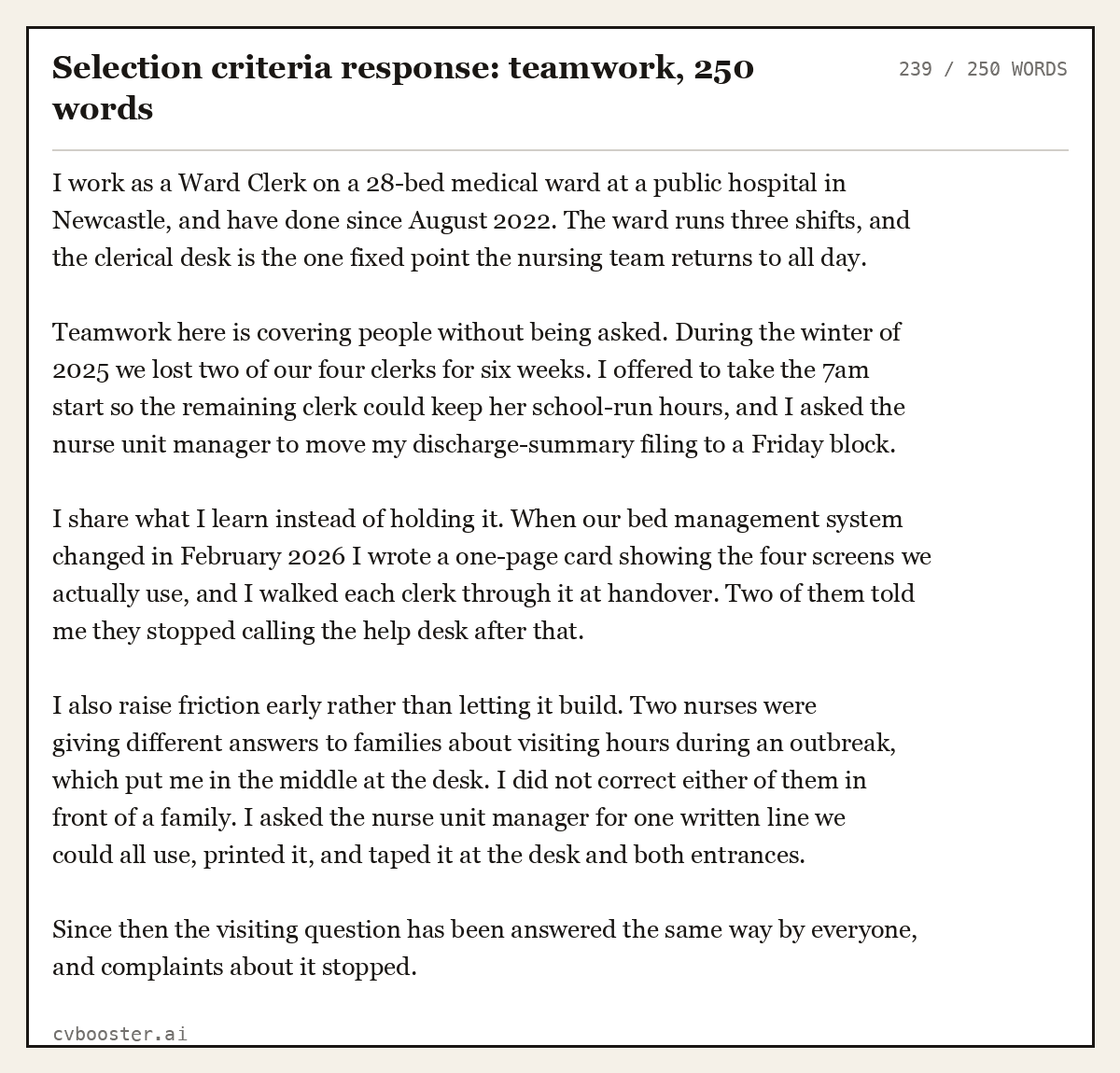
Selection criteria response: teamwork, 250 words (239 words)
I work as a Ward Clerk on a 28-bed medical ward at a public hospital in Newcastle, and have done since August 2022. The ward runs three shifts, and the clerical desk is the one fixed point the nursing team returns to all day.
Teamwork here is covering people without being asked. During the winter of 2025 we lost two of our four clerks for six weeks. I offered to take the 7am start so the remaining clerk could keep her school-run hours, and I asked the nurse unit manager to move my discharge-summary filing to a Friday block.
I share what I learn instead of holding it. When our bed management system changed in February 2026 I wrote a one-page card showing the four screens we actually use, and I walked each clerk through it at handover. Two of them told me they stopped calling the help desk after that.
I also raise friction early rather than letting it build. Two nurses were giving different answers to families about visiting hours during an outbreak, which put me in the middle at the desk. I did not correct either of them in front of a family. I asked the nurse unit manager for one written line we could all use, printed it, and taped it at the desk and both entrances.
Since then the visiting question has been answered the same way by everyone, and complaints about it stopped.
What the sifter is scoring
- Advert wording quoted: "Demonstrated capacity to work and collaborate with others in a team environment" (Education Support advert, careers.vic.gov.au). Proof in the response: the 7am starts, the renegotiated filing block, the handover card.
- Advert wording quoted: "Ability to work as part of a team" (JobAccess sample criterion). Proof in the response: the visiting hours line agreed in writing rather than argued at the desk.
- Why the ending works: the result is a behaviour that changed and stayed changed, not an adjective about being a team player.
Customer service
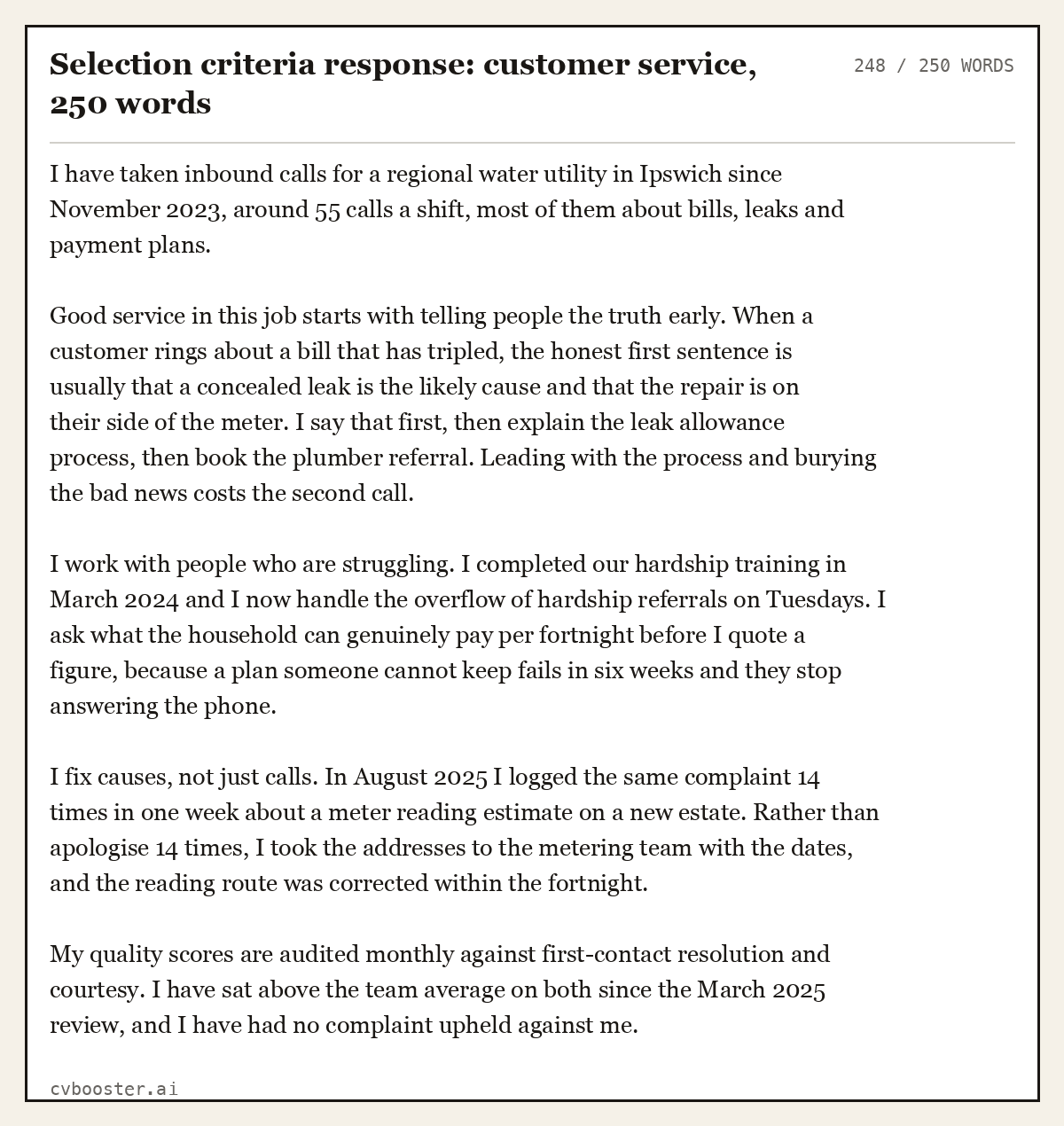
Selection criteria response: customer service, 250 words (248 words)
I have taken inbound calls for a regional water utility in Ipswich since November 2023, around 55 calls a shift, most of them about bills, leaks and payment plans.
Good service in this job starts with telling people the truth early. When a customer rings about a bill that has tripled, the honest first sentence is usually that a concealed leak is the likely cause and that the repair is on their side of the meter. I say that first, then explain the leak allowance process, then book the plumber referral. Leading with the process and burying the bad news costs the second call.
I work with people who are struggling. I completed our hardship training in March 2024 and I now handle the overflow of hardship referrals on Tuesdays. I ask what the household can genuinely pay per fortnight before I quote a figure, because a plan someone cannot keep fails in six weeks and they stop answering the phone.
I fix causes, not just calls. In August 2025 I logged the same complaint 14 times in one week about a meter reading estimate on a new estate. Rather than apologise 14 times, I took the addresses to the metering team with the dates, and the reading route was corrected within the fortnight.
My quality scores are audited monthly against first-contact resolution and courtesy. I have sat above the team average on both since the March 2025 review, and I have had no complaint upheld against me.
What the sifter is scoring
- Advert wording quoted: "well-developed customer service skills" (APSC, Applying for an APS job, list of common selection criteria). Proof in the response: the honest first sentence, the hardship referrals, the fortnightly figure set by the customer.
- Official instruction quoted: "Where possible use actual, specific examples of what you have done, how well you did it, what you achieved, and how it relates to the requirements of the job" (APSC). Proof in the response: the call volume, the 14 logged complaints and the audited quality measure.
Problem solving, organisation and attention to detail
The criteria that decide administrative and technical shortlists. Panels are looking for a method they can picture, not for the word "meticulous".
Problem solving
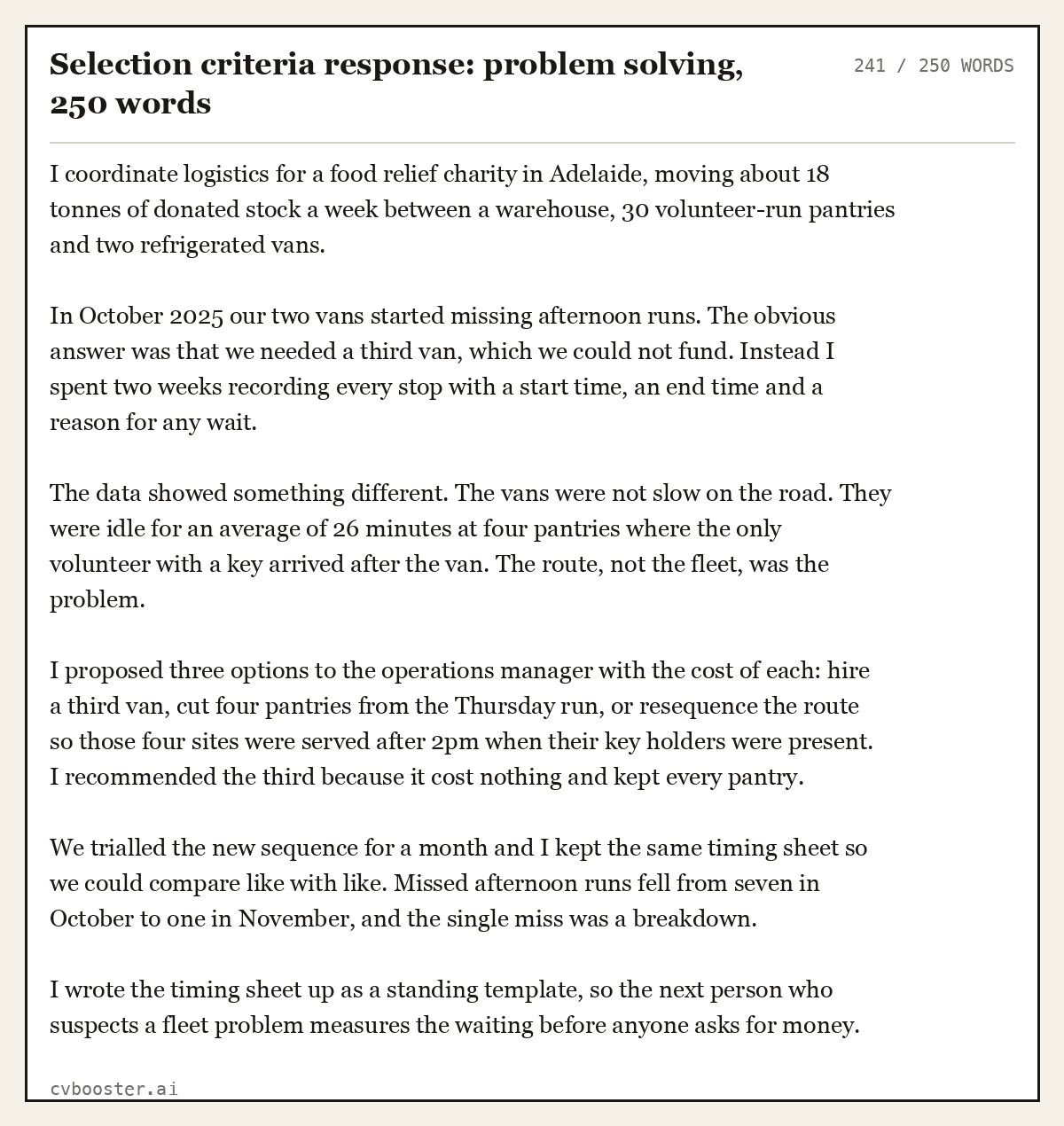
Selection criteria response: problem solving, 250 words (241 words)
I coordinate logistics for a food relief charity in Adelaide, moving about 18 tonnes of donated stock a week between a warehouse, 30 volunteer-run pantries and two refrigerated vans.
In October 2025 our two vans started missing afternoon runs. The obvious answer was that we needed a third van, which we could not fund. Instead I spent two weeks recording every stop with a start time, an end time and a reason for any wait.
The data showed something different. The vans were not slow on the road. They were idle for an average of 26 minutes at four pantries where the only volunteer with a key arrived after the van. The route, not the fleet, was the problem.
I proposed three options to the operations manager with the cost of each: hire a third van, cut four pantries from the Thursday run, or resequence the route so those four sites were served after 2pm when their key holders were present. I recommended the third because it cost nothing and kept every pantry.
We trialled the new sequence for a month and I kept the same timing sheet so we could compare like with like. Missed afternoon runs fell from seven in October to one in November, and the single miss was a breakdown.
I wrote the timing sheet up as a standing template, so the next person who suspects a fleet problem measures the waiting before anyone asks for money.
What the sifter is scoring
- Advert wording quoted: "problem-solving" appears in the official list of criteria examples in iworkfor.SA's Addressing selection criteria. Proof in the response: the assumption tested, the measurement, the three costed options.
- Official instruction quoted: "In the above example, they are looking for two skills: organisational and problem solving skills" (Jobs and Skills WA), which is why the timing sheet and the route both appear.
- What a panel scores here: the rejected options. A response that reaches the right answer without showing the alternatives reads as luck.
Organisational skills
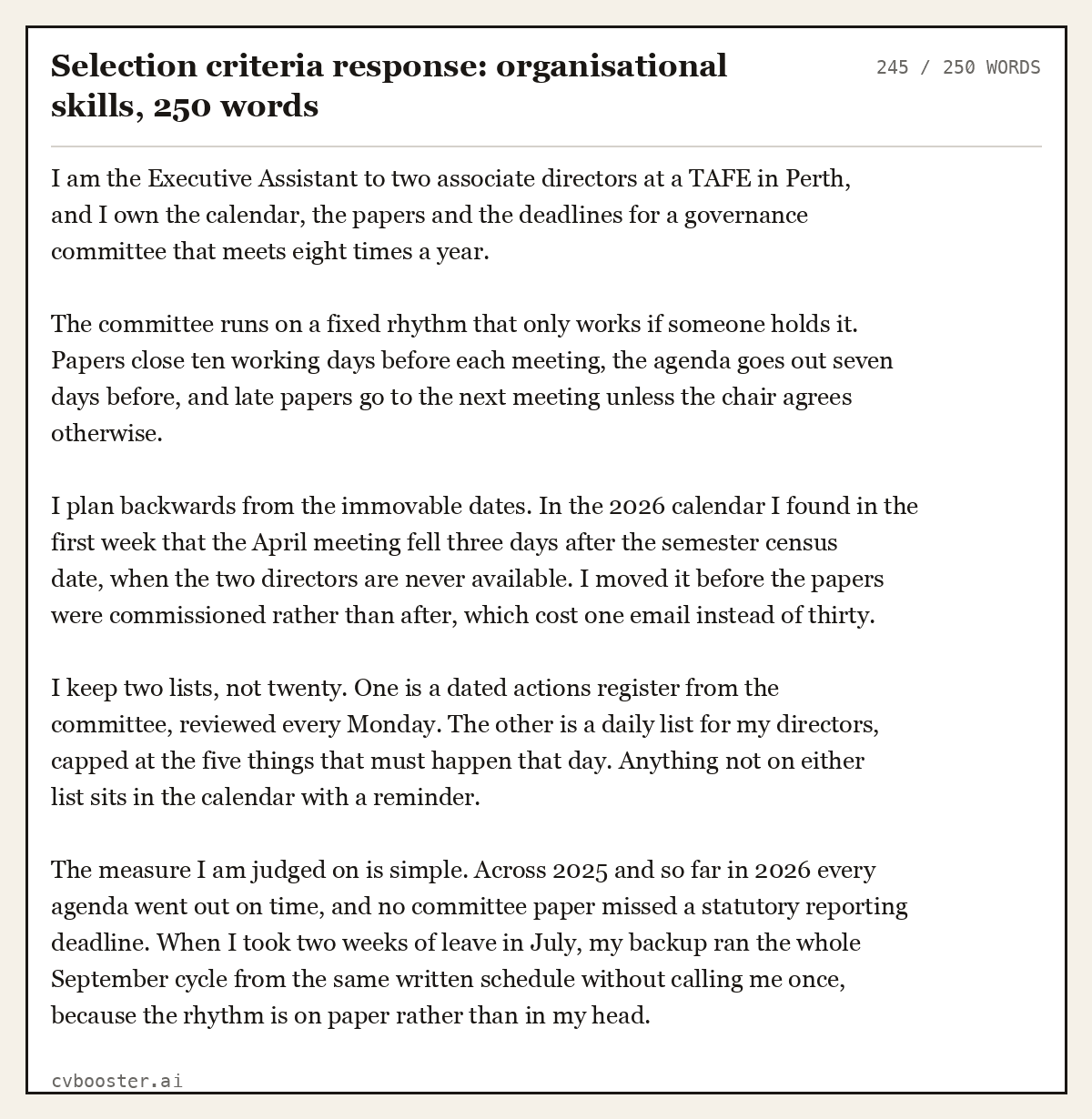
Selection criteria response: organisational skills, 250 words (245 words)
I am the Executive Assistant to two associate directors at a TAFE in Perth, and I own the calendar, the papers and the deadlines for a governance committee that meets eight times a year.
The committee runs on a fixed rhythm that only works if someone holds it. Papers close ten working days before each meeting, the agenda goes out seven days before, and late papers go to the next meeting unless the chair agrees otherwise.
I plan backwards from the immovable dates. In the 2026 calendar I found in the first week that the April meeting fell three days after the semester census date, when the two directors are never available. I moved it before the papers were commissioned rather than after, which cost one email instead of thirty.
I keep two lists, not twenty. One is a dated actions register from the committee, reviewed every Monday. The other is a daily list for my directors, capped at the five things that must happen that day. Anything not on either list sits in the calendar with a reminder.
The measure I am judged on is simple. Across 2025 and so far in 2026 every agenda went out on time, and no committee paper missed a statutory reporting deadline. When I took two weeks of leave in July, my backup ran the whole September cycle from the same written schedule without calling me once, because the rhythm is on paper rather than in my head.
What the sifter is scoring
- Advert wording quoted: "good organisational and administrative skills" (APSC, common selection criteria). Proof in the response: the ten-day and seven-day rule, the backwards planning, the two lists.
- Advert wording quoted: "organisational/planning/prioritising/time management/ability to meet deadlines" (iworkfor.SA list of criteria examples). Proof in the response: the census date clash found in week one and the clean deadline record.
Attention to detail
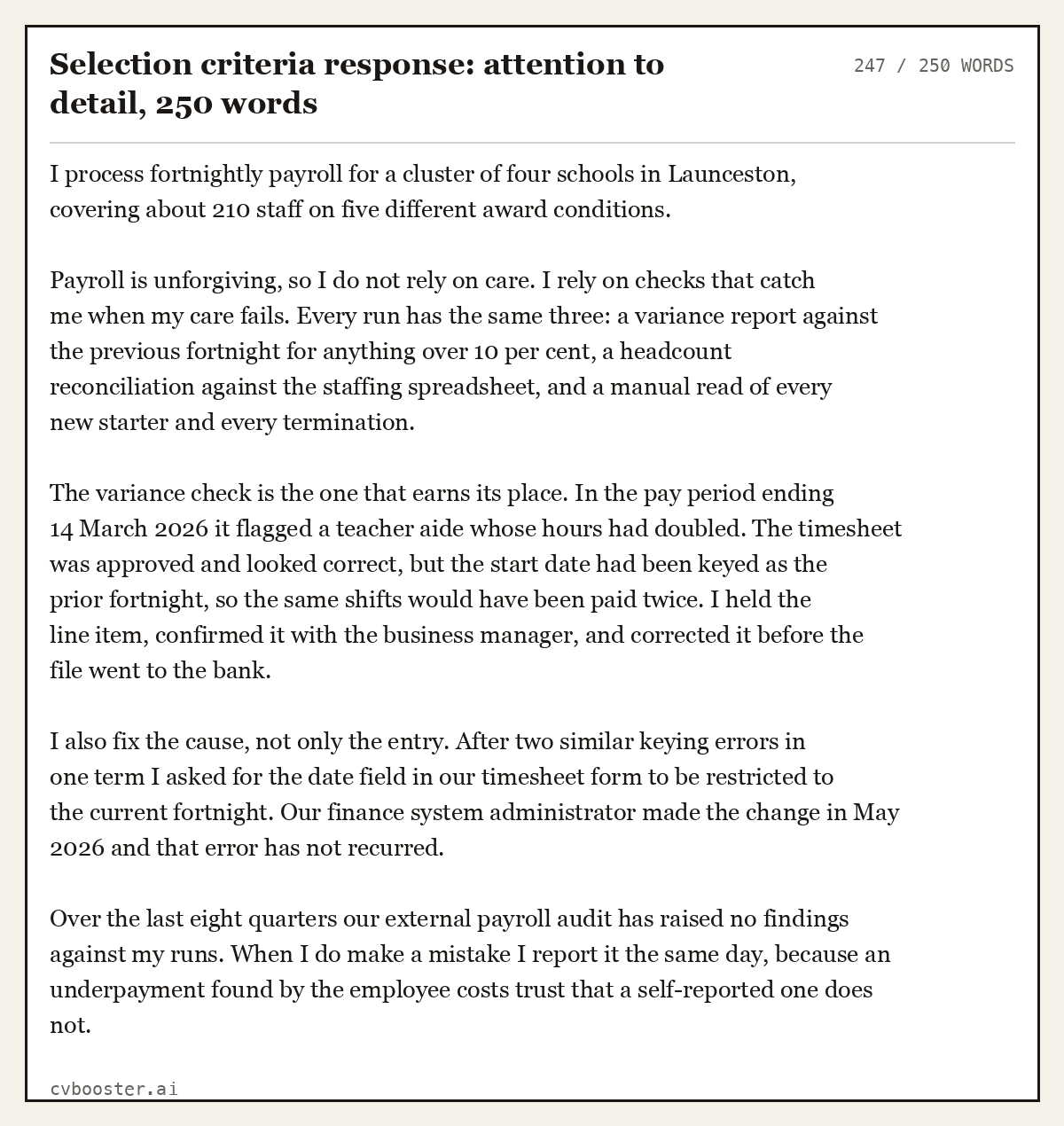
Selection criteria response: attention to detail, 250 words (247 words)
I process fortnightly payroll for a cluster of four schools in Launceston, covering about 210 staff on five different award conditions.
Payroll is unforgiving, so I do not rely on care. I rely on checks that catch me when my care fails. Every run has the same three: a variance report against the previous fortnight for anything over 10 per cent, a headcount reconciliation against the staffing spreadsheet, and a manual read of every new starter and every termination.
The variance check is the one that earns its place. In the pay period ending 14 March 2026 it flagged a teacher aide whose hours had doubled. The timesheet was approved and looked correct, but the start date had been keyed as the prior fortnight, so the same shifts would have been paid twice. I held the line item, confirmed it with the business manager, and corrected it before the file went to the bank.
I also fix the cause, not only the entry. After two similar keying errors in one term I asked for the date field in our timesheet form to be restricted to the current fortnight. Our finance system administrator made the change in May 2026 and that error has not recurred.
Over the last eight quarters our external payroll audit has raised no findings against my runs. When I do make a mistake I report it the same day, because an underpayment found by the employee costs trust that a self-reported one does not.
What the sifter is scoring
- Advert wording quoted: "accuracy and attention to detail" (iworkfor.SA, official list of selection criteria examples). Proof in the response: the three named checks, the doubled-hours catch, the audit record.
- Official instruction quoted: "Try to avoid sounding 'perfect'" (Jobs and Skills WA). Proof in the response: the sentence about self-reporting a mistake the same day.
- More at criterion level: four longer responses for this criterion are in attention to detail selection criteria examples.
Leadership and initiative
Two criteria that are often misread. Leadership does not require a title, and initiative is not the same as volunteering for extra work.
Leadership
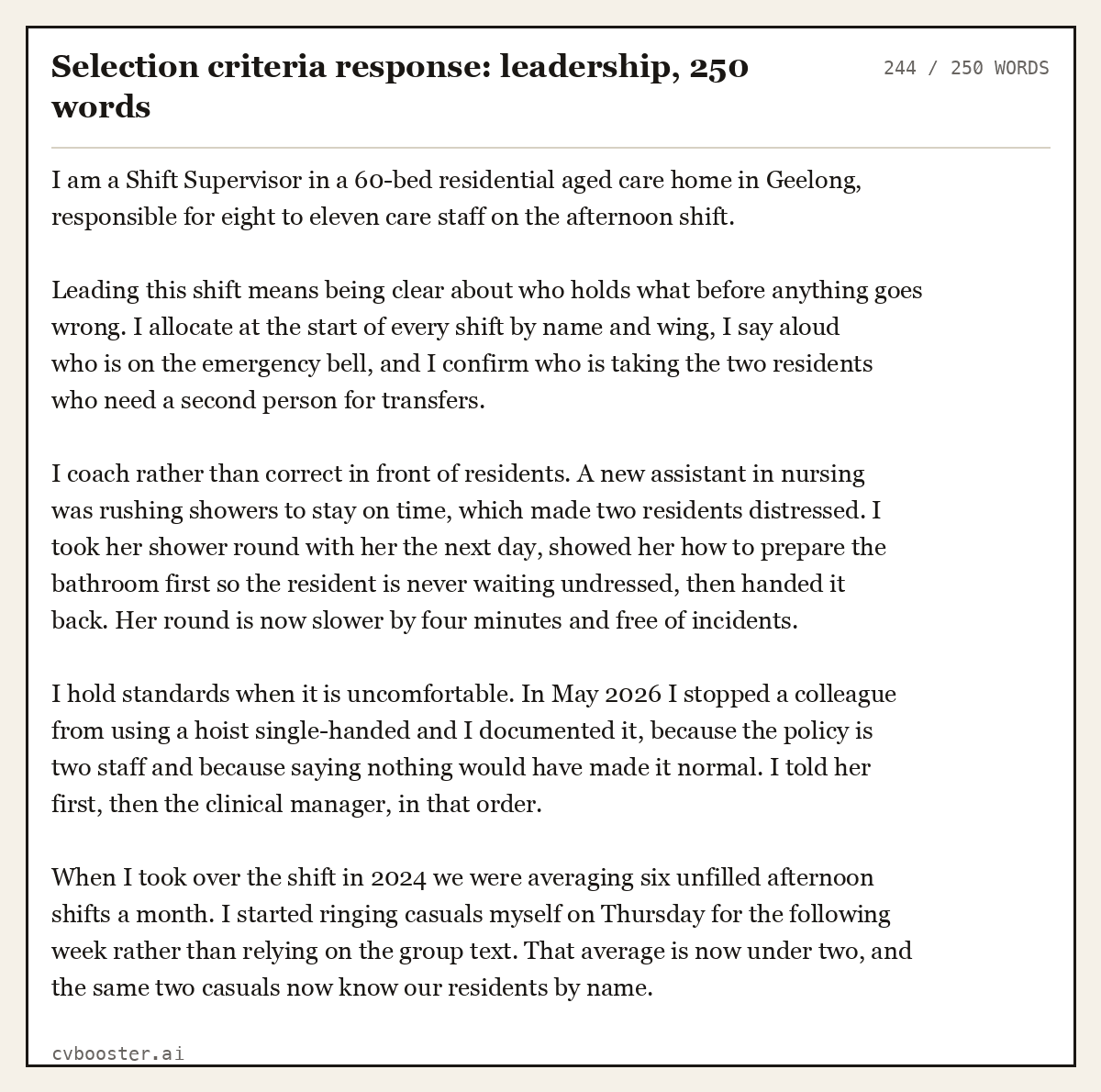
Selection criteria response: leadership, 250 words (244 words)
I am a Shift Supervisor in a 60-bed residential aged care home in Geelong, responsible for eight to eleven care staff on the afternoon shift.
Leading this shift means being clear about who holds what before anything goes wrong. I allocate at the start of every shift by name and wing, I say aloud who is on the emergency bell, and I confirm who is taking the two residents who need a second person for transfers.
I coach rather than correct in front of residents. A new assistant in nursing was rushing showers to stay on time, which made two residents distressed. I took her shower round with her the next day, showed her how to prepare the bathroom first so the resident is never waiting undressed, then handed it back. Her round is now slower by four minutes and free of incidents.
I hold standards when it is uncomfortable. In May 2026 I stopped a colleague from using a hoist single-handed and I documented it, because the policy is two staff and because saying nothing would have made it normal. I told her first, then the clinical manager, in that order.
When I took over the shift in 2024 we were averaging six unfilled afternoon shifts a month. I started ringing casuals myself on Thursday for the following week rather than relying on the group text. That average is now under two, and the same two casuals now know our residents by name.
What the sifter is scoring
- Advert wording quoted: "Demonstrated exemplary interpersonal and leadership skills" (Leading Teacher advert, careers.vic.gov.au). Proof in the response: the named allocation, the coaching on the shower round, the hoist intervention.
- Advert wording quoted: "leadership" is listed as a standard criterion by iworkfor.SA. Proof in the response: an unfilled-shift figure that moved because of something the applicant personally changed.
Initiative
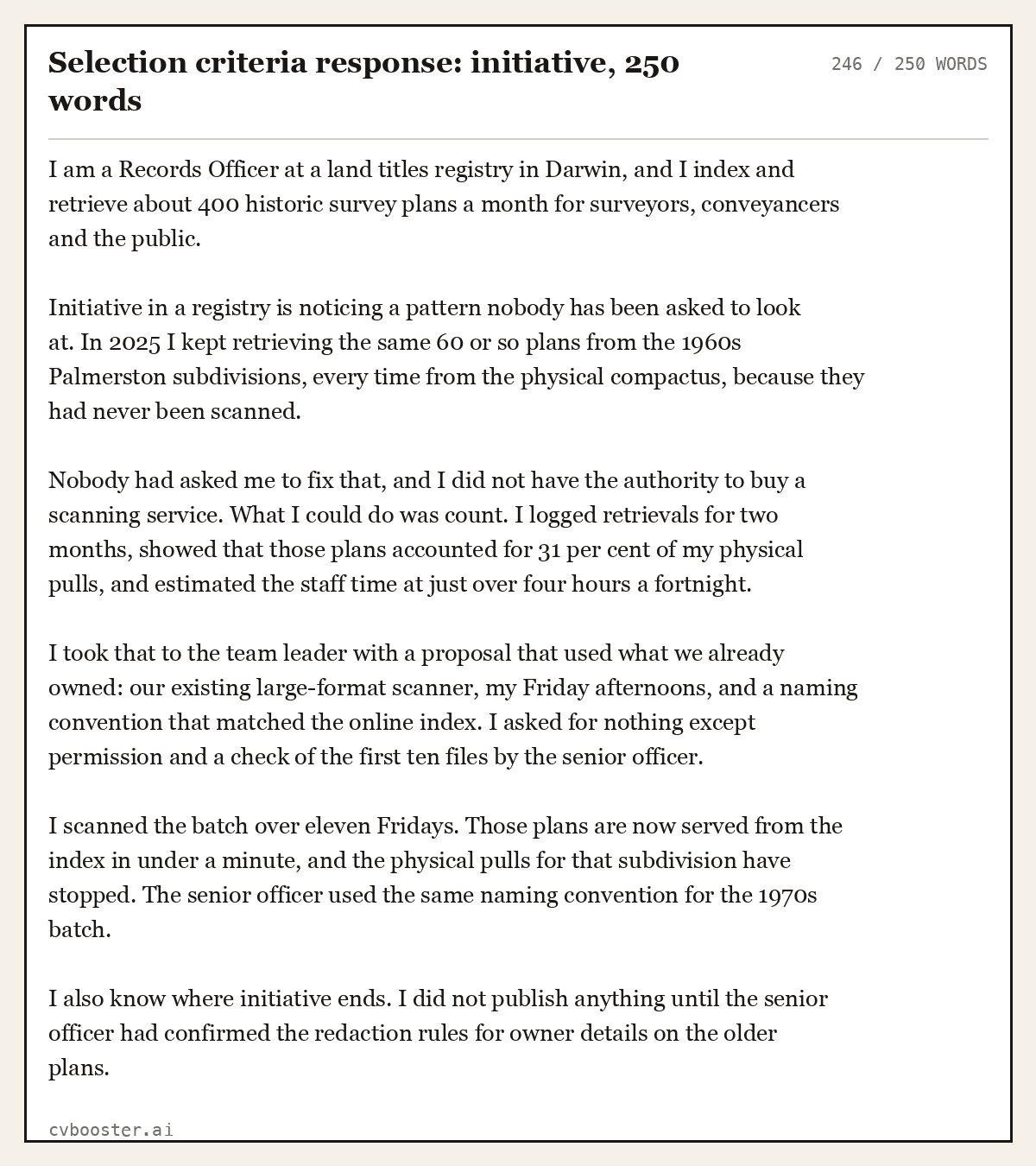
Selection criteria response: initiative, 250 words (246 words)
I am a Records Officer at a land titles registry in Darwin, and I index and retrieve about 400 historic survey plans a month for surveyors, conveyancers and the public.
Initiative in a registry is noticing a pattern nobody has been asked to look at. In 2025 I kept retrieving the same 60 or so plans from the 1960s Palmerston subdivisions, every time from the physical compactus, because they had never been scanned.
Nobody had asked me to fix that, and I did not have the authority to buy a scanning service. What I could do was count. I logged retrievals for two months, showed that those plans accounted for 31 per cent of my physical pulls, and estimated the staff time at just over four hours a fortnight.
I took that to the team leader with a proposal that used what we already owned: our existing large-format scanner, my Friday afternoons, and a naming convention that matched the online index. I asked for nothing except permission and a check of the first ten files by the senior officer.
I scanned the batch over eleven Fridays. Those plans are now served from the index in under a minute, and the physical pulls for that subdivision have stopped. The senior officer used the same naming convention for the 1970s batch.
I also know where initiative ends. I did not publish anything until the senior officer had confirmed the redaction rules for owner details on the older plans.
What the sifter is scoring
- Advert wording quoted: "initiative" and "independence" both appear in the iworkfor.SA list of selection criteria examples. Proof in the response: a problem nobody assigned, measured before it was raised, and solved with existing equipment.
- Advert wording quoted: "Demonstrated your ability to learn new skills and adapt to change" (JobAccess sample criterion). Proof in the response: learning the large-format scanner and the index naming convention.
- The line that saves it: the last paragraph. Initiative without a check on authority reads as risk.
Technical skills and working under pressure
The last two criteria reward specificity. Name the systems and name the busy period.
Computer and technical skills
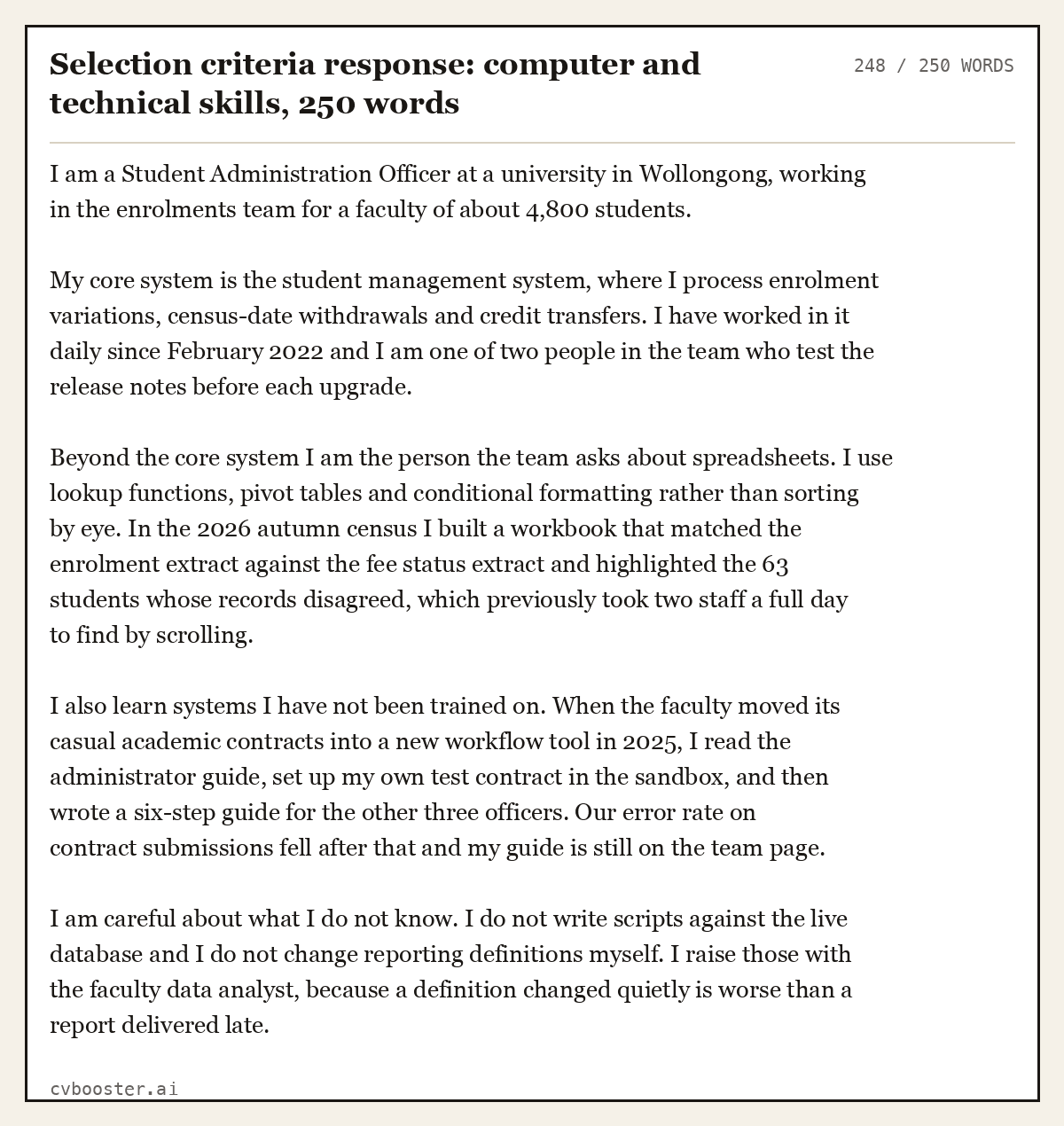
Selection criteria response: computer and technical skills, 250 words (248 words)
I am a Student Administration Officer at a university in Wollongong, working in the enrolments team for a faculty of about 4,800 students.
My core system is the student management system, where I process enrolment variations, census-date withdrawals and credit transfers. I have worked in it daily since February 2022 and I am one of two people in the team who test the release notes before each upgrade.
Beyond the core system I am the person the team asks about spreadsheets. I use lookup functions, pivot tables and conditional formatting rather than sorting by eye. In the 2026 autumn census I built a workbook that matched the enrolment extract against the fee status extract and highlighted the 63 students whose records disagreed, which previously took two staff a full day to find by scrolling.
I also learn systems I have not been trained on. When the faculty moved its casual academic contracts into a new workflow tool in 2025, I read the administrator guide, set up my own test contract in the sandbox, and then wrote a six-step guide for the other three officers. Our error rate on contract submissions fell after that and my guide is still on the team page.
I am careful about what I do not know. I do not write scripts against the live database and I do not change reporting definitions myself. I raise those with the faculty data analyst, because a definition changed quietly is worse than a report delivered late.
What the sifter is scoring
- Advert wording quoted: "Possess the technical knowledge and expertise relevant to the position" (Education Support advert, careers.vic.gov.au). Proof in the response: named system, named functions, the workbook and the sandbox test.
- Advert wording quoted: "proficiency in a range of computing skills" and "knowledge/experience of specific software or equipment" (iworkfor.SA criteria list). Proof in the response: daily use since 2022 and the release-note testing.
Working under pressure
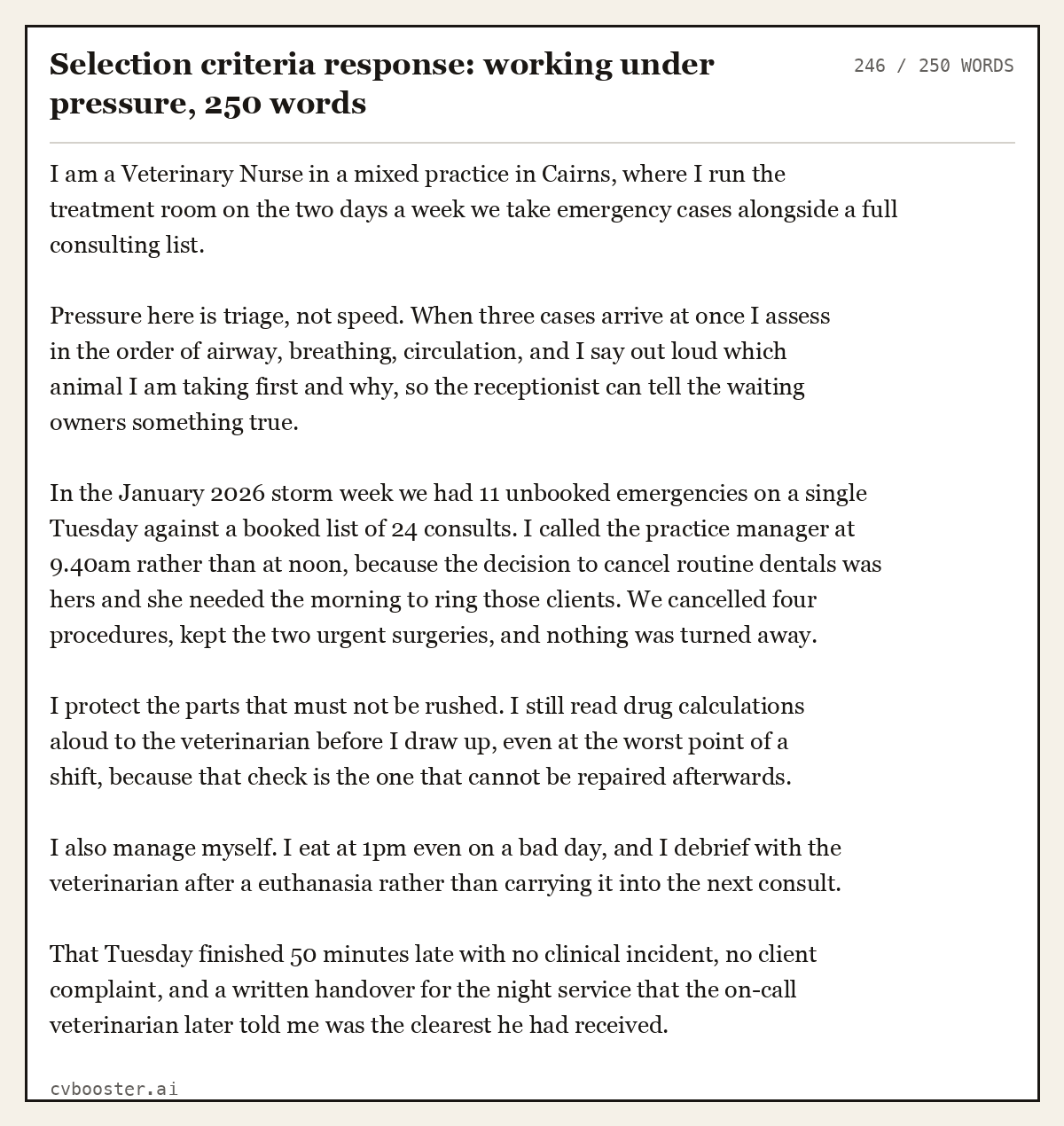
Selection criteria response: working under pressure, 250 words (246 words)
I am a Veterinary Nurse in a mixed practice in Cairns, where I run the treatment room on the two days a week we take emergency cases alongside a full consulting list.
Pressure here is triage, not speed. When three cases arrive at once I assess in the order of airway, breathing, circulation, and I say out loud which animal I am taking first and why, so the receptionist can tell the waiting owners something true.
In the January 2026 storm week we had 11 unbooked emergencies on a single Tuesday against a booked list of 24 consults. I called the practice manager at 9.40am rather than at noon, because the decision to cancel routine dentals was hers and she needed the morning to ring those clients. We cancelled four procedures, kept the two urgent surgeries, and nothing was turned away.
I protect the parts that must not be rushed. I still read drug calculations aloud to the veterinarian before I draw up, even at the worst point of a shift, because that check is the one that cannot be repaired afterwards.
I also manage myself. I eat at 1pm even on a bad day, and I debrief with the veterinarian after a euthanasia rather than carrying it into the next consult.
That Tuesday finished 50 minutes late with no clinical incident, no client complaint, and a written handover for the night service that the on-call veterinarian later told me was the clearest he had received.
What the sifter is scoring
- Criterion wording, stated honestly: no advert fetched for this page used a works-well-under-pressure phrase. The closest published wording is iworkfor.SA's "organisational/planning/prioritising/time management/ability to meet deadlines", so the response is written to that.
- Official instruction quoted: "Explain the challenge you had to face" (JobAccess). Proof in the response: 11 emergencies against 24 booked consults, with the time the escalation was made.
The sentences that cost marks
Four real patterns, with the fix. Each rewrite uses the same facts as the original.
- Before: "I have excellent communication skills and am able to communicate with people at all levels." After: "I rewrote our overdue notice in June 2025, and monthly calls asking what the notice meant fell from 42 to nine."
- Before: "I am a dedicated team player who always goes above and beyond for my colleagues." After: "I took the 7am start for six weeks so the remaining clerk could keep her school-run hours."
- Before: "I am highly organised and able to juggle multiple competing priorities in a fast-paced environment." After: "Papers close ten working days before each meeting, and I hold that date unless the chair agrees otherwise."
- Before: "I have a keen eye for detail and pride myself on accuracy at all times." After: "My variance check flagged a doubled-hours entry on 14 March 2026, before the file went to the bank."
Tip: if a sentence would still be true after you swapped in a different applicant's name, it is not evidence. Put a date, a place or a number in it.
Before you submit
- Copy each criterion heading word for word from the advert, in the advert's order, and mark it essential or desirable.
- Check the word or page limit and meet it. The APSC's instruction is "If a word or page limit is set, make sure you stick to it".
- Use one strong example per criterion, not three thin ones.
- Make sure the result paragraph says what changed, for whom, and when.
- Read the response aloud. Anything you cannot say without embarrassment is probably a claim with no evidence under it.
- If your advert asks for a pitch instead, use the APS statement of claims example and the APS one page pitch example.
- For the full method, including SAO and how to handle criteria with two parts, see how to address selection criteria.
Frequently asked questions
What are common selection criteria examples?
The most common are communication, teamwork, problem solving, organisational skills, customer service, attention to detail, leadership, initiative, computer skills and meeting deadlines under pressure. All ten are answered in full above. The South Australian public sector publishes a longer official list that also includes analysis and research, decision making, negotiation, presentation and supervisory skills.
How to write the selection criteria?
Write one response per criterion, under the criterion's exact heading, using a single strong example. Set the scene in about 40 words, state your task, spend the middle of the response on what you personally did, and finish with a measurable result. Stay inside the advert's word limit, mark criteria as essential or desirable, and put a date or a number in every claim.
What are your selection criteria?
Selection criteria are the skills, knowledge, experience and qualities the employer has decided a person needs to do the job. They are set by the employer in the role description, not by you, and they are usually split into essential criteria you must meet and desirable criteria that separate applicants who all meet the essentials.
How to answer NSW health selection criteria?
Answer each targeted question inside the character limit shown next to it in the online form, which is often 2,000 characters rather than a word count. Use one clinical or service example per question, name the setting and the date, and show what changed for the patient or the team. Draft in a separate document first, because the form can time out.
What are 5 personal skills examples?
Communication, teamwork, problem solving, initiative and time management are the five that appear most often in Australian adverts. Each one needs an example from a real workplace to score, not an adjective. A personal skill claimed without a situation, an action and a result is treated by most panels as not demonstrated.
More in this series: Australian Public Service applications
- APS Statement of Claims Example: APS4, APS5 and APS6
- Attention to Detail Selection Criteria Examples: 4 Answers
- How to Address Selection Criteria: 6 Worked STAR Examples
Related articles
- How to Address Selection Criteria: 6 Worked STAR Examples
- Attention to Detail Selection Criteria Examples: 4 Answers
- APS Statement of Claims Example: APS4, APS5 and APS6
- Selection Criteria Examples Nursing: 3 Full Responses
More articles
- Selection Criteria Examples Administration: 3 Answers
- Selection Criteria Examples Teaching: 3 Full Responses
Looking for a worked example for your job title? Browse the resume examples by job title.