Urban Planner Resume Examples: free ATS score and gap list
Design Your Future with an Urban Planner Resume
By Mustafa Tarabya, founder of CVBooster · Published · Updated
Build an urban planner resume showcasing your community development expertise, GIS skills, and zoning knowledge for municipal and planning roles.
Sample resumes for a urban planner
The same urban planner content laid out in three CVBooster templates, so you can see what the finished document looks like before you write a word.
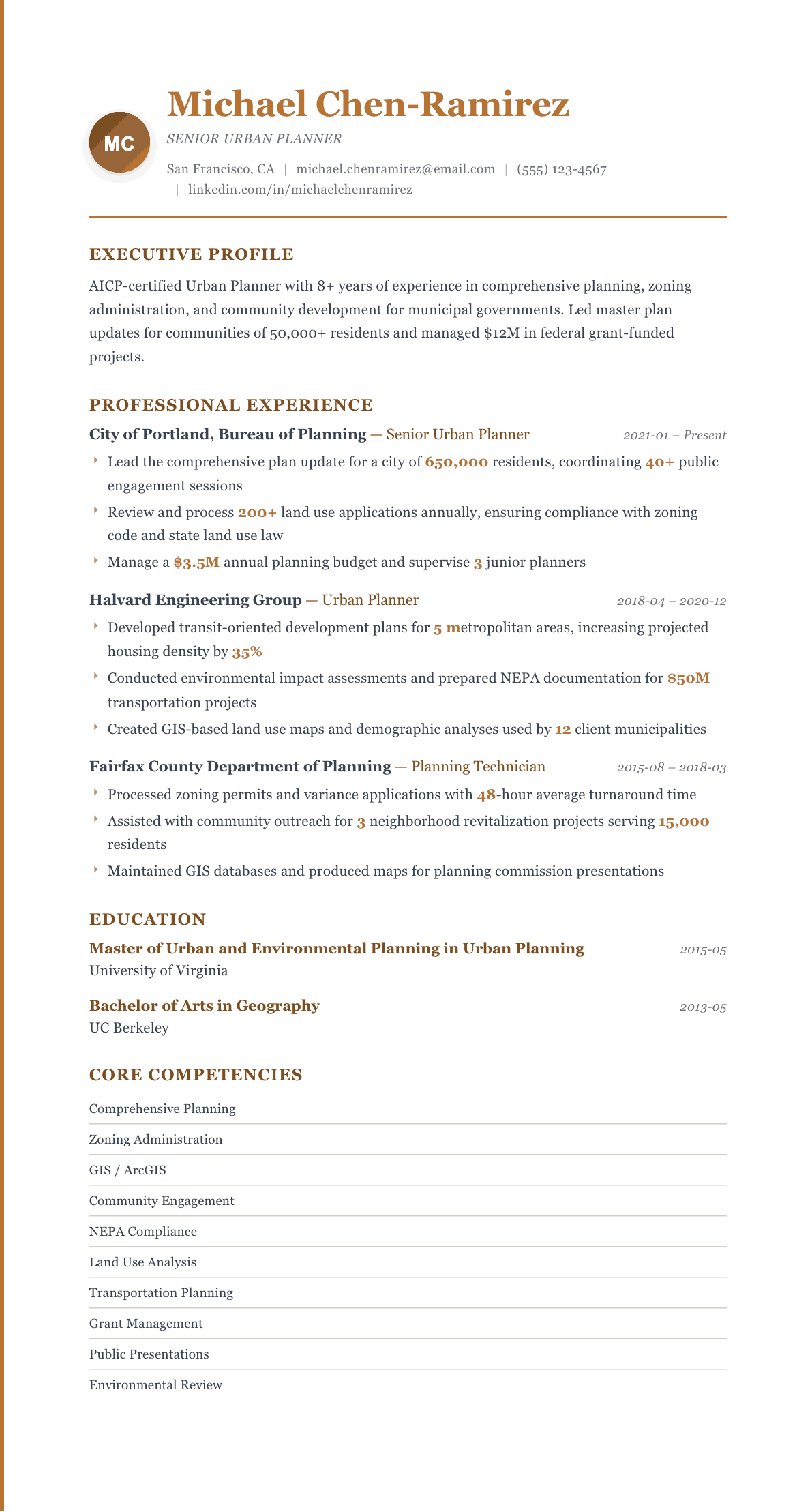
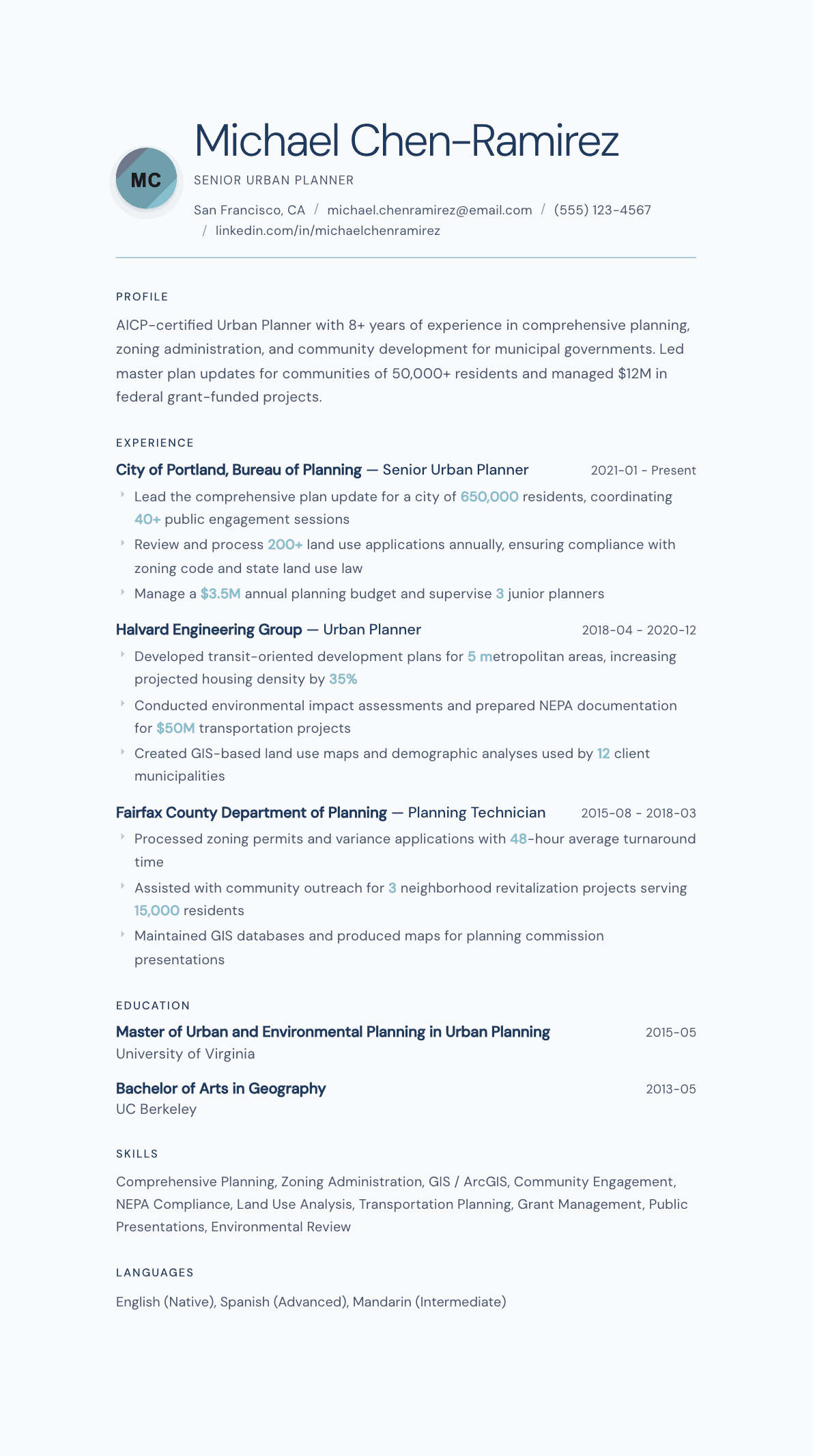
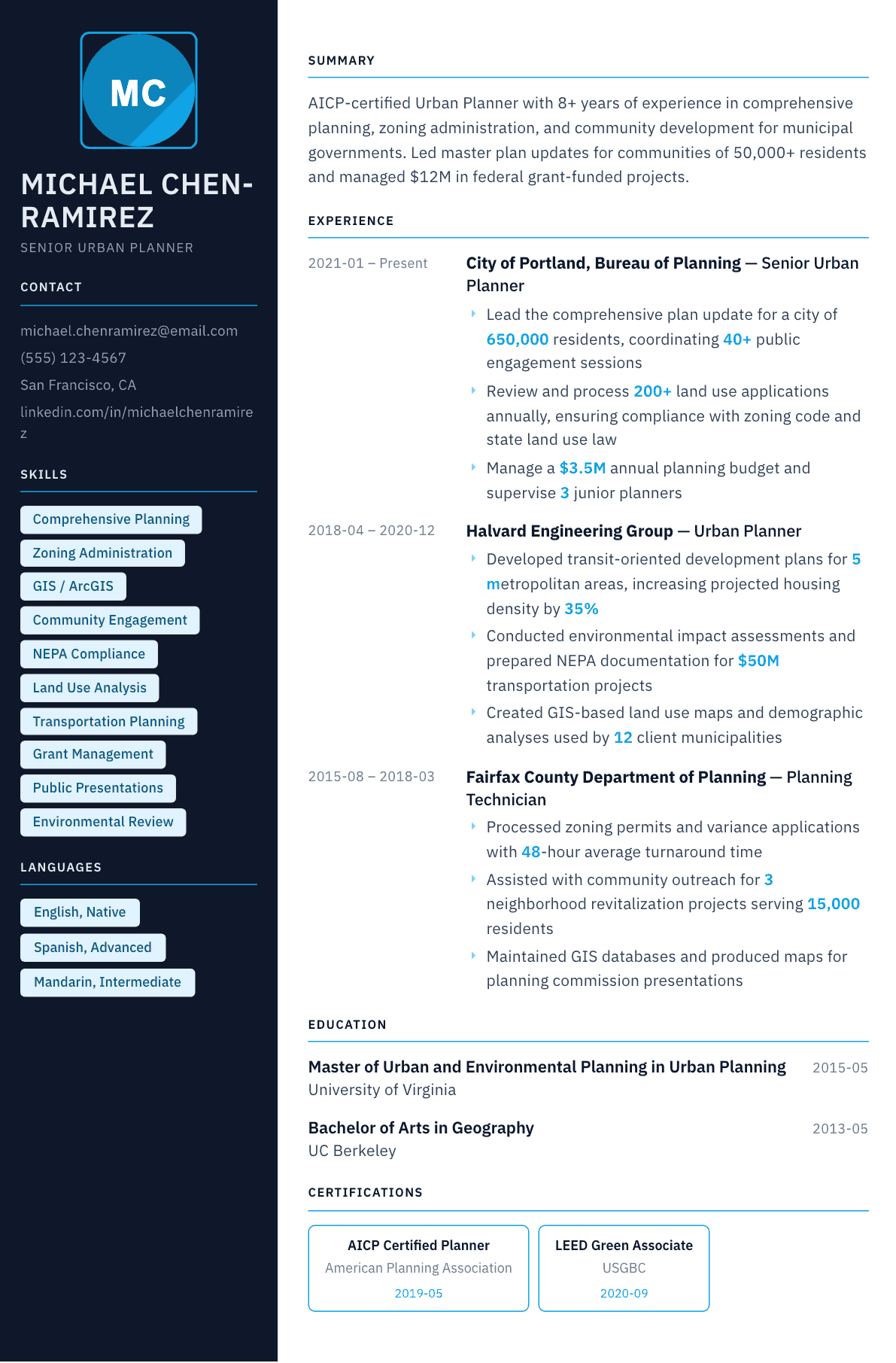
Example Urban Planner summary
AICP-certified Urban Planner with 8 years of experience in comprehensive planning, zoning administration, and community development. Led master plan updates for cities of 650,000+ and managed $12M in grant-funded projects. Seeking a planning director role in a progressive municipality.
Skills to list on a Urban Planner resume
- Comprehensive Planning
- Zoning & Land Use
- GIS / ArcGIS
- Community Engagement
- Environmental Review (NEPA)
- Transportation Planning
- Housing Policy
- Grant Writing & Management
- Public Presentations
- Demographic Analysis
- Site Plan Review
- Historic Preservation
- Sustainability Planning
- LEED / Green Building
What actually gets this resume read
- Include your AICP certification prominently. It is the gold standard in the planning profession.
- Highlight GIS and mapping software skills (ArcGIS, QGIS) as these are essential technical requirements.
- Quantify community impact: population served, housing units planned, or grant dollars managed.
- Showcase public engagement experience: number of meetings facilitated, outreach strategies used.
- Mention specific plan types: comprehensive plans, master plans, corridor studies, TOD plans.
- Include environmental review experience (NEPA, CEQA, SEPA) for government roles.
How to write a urban planner resume
An urban planner resume is usually screened by a planning director or a principal planner who wants to know one thing quickly: can you carry a caseload of applications through a public hearing without the city attorney having to rescue you. Everything else, the mapping, the modeling, the writing, sits underneath that question.
The field splits into two hiring tracks that read differently. Current planning is permit work: site plan review, variances, conditional use permits, subdivision plats, code interpretation and staff reports that go to a planning commission. Long range planning is policy work: comprehensive plan elements, zoning code rewrites, housing and transportation elements, environmental review and the public engagement that surrounds them. A resume that does not signal which track you belong to gets filed under neither.
This guide covers how to structure the document for a municipal or consulting hiring panel, with example summaries for a planning technician, a mid career planner and a principal planner, before and after bullets drawn from real casework, and the questions planners ask when they move between the public and private sides.
Format: one page early, two pages once you have a project list
Reverse chronological, plain and parseable. Public agencies commonly run applications through a civil service system that flattens formatting, and consulting firms attach your resume to proposals where a client procurement officer reads it against a scope of work. Both audiences want scannable headings, not a designed layout.
Once you have five or more substantial projects, add a selected projects section under experience. Give each project the jurisdiction, your role, the deliverable and the outcome, because in this field the project list is what a proposal manager copies into a statement of qualifications.
- Header: name, AICP if you hold it, city and state, phone, email.
- Order: summary, experience, selected projects, education, certifications, technical skills.
- Name the jurisdiction population and the plan or code you worked under in every job.
Summary: track, jurisdiction scale, and the statutory framework you know
Three lines. Say whether you are a current planning, long range or transportation planner, give the size and type of jurisdiction, and name the legal framework you have practiced under. State land use law is not portable in the way software is, so a planner who has worked under a state growth management act, a California environmental quality review process or a home rule zoning enabling act should say so plainly.
If you are moving from consulting into a city job, or the reverse, name the transferable part. A consultant moving in-house should lead with the plans they authored for municipal clients and any hearings they presented at, because the gap a director worries about is public exposure, not technical ability.
Experience: caseload, code, hearings and the deliverable
Each job needs the jurisdiction and its size, the type of planning, and the volume of work. A line saying current planner for a city of 120 thousand residents reviewing site plans, variances and conditional use permits under a form based code tells a director what your week looked like.
Then write bullets around casework and deliverables. Applications reviewed per year and average turnaround. Staff reports authored and the bodies they went to: planning commission, board of zoning appeals, city council, design review board. Code amendments you drafted and whether they were adopted. Comprehensive plan elements you wrote. Environmental documents you prepared or managed. Public meetings you facilitated and the attendance.
Adoption is the outcome that counts. A plan that was adopted, a code amendment that passed, a rezoning that was approved on staff recommendation, a grant that funded construction. Planners produce documents, and a document that never cleared a legislative body is an unfinished sentence.
Technical skills: the tools a planning office actually uses
Name the geographic information system by product, since ArcGIS Pro, ArcMap and QGIS are not interchangeable on a job posting. Add the permitting and land management system you worked in, such as Accela, Tyler EnerGov or Municity, because that single line saves a new hire weeks of ramp up and directors notice it.
Round out with the analytical and visual tools: parcel and demographic analysis from census data, travel demand or trip generation work, site plan review against dimensional standards, Adobe InDesign and Illustrator for plan documents, SketchUp or similar for massing studies, and public engagement platforms used for online comment.
- Name the zoning ordinance style you know: Euclidean, form based, hybrid, unified development ordinance.
- List the environmental review framework you have worked under by name.
- Say which model or dataset you built analyses from rather than writing data analysis.
AICP, education and professional standing
The American Institute of Certified Planners credential is the one that changes how your resume is read, because many senior and principal classifications either require it or list it as a preferred qualification with a salary differential. Put the letters after your name and the certification in its own line with the year you earned it.
Note whether your degree program was accredited by the Planning Accreditation Board. Some job specifications treat an accredited master of urban planning as a substitute for years of experience, and a screener who cannot tell will not give you the benefit of the doubt. If you sit on a board or commission in another jurisdiction, list it: planners who have been on the other side of the dais read differently.
Keywords a planning posting is scanning for
Planning classifications repeat a small vocabulary. Mirror the ones that are true of you: comprehensive plan, zoning administration, site plan review, subdivision, variance, conditional use permit, land development code, staff report, public hearing, community engagement, transit oriented development, affordable housing, capital improvement program and environmental review. Use each inside a sentence describing a real case, since the reviewing planner can tell the difference between a keyword and a memory.
Urban Planner resume summary examples
Planning technician
Planning graduate with 2 years processing zoning permits, sign permits and variance applications for a suburban city, plus GIS support for the planning commission. Maintained parcel and land use layers in ArcGIS Pro and produced hearing exhibits for 40 cases. Seeking an associate planner position.
Six years in
AICP planner with 6 years of current planning for a city of 120 thousand residents, reviewing 200 land use applications a year and authoring staff reports for the planning commission and board of zoning appeals. Drafted and shepherded four adopted code amendments, including an accessory dwelling unit ordinance.
Principal planner
Principal planner with 12 years across municipal and consulting practice, leading the comprehensive plan update for a city of 650 thousand residents and supervising three planners. Managed environmental documentation for transportation projects and ran engagement programs reaching neighborhoods that had never appeared at a hearing.
Work experience bullets: before and after
Before: Reviewed development applications for the city.
After: Reviewed 200 land use applications a year, including site plans, variances and conditional use permits, and issued written determinations within the 30-day statutory review clock.
Volume, application type and the review deadline tell a director whether you can hold a caseload without falling behind the statute.
Before: Worked on the comprehensive plan.
After: Authored the housing and land use elements of the comprehensive plan update, ran 40 public engagement sessions, and carried the draft through planning commission and council adoption.
Naming the elements you wrote and the adoption at the end shows ownership of a deliverable instead of participation in a process.
Before: Used GIS for mapping and analysis.
After: Built a parcel-level buildable land inventory in ArcGIS Pro combining zoning, slope and utility service layers, which became the basis for the density assumptions in the housing element.
The specific analysis and its downstream use prove analytical judgment rather than software familiarity.
Before: Presented at public meetings.
After: Presented 60 staff reports to the planning commission and board of zoning appeals, including three contested rezonings that were approved on staff recommendation after neighborhood opposition.
Hearing volume and a contested case are the closest evidence a resume can give that you can stand at the podium.
Before: Helped secure grant funding for planning projects.
After: Wrote the planning grant application that funded a corridor study for a state transportation program, then managed the consultant team and the study through council acceptance.
Following the money from application to acceptance shows you can run a funded project, not just write a narrative.
Hard skills
- Zoning administration
- Site plan and subdivision review
- Comprehensive plan development
- Land development code drafting
- Staff report writing
- ArcGIS Pro and QGIS
- Accela and permitting systems
- Environmental review documentation
- Demographic and land use analysis
- Capital improvement programming
- Adobe InDesign for plan documents
- Public engagement facilitation
Soft skills
- Hearing presentation
- Conflict de-escalation with residents
- Plain-language writing
- Interdepartmental coordination
- Political awareness
- Applicant negotiation
Certifications worth listing
- AICP Certified Planner (American Institute of Certified Planners)
- AICP Candidate Program (American Institute of Certified Planners)
- LEED Green Associate (U.S. Green Building Council)
- Certified Floodplain Manager (CFM) (Association of State Floodplain Managers)
- Certified Zoning Official (American Association of Code Enforcement)
Mistakes that cost urban planner candidates the interview
- Writing a resume that never says whether you do current planning or long range planning, which forces a director to guess.
- Listing plans and studies without saying whether the legislative body adopted them.
- Writing GIS as a single skill instead of naming the product and the analysis you built with it.
- Leaving out the permitting system, which is one of the few lines that predicts how fast a new planner becomes useful.
- Hiding AICP at the bottom when the classification pays a differential for it.
- Omitting jurisdiction size, so a panel cannot tell a rural county with one planner from a metropolitan department.
Urban Planner resume questions
Do I need AICP to get a planning job?
Not for entry or associate roles, where a degree and experience are enough. Senior, principal and manager classifications frequently require it or offer pay for it, so if you meet the experience threshold, put your candidacy or your certification on the resume in the header.
How do I move from consulting to a city planning department?
Lead with the municipal clients you served, the plans and codes you authored for them, and any hearing or commission meeting you presented at. Directors worry that consultants have never been publicly accountable for a recommendation, so evidence of standing at a podium answers the real objection.
Should I include a project list on an urban planner resume?
Yes once you have several substantial projects. Give each one the jurisdiction, your role, the deliverable and the adoption or approval outcome. Consulting firms reuse that block directly in statements of qualifications, which makes you easier to hire.
How much GIS detail belongs on the resume?
Name the software version family and describe one or two analyses you actually built, such as a buildable land inventory or a transit access study. A long list of tools with no analysis behind it reads as coursework rather than professional practice.
Does state land use law experience transfer between states?
The skills transfer, the statutes do not. Name the framework you practiced under and say plainly that you are ready to learn the new one. Hiring panels in states with distinctive review requirements are used to training in-migrants, but they want the gap acknowledged rather than hidden.
Related resume examples
- Policy Analyst Resume example
- City Manager Resume example
- Public Health Director Resume example
- City Planner Resume example
- Zoning Administrator Resume example
- Community Development Manager Resume example