Editorial Assistant Resume Examples: what gets the call
Write an Editorial Assistant Resume That Gets a First Publishing Job
By Mustafa Tarabya, founder of CVBooster · Published · Updated
Editorial assistant resume examples and a guide to internships, slush reading, permissions, scheduling and the skills publishers screen for.
Sample resumes for a editorial assistant
The same editorial assistant content laid out in three CVBooster templates, so you can see what the finished document looks like before you write a word.
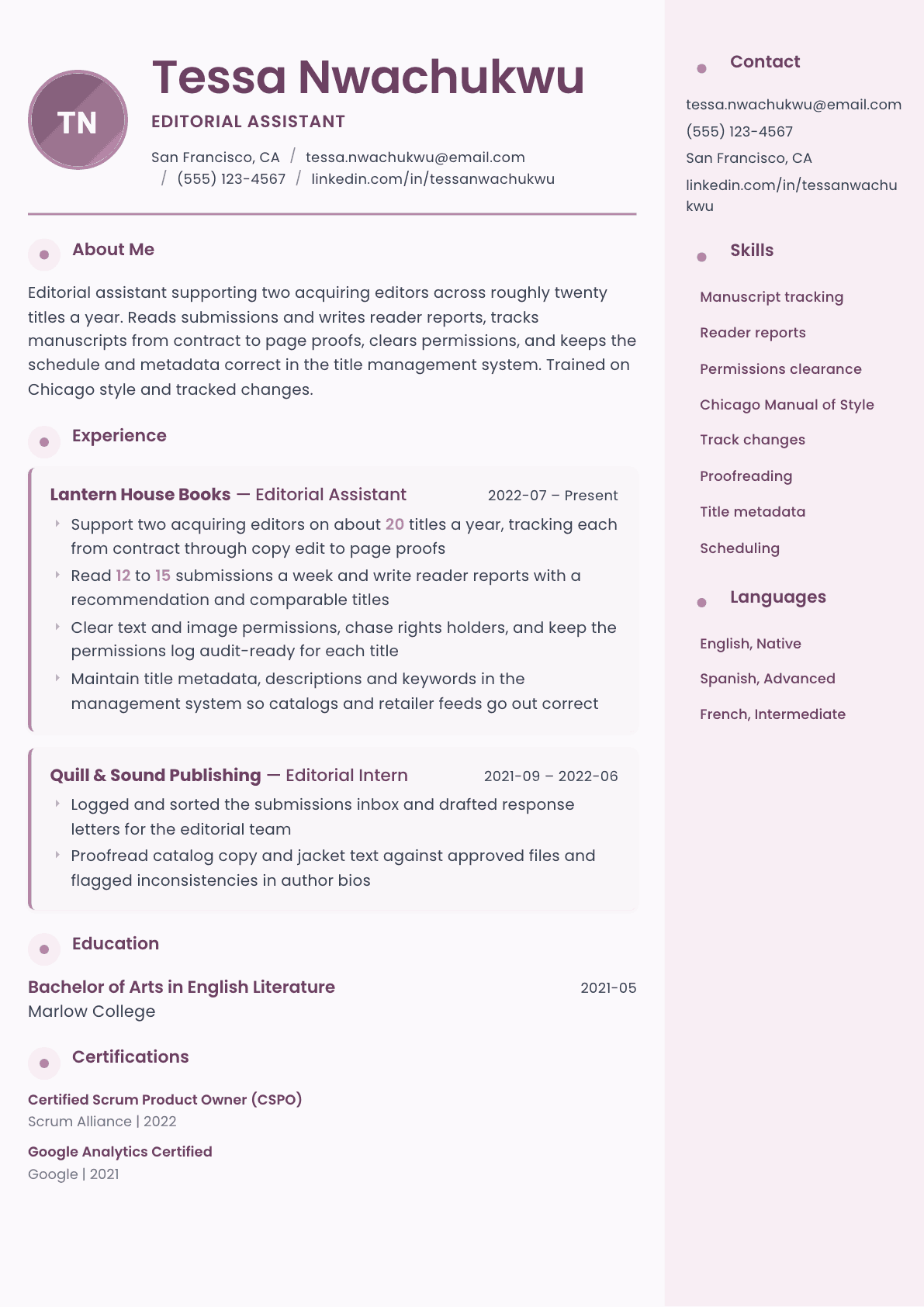
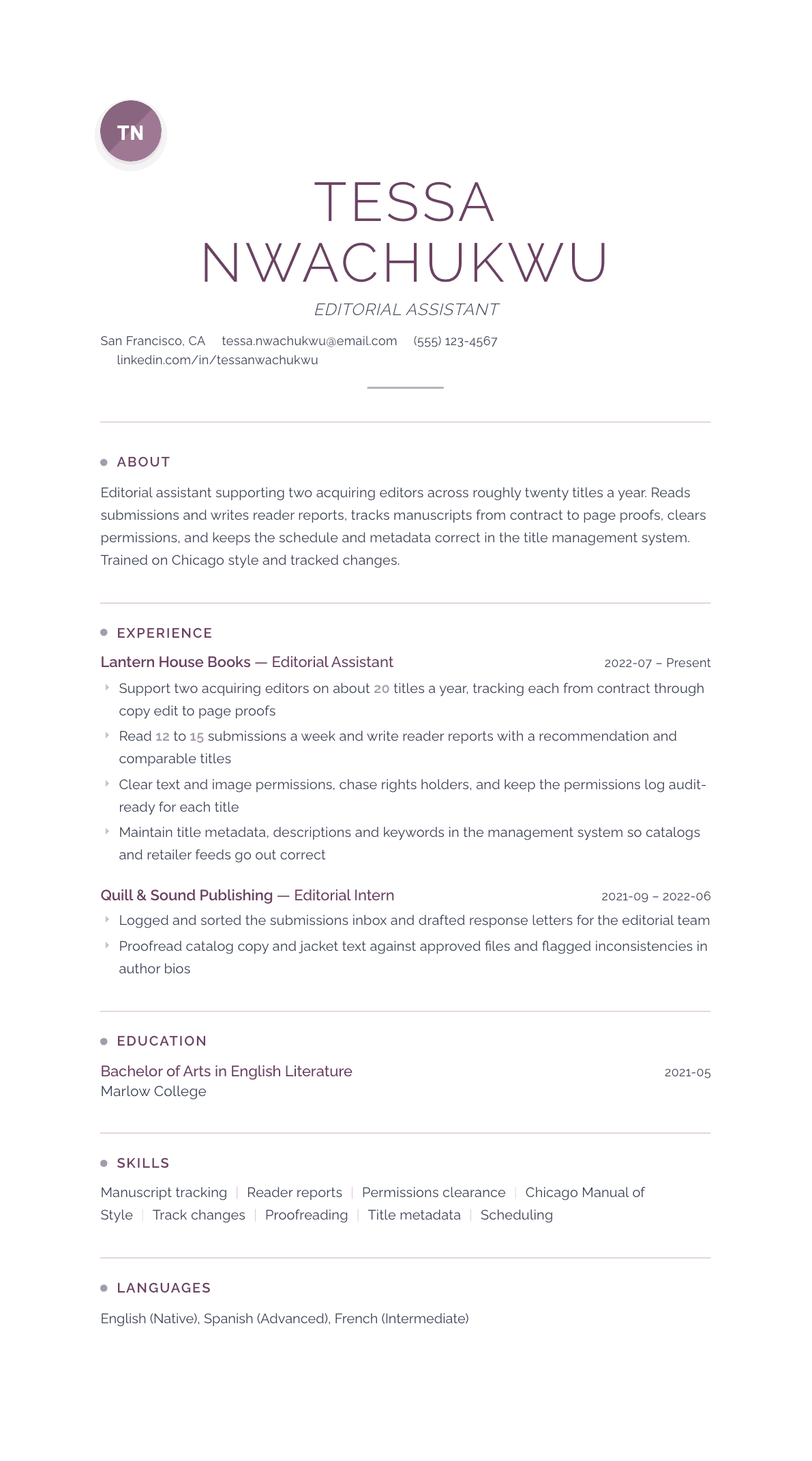
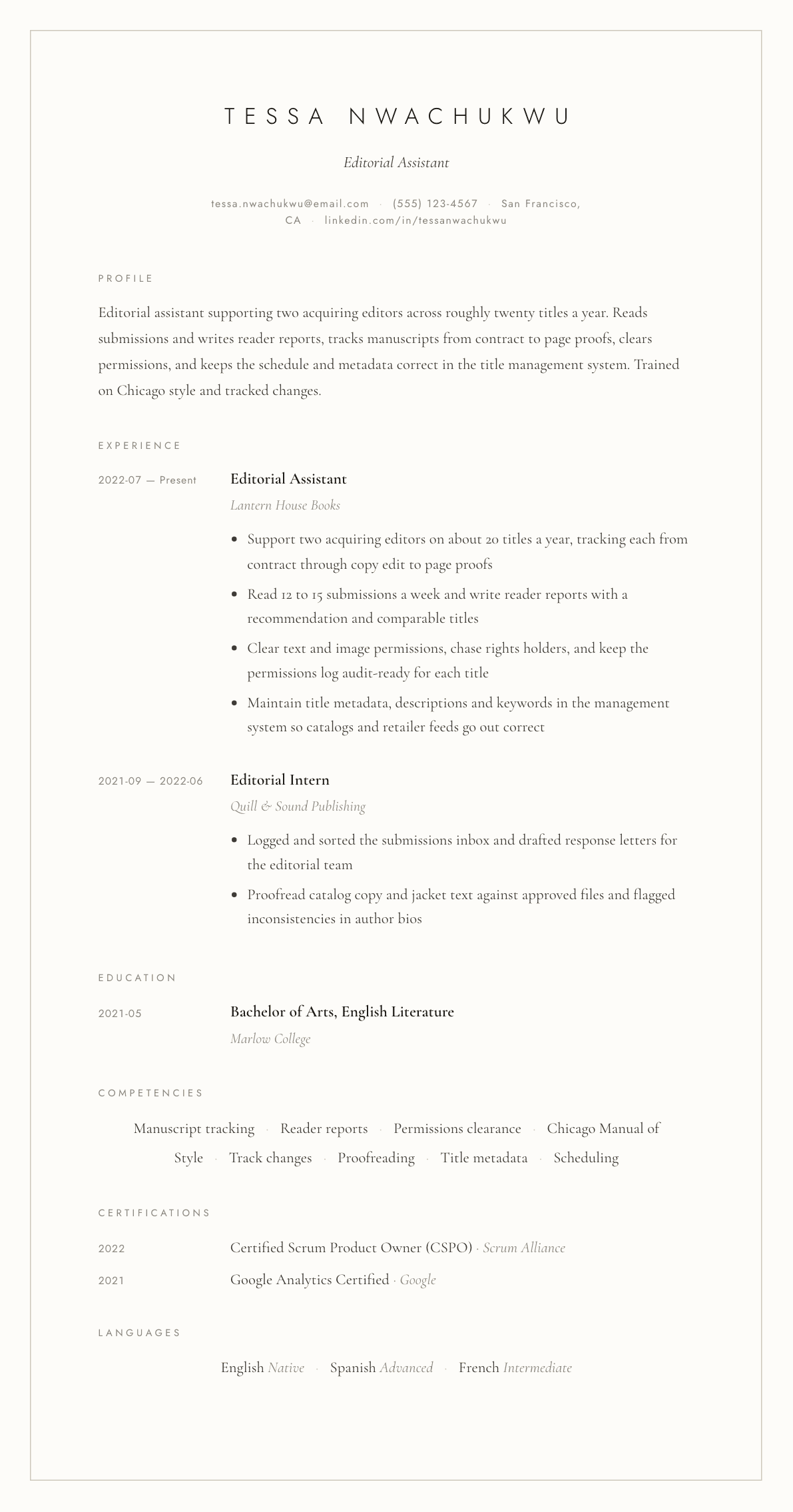
Example Editorial Assistant summary
Editorial assistant supporting two acquiring editors on about twenty titles a year, from signed contract through copy edit to page proofs. Reads a dozen submissions a week and writes reader reports with comparable titles, clears text and image permissions, and keeps title metadata accurate for catalogs and retailer feeds. Trained in Chicago style and tracked changes.
Skills to list on a Editorial Assistant resume
- Manuscript tracking
- Reader reports
- Slush pile reading
- Permissions and rights
- Chicago Manual of Style
- Proofreading
- Track changes
- Title metadata
- Catalog copy
- Editorial scheduling
- Author correspondence
- Meeting minutes
- Microsoft Excel
What actually gets this resume read
- Lead with the number of titles or writers you support, because publishers hire assistants to hold volume.
- Name the stages you track: contract, delivery, copy edit, page proofs, printer files and publication date.
- Put reader reports on the resume if you write them, and say what a report from you contains.
- Show permissions and rights work explicitly, since it is unglamorous, essential, and rarely on a junior resume.
- List every system by name, including the title management database, the CMS and any scheduling tool.
- Turn your internships into real bullets with volumes and outcomes rather than a bare list of duties.
How to write a editorial assistant resume
The editorial assistant job is the front door to book and magazine publishing, which means the pile of applications is deep and most of them look identical: an English degree, a love of reading, one internship, and a list of duties. The editor doing the screening is not looking for enthusiasm, which is abundant. She is looking for someone who will not drop a page-proof deadline, will chase a rights holder four times without being asked, and will keep a spreadsheet accurate for a year.
That is why administrative precision belongs in front of literary taste on this resume. Taste gets tested in the reader report you will be asked to write during the hiring process. Reliability has to be argued on paper, with title counts, tracked stages, permissions cleared and systems kept correct.
This guide covers how to structure a resume with little paid experience, how to turn internships and coursework into real bullets, three summaries from intern to senior assistant, and the questions people ask when they are trying to get a first publishing job.
Format: one page, clean, and never a decorated template
One page in reverse chronological order, one typeface, generous margins. Publishing is a text industry and a resume with color blocks and icons reads as someone who has not looked at a manuscript workflow. The document should look like something that would sit comfortably in a submission pile.
With under two years of paid work, put education above experience and add a section for relevant coursework, a student publication, or a literary magazine you helped run. After a full year in a publishing job, drop the coursework and let the titles carry the page.
- Header: name, city and state, phone, email, and the list or category you want to work in if you have a preference.
- Section order for a first job: summary, education, publishing experience, other experience, skills and systems.
- Name any imprint, list or genre you have worked on, since acquiring editors hire for their own shelf.
Summary: who you support, how many titles, and what you keep correct
Say how many editors you support and how many titles or issues a year pass through your hands. Support for two acquiring editors on twenty titles a year is a specific workload that a hiring editor can compare to her own desk. Then name the stages you track and the systems you keep accurate, because that is what the job is on a Tuesday afternoon.
Add one line on reading. Submissions read per week and the fact that you write reader reports with a recommendation and comparable titles proves editorial judgment without the word passionate appearing anywhere.
Experience: stages tracked, permissions cleared, metadata correct
Write bullets around the pipeline. A title moves from signed contract to delivery, copy edit, page proofs, printer files and publication date, and the assistant is the person who knows where every one of them is on any given morning. Say how many you tracked at once and what you did when a stage slipped.
Put permissions and rights work on the page explicitly. Clearing text and image permissions, chasing rights holders, keeping the permissions log audit-ready and knowing when a quotation needs clearance is unglamorous, genuinely difficult, and almost never on a junior resume. It is one of the fastest ways to look like someone who has really done the job.
Do not forget metadata and catalog copy. Title descriptions, keywords, categories and jacket text feed retailer systems and sales catalogs, and errors there are expensive and public. An assistant who says she kept the title management records correct so catalogs and retailer feeds went out clean is speaking the language of the production and sales meetings.
Turning internships and unpaid work into real bullets
An internship written as a duty list wastes the strongest evidence a junior candidate has. Give it volume and outcome the same way a paid role gets them. Submissions logged per week, response letters drafted, catalog copy proofed against approved files, meeting minutes circulated the same day, inconsistencies flagged in author bios: each one is a fact, and facts are what the pile is short of.
Student publications, campus literary journals, bookstore work and library shifts all count when written with the same discipline. Bookselling in particular is worth keeping, because it proves you know how books reach readers and how a category actually sells, which is knowledge an acquiring editor values.
- Say what a reader report from you contains: summary, market position, comparable titles and a clear recommendation.
- Include the correspondence you handle with authors and agents, since tone in those emails is part of the job.
- List Excel or the spreadsheet work honestly, because schedules, permissions logs and royalty checks live there.
Skills, systems and the keywords a publisher screens on
Name the systems by name: the title management database, the content system, the scheduling tool, the submissions inbox process, tracked changes in Word, and the style authority you were trained in, which in book publishing is usually Chicago. A junior candidate who can list the tools is cheaper to onboard than one who cannot.
The recurring posting terms are manuscript tracking, reader reports, submissions, permissions, editorial scheduling, title metadata, catalog copy, proofreading, author correspondence and diary or calendar management. Mirror the wording once in the skills block and once in a bullet that shows it.
Editorial Assistant resume summary examples
Straight from an internship
English graduate with two publishing internships, logging the submissions inbox, drafting response letters and proofreading catalog copy against approved files. Trained in Chicago style and tracked changes, and comfortable keeping a schedule spreadsheet accurate across a full seasonal list.
Two years in
Editorial assistant supporting two acquiring editors on about 20 titles a year, tracking each from signed contract through copy edit to page proofs. Reads 12 to 15 submissions a week and writes reader reports with comparable titles, clears text and image permissions, and keeps title metadata correct for catalogs and retailer feeds.
Senior assistant moving to assistant editor
Senior editorial assistant on a nonfiction list of 30 titles a year, running the permissions log, the schedule and the freelance copy editor roster. Acquired two titles from the submissions pile, line edits proposals before they reach the acquisitions meeting, and trains each new assistant on the title system.
Work experience bullets: before and after
Before: Assisted editors with day-to-day tasks.
After: Supported two acquiring editors across about 20 titles a year, tracking every title from signed contract through copy edit and page proofs to printer files.
A title count and a named pipeline replace the word tasks with a workload a hiring editor can size.
Before: Read submissions from the slush pile.
After: Read 12 to 15 submissions a week and wrote reader reports covering the story, the market position, three comparable titles and a clear recommendation.
Volume plus the anatomy of your report demonstrates editorial judgment instead of claiming taste.
Before: Handled permissions for books.
After: Cleared text and image permissions for each title, chased rights holders to written agreement, and kept the permissions log audit-ready ahead of the printer deadline.
Chasing to agreement and an audit-ready log show the persistence the work really requires.
Before: Updated the title database.
After: Maintained title metadata, descriptions and keywords in the management system so seasonal catalogs and retailer feeds published without correction.
Linking the data work to the downstream output shows you understand why the accuracy matters.
Before: Did an internship at a publishing house.
After: Logged and sorted an inbox of about 60 submissions a week, drafted response letters for editor approval, and proofread catalog copy against approved files.
The internship becomes evidence once it carries volumes and deliverables like any other job.
Hard skills
- Manuscript and schedule tracking
- Reader reports
- Submissions and slush reading
- Permissions and rights clearance
- Chicago Manual of Style
- Proofreading
- Tracked changes in Word
- Title metadata and keywords
- Catalog and jacket copy
- Editorial scheduling
- Author and agent correspondence
- Meeting minutes and follow-ups
- Microsoft Excel
Soft skills
- Follow-through without reminders
- Discretion with unpublished work
- Professional tone in author email
- Prioritizing across two managers
- Accuracy under repetition
- Reading widely in a category
Mistakes that cost editorial assistant candidates the interview
- Opening with a love of books, which is true of every applicant and settles nothing for the screener.
- Writing internships as duty lists instead of giving them volumes, deliverables and outcomes.
- Leaving permissions, metadata and scheduling off the page, which are the parts that prove real desk experience.
- Using a decorated template with icons and color blocks in an industry that reads plain text all day.
- Never naming the style authority or the title management system, so onboarding cost looks high.
- Listing unrelated retail or hospitality work with no bullets, when the same jobs prove reliability and volume if written properly.
- Sending a resume with a typo to an editorial job, which is treated as the answer to the whole application.
Editorial Assistant resume questions
How do I get an editorial assistant job with no publishing experience?
Lead with any work that proves accuracy under volume, such as bookselling, library, administrative or student publication roles, written with real numbers. Then add a reading credential: a reader report you have written, or a category you follow closely enough to name comparable titles.
Should I list the books I have worked on?
List categories and counts rather than a bibliography, unless a title is genuinely well known and you can describe your part accurately. Editors are wary of assistants who claim credit for acquisitions, so describe the stage you handled instead.
Do I need to include a cover letter for publishing jobs?
Almost always yes, and in this field it is read carefully because it is a writing sample. Name the list or imprint, mention two recent titles you admire and why, and keep it to one page in clean prose without ornament.
What does a reader report on a resume actually show?
It shows you can summarize a manuscript, place it against comparable titles and make a defensible recommendation. Saying what your report contains is far stronger than listing reading as a skill, because it describes an output an editor already relies on.
Is magazine or journal experience useful for a book publishing job?
Yes, because the tracking, permissions and proof stages transfer almost directly. Translate the vocabulary for the reader: issue close becomes title schedule, contributor contracts become author agreements, and fact-checking becomes verification during the editorial pass.