Managing Editor Resume Examples: the lines they read
Shape a Managing Editor Resume Around Schedule, Staff and Standards
By Mustafa Tarabya, founder of CVBooster · Published · Updated
Managing editor resume examples plus a guide to publishing cadence, staff size, budget ownership and the metrics editors in chief check.
Sample resumes for a managing editor
The same managing editor content laid out in three CVBooster templates, so you can see what the finished document looks like before you write a word.
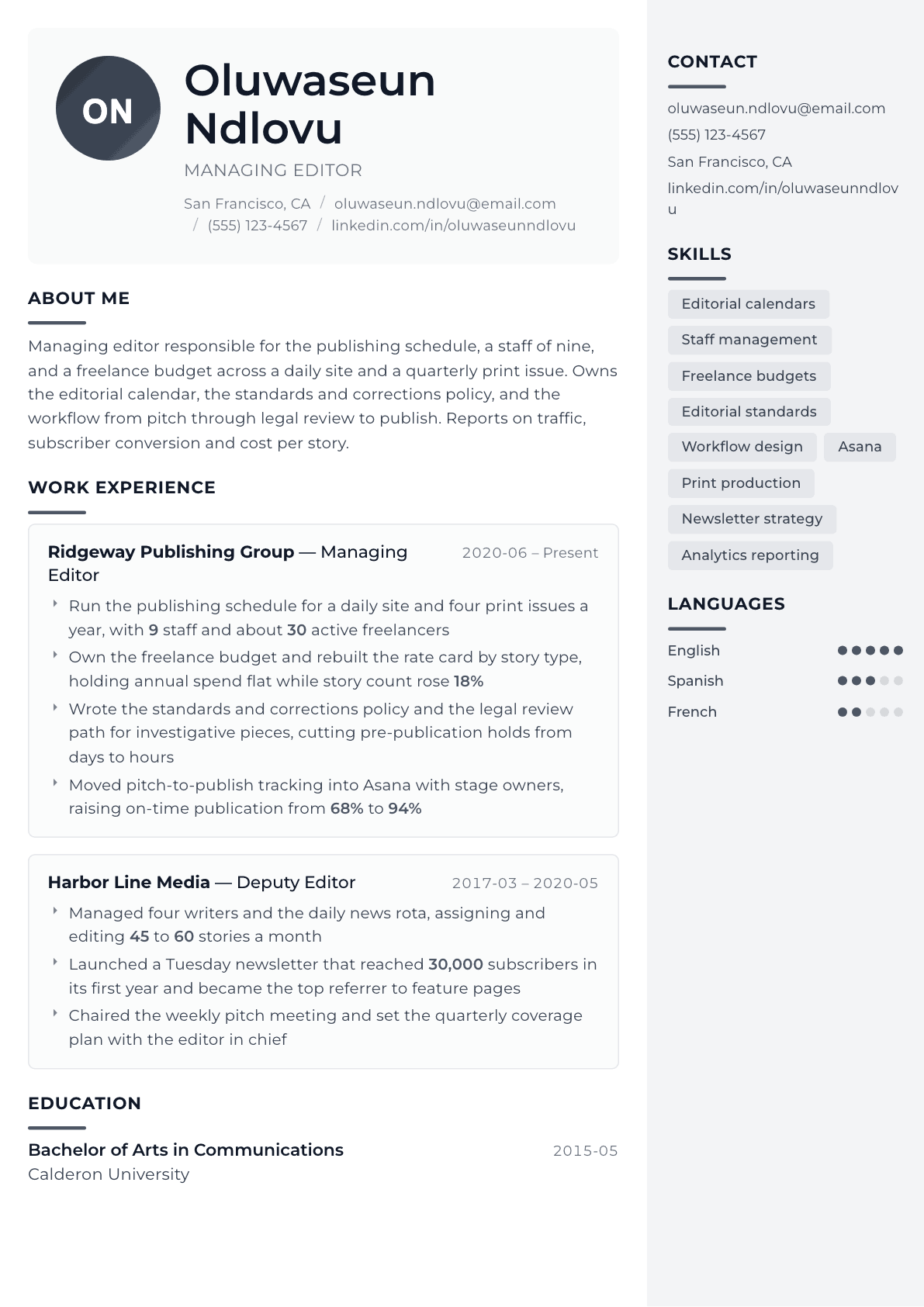
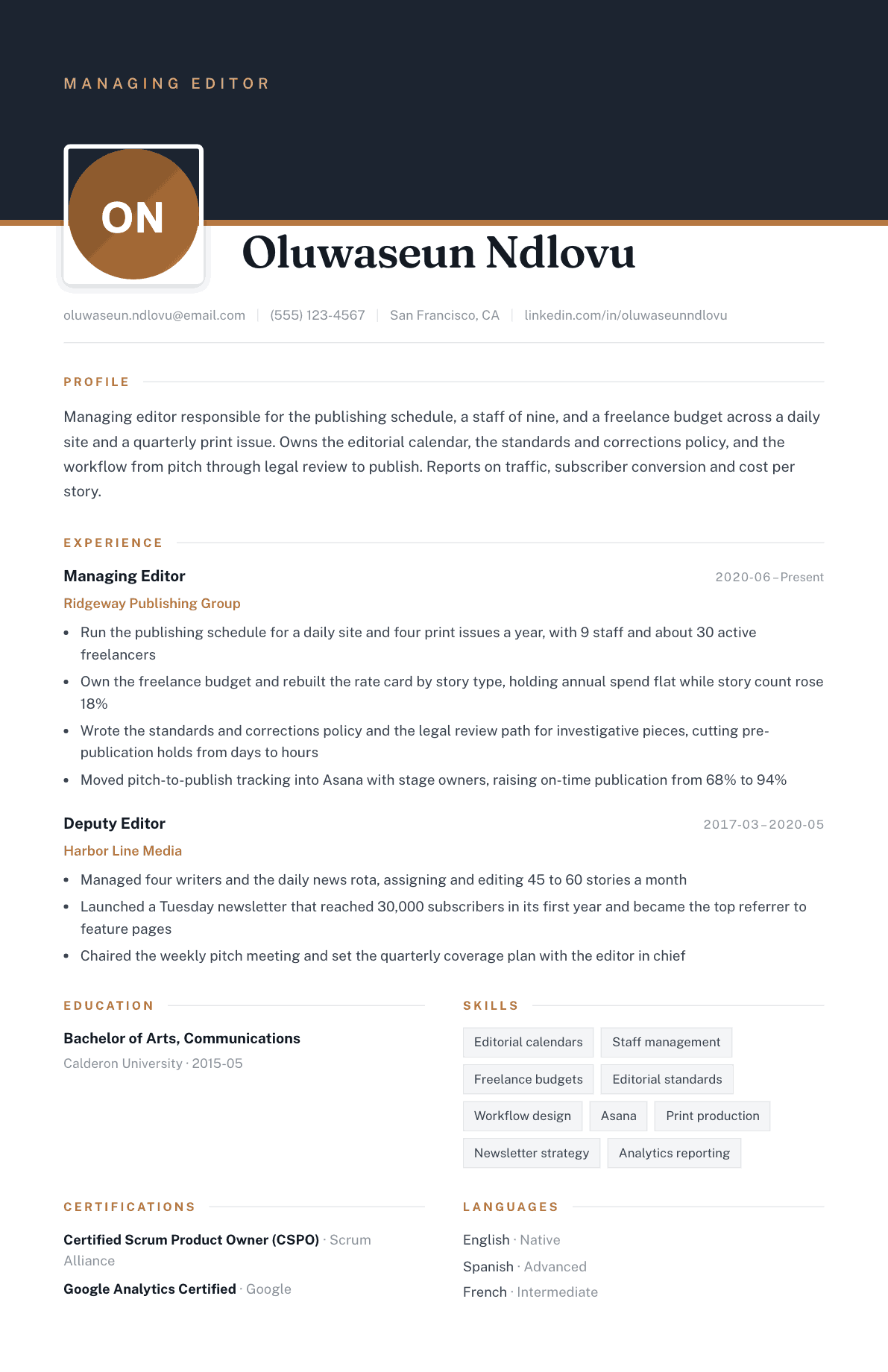
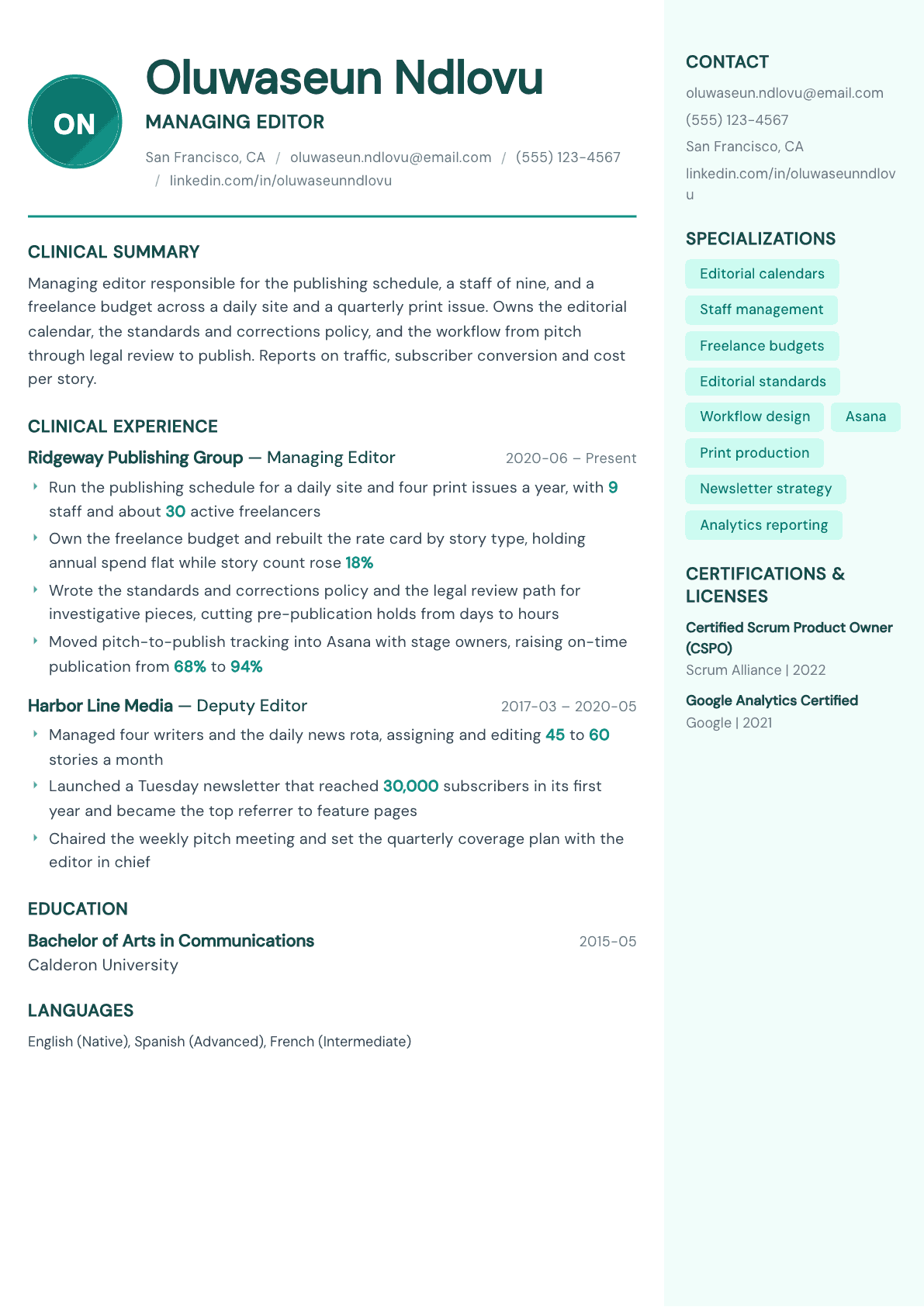
Example Managing Editor summary
Managing editor running a daily site and four print issues a year with nine staff and roughly thirty freelancers. Owns the editorial calendar, the freelance budget, the standards and corrections policy, and the pitch-to-publish workflow in Asana. Raised on-time publication from 68% to 94% while holding annual freelance spend flat against an 18% rise in story count.
Skills to list on a Managing Editor resume
- Editorial calendar management
- Staff and freelance management
- Budget ownership
- Editorial standards and ethics
- Workflow design
- Print production scheduling
- Asana
- WordPress
- Newsletter strategy
- Analytics reporting
- Hiring and coaching
- Legal review coordination
- Coverage planning
- Corrections policy
What actually gets this resume read
- Open with the cadence you run: daily site, weekly print, monthly magazine, and how many stories that means.
- Give the size of the team you manage and the freelance roster you commission, since scope decides the level.
- Name the budget you own and what you did with it, because managing editors are hired to control cost per story.
- Show the workflow you built and the tool it runs in, from pitch through edit, legal check and publication.
- Include one standards achievement, such as a corrections policy, a sourcing rule, or a fact-check process you set.
- Report two numbers an editor in chief tracks: on-time publication rate and traffic or subscriber conversion.
How to write a managing editor resume
A managing editor is hired to make the publication come out on time, on standard and on budget, which means the resume is read as an operations document rather than a writing sample. The editor in chief scanning it wants the cadence you ran, the size of the staff and freelance roster you carried, the budget you controlled, and the workflow you owned from pitch to publication. Prose quality is assumed; delivery is what is being bought.
That makes the common mistake easy to spot. Many managing editor resumes read like senior editor resumes with a bigger story count, all commissioning and line editing and no schedule, staff, budget or standards work. The result is a candidate who looks talented but not accountable, and the job goes to whoever named the numbers.
This guide covers how to structure the file around cadence and scope, what to put in the experience bullets, three summaries from deputy to head of a newsroom or list, and the questions managing editors ask when they sit down to rewrite this document.
Format: two pages once you have run a masthead
Reverse chronological, one column, and no design flourishes. A managing editor resume that leans on a decorative template invites the wrong read, because the job is administration of a creative process rather than the creative act. Keep the top third dense with scope, since that is where the decision is made.
Two pages is normal once you have run a schedule for more than a few years. Use the second page for earlier editing roles compressed to two lines each, plus a short block for standards work, awards administration, hiring, or launches you managed.
- Header: name, city and state, phone, email, and the type of publication you run.
- Section order: summary, scope snapshot, experience, standards and workflow, skills and systems, education.
- A scope snapshot of three lines listing cadence, team size and budget responsibility saves a screener a full read.
Summary: cadence, headcount, budget, and one delivery number
The first sentence names the publishing cadence and the surfaces: a daily site, a weekly print edition, four issues a year, a newsletter portfolio, a podcast feed. The second gives staff headcount and the active freelance roster. The third gives one delivery number, usually the on-time publication rate or the change in stories produced against flat spend.
Resist adjectives about collaboration and passion here. A managing editor is judged on whether the issue closed, so lead with the evidence that it did, then let the interview cover temperament.
Experience: schedule, staff, money, standards
Structure each role around the four things the job actually owns. The schedule: what published, how often, how many pieces, and what the close process looked like. The staff: how many editors, writers, designers and photo people reported to you, plus the freelance roster you commissioned and rated. The money: the budget you held, the rate card you set, and what you did about cost per piece. The standards: the corrections policy, sourcing rules, fact-check process, and the legal review path for sensitive work.
Then quantify delivery rather than volume alone. On-time publication rate, average pitch-to-publish days, the percentage of stories arriving at the copy desk on the assigned date, and the number of late invoices to freelancers are all measures an editor in chief recognizes because they cause the pain a managing editor is hired to remove.
Include one bullet per role about people. Hires made, editors promoted, a rota you designed that ended weekend chaos, or a coaching structure for junior staff. Retention and development are the second half of the job and most resumes leave them out entirely.
Workflow and systems: name the tool and the stages
Describe the pipeline you built and the stages it enforces: pitch, commission, contract, draft, edit, fact-check, legal read, copy edit, art and photo, headline, publication, then promotion. Say who owns each stage and what a piece cannot pass without. Editors hire process because process is what survives after you leave.
Name the systems: the content management system, the project tracker such as Asana, Trello, Airtable or Jira, the print production tooling if you close an issue, the invoicing or contributor payment system, and the analytics dashboard you report from. Publishing organizations screen hard on these because a managing editor who has to learn the tracker for three months is a slow start.
- Give the contributor lifecycle you manage: rate card, contract, kill fee policy, payment terms, invoice tracking.
- Say how you run the pitch meeting and set the quarterly coverage plan with the top editor.
- Note any redesign, platform migration or launch you delivered while the schedule kept running.
Numbers, keywords and what the editor in chief checks
Postings for this role repeat a narrow set of terms: editorial calendar, publishing schedule, editorial standards, corrections policy, freelance budget, workflow, coverage planning, staff management and analytics reporting. Use the same words the posting uses, once in the skills block and once inside a bullet where the work is shown.
Two audience numbers are worth carrying: one about reach or subscriber conversion for the surface you run, and one about efficiency such as cost per piece or on-time rate. Do not turn the resume into a traffic report. A managing editor who can only talk about pageviews looks like a growth editor, and one who can only talk about schedules looks like a production clerk.
Managing Editor resume summary examples
Stepping up from deputy
Deputy editor moving into a managing role, running the daily news rota for four writers and editing 45 to 60 stories a month. Chairs the weekly pitch meeting, owns the assignment tracker, and launched a Tuesday newsletter that became the top referrer to feature pages.
Six years in
Managing editor for a daily site and four print issues a year, with nine staff and about 30 active freelancers. Owns the editorial calendar, the freelance budget and the corrections policy, and moved pitch-to-publish tracking into Asana, raising on-time publication from 68% to 94%.
Head of newsroom operations
Managing editor over a newsroom of 24 across news, features and video, plus a contributor roster of 60. Rebuilt the rate card by story type, held annual freelance spend flat against an 18% rise in story count, and wrote the standards, sourcing and legal review policies now used across three titles.
Work experience bullets: before and after
Before: Managed the editorial calendar.
After: Ran the publishing schedule for a daily site and four print issues a year, holding a close checklist that moved on-time publication from 68% to 94%.
The cadence plus a delivery number turns a duty into proof that the schedule improved under you.
Before: Worked with freelance writers.
After: Commissioned about 30 active freelancers against a rate card I rebuilt by story type, with contracts, kill fees and payment dates tracked in one view so late invoices went to near zero.
It shows the whole contributor lifecycle, including the money, rather than a working relationship.
Before: Improved editorial processes.
After: Designed the pitch-to-publish pipeline in Asana with a named owner per stage, cutting average time from commission to publication by nine days.
A named tool, an ownership model and a time saved make the process real to anyone who has run a desk.
Before: Set editorial standards for the publication.
After: Wrote the standards and corrections policy plus the legal review path for investigative pieces, reducing pre-publication holds from days to hours.
Standards work is judged by whether it unblocked publishing, so the outcome matters as much as the document.
Before: Managed a team of editors and writers.
After: Led nine staff across news and features, hired three editors, promoted two writers into lead-story rotation, and set a rota that ended unplanned weekend coverage.
Hiring, promotion and a scheduling fix show people management instead of a headcount.
Hard skills
- Editorial calendar management
- Publishing schedule and close process
- Freelance budget and rate cards
- Editorial standards and corrections policy
- Workflow design
- Print production scheduling
- Asana and editorial trackers
- WordPress and other content systems
- Newsletter portfolio management
- Analytics and performance reporting
- Hiring, coaching and rotas
- Legal and sensitivity review coordination
- Coverage and quarterly planning
Soft skills
- Decisiveness at close
- Negotiation with contributors
- Calm under breaking news
- Cross-team diplomacy
- Clear written direction
- Holding a standard without losing writers
Certifications worth listing
- Project Management Professional (PMP) (Project Management Institute)
- Poynter ACES Certificate in Editing (The Poynter Institute with ACES: The Society for Editing)
Mistakes that cost managing editor candidates the interview
- Writing a senior editor resume with a bigger story count and no schedule, budget or staffing evidence.
- Leaving out headcount and freelance roster size, so the reader cannot place the scope of the job you ran.
- Never naming the tracker or content system, which suggests the workflow lived in your head rather than in a process.
- Reporting only traffic, which reads as a growth role, or only deadlines, which reads as a production clerk.
- Omitting standards work such as the corrections policy or sourcing rules, the part that protects the title.
- Burying a launch, a redesign or a platform migration in a single clause when it is the strongest delivery proof you have.
- Listing awards the publication won without saying what you ran while it won them.
Managing Editor resume questions
What is the difference between a managing editor and an executive editor on a resume?
A managing editor owns delivery: schedule, staff, budget and standards. An executive or top editor owns direction and voice. Write to whichever the posting describes, because titles vary between publishers and the wrong emphasis reads as applying for a different job.
Should I include traffic numbers?
Include one audience number that you influenced, such as subscriber conversion or newsletter growth for a surface you launched. Pair it with an operations number like on-time publication so the file reads as delivery with commercial awareness rather than a marketing report.
How do I show budget ownership without giving away confidential figures?
Describe the scope and the change instead of the amount. Say you held annual freelance spend flat against a rise in story count, or rebuilt a rate card by story type across a roster of thirty, and leave the absolute number for the interview.
Do I need print production experience for a digital managing editor role?
Not usually, but say so directly if you have it, because print teaches hard close discipline that digital-only candidates often lack. If you have digital only, emphasize the close process you enforce on a daily or weekly cadence instead.
How much of the resume should cover people management?
At least one bullet per role. Hires made, editors promoted, rotas designed, coaching structures set and retention through a difficult period all belong on the page, because a managing editor is measured on whether the desk stays staffed and functional.