Proofreader Resume Examples: free ATS score and gap list
Craft a Proofreader Resume With Volume, Accuracy and Proof
By Mustafa Tarabya, founder of CVBooster · Published · Updated
Proofreader resume examples with sample bullets, keywords and a guide to page rates, proofreading marks, PDF markup and turnaround.
Sample resumes for a proofreader
The same proofreader content laid out in three CVBooster templates, so you can see what the finished document looks like before you write a word.
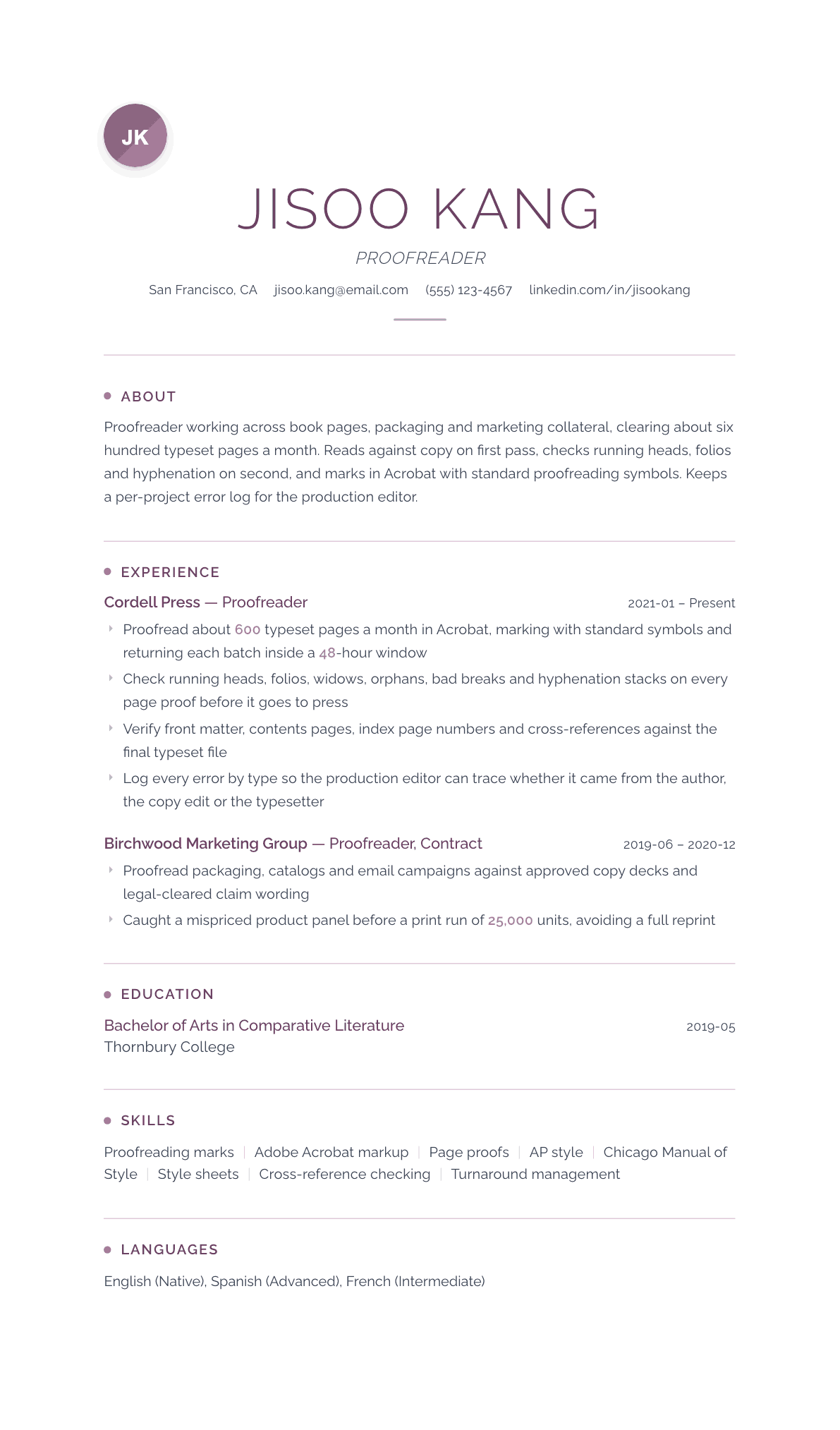
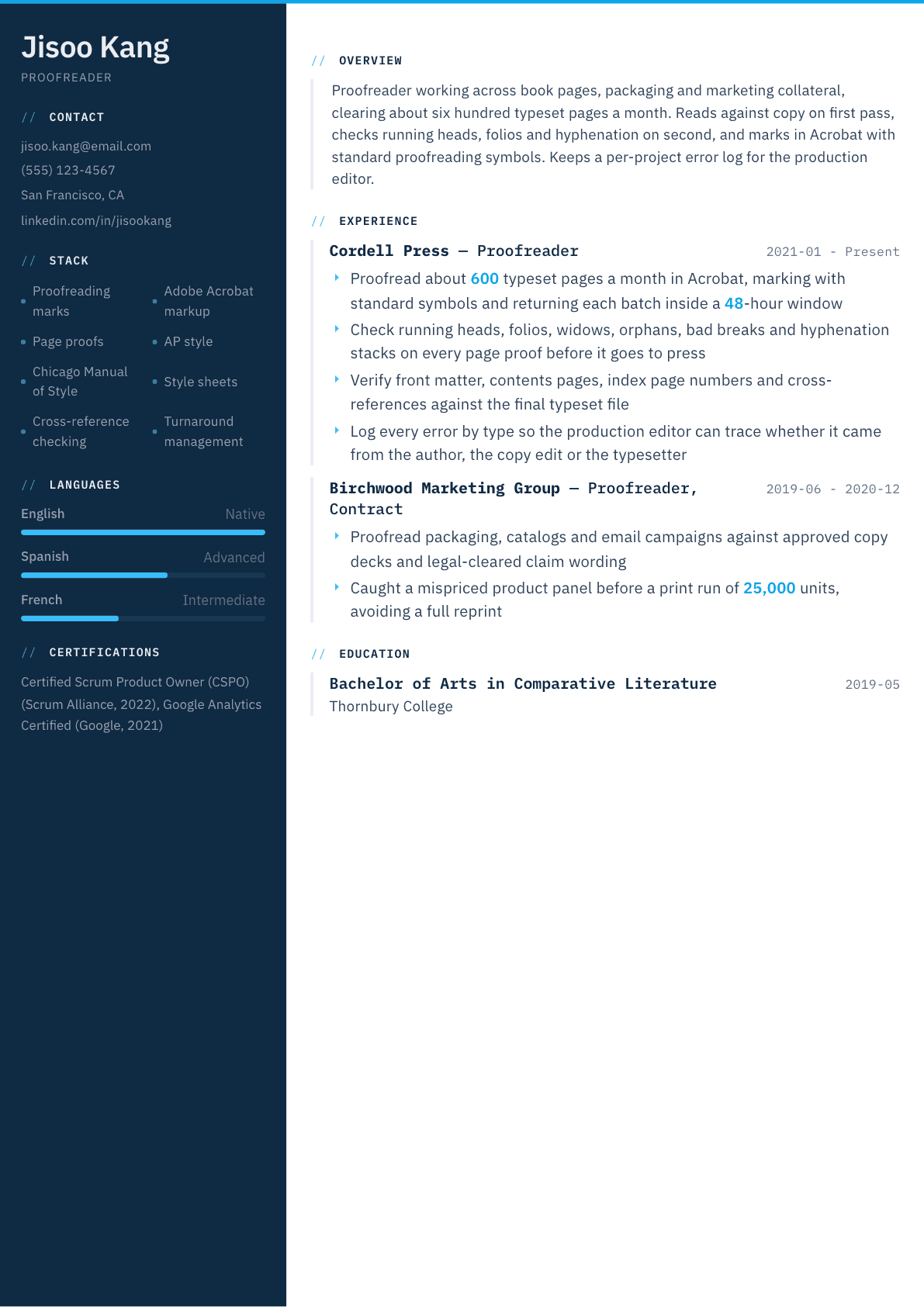
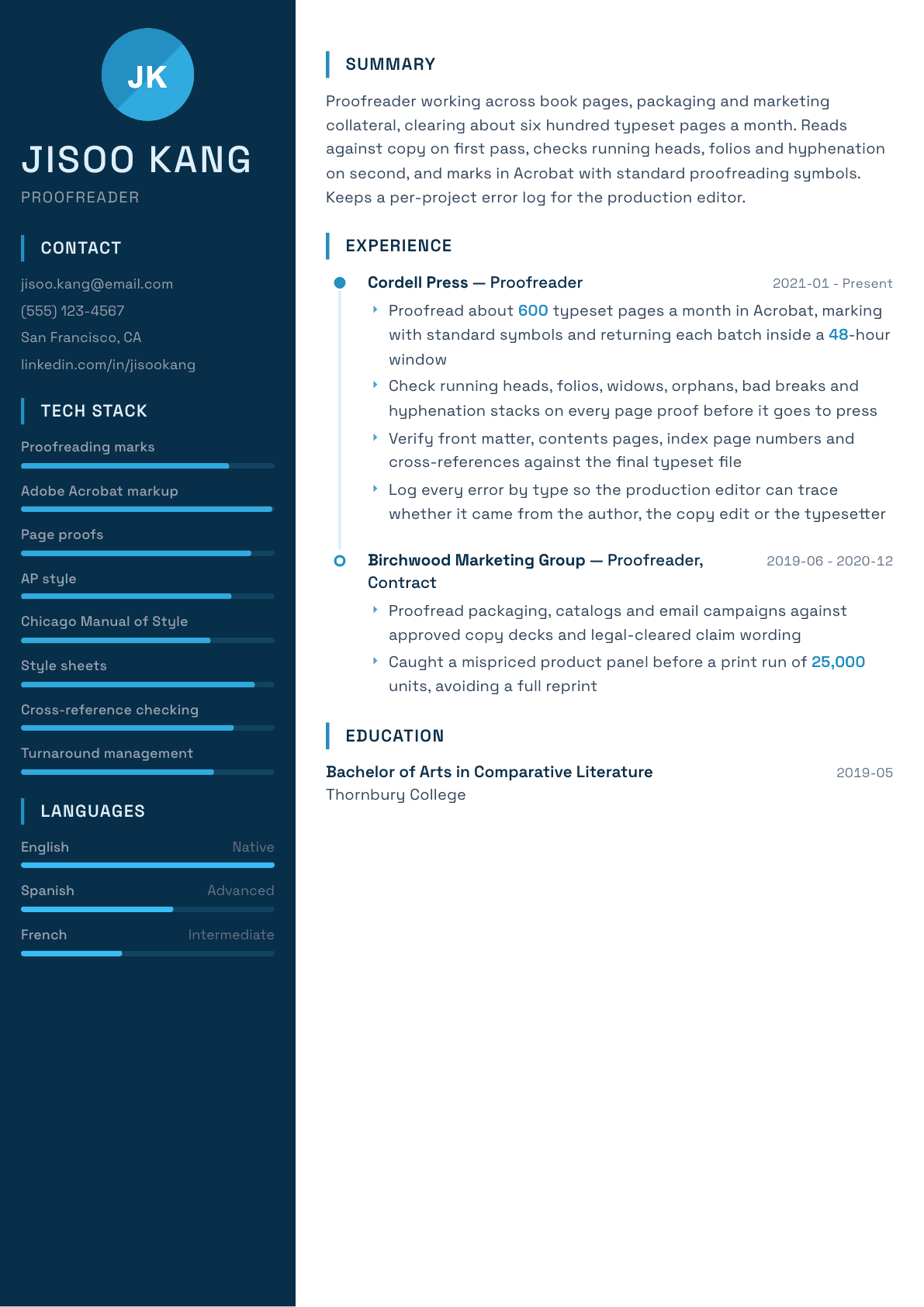
Example Proofreader summary
Proofreader clearing around six hundred typeset pages a month across trade nonfiction and marketing collateral. Reads proofs against copy, checks running heads, folios, bad breaks and index cross-references, and marks in Acrobat with standard proofreading symbols. Returns each batch within 48 hours and keeps an error log by source so production can fix the cause, not just the page.
Skills to list on a Proofreader resume
- Proofreading
- Proofreading marks
- Page proofs
- Adobe Acrobat markup
- Chicago Manual of Style
- AP style
- Style sheet adherence
- Cross-reference checking
- Typographic error detection
- Numbering and folios
- Track changes
- Turnaround management
- Copy deck comparison
What actually gets this resume read
- Lead with pages or words cleared per month, because volume with accuracy is the whole case for hiring you.
- Name the medium you proof: book pages, packaging, financial documents, subtitles or marketing collateral.
- Say whether you mark on paper with standard symbols, in Acrobat, or in tracked changes, and prove you know both.
- Show that you catch layout faults too: bad breaks, widows, wrong folios and broken cross-references.
- Give your normal turnaround and the longest run you have handled, since production schedules drive the hire.
- Keep the resume itself immaculate on spacing, hyphens and consistent date formats, since a proofreader is judged on it.
How to write a proofreader resume
Proofreading is the last checkpoint before something becomes permanent, whether that is a print run, a packaging panel or a filed document. The person hiring you is buying insurance against a reprint, so the resume has to argue two things at once: that you can clear a lot of pages quickly, and that almost nothing gets past you while you do it. Volume without accuracy is worthless here, and accuracy without volume misses production schedules.
Production editors also want to know what kind of proofreading you do. Reading typeset pages against a copy-edited manuscript is not the same job as checking marketing collateral against an approved copy deck, and neither resembles subtitle or financial document proofing. Say which one you have done and in what medium, because the hiring pipelines barely overlap.
This guide sets out the section order production teams expect, how to make invisible work visible on paper, three summaries from first contract to lead proofreader, and the errors that get a careful proofreader screened out by a careless resume.
Format: immaculate, one page, and consistent to the character
Nobody will say it out loud, but a proofreader resume is graded on its own typography. Check the hyphens against the en dash policy you claim to follow, keep one date format, align every column, remove every double space, and make sure no line ends in a broken word. Print it and read the hard copy, because screen reading hides spacing faults.
Keep it to one page in reverse chronological order. If you freelance for many clients, make one entry for the freelance practice with a date range and list clients or sectors underneath rather than creating an entry per book.
- Header: name, city and state, phone, email, and your normal turnaround window.
- Section order: summary, experience, media and tools, style authorities, education and training.
- Give a client or title list only when the names are not under a confidentiality agreement.
Summary: pages a month, medium, and the pass you own
Lead with throughput. Pages of typeset proof per month, or words per week for screen-based work, is the first number a production editor needs in order to schedule you. Follow it with the medium: trade nonfiction, journals, packaging, catalogs, annual reports, subtitles or e-learning.
Close the summary with the pass you own and the deliverable that comes back. First pass against copy, second pass on layout, cold read, or a press check are distinct stages, and saying which one you carry tells a manager where you slot into the schedule.
Experience: what you read against and what you caught
Every bullet should answer one question: what was the proof checked against. Pages against the copy-edited manuscript, collateral against an approved copy deck, a translation against the source, or a reprint against the previous edition are all different guarantees, and naming the reference is what separates a proofreader from a spellchecker.
Show that you catch faults that live in the layout rather than in the words. Running heads, folios, widows and orphans, bad breaks, hyphenation stacks, rivers, missing or duplicated lines from a reflow, wrong contents page numbers, broken cross-references, and figures that do not match their captions. Anyone can read for typos. Layout faults are why a proofreader is hired at the page stage rather than earlier.
End with one bullet that shows consequence. A mispriced panel caught before a print run, a legal claim that did not match the cleared wording, or a duplicated paragraph found in the index all prove the value of the pass in terms a production manager already thinks in.
Marks, markup and the tools of the pass
State how you mark. Standard proofreading symbols on hard copy, stamps and comments in Adobe Acrobat, tracked changes in Word, or annotations inside a proofing platform are all normal, and most employers now expect at least the first two. Saying that you mark in Acrobat with standard symbols answers a question that otherwise comes up in the first phone call.
Name the style authorities you work under, usually Chicago for books, AP for news and marketing, or a client house sheet, and say that you keep to the project style sheet rather than imposing preferences at proof stage. Restraint at this stage is a professional signal: a proofreader who rewrites sentences on page proofs costs money in resetting.
- List turnaround: normal batch size, the fastest you have worked, and the longest continuous project.
- Say whether you log errors by source so production can trace the author, copy edit or typesetting stage.
- Include any second-pair-of-eyes protocol you follow on numbers, names, prices and legal claims.
Skills, keywords and the proofreading test
Postings recycle a small vocabulary: page proofs, proofreading marks, copy deck, style sheet adherence, cross-reference checking, quality control, turnaround, and the name of the markup tool. Mirror those words once in the skills block and once inside a bullet so both the software and the human reader find them.
Expect a timed test with planted errors of several kinds: a spelling mistake, a factual inconsistency between two pages, a wrong folio, a bad break and a style sheet violation. Writing on the resume that you read a first pass against copy and a second pass on layout frames you as someone who already works in passes, which is exactly what the test rewards.
Proofreader resume summary examples
First contracts
Proofreader clearing about 250 typeset pages a month for a small press after completing a publishing proofreading course. Reads first pass against the copy-edited manuscript and a second pass for running heads, folios and bad breaks, marking in Acrobat with standard symbols.
Four years in
Proofreader handling roughly 600 typeset pages a month across trade nonfiction and marketing collateral. Reads proofs against copy, checks folios, cross-references and index page numbers, returns each batch within 48 hours, and logs errors by source so production can fix the cause rather than the page.
Lead proofreader
Lead proofreader coordinating three freelance readers across a seasonal list of 40 titles. Sets the pass structure and the error log taxonomy, takes the cold read on cover and jacket copy, and runs the final numbers check on prices, ISBNs and legal lines before files go to the printer.
Work experience bullets: before and after
Before: Proofread books before publication.
After: Proofread about 600 typeset pages a month against the copy-edited manuscript, marking in Acrobat with standard symbols and returning each batch inside a 48-hour window.
Volume, the reference document, the markup method and the turnaround are the four facts a production editor schedules from.
Before: Checked pages for errors.
After: Checked running heads, folios, widows, orphans, bad breaks and hyphenation stacks on every page proof, plus contents and index page numbers against the final typeset file.
Naming layout faults shows you proof pages rather than only reading text.
Before: Caught a pricing mistake on a package.
After: Caught a mispriced product panel against the approved copy deck before a run of twenty-five thousand units, avoiding a full reprint of the packaging.
Tying the catch to the reference document and the consequence puts a cost avoided in front of the reader.
Before: Kept track of the errors I found.
After: Logged every error by type and by source so the production editor could see whether it originated with the author, the copy edit or the typesetter.
A taxonomy that fixes the upstream cause is process thinking, not just careful reading.
Before: Worked to tight deadlines.
After: Held a standing 48-hour turnaround on batches of up to 120 pages and cleared two same-day press checks a month without a returned correction.
A named window, a batch size and an outcome replace an adjective every applicant uses.
Hard skills
- Proofreading page proofs
- Standard proofreading marks
- Adobe Acrobat markup and stamps
- Tracked changes
- Chicago Manual of Style
- AP style
- Style sheet adherence
- Copy deck comparison
- Cross-reference and index checking
- Folios, running heads and pagination
- Typographic fault detection
- Error logging and taxonomy
- Turnaround and batch scheduling
Soft skills
- Sustained concentration
- Restraint at proof stage
- Clear query writing
- Reliability on deadline
- Comfort with repetitive detail
- Working to another editor decisions
Certifications worth listing
- Poynter ACES Certificate in Editing (The Poynter Institute with ACES: The Society for Editing)
- Certified Professional Editor (CPE) (Editors Canada)
- Proofreading Course (Chartered Institute of Editing and Proofreading)
Mistakes that cost proofreader candidates the interview
- Sending a resume with a spacing fault, an inconsistent dash or a stray double space, which is treated as a failed test.
- Giving no throughput figure, so a production editor cannot tell whether you can carry a list or a single title.
- Never naming what the proof was read against, which makes the pass sound like a spellcheck.
- Ignoring layout faults entirely, so the resume reads like a copy editor applying for a proofreading job.
- Listing every freelance title as its own entry until a steady practice looks like scattered work.
- Claiming to be a perfectionist rather than describing a two-pass method and an error log.
- Leaving the markup method out, so the manager has to ask whether you can work on paper, in Acrobat or in tracked changes.
Proofreader resume questions
How many pages a day should a proofreader claim?
Claim what you can hold on a normal week with the accuracy you promise, and say what medium it is. Dense academic pages read far slower than trade nonfiction, and an inflated figure collapses on the first real schedule.
Do I need to know standard proofreading marks?
Yes for print and packaging work, because press-side teams still mark hard copy and expect the symbols to be read correctly. For screen-only workflows, Acrobat comments and tracked changes matter more, so list both if you have them.
How do I get proofreading work with no publishing experience?
Lead with adjacent proof work you have already done: reviewing legal documents, checking marketing collateral against approved copy, or verifying data in reports. Add a recognized proofreading course, then take small first passes for a local press or agency to build a page count.
Should a proofreader resume include a client list?
Include it when the names are not under confidentiality and they show range across media. Group by sector rather than listing every title, and give the volume for each group so the list proves capacity instead of only prestige.
What is the difference between proofreading and copy editing on a resume?
Copy editing changes the text for grammar, style and clarity before layout. Proofreading checks the laid-out result against an approved reference and flags faults rather than rewriting. Employers test them separately, so state clearly which pass you are applying to carry.