Content Writer Resume Examples: the lines they read
Sample Resume for a Writer: Content Writer Resume Example
By Mustafa Tarabya, founder of CVBooster · Published · Updated
Sample resume for a writer: a content writer resume example written out in full, with portfolio layout, summaries, bullets and the skills editors check.
Sample resumes for a content writer
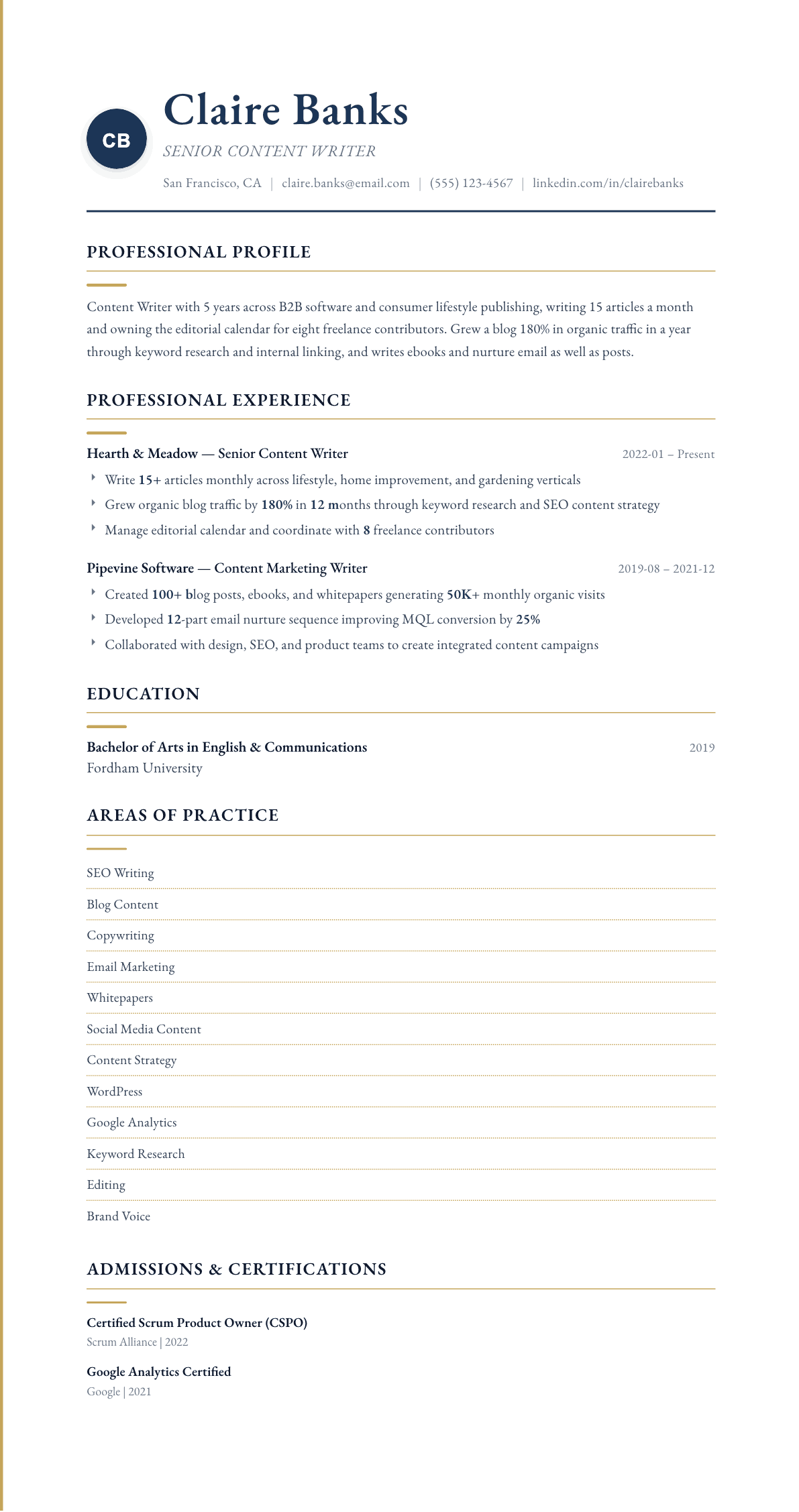
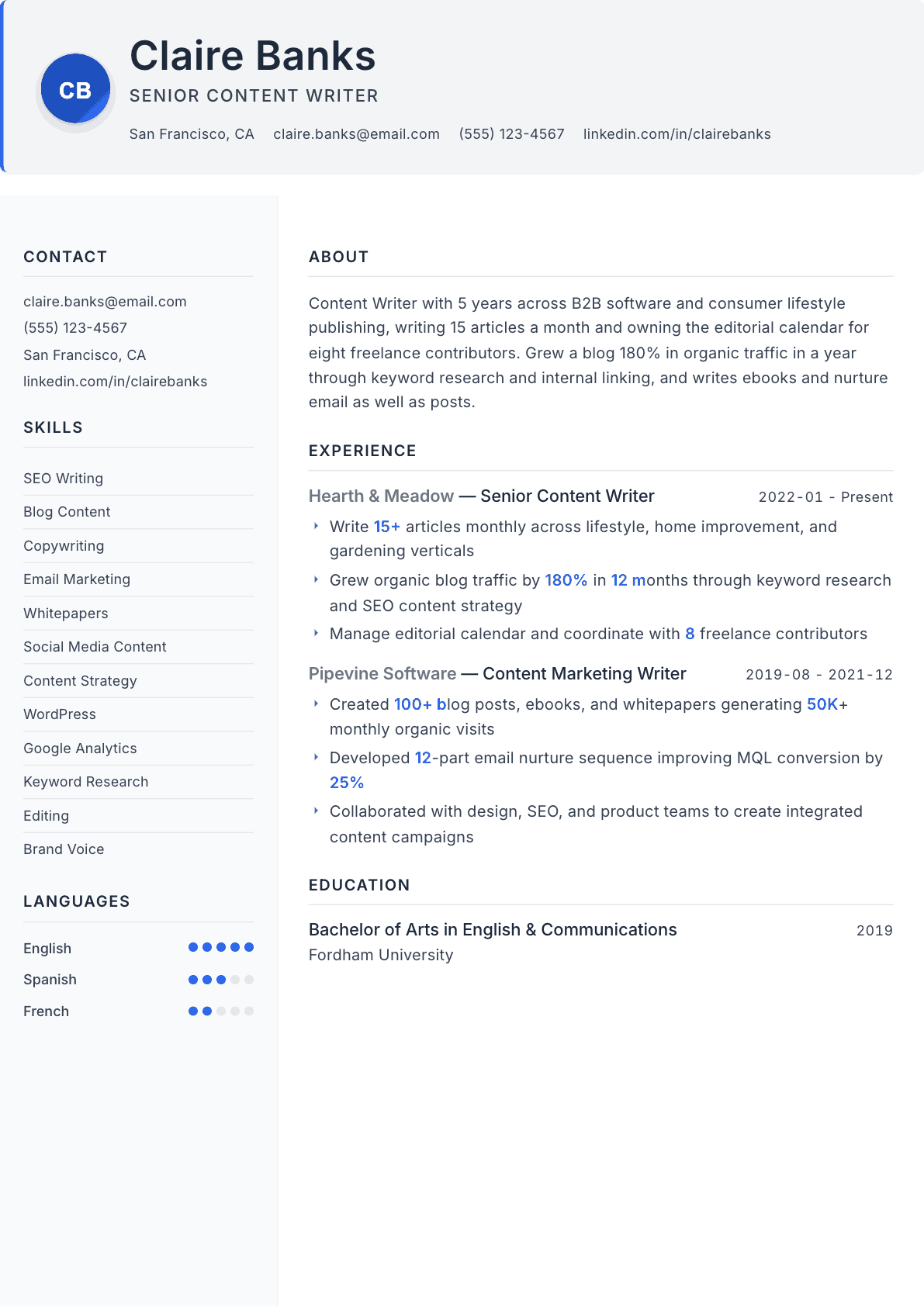
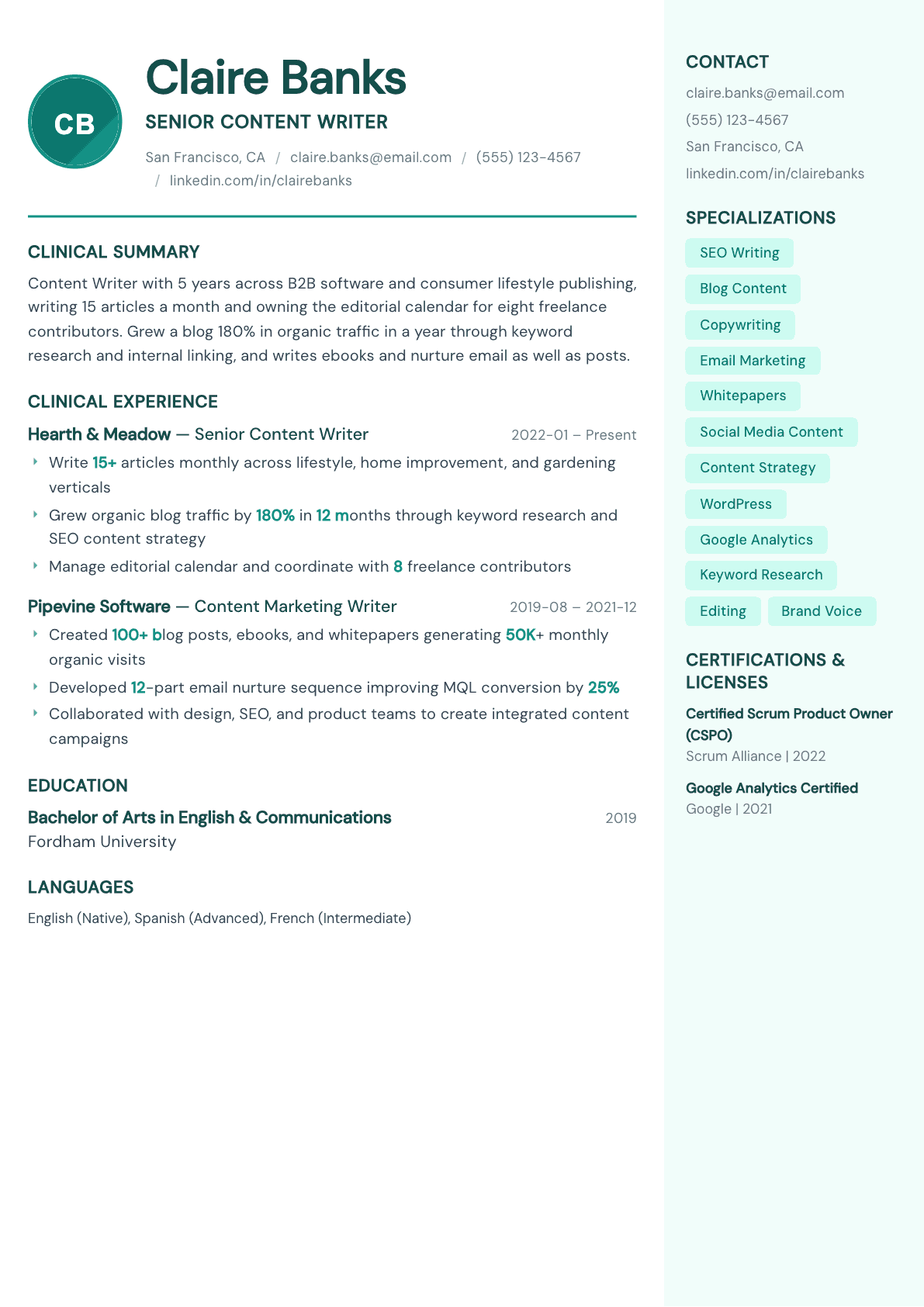
The same content writer content laid out in three CVBooster templates, so you can see what the finished document looks like before you write a word.
Example Content Writer summary
Content writer, 5 years, comfortable in both software and lifestyle verticals, from 1,500-word SEO articles to whitepapers and nurture sequences. Grew one blog 180% in twelve months, produced 100 pieces that carry 50K monthly organic visits, and edits and briefs freelance contributors.
Skills to list on a Content Writer resume
- SEO Writing
- Blog Content
- Copywriting
- Email Marketing
- Whitepapers
- Social Media Content
- Content Strategy
- WordPress
- Google Analytics
- Keyword Research
- Editing
- Brand Voice
What actually gets this resume read
- Include links to published work and a portfolio website.
- Quantify readership, traffic growth, and conversion metrics.
- Show versatility across content formats (blog, email, social, video scripts).
- Highlight SEO knowledge and keyword research tools used.
- Mention brand voice development and editorial guideline experience.
How to write a content writer resume
Hiring a content writer is mostly a reading exercise. The editor who screens your application opens the portfolio before the resume, spends about a minute on one sample, and decides whether the sentences are good enough to keep going. Everything on the resume exists to get that sample opened and to answer the questions the sample cannot: how fast you file, how clean the draft arrives, whether you can research a subject you did not know last week, and whether you understand who the piece is for.
The second screen is fit. A writer who has spent four years on consumer wellness articles is a risky hire for a technical documentation team, and a writer who can explain a database index is wasted on lifestyle features. Editors read your bylines for subject range and for register, so a resume that names the audiences and formats you have written for saves them the guesswork.
If you came here for a sample resume for a writer, the full writer's resume sample is written out below under Writer's resume sample, written out in full, header to skills, ready to copy and rewrite with your own clips. This guide covers how to lay out a writer resume around the portfolio, how to write bullets about writing without sounding like a job description, three summaries at different career stages, before-and-after examples, and the questions writers ask when their best work sits behind a client contract they cannot name.
Format: one page, with the portfolio link impossible to miss
One page for almost every content writer, two only after you have led an editorial team. The portfolio link belongs in the header on its own line, not buried in the last section. Editors receiving dozens of applications will not hunt for it, and an application with no reachable samples is usually closed within seconds.
Under the summary, add a short capability line: the formats you write (long-form articles, product documentation, newsletters, scripts, case studies, landing pages), the subjects you know, the output you sustain, and the content management systems you publish into. That line answers the practical questions an editor would otherwise ask in a first call.
- Header: name, title, city, email, portfolio link, and one relevant social or publication profile.
- Capability line: formats, subject areas, typical weekly output, CMS and research tools.
- Sections in this order: summary, capability line, selected work, experience, skills, education.
- Selected work: five to eight pieces with the publication, the format and one line on the result or the difficulty.
Summary: subjects, formats, audience, and the level you write at
Three lines. Name the subject areas you can write without a long ramp, the formats you file most often, and the audience level, since writing for practitioners is a different craft from writing for a general reader. Then add one signal of reliability, such as the volume you sustain or the years you have held a regular column or client.
Do not open with versatile or passionate wordsmith. Every writer in the pile claims range. What distinguishes candidates is a specific pairing: healthcare content written for clinicians, financial explainers written for first-time investors, developer tutorials written from working code.
Selected work: choose for evidence, not for the biggest logo
Pick pieces that prove different things: one that shows research depth with named sources, one that shows structure on a complicated subject, one that shows voice, one that performed measurably, and one from the exact subject area of the job you are applying for. Annotate each with a single line about the brief or the challenge, because an editor reading an annotated list understands your process without asking.
If a piece performed, say how and over what period: entrances from search, time on page compared with the section average, subscriptions from a newsletter issue, or a placement that earned links. Numbers matter less here than in most marketing roles, but a writer who understands what happened after publication is unusual and worth flagging.
Experience: research method, editorial process and output
Bullets should show how the work gets made. Interviewing subject matter experts and turning a transcript into structure, working from documentation or a product build, fact checking and sourcing, filing to a brief, taking an editor's notes without ego, and hitting a schedule. Editors are hiring a colleague they will send notes to every week, so evidence of a workable process is a hiring reason.
Include search work at the level you do it. Writing to a keyword brief, structuring a piece around the questions readers actually ask, writing titles and meta descriptions, and updating older articles. Avoid claiming search strategy ownership unless you set the topic plan yourself.
Say something about volume and reliability, because agencies and content teams are buying throughput as much as craft. A steady figure such as four long-form pieces and two newsletters a week says more than a claim of being detail oriented.
Keywords, tools and the confidentiality problem
Name the publishing and research tools you use: the content management system, the keyword research tool, the style guide you write against such as AP or Chicago, and the collaboration tools your drafts live in. If you write in a regulated field, name the review process you have worked inside, since medical and financial editors screen for that first.
Ghostwritten and unbylined work is common. You can still list it: describe the format, the audience and the outcome without naming the client, or ask the client for permission to share a single sample privately. Never post client work publicly that your contract restricts, and say on the resume that additional samples are available on request.
Writer's resume sample, written out in full
This is a writers resume example for a mid level content writer applying to an in-house content team, written as plain text so you can see every line. The person is invented; the layout is the part to keep. Swap in your own subjects, clips and cadence, and keep the portfolio link where it is, because that is the line the editor clicks first.
For a freelance writer the same sample works with one change: replace the employer entries with a single Freelance Writer entry and list the clients or publications under it, unnamed where your contract requires it.
- Header: Nadia Ferris, Content Writer, Portland, Oregon. Email address, then the portfolio link on its own line, then one publication profile link.
- Summary: Content writer with five years covering personal finance and small business software for first-time buyers and owners. Files three researched long-form pieces and one newsletter a week to editorial briefs, interviews a subject expert for every feature, and writes to AP style in WordPress.
- Capability line: long-form articles, comparison guides, newsletters, case studies, product help pages. Tools: WordPress, Google Docs, a keyword research tool, Google Search Console.
- Selected work: a buying guide to small business accounting software, built from interviews with two accountants; a newsletter issue explaining tax deadlines for sole owners; a case study written from a customer call; a rewrite of an older budgeting article that returned it to page one.
- Experience, Content Writer, a personal finance publisher, three years: wrote three long-form articles a week to keyword briefs; interviewed accountants and financial planners for every feature and sent technical claims back for review; refreshed older articles each quarter with the editor.
- Experience, Junior Writer, a marketing agency, two years: wrote blog posts, landing pages and email copy for software and retail clients; took edits from three account leads and filed on a weekly schedule.
- Education and skills: BA in English. Skills: source interviews, fact checking, AP style, search intent briefs, headline writing, newsletter writing, content refreshes.
Content Writer resume summary examples
First staff writing job
Writer with two years of freelance work across personal finance and small business subjects, filing three to four researched articles a week to editorial briefs. Published in two national personal finance outlets, comfortable interviewing sources, and working to AP style in WordPress with basic search briefs.
Five years in
Content writer with five years covering software and developer tooling for practitioner audiences, writing tutorials from working code as well as long-form features. Sustains four pieces a week, sources technical reviewers for every draft, and grew a documentation-adjacent article set to 60% of the site entrances from search.
Senior writer and editor
Senior writer and editor covering healthcare for clinical and patient audiences, working inside a medical review process and to a house style guide. Owns a weekly newsletter of forty thousand subscribers, edits three staff writers, and rebuilt the condition guide series that now accounts for a third of organic entrances.
Work experience bullets: before and after
Before: Wrote blog posts for the company website.
After: Wrote three long-form articles a week for a practitioner audience, each built from an interview with an in-house expert and reviewed against the house style guide before publication.
Cadence, audience level and the research input show what kind of writer you are instead of naming the format alone.
Before: Wrote SEO-optimized content.
After: Wrote to keyword briefs covering search intent, competing results and required subtopics, and rewrote 18 older articles whose entrances had dropped, recovering top-five positions for 11 of them.
The rewrite shows the actual method and a result, where the original is a phrase every applicant uses.
Before: Interviewed experts for articles.
After: Ran 60-minute interviews with engineers and support leads, turned transcripts into structured drafts within two days, and sent every technical claim back for review before filing.
A described workflow with a turnaround time tells an editor exactly what working with you looks like.
Before: Helped with the company newsletter.
After: Wrote and edited a weekly newsletter to forty thousand subscribers, tested subject lines each issue, and lifted the average open rate from 22% to 34% over six months.
Ownership, audience size and a tested outcome replace a vague supporting role.
Before: Met deadlines consistently.
After: Filed on schedule across a rolling queue of eight assignments, averaging one round of edits per piece, which let the editor cut the review buffer from five days to two.
Reliability becomes evidence when it is expressed as edit rounds and time saved for the person you file to.
Hard skills
- Long-form article writing
- Research and source interviews
- Fact checking
- Search intent briefs
- Keyword research
- Editing and self-editing
- AP and Chicago style
- Newsletter writing
- Case study writing
- Product documentation
- WordPress
- Headline and meta description writing
- Content refreshes
- Script writing
Soft skills
- Taking editorial notes
- Deadline discipline
- Curiosity across subjects
- Interviewing
- Adapting to a house voice
- Working with reviewers
Certifications worth listing
- Content Marketing Certification (HubSpot Academy)
- Google Analytics Certification (Google Skillshop)
Mistakes that cost content writer candidates the interview
- Applying with no reachable portfolio link, which ends most content writing applications before the resume is read.
- Sending twenty samples instead of six chosen to prove research, structure, voice and subject fit.
- Describing writing in job-description language, so the bullets say produced engaging content and nothing more.
- Hiding the subject areas you actually know, which leaves an editor unsure whether you can cover their beat.
- Publishing ghostwritten client work as your own without permission, which is a fast way to lose a reference.
- Claiming ownership of search strategy when your role was writing to briefs someone else built.
- Sending a resume with a typo, since copy errors carry more weight in this role than in any other application.
Content Writer resume questions
How do I build a portfolio with no published clips?
Write three pieces in the exact format and subject of the jobs you want and publish them somewhere with a stable link. Editors care about the quality of the reading experience, not the prestige of the outlet, so self-published work that is genuinely good still counts.
Can I include ghostwritten work on a content writer resume?
Yes, if you respect the agreement. Describe the format, audience, subject and result without naming the client, mark it as unbylined, and offer samples privately on request. Most editors accept this because ghostwriting is normal in the field.
What should a writer's resume sample include?
A header with a portfolio link, a three line summary naming your subjects and audience, a capability line of formats and tools, five to eight selected pieces with one line each, then experience, education and skills. Cadence, such as three long-form pieces a week, says more than a total word count.
Do content writers need SEO skills?
Most commercial writing roles expect working knowledge: reading a keyword brief, covering the subtopics readers search for, writing a clear title, and structuring for scanning. Deep technical search work is a separate specialty and should not be claimed unless you have done it.
How do I switch subject areas as a content writer?
Write two or three pieces in the new subject before applying, ideally with a real source interview, and place them at the top of your selected work. Then reframe your summary around the transferable craft: research, structure and writing for a defined reader level.