Journalist Resume Examples: free ATS score and gap list
Build a Journalist Resume That Gets You Into the Newsroom
By Mustafa Tarabya, founder of CVBooster · Published · Updated
Create a compelling journalist resume showcasing investigative skills, published work, and editorial expertise with ATS-optimized formatting for top media outlets.
Sample resumes for a journalist
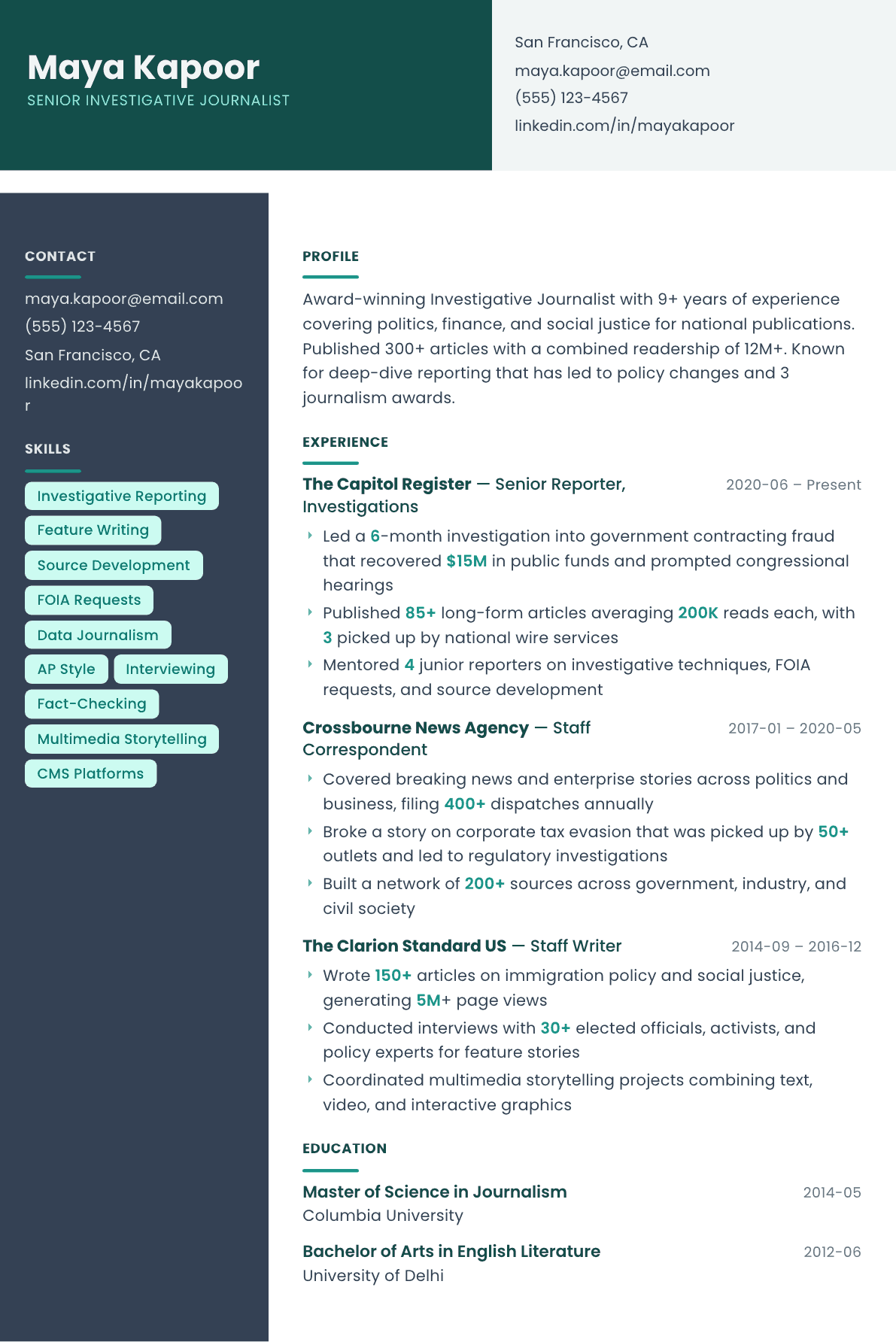
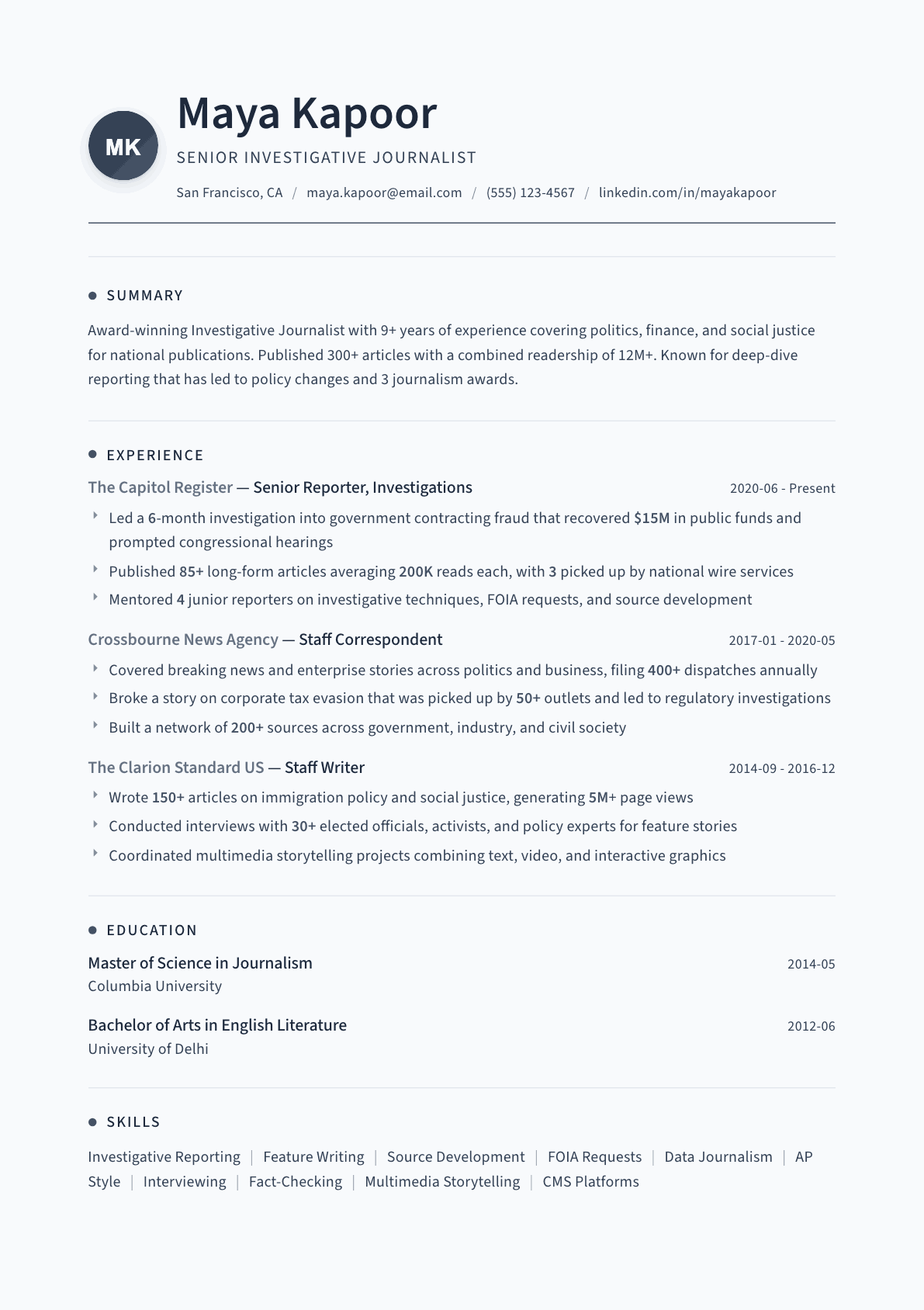
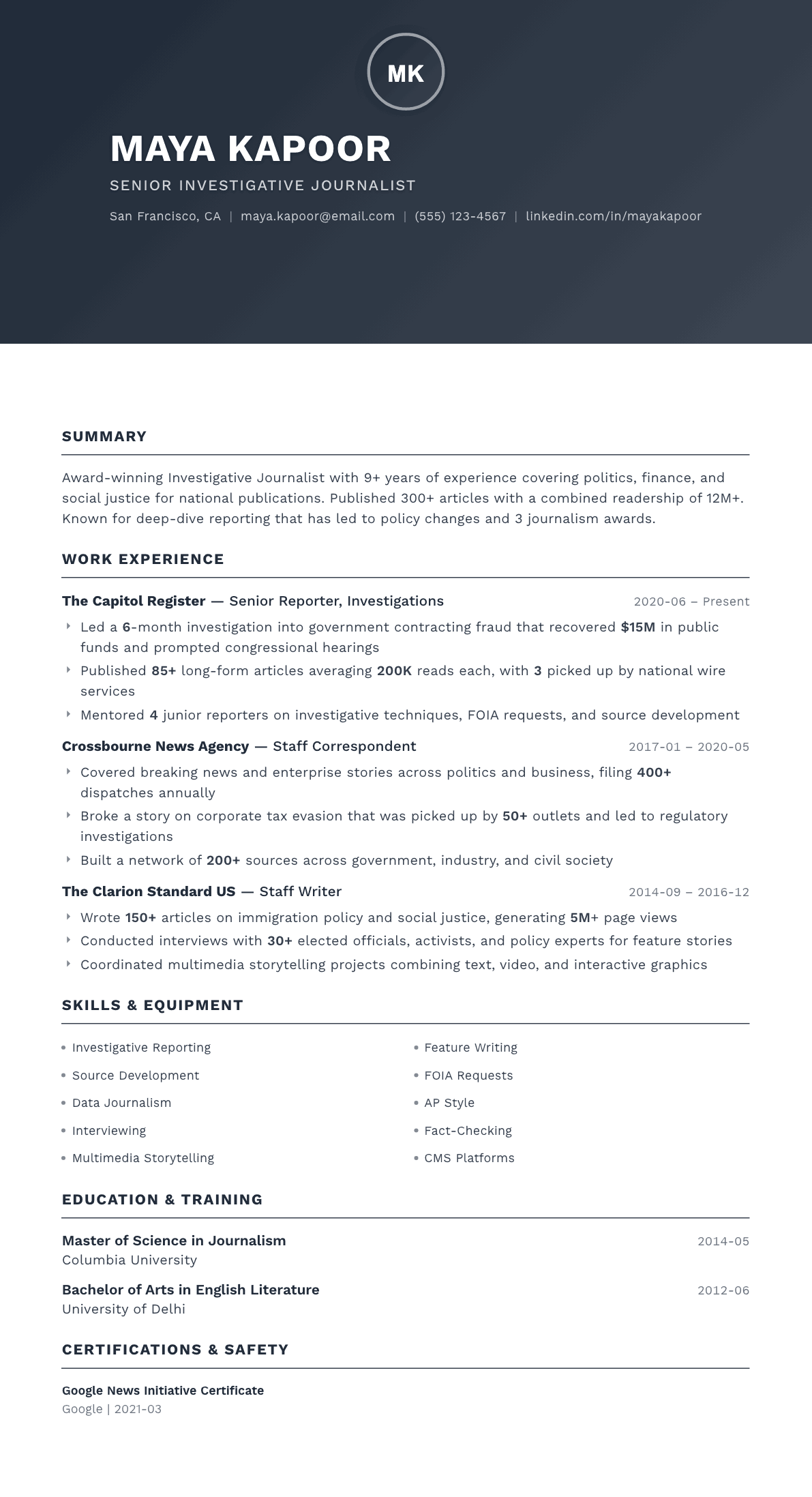
The same journalist content laid out in three CVBooster templates, so you can see what the finished document looks like before you write a word.
Example Journalist summary
Award-winning Investigative Journalist with 9 years of experience covering politics, finance, and social justice for national outlets. Published 300+ articles reaching 12M+ readers. Skilled in deep-dive investigations, FOIA research, and multimedia storytelling.
Skills to list on a Journalist resume
- Investigative Reporting
- Feature Writing
- Breaking News
- Source Development
- FOIA & Public Records
- Data Journalism
- AP Style
- Interviewing
- Fact-Checking
- Multimedia Production
- CMS & Publishing Tools
- Social Media
What actually gets this resume read
- Lead with your most impactful published stories and the reach or outcomes they generated.
- Include a portfolio link or clips section. Editors expect to see your writing samples.
- Highlight beat expertise: politics, business, tech, health, or culture to show domain depth.
- Mention the volume of your output: articles published per month, word counts, and deadlines met.
- Show versatility across formats: print, digital, video, podcasts, and social media.
How to write a journalist resume
An editor hiring a journalist reads the resume for three things and then goes straight to the clips. She wants the beat, because newsrooms hire coverage areas rather than generalists. She wants the output, because a desk has holes to fill and needs to know whether you can file daily, weekly or twice a year. And she wants proof of sourcing, because anyone can write, and far fewer can develop a source who tells them something nobody else has.
The clips do the rest. A resume that arrives without a link to published work, or with a link to a personal site whose newest piece is two years old, is not competitive against candidates who make it easy. Editors are reading dozens of applications between deadlines and they will not hunt for your byline.
This guide covers the structure editors expect, how to write about stories without sounding like a press release for yourself, three summaries from a first newsroom job through to a senior investigative reporter, before and after bullets, and the questions reporters ask when moving between print, digital, broadcast and freelance work.
Format: one page, clips link in the header, beat stated up front
One page until you are ten years in, then two at most. Under your name, put the beat and the medium: "Health reporter, digital and print", "Local government reporter", "Business features, longform". An editor deciding whether to keep reading needs that in the first line, not in paragraph three.
Put the clips link in the header alongside the email. It should open on a phone, load fast, and lead with your three strongest pieces rather than a reverse chronological dump. If you have work behind a paywall, say so and offer to send copies.
- Header: name, beat and medium, city, phone, email, clips link, one professional profile link.
- Order: summary, experience, selected work, skills, awards and fellowships, education.
- Student journalists put education and campus newsroom experience first, with real bylines listed.
- Freelancers group by publication rather than by individual assignment.
Summary: beat, publication type, output and one story you are known for
Three lines. Name your beat, the kind of newsroom you have worked in, roughly how much you file, and one piece of work that had an effect a stranger can verify. A story that changed a policy, prompted an official response, was cited elsewhere or was followed by other outlets is worth more than any self-assessment of your writing.
If you are switching beats, name the reporting skills that carry over rather than pretending expertise you do not have. A courts reporter moving to health has document skills, records requests and a habit of reading primary sources, and those are the transferable assets.
Experience: output, beat depth and what the stories did
Give each newsroom job the beat, the publication type and frequency, and the workload. Filing three to five pieces a week for a daily digital desk is a different job from producing one investigation a quarter, and an editor is staffing for a specific rhythm.
Then bullets that show reporting rather than writing. Building a source in a closed institution, filing public records requests and fighting a denial, working a document set, building a dataset from scattered filings, and confirming a fact with three independent sources are the things editors trust. Elegant prose is assumed and demonstrated in the clips.
Say what happened after publication where you honestly can: an official response, a resignation, a policy change, a follow-up by other outlets, an award, or the piece being cited in a hearing. Avoid claiming impact you cannot point to, because editors check and a hollow claim ends the application.
Skills: reporting craft, tools and the formats you can produce
List the craft first: records requests and open government law, interviewing including hostile and trauma-informed interviews, document analysis, fact-checking, and the style guide you write to. Then the tools: the content management system you publish in, spreadsheets and data cleaning, basic query languages if you have them, mapping tools, and audio and video editing for the formats your newsroom expects.
Multimedia claims should be honest about level. Recording clean audio on a phone and cutting a three-minute piece is worth stating; calling yourself a video journalist because you once appeared on camera is not. Editors staff around real capabilities and will find out quickly.
- Reporting: source development, records requests, document analysis, interviewing, verification.
- Writing: news, features, analysis, obituaries, live coverage, headline and standfirst writing.
- Data: spreadsheets, cleaning and joining public datasets, charts, basic queries and scraping.
- Production: content management systems, audio recording and editing, mobile video, social publishing.
Awards, fellowships and selected work
A short section for awards, fellowships, grants and residencies with the awarding body and the year, plus any teaching or panel work. These are verifiable and they help an editor calibrate a career quickly, especially for freelancers whose history is otherwise a list of publications.
Under selected work, list four or five pieces by headline, publication and what the story did. This is the part most candidates skip and it is often what gets read most carefully, because it shows the kind of story you go after when nobody assigns it.
Journalist resume summary examples
First newsroom job
Journalism graduate with two internships and a year at a campus daily, filing three to four local government and campus safety stories a week. Has filed public records requests, covered council meetings and a contested election night, and writes to Associated Press style.
Six years reporting
Health reporter with six years at regional daily newspapers, filing four pieces a week plus a monthly longform feature. Built a source network across two hospital systems and a state agency, and broke a story on nursing shortages that prompted a legislative hearing.
Investigative reporter
Investigative reporter with fourteen years covering public money and procurement, producing three to four major investigations a year from document and data reporting. Litigated two records denials, mentors junior reporters on sourcing, and has had work cited in state audits and follow-up coverage nationally.
Work experience bullets: before and after
Before: Wrote articles about local government.
After: Covered city council, county budget and school board for a regional daily, filing three to five stories a week including live coverage of budget votes and contested elections.
The specific bodies covered and the filing rate tell an editor whether you can hold a daily beat.
Before: Did investigative reporting on public spending.
After: Built a dataset from four years of scattered contract filings, interviewed 22 current and former employees, and published a three-part investigation that led to a state audit.
Method, source count and a verifiable outcome are what an investigations editor is actually assessing.
Before: Used public records to get information.
After: Filed 40 public records requests over two years, appealed three denials and obtained inspection reports that had never been released, forming the basis of two front-page stories.
Request volume, an appeal fought and the resulting stories show records work as a real reporting discipline.
Before: Developed good relationships with sources.
After: Developed sources inside a closed state agency over 18 months, producing four stories from internal documents while protecting the identity of every source involved.
Time invested and source protection are concrete, where a claim about relationships is not.
Before: Worked on multimedia and social media content.
After: Produced a six-episode audio series on housing court, recording and editing all interviews, and adapted each episode into a vertical video that ran on the newsroom social accounts.
Naming the format, the volume and the hands-on production makes the multimedia claim checkable.
Hard skills
- Beat reporting
- Investigative reporting
- Public records requests and appeals
- Source development and protection
- Interviewing under pressure
- Fact-checking and verification
- Associated Press style
- Feature and longform writing
- Breaking news and live coverage
- Data cleaning and analysis
- Content management systems
- Audio recording and editing
- Mobile video and social publishing
Soft skills
- Persistence with reluctant sources
- News judgment
- Deadline discipline
- Ethical decision making
- Working with editors on rewrites
- Handling legal and complaint pressure
Mistakes that cost journalist candidates the interview
- Sending a resume with no clips link, or a link to a portfolio whose newest piece is years old.
- Leaving the beat unnamed, when newsrooms hire coverage areas rather than general writers.
- Describing writing ability instead of reporting method, which is the part editors cannot see in a clip.
- Claiming a story caused a change without being able to point to the hearing, audit, resignation or follow-up.
- Listing every publication a freelance piece ever ran in rather than grouping the relationships that were ongoing.
- Overstating multimedia skills, which unravels the first week a desk asks for a cut piece by the afternoon.
- Hiding a career gap or a layoff behind vague dates instead of a plain line, which newsrooms understand well.
Journalist resume questions
How many clips should a journalist send with an application?
Three to five, chosen to match the job rather than to show range. Lead with the piece closest to the beat being hired, add one that shows reporting depth, and include one that shows you can turn something around fast.
How do I list freelance journalism work?
Group by publication with the date range and a note on what you covered and how often, then list a few standout pieces. Separate entries for every single assignment make a steady freelance career look like scattered one-off work.
Should a journalist resume include social media following?
Only if the number is genuinely relevant to the role and the platform matters to that newsroom. A reporting job is filled on sourcing and output, and leading with follower counts can suggest you are pitching yourself as a personality rather than a reporter.
How do I change beats as a journalist?
Lead with the transferable reporting skills: records work, document analysis, source development and verification. Then show early evidence of the new beat, whether freelance pieces, a newsletter or a project you reported on your own time, so the switch reads as underway rather than aspirational.
What do editors look for in a journalist cover letter?
Story ideas. A letter that names three specific pieces you would report on that beat in your first months, with a sense of who you would call, does more than any description of your qualities. Keep it short and put the ideas near the top.