Archivist Resume Examples: free ATS score and gap list
Write an Archivist Resume That Proves Collection Work
By Mustafa Tarabya, founder of CVBooster · Published · Updated
Build an archivist resume with processing examples, finding aid wording, the systems repositories screen for, and a full writing guide.
Sample resumes for a archivist
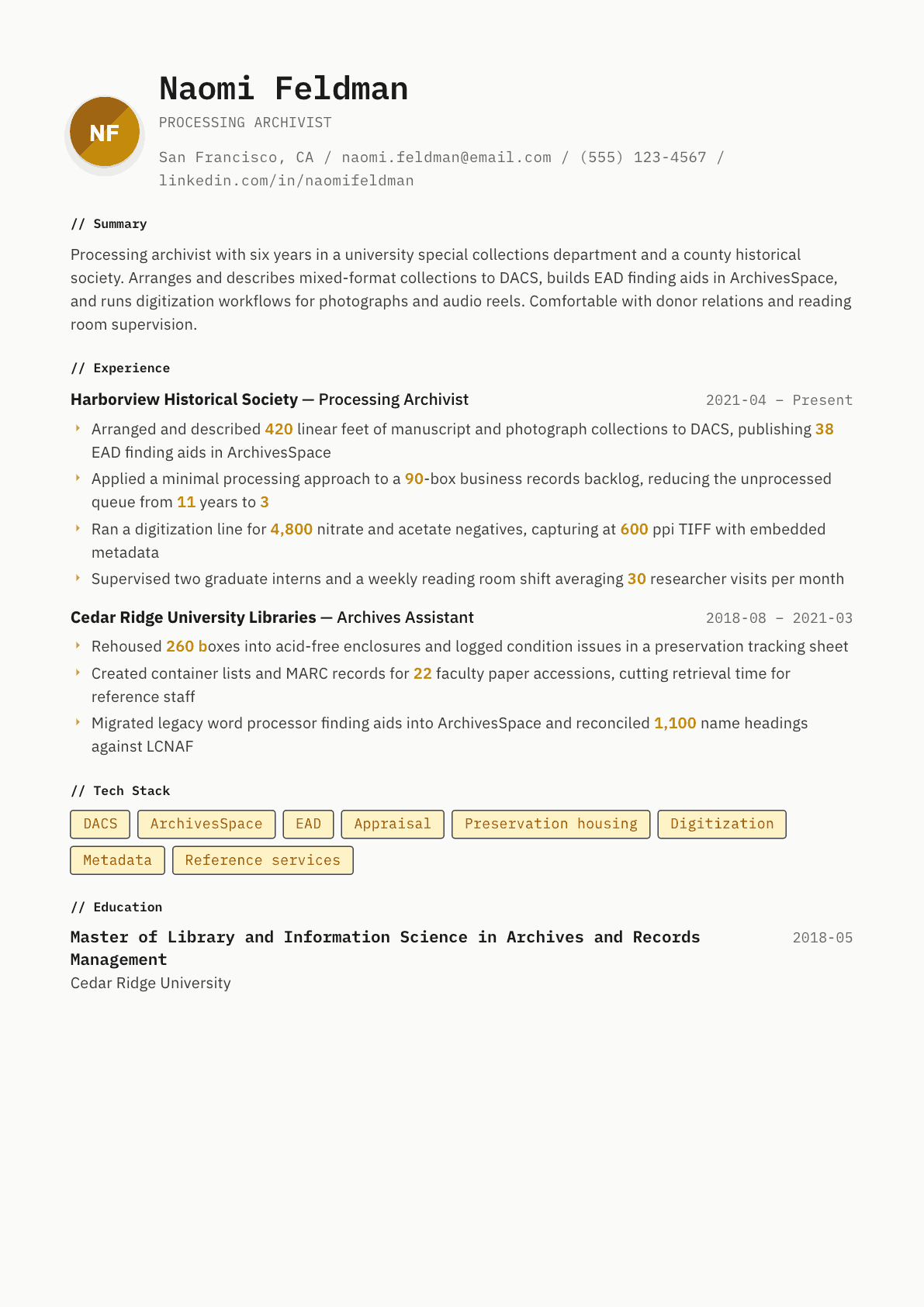
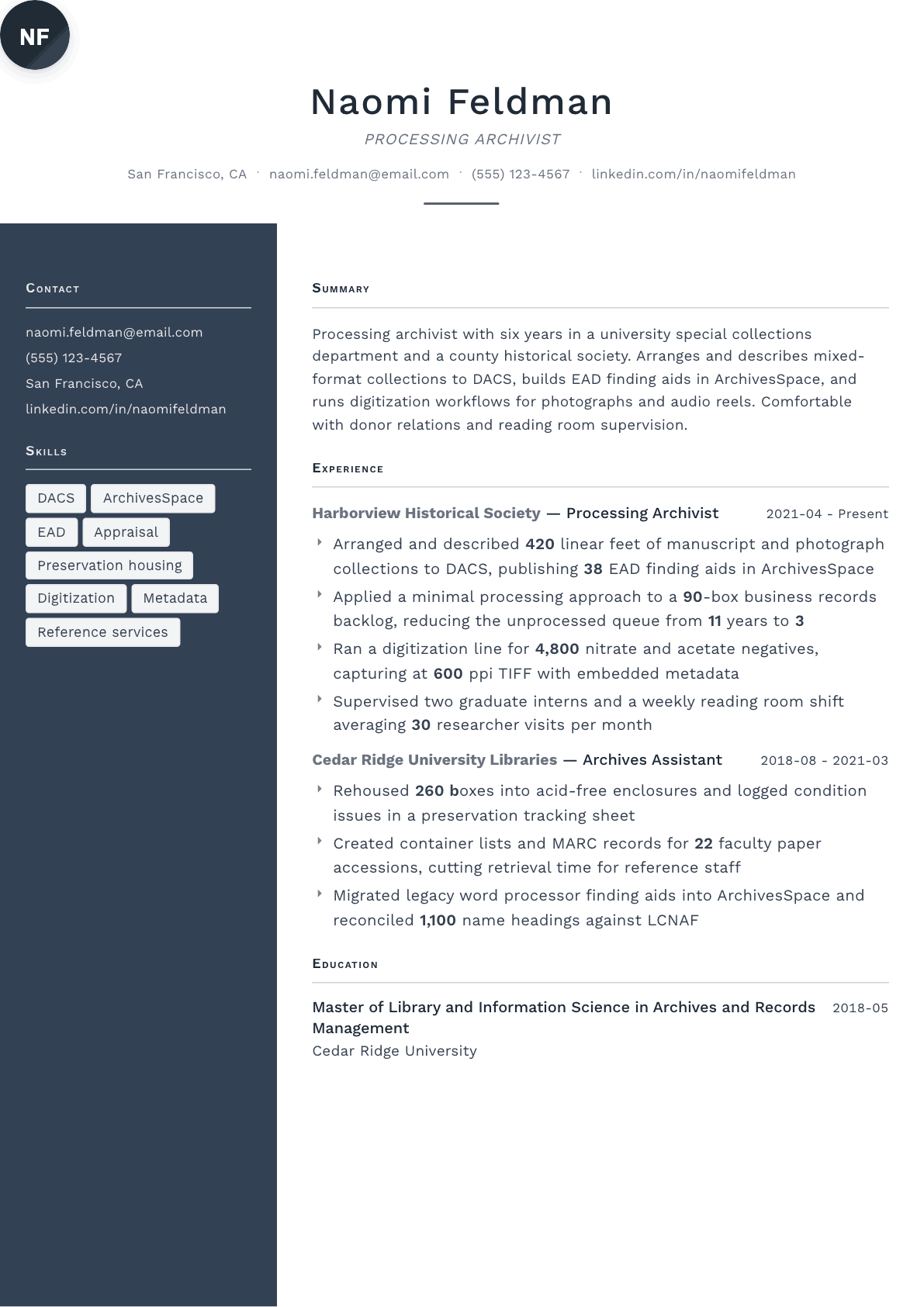
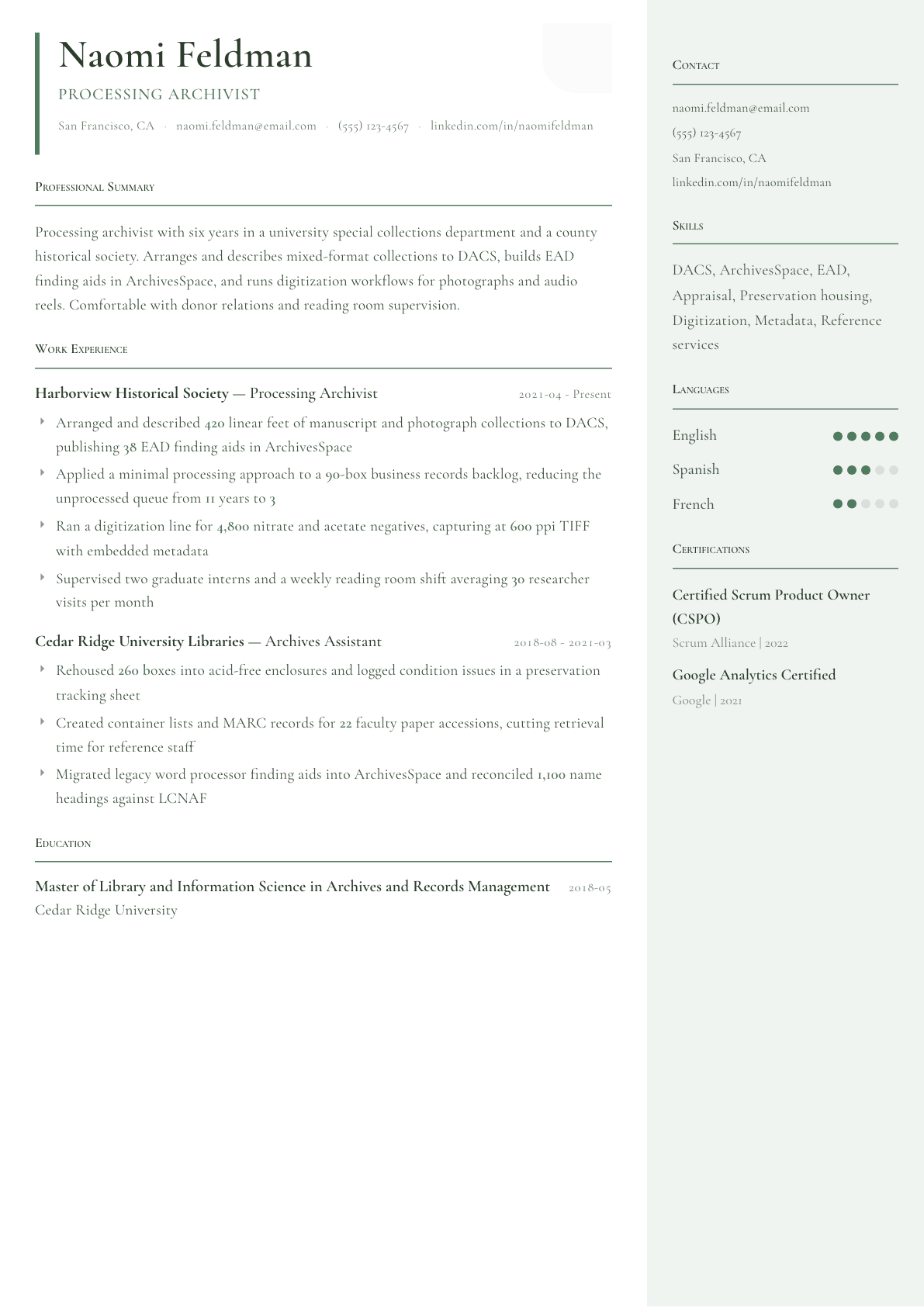
The same archivist content laid out in three CVBooster templates, so you can see what the finished document looks like before you write a word.
Example Archivist summary
Processing archivist with six years arranging and describing manuscript, photograph and audiovisual collections in academic and local history repositories. Fluent in DACS, EAD and ArchivesSpace, with a record of clearing long backlogs through minimal processing without losing intellectual control. Experienced in donor negotiation, reading room supervision and digitization projects from capture through metadata delivery.
Skills to list on a Archivist resume
- Arrangement and description
- DACS
- EAD and EAC-CPF
- ArchivesSpace
- Accessioning
- Appraisal and deaccessioning
- Preservation housing
- Digitization workflows
- Metadata standards
- Born-digital processing
- Reference and research services
- Donor relations
- Records retention schedules
- Copyright and access review
- Exhibit support
What actually gets this resume read
- Lead every job with the volume you handled in linear feet or gigabytes, because that is the number a repository director checks first.
- Name the descriptive standards and the collection management system you worked in: DACS, EAD, MARC, ArchivesSpace, Preservica, AtoM.
- Separate arrangement and description work from reference, outreach and digitization work so a hiring committee can see the balance.
- Include born-digital experience if you have any, naming the tools such as BitCurator, FTK Imager or write blockers you used.
- Give the format mix of your collections: paper, photographs, audiovisual reels, oversize maps, architectural drawings, magnetic media.
- Academic and government postings expect a longer resume or a CV, so list presentations, publications and grants in their own sections.
How to write a archivist resume
An archivist resume is graded on two things a search committee can verify quickly: how much material you have actually put under intellectual control, and whether you can describe it to a recognized standard. Everything else on the page is context. A repository director reading your file wants to know the linear feet you processed, the formats you handled, the descriptive standard you applied and the collection management system that holds your work.
The trap is writing about the profession rather than your practice. Phrases like preserving cultural heritage and stewarding the historical record appear on nearly every application to a special collections department, and they tell a hiring committee nothing about whether you can accession a truckload of unlabeled banker boxes on a Tuesday.
This guide covers the section order academic, government and historical society postings expect, how to write a processing bullet that survives scrutiny, where DACS and EAD belong, and the questions people ask when they move from a graduate assistantship into a first professional archivist job.
Format: one page for a first professional post, longer for academic search committees
Reverse chronological, plain single column, no icons. Academic and government repositories frequently ask for a curriculum vitae rather than a resume, and when they do the length limit disappears: presentations, publications, grants, professional service and instruction each get their own heading. Read the posting closely, because sending a tight one page resume to a tenure track curator search reads as an incomplete application.
For a corporate archives or a records management post inside a company, go the other way. One page, business vocabulary, retention schedules and compliance framed as risk reduction rather than as scholarship.
- Header: name, city and state, phone, email, and a link to an online finding aid or portfolio if you have one published.
- Order for a repository post: summary, professional experience, education, technical skills, professional service, presentations and publications.
- Order for a corporate records post: summary, experience, technical skills, education, certifications.
Summary: repository type, volume, standards, formats
Three sentences. Name the kind of repository you have worked in, since a university special collections department, a county historical society, a diocesan archive and a corporate records center run on different rules. Then the descriptive standards you are fluent in and the format mix you have handled: manuscripts, photographic negatives, audiovisual reels, oversize architectural drawings, magnetic media.
If you have cleared a backlog, put that in the summary. Backlog reduction is the single most persuasive claim an early career archivist can make, because every repository has one and most directors have failed to move it.
Experience: linear feet first, then description, then everything else
Open each position with the extent you handled. Linear feet for paper and photographs, gigabytes or terabytes for born-digital accessions, item counts for artificial collections. A committee reads that number before it reads anything else, because it converts your years into work.
The second bullet should be description: how many finding aids you produced, in which encoding, in which system, to which standard. Naming ArchivesSpace, AtoM, Preservica or a locally built database matters, because migrating between them is a real project and prior familiarity shortens onboarding by months.
After that, separate the strands of the job. Accessioning and appraisal is not the same work as arrangement. Reference and reading room supervision is not the same work as digitization. A committee filling a processing line needs to see that block clearly, and a committee filling a public services post needs to see the other one. Give each its own bullet rather than blending them into a sentence about supporting the mission of the archives.
Born-digital experience deserves an explicit bullet if you have any at all, naming write blockers, disk imaging, BitCurator or FTK Imager, and what you did with the resulting forensic images. Repositories are short of people who have actually done this rather than read about it.
Standards and systems: name them exactly
DACS is the expected descriptive standard for archival materials in the United States, and a resume that never names it invites the assumption that you learned description informally. Add the encoding and authority work you have done: EAD for finding aids, EAC-CPF for corporate bodies and persons, MARC for catalog records, and reconciliation against the Library of Congress Name Authority File.
For digitization, give the capture specification rather than the word digitized. Resolution, bit depth, file format, color target, and where the metadata was embedded tell a reader you ran a real production line rather than a scanner in a back room.
Keywords a repository posting reuses
Search committees at large universities route applications through a human resources system first, and the position description supplies the vocabulary. Expect arrangement and description, accessioning, appraisal, deaccessioning, finding aid, intellectual control, physical control, provenance, original order, minimal processing, reading room, donor relations, retention schedule and copyright review. Mirror the exact phrasing from the posting once in your summary and once inside a bullet where it is demonstrated.
Archivist resume summary examples
New MLIS graduate
MLIS graduate with an archives concentration and 600 practicum hours across a university special collections department and a municipal archive. Processed 45 linear feet of personal papers to DACS and published three EAD finding aids in ArchivesSpace. Comfortable with rehousing, condition reporting and reading room reference.
Five years in
Processing archivist with five years in a historical society, responsible for 380 linear feet of manuscript and photograph collections described to DACS and encoded in EAD. Applied minimal processing to reduce a nine year backlog to under two. Runs a photographic digitization line and supervises graduate interns.
Head of collections
Head of archival collections with twelve years across academic and government repositories, leading a team of four processing archivists and a digitization technician. Owns accessioning policy, appraisal decisions, donor negotiation and the migration of legacy finding aids into ArchivesSpace, alongside a born-digital workflow built on disk imaging and fixity checking.
Work experience bullets: before and after
Before: Processed archival collections and created finding aids.
After: Arranged and described 420 linear feet of manuscript and photograph collections to DACS, publishing 38 EAD finding aids in ArchivesSpace over three years.
Extent, standard, encoding and system turn an unverifiable claim into a measurable body of work.
Before: Reduced the unprocessed backlog.
After: Applied a minimal processing approach to a 90 box business records accession, cutting the unprocessed queue from eleven years of arrears to three without losing box level intellectual control.
The method, the volume and the qualifier about intellectual control show a deliberate appraisal decision rather than a shortcut.
Before: Worked on digitization projects.
After: Ran a digitization line for 4,800 nitrate and acetate negatives, capturing 600 ppi archival TIFF masters with embedded IPTC metadata and a color target in every batch.
The capture specification proves production discipline that the word digitization on its own never carries.
Before: Helped researchers in the reading room.
After: Supervised a weekly reading room shift averaging thirty researcher visits a month, handling reference interviews, reproduction requests and access review on restricted personnel files.
Volume plus the restricted material detail shows judgment about access, not just desk coverage.
Before: Cleaned up name headings in the catalog.
After: Migrated legacy word processor finding aids into ArchivesSpace and reconciled 1,100 name headings against the Library of Congress Name Authority File.
Naming the migration and the authority file shows genuine descriptive and data work rather than tidying.
Hard skills
- Arrangement and description
- DACS
- EAD and EAC-CPF encoding
- ArchivesSpace
- Accessioning
- Appraisal and deaccessioning
- Preservation housing and rehousing
- Digitization workflows
- Metadata standards
- Born-digital processing and disk imaging
- MARC and authority control
- Records retention schedules
- Copyright and access review
- Reference and research services
Soft skills
- Donor relations
- Written clarity
- Patience with ambiguity
- Project sequencing
- Intern supervision
- Discretion with restricted material
Certifications worth listing
- Certified Archivist (CA) (Academy of Certified Archivists)
- Certified Records Manager (CRM) (Institute of Certified Records Managers)
- Digital Archives Specialist (DAS) (Society of American Archivists)
- Information Governance Professional (IGP) (ARMA International)
Mistakes that cost archivist candidates the interview
- Omitting linear feet or gigabytes entirely, which leaves a committee unable to tell a semester practicum from six years of production processing.
- Writing about the value of archives rather than the work you did, which reads as a personal statement pasted into the wrong document.
- Never naming a descriptive standard, so the reader assumes you learned description from whatever the last supervisor happened to do.
- Blending reference, digitization and processing into one paragraph when the posting is clearly filling only one of those lanes.
- Sending a one page resume to an academic search that asked for a curriculum vitae with presentations, publications and service.
- Listing every software package you have opened once instead of the two or three collection management systems you can genuinely work in unsupervised.
- Leaving donor relations off the page when the posting mentions development, since negotiating a deed of gift is a distinct and prized skill.
Archivist resume questions
Do I need a resume or a curriculum vitae for an archivist job?
Read the posting. Academic and government repositories usually ask for a curriculum vitae and expect presentations, publications, grants and professional service. Historical societies, museums and corporate records departments generally want a one or two page resume in business format.
How do I show processing volume if I only had a practicum?
Give the real number anyway, even if it is small. Forty five linear feet described to DACS with three published finding aids is concrete and checkable, and a committee hiring at entry level cares far more about method and accuracy than about scale.
Is the Certified Archivist credential worth listing?
Yes, if you hold it. The Academy of Certified Archivists credential is not required by most employers, but some public sector and federal postings name it explicitly, and it is a clean signal in a field with no licensing body.
Should I list born-digital experience if it was only one accession?
Absolutely. Name the write blocker, the imaging tool, the format of the resulting image and what you did about fixity and virus checks. One documented born-digital accession puts you ahead of many applicants who have only classroom exposure.
How much detail should I give about digitization work?
Enough to prove a production standard: capture resolution, file format for masters and derivatives, whether you embedded metadata, and the total item count. Skip the scanner model unless the posting names the same equipment or a specific format such as reel to reel audio.