Education Consultant Resume Examples: what gets the call
Craft an Education Consultant Resume Districts Take Seriously
By Mustafa Tarabya, founder of CVBooster · Published · Updated
Education consultant resume examples with district engagement keywords, coaching and curriculum proof points, and a full section by section guide.
Sample resumes for a education consultant
The same education consultant content laid out in three CVBooster templates, so you can see what the finished document looks like before you write a word.
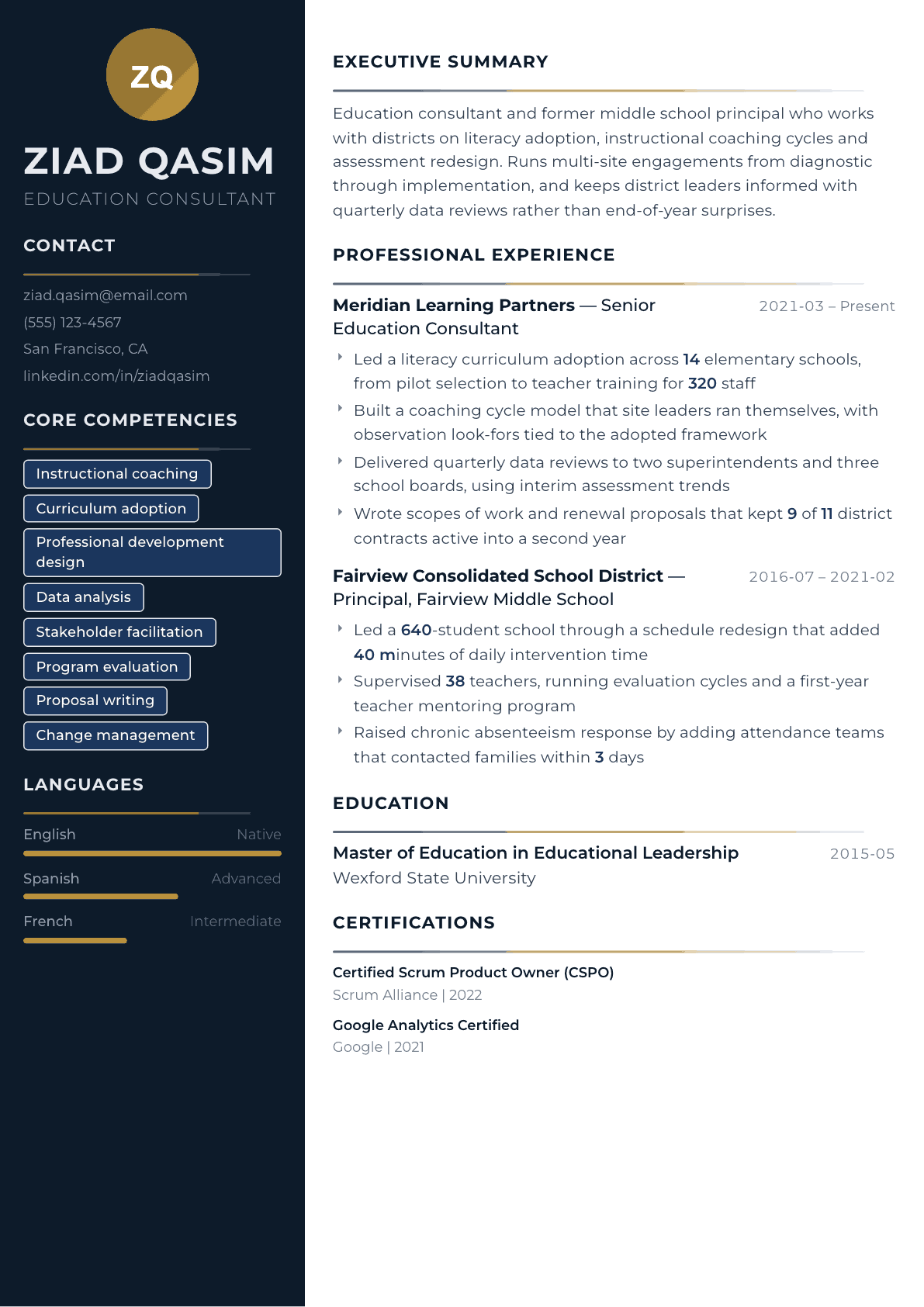
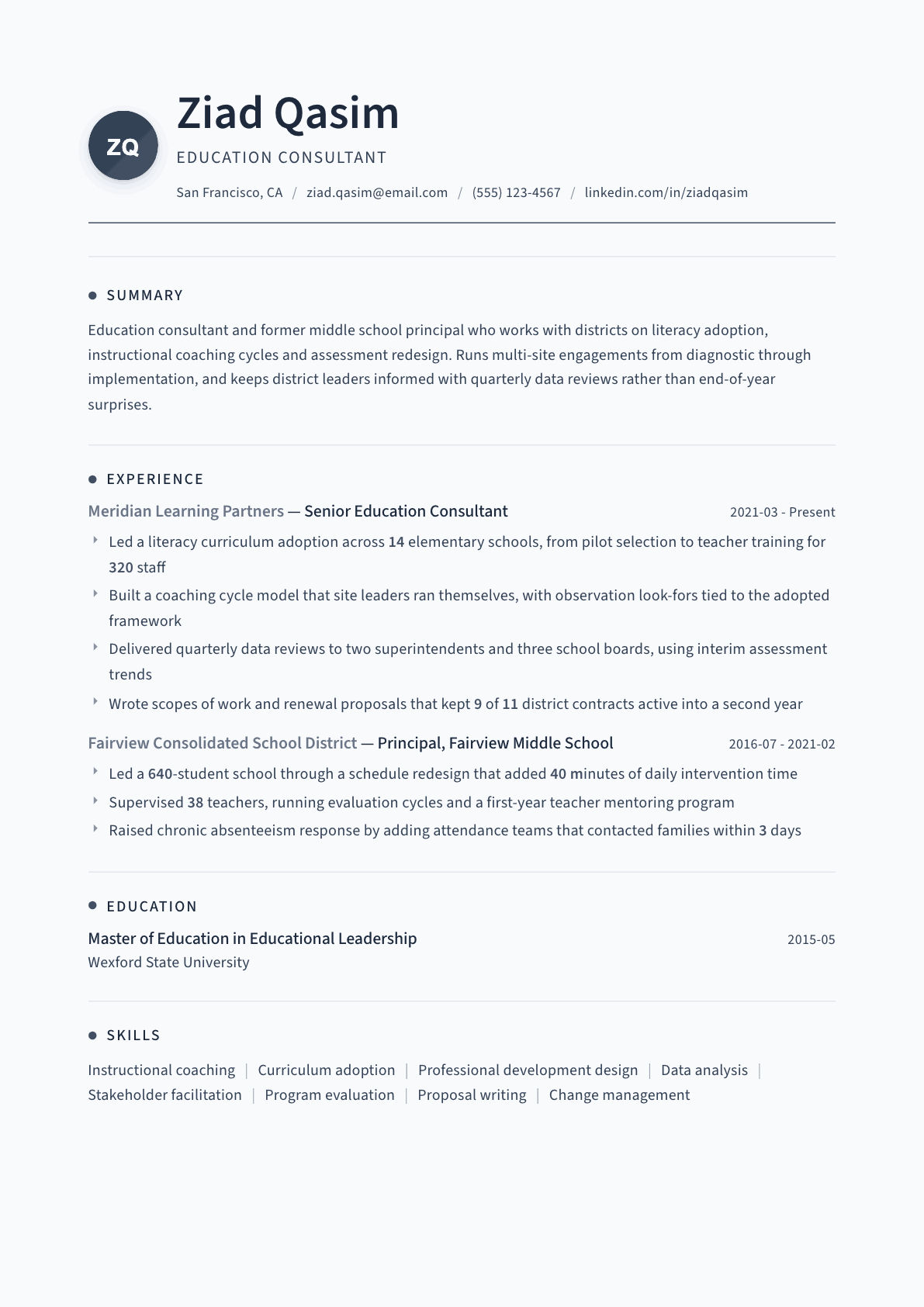
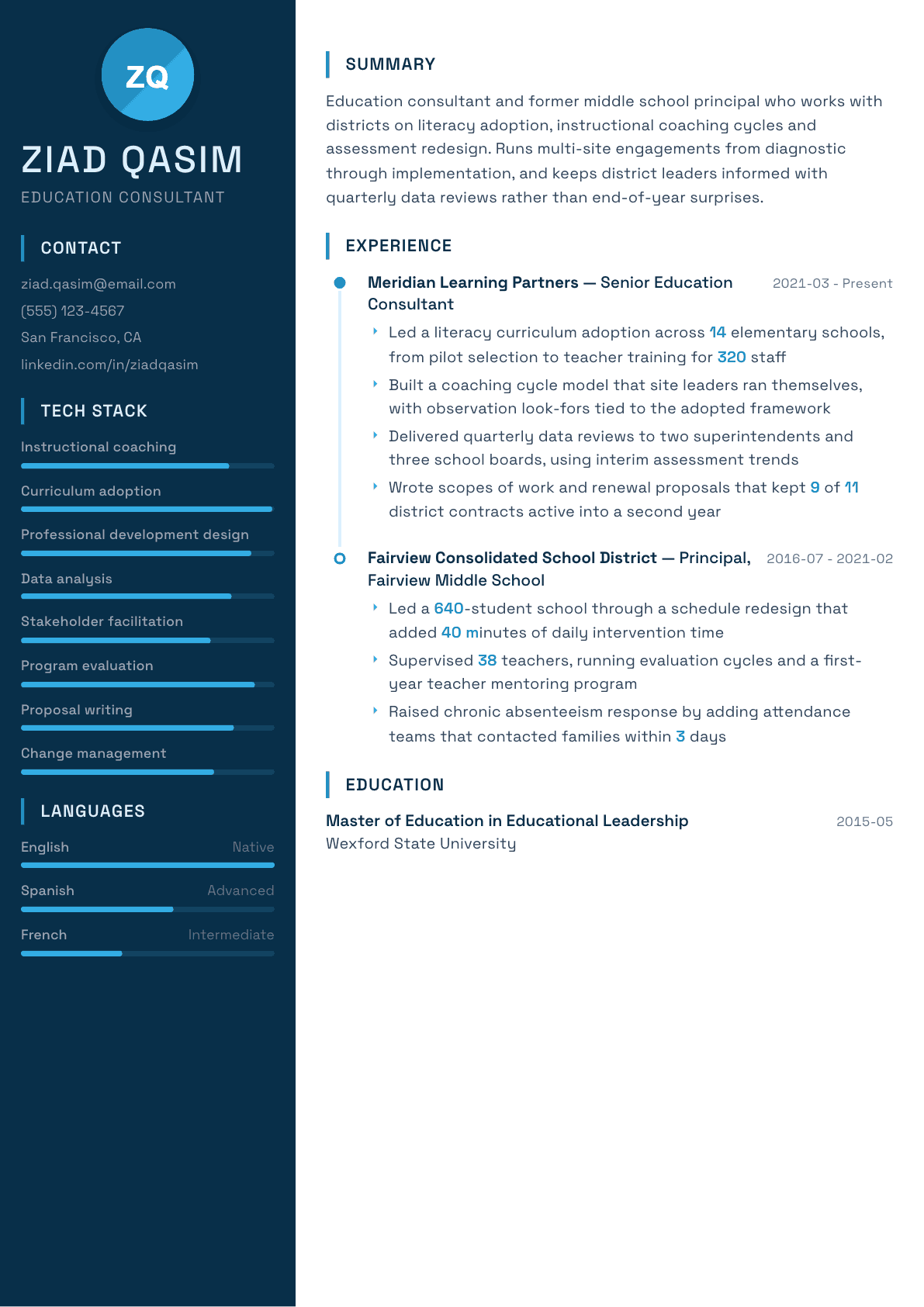
Example Education Consultant summary
Education consultant and former middle school principal supporting districts on literacy adoption, instructional coaching and assessment redesign. Has run multi-site engagements covering fourteen schools and more than three hundred teachers, from needs diagnostic through implementation and quarterly data review. Known for scopes of work that district leaders can defend to a board, and for renewals that come from results rather than relationships alone.
Skills to list on a Education Consultant resume
- Instructional coaching
- Curriculum adoption
- Professional development design
- Program evaluation
- Needs assessment
- Data-driven instruction
- Stakeholder facilitation
- Change management
- Proposal and scope writing
- School improvement planning
- Assessment design
- Adult learning
- Title I compliance
- Workshop facilitation
What actually gets this resume read
- Lead every engagement with the client type, the scope and the result, because consultants are judged on repeat work.
- Show classroom credibility first: districts rarely hire a consultant who has never taught or led a school building.
- Name the frameworks and curricula you have implemented so a director can match you to their current adoption.
- Quantify reach with schools, teachers trained, sites supported and contract renewals rather than vague influence claims.
- Add a short line on business development if you want senior roles, since firms need consultants who can renew accounts.
- Keep any state license or administrator credential visible near the top, since many district contracts require one.
How to write a education consultant resume
An education consultant resume is read by two very different buyers. A consulting firm partner wants proof you can hold a district account, scope work honestly and come back for a renewal. A district or state agency hiring a consultant directly wants proof you have stood in front of resistant teachers and left them better off. The same resume has to answer both.
The failure mode is a page full of workshop titles. Titles describe what you offered, not what changed. Districts buy consultants to close a gap they cannot close internally, so every engagement on the page should name the gap, the scope of the work, and what the district could do afterward that it could not do before.
This guide covers how to structure engagements, why classroom credibility has to appear early, how to write about coaching and adoption work without slipping into jargon, and the business development language that separates a senior consultant from a contract facilitator.
Format: engagement blocks, not a duty list
Use reverse-chronological employment, but inside each firm or independent practice, write engagements as compact blocks. A block gives the client type, the scope, the duration and the result. A district director reading five of those learns more about your range than a page of responsibilities ever conveys.
Two pages is standard for this role because the work spans teaching, leadership and consulting. Keep the third page off. If your list of engagements runs long, select the six closest to the posting and add a line saying additional engagements are available on request.
- Header: name, credentials, city, phone, email, and any active administrator license.
- Order: summary, consulting engagements, prior school leadership or teaching, education, licenses, selected professional learning delivered.
- Independent consultants list the practice name as the employer and the districts as clients.
Lead with classroom and building credibility
Districts are skeptical of outside advice, and the fastest way to lose a room of teachers is to be the consultant who has never taught. Make your teaching years and any principal or coordinator role visible in the first half of the page, with the grade band and subject area named.
If your teaching is far in the past, keep the dates but add a current-practice signal: recent classroom observations, co-teaching during an engagement, or model lessons you deliver yourself. Consultants who still get into classrooms are treated differently by the staff they are asked to change.
Write engagements around the gap and the handoff
Start each engagement with the client problem in plain terms: a curriculum adoption with no training plan, a coaching program running without look-fors, an assessment calendar nobody trusted. Then describe the scope in units a district recognizes, such as schools, teachers, coaching cycles and days on site.
End with the handoff. The strongest signal in this field is that the district kept running the work after you left. Site leaders who now facilitate their own cycles, a data review protocol that survived a leadership change, an internal coach who took over the training: those are the outcomes that earn renewals and that hiring partners look for.
- Name the frameworks and curricula by title so a director can match you to a live adoption.
- Give reach in schools, teachers trained, sessions delivered and grade bands covered.
- Say what the district owned at the end of the engagement, not only what you delivered during it.
Data and evaluation without invented claims
Consultants are rightly held to a high bar on outcome claims because so many are unprovable. Report what you can defend: implementation fidelity measures, walkthrough data, completion of coaching cycles, teacher survey results you actually collected, or interim assessment trends the district shared with you.
When achievement movement is genuinely attributable, say so carefully and name the measure and the population. When it is not, describe the leading indicators instead. A reviewer who has bought consulting before recognizes both the honest version and the inflated one.
Business development and contract language
Firms hire senior consultants who can renew and expand accounts. If you have written scopes of work, priced engagements, responded to a request for proposals or presented to a school board, put it on the page. Even one renewal statistic changes how a partner reads the rest of the resume.
Independent consultants should show the operating side too: contracting, invoicing, subcontractor facilitators, and how many concurrent districts you carry. It signals you can run a book of work rather than one relationship at a time.
Education Consultant resume summary examples
First consulting role
Instructional coach with seven years teaching upper elementary literacy, moving into consulting. Has trained 60 teachers across four schools on a structured literacy adoption, run weekly coaching cycles, and facilitated grade-level data meetings. Holds a reading specialist endorsement and a master in curriculum.
Four years consulting
Education consultant supporting eight districts on curriculum adoption and coaching design. Runs engagements from needs diagnostic through implementation, has trained more than 300 teachers, and reports quarterly to cabinet-level leaders. Former middle school assistant principal with a state administrator license.
Senior consultant, practice lead
Senior education consultant and former principal leading a five-person practice across literacy and assessment. Owns scoping, pricing and renewal for eleven district accounts, presents to school boards, and mentors associate consultants. Known for engagements districts continue running internally after the contract closes.
Work experience bullets: before and after
Before: Provided professional development to teachers.
After: Trained 320 elementary teachers across 14 schools on a structured literacy adoption, then coached site leaders to facilitate the follow-up sessions themselves.
Scale plus the handoff to site leaders shows the work outlived the contract, which is what districts buy.
Before: Worked with district leadership on school improvement.
After: Facilitated a quarterly data review with two superintendents and three school boards, tying interim assessment trends to the coaching priorities for the next cycle.
Naming the audience and the cadence proves access at cabinet level rather than building-level delivery only.
Before: Helped with curriculum selection.
After: Ran a pilot-based adoption process with a teacher review committee, scoring three programs against district criteria and documenting the recommendation for board approval.
A defined process and a board-facing artifact turn a soft claim into evidence of governance experience.
Before: Managed client relationships.
After: Wrote scopes of work and renewal proposals for eleven district contracts and kept nine active into a second year of engagement.
Renewal counts are the clearest proof of consulting value and firms screen for them directly.
Before: Designed workshops on differentiated instruction.
After: Built a four-session differentiation series with classroom-embedded practice between sessions and a walkthrough tool site administrators used to check transfer.
Between-session practice and a transfer check show design that changes behavior rather than a one-day event.
Hard skills
- Needs assessment and diagnostic review
- Curriculum adoption processes
- Instructional coaching design
- Professional learning design
- Program evaluation
- Assessment system design
- School improvement planning
- Data review protocols
- Scope of work and proposal writing
- Board and cabinet presentation
- Adult learning design
- Federal program compliance
Soft skills
- Reading the politics of a district
- Handling resistance without escalation
- Facilitating groups with mixed buy-in
- Honest scoping and expectation setting
- Building trust with union representatives
- Coaching leaders rather than replacing them
Certifications worth listing
- National Board Certification (National Board for Professional Teaching Standards)
- Certified Professional in Talent Development (CPTD) (Association for Talent Development)
- Project Management Professional (PMP) (Project Management Institute)
Mistakes that cost education consultant candidates the interview
- Listing workshop titles with no scope, reach or result attached to any of them.
- Burying teaching and building leadership so far down that a district reads you as an outsider.
- Claiming achievement gains that no one could attribute to the engagement without a comparison group.
- Filling the page with framework jargon that a superintendent would have to translate before evaluating it.
- Leaving out contract, pricing and renewal work when applying to a consulting firm that sells on accounts.
- Using the same resume for a firm role and a district-side role, when the two buyers weigh different halves.
Education Consultant resume questions
Do I need to have been a principal to work as an education consultant?
No, but you need credibility with the audience you will train. Teachers accept coaches and lead teachers readily. Cabinet-level advisory work usually expects building or district leadership experience, because the conversation turns to budget, staffing and board politics quickly.
How do I show results when districts will not share their data?
Use implementation measures you own: coaching cycles completed, walkthrough look-fors met, teacher survey responses you collected, and adoption milestones. These are defensible, they are yours to report, and experienced buyers trust them more than unverifiable achievement claims.
Should an independent consultant list every client district?
List the six most relevant and group the rest by type, such as four rural districts on literacy adoption. A long undifferentiated list reads as volume without depth, and reviewers stop reading before reaching the engagements that would have impressed them.
How long should an education consultant resume be?
Two pages. The role spans teaching, leadership and consulting, and compressing all three into one page usually costs you the engagement detail that wins interviews. Three pages signals you have not chosen what matters for this particular posting.
What certifications help an education consultant?
An active state administrator or teaching license carries the most weight, since many contracts require one. Beyond that, board certification, a talent development credential or project management certification each help, depending on whether you sell instructional depth or program delivery.