Curriculum Developer Resume Examples: what gets the call
Design a Curriculum Developer Resume That Educates and Impresses
By Mustafa Tarabya, founder of CVBooster · Published · Updated
Create a curriculum developer resume showcasing standards alignment, instructional design, and assessment development with measurable learning outcomes.
Sample resumes for a curriculum developer
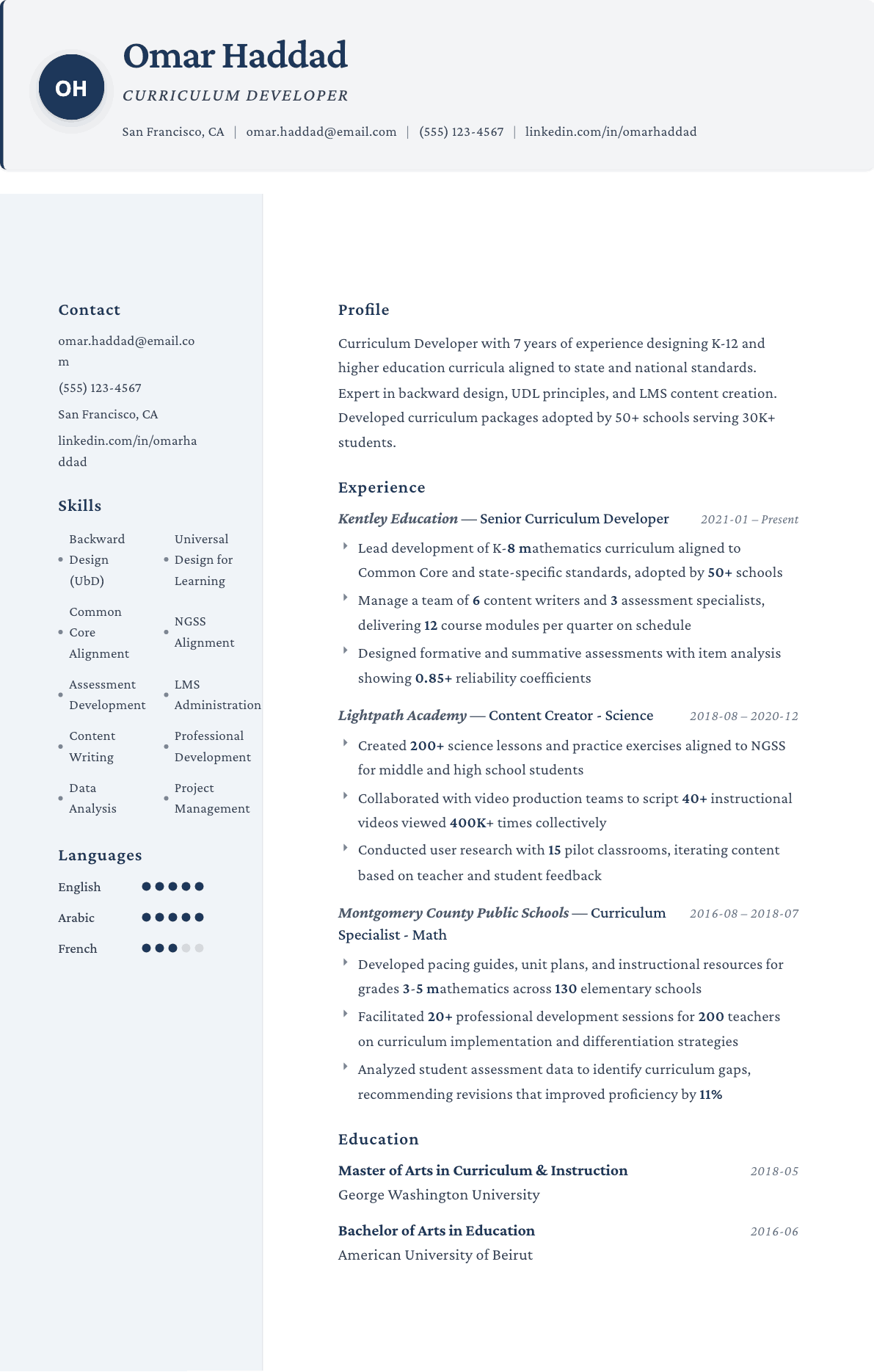
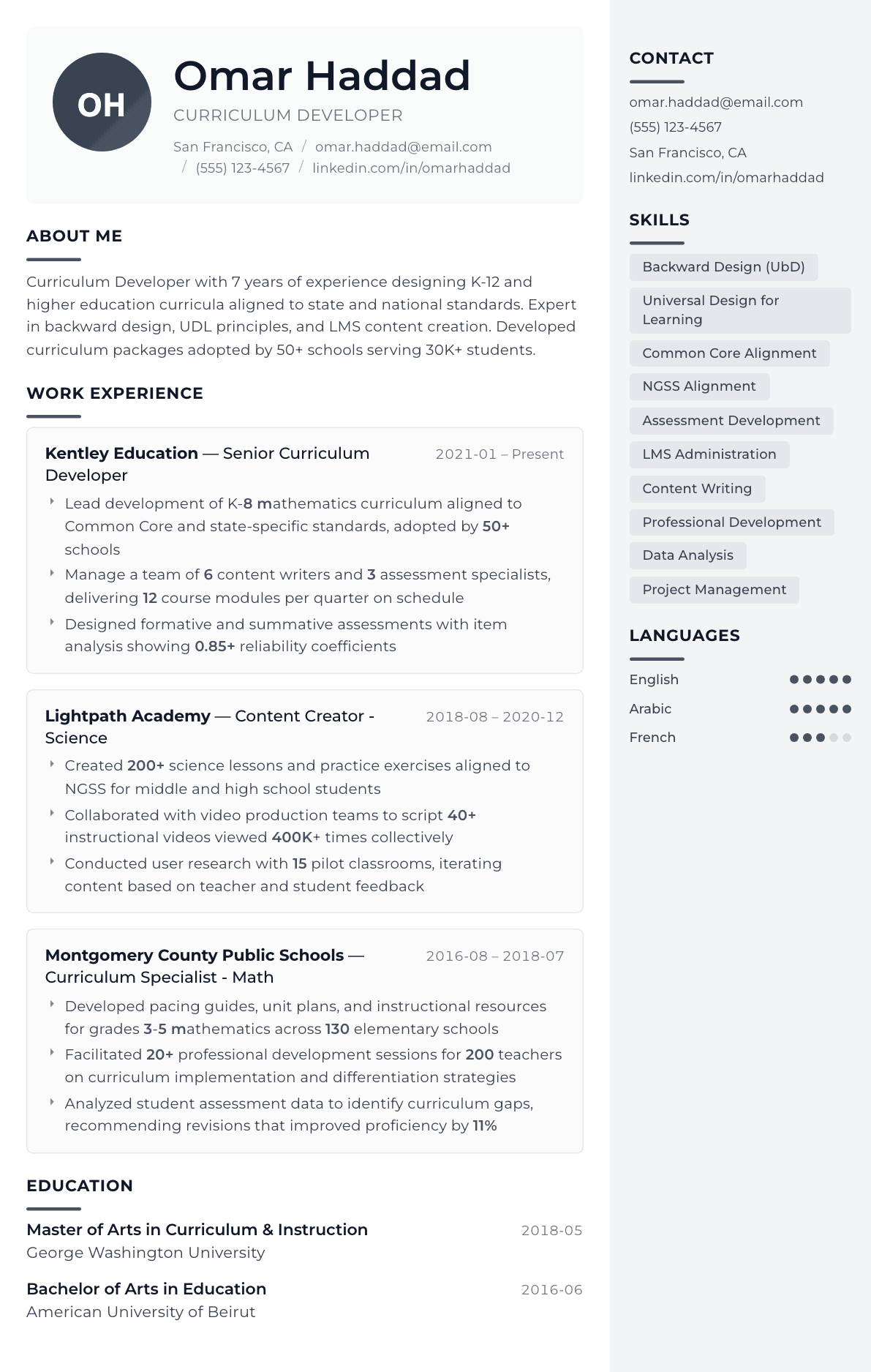
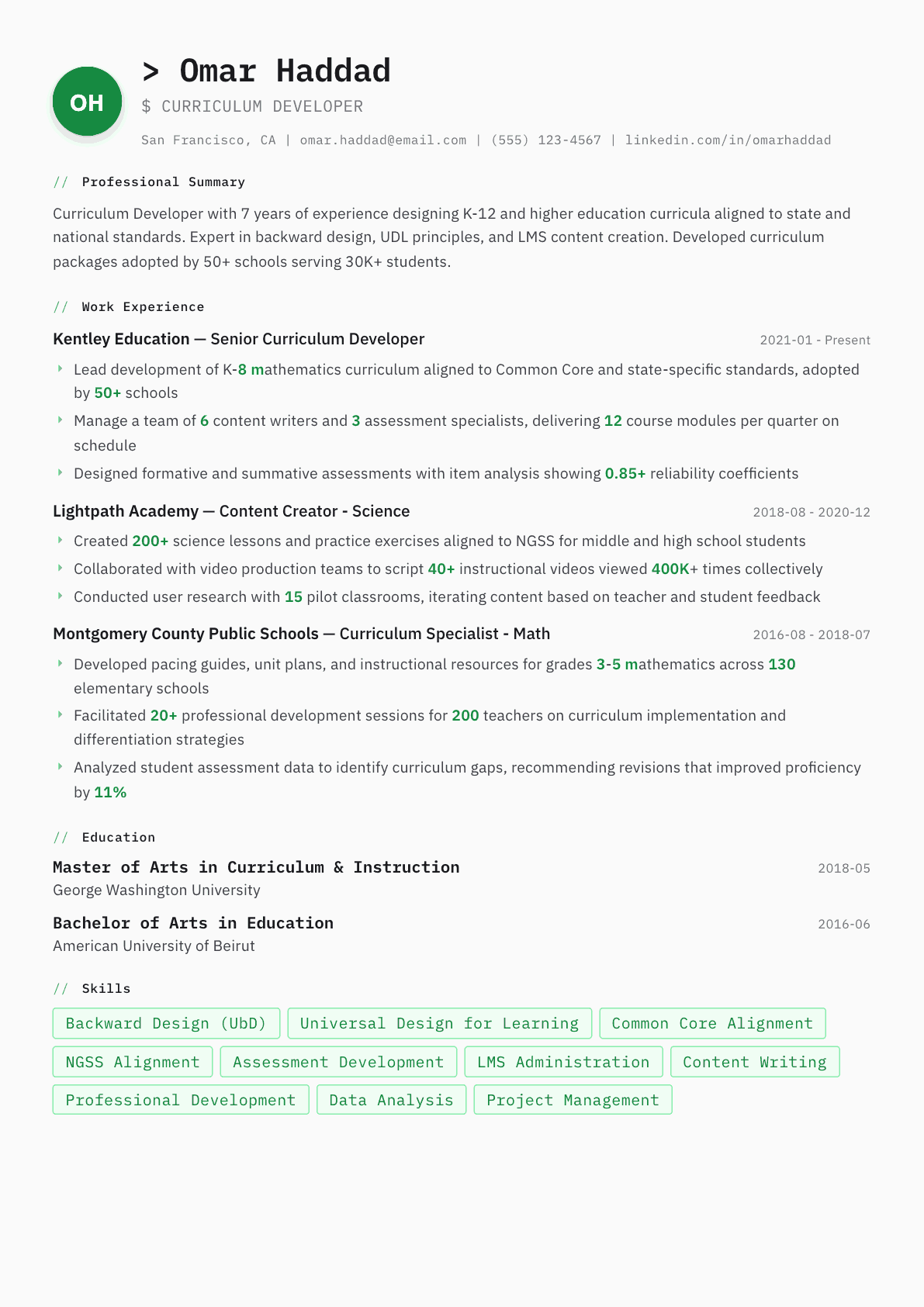
The same curriculum developer content laid out in three CVBooster templates, so you can see what the finished document looks like before you write a word.
Example Curriculum Developer summary
Curriculum Developer with 7 years of experience designing standards-aligned K-12 curricula adopted by 50+ schools serving 30K+ students. Expert in backward design, UDL, and assessment development. Leads a team of six content writers and delivers 12 course modules a quarter on schedule.
Skills to list on a Curriculum Developer resume
- Backward Design (UbD)
- Universal Design for Learning
- Standards Alignment
- Assessment Development
- Item Analysis
- LMS Content Creation
- ADDIE Model
- Professional Development
- Content Writing & Editing
- Data-Driven Curriculum Revision
- Project Management
- Scope & Sequence Design
- Digital Content Development
- Pilot Testing & Iteration
What actually gets this resume read
- Reference design frameworks: Understanding by Design (UbD), ADDIE, backward design, UDL.
- Specify standards alignment experience: Common Core, NGSS, state standards, AP frameworks.
- Quantify adoption and impact: schools reached, students served, assessment reliability, score improvements.
- Include LMS and authoring tools: Canvas, Blackboard, Google Classroom, Articulate, Captivate.
- Describe professional development facilitation for teachers implementing your curriculum.
- Mention content types: lesson plans, assessments, pacing guides, scope & sequence, digital content.
How to write a curriculum developer resume
A curriculum developer resume is read by someone who owns a publishing calendar. Whether that is a district curriculum director, an editorial director at a materials publisher, or a program lead at an education technology company, the question is the same: can this person write standards-aligned materials that teachers will actually use, to a specification, and hand them in on the date they promised. Missing a pilot date costs a whole adoption cycle, so reliability is screened as hard as writing quality.
The second question is whether you have taught. Teachers can tell within a page whether a lesson was written by someone who has managed thirty students through it, and curriculum leads know this. Classroom years are an asset on this resume, not a past life to be minimized, and they should be framed as the source of your design judgment.
This guide covers how to describe a body of work by volume and scope, which frameworks and standards to name, how to show assessment quality, and the questions writers ask when they move between district curriculum offices, publishers and instructional design in industry.
Format: one to two pages, output volume and standards named early
Reverse chronological, with a short line under the header stating the grade bands, the subjects and the standards frameworks you write to. That single line answers most of the screening question, because a middle school mathematics writer and a high school career and technical education writer are not interchangeable hires.
Include a portfolio or writing sample link. Curriculum hiring almost always involves a writing task, and candidates who arrive with a published unit, a scope and sequence document, or a sample assessment shorten the process considerably. Note if your samples are behind a district or publisher paywall so nobody assumes the link is broken.
- Header: name, city and state, phone, email, and a link to published or sample materials.
- Section order: summary, curriculum development experience, teaching experience, tools and standards, education, certifications.
- Former teachers keep classroom experience as a full section and describe the curriculum work done inside it.
Summary: subject, grade band, output, and adoption
Say what you write, for whom, and how much of it exists. Subject and grade band, the standards framework, the volume in lessons or units, and where the materials landed: a single school, a district, a state adoption list, or a commercial catalog.
Adoption is the outcome that matters in this field. Materials that were written and never implemented are a portfolio, while materials in daily use in classrooms are a track record, and the resume should be clear about which it is describing.
Experience: scope, process, and the evidence the materials worked
Open each role with the scope of what you produced: the courses, the number of units and lessons, the grade levels, the number of instructional days covered, and whether the work included print, digital, or both. A curriculum director reading a full-year Algebra 1 course of 160 lessons with embedded formative assessment knows exactly what that took.
Then show the process, because that is what makes you employable on a team rather than as a solo writer. Backward design from standards and enduring understandings, alignment mapping, internal review and editorial cycles, accessibility and Universal Design for Learning review, bias and sensitivity review, copyright and permissions clearance, pilot testing in classrooms, and revision from teacher feedback and item data.
Include the teacher-facing side. Pacing guides, scope and sequence documents, teacher editions with instructional notes, professional learning sessions for implementation, and the support cycle after launch. Materials without implementation support get abandoned, and curriculum leads know it.
Close with evidence. Adoption counts, classroom pilot feedback, assessment item statistics such as difficulty and discrimination, revisions made in response to data, and student performance changes where the district measured them honestly.
Standards, frameworks and accessibility language
Name the standards you have aligned to rather than saying standards-aligned: state academic standards by name, the Common Core State Standards, the Next Generation Science Standards, advanced placement course and exam descriptions, International Baccalaureate subject guides, or industry certification frameworks in career and technical education.
Then name the design frameworks: Understanding by Design and backward design, Universal Design for Learning with its three principles, Webb's Depth of Knowledge or Bloom's revised taxonomy for cognitive demand, and the specific instructional models your subject uses, such as the science storyline or a mathematics concrete to representational to abstract progression.
Accessibility is increasingly a procurement requirement. If you have written to the Web Content Accessibility Guidelines, produced alternative text and readable tables, supported screen reader use, or worked through a voluntary product accessibility evaluation, put it on the page.
Assessment writing: the part that separates candidates
Assessment is where weak curriculum work shows first. Describe the item types you write, whether selected response, constructed response, performance task or portfolio, and the quality controls you apply: alignment to a specific standard and depth of knowledge level, distractor rationales built from common misconceptions, reading level control, and rubric design with anchor papers.
If you have worked with item data, say so precisely. Item analysis after a pilot, difficulty and discrimination review, retiring or rewriting items that underperformed, and reliability review on a full form are all signals that you write assessments rather than quizzes.
Curriculum Developer resume summary examples
Teacher moving into curriculum
Middle school science teacher with six classroom years moving into curriculum development, having written a full seventh grade unit sequence aligned to the Next Generation Science Standards and adopted across four schools in the district. Skilled in backward design, phenomenon-based storylines and formative assessment writing.
Five years writing curriculum
Curriculum developer with five years authoring standards-aligned mathematics materials for grades 6 to 8, including two full-year courses of 160 lessons each with embedded assessment. Ran classroom pilots in nine schools and revised from teacher feedback and item analysis before publication.
Lead curriculum designer
Lead curriculum designer managing a team of six writers and two editors across a K-12 literacy program adopted by more than 40 districts. Owns scope and sequence, editorial standards, accessibility review and the release calendar, and delivered three consecutive adoption cycles on schedule.
Work experience bullets: before and after
Before: Developed curriculum materials aligned to state standards.
After: Authored a full-year grade 7 mathematics course of 160 lessons aligned to state standards, with a pacing guide, teacher edition notes and an end-of-unit assessment for each of the eight units.
Course, lesson count and the accompanying teacher materials show the true size and completeness of the deliverable.
Before: Wrote assessments for the units I created.
After: Wrote 320 assessment items mapped to standard and depth of knowledge level, built distractors from documented student misconceptions, and rewrote 28 items after pilot item analysis flagged weak discrimination.
Item volume, alignment mapping and a revision driven by item statistics separate assessment writing from quiz writing.
Before: Worked with teachers to get feedback on the materials.
After: Piloted three units in nine classrooms across two districts, observed six lessons in person, collected structured teacher feedback forms, and cut average lesson length after teachers reported consistent overrun.
The pilot design and a specific change made in response prove that feedback altered the product.
Before: Made sure materials were accessible to all learners.
After: Applied Universal Design for Learning across the course with leveled reading passages, alternative text on every graphic, and scaffolded task versions, then verified color contrast and screen reader order in the digital build.
Naming the specific accommodations and the digital checks makes accessibility a completed process rather than an intention.
Before: Trained teachers on the new curriculum.
After: Delivered 11 implementation sessions to 240 teachers across four districts, then ran monthly office hours through the first semester and logged the recurring questions into the revision backlog.
Session and audience counts plus a feedback loop into revision show implementation support, not a one-time launch day.
Hard skills
- Backward design and Understanding by Design
- Standards alignment and crosswalk mapping
- Universal Design for Learning
- Scope and sequence development
- Pacing guide writing
- Assessment and item writing
- Rubric design with anchor papers
- Item analysis and revision
- Learning management system content build
- Articulate and digital authoring tools
- Editorial review and style guide compliance
- Copyright and permissions clearance
- Classroom pilot design
- Professional learning facilitation
Soft skills
- Writing plainly for busy teachers
- Taking editorial feedback
- Holding a release calendar
- Subject matter expert collaboration
- Attention to alignment detail
- Explaining design decisions to reviewers
Certifications worth listing
- State Teaching License (State Department of Education)
- Certified Professional in Talent Development (CPTD) (Association for Talent Development)
- Quality Matters Applying the QM Rubric Certificate (Quality Matters)
Mistakes that cost curriculum developer candidates the interview
- Saying standards-aligned without ever naming a standards framework, which reads as work that was never truly mapped.
- Describing materials that were written but never implemented as though they were adopted.
- Hiding classroom teaching experience, which is the credential that convinces teachers your lessons will survive a real period.
- Leaving out volume, so a reader cannot tell whether you wrote a single unit or a full-year course.
- Treating assessment as an afterthought when item quality is what a reviewer inspects first.
- Omitting accessibility work at a time when it is a procurement requirement for most district purchases.
- Skipping the pilot and revision cycle, which makes the work look like writing rather than product development.
Curriculum Developer resume questions
Do I need classroom teaching experience to be a curriculum developer?
It is not always required, but it is the strongest single qualification for K-12 work. Teams that hire nonteachers usually want deep subject expertise, editorial or publishing experience, or assessment training instead, and they will pair you with teacher reviewers.
What should be in a curriculum developer portfolio?
Three to five pieces that show range: one complete lesson with teacher notes, one unit overview with a scope and sequence, one assessment with a rubric and alignment map, and any pacing guide or implementation material. Note which pieces were classroom tested.
How do I show impact when I never see the student data?
Report the outcomes you can evidence: districts and schools that adopted the materials, teachers trained, pilot feedback and the revisions it produced, item statistics from a pilot form, and renewal or re-adoption of the program in a later cycle.
Is curriculum developer the same as instructional designer?
They overlap but sit in different worlds. Curriculum development is usually K-12 or higher education, organized around academic standards and school calendars. Instructional design is usually corporate, organized around job tasks and business outcomes. Match your vocabulary to whichever posting you are answering.
How do I write about work I did under a nondisclosure agreement?
Describe the shape without the name: the subject, grade band, volume, standards framework and your role, with the publisher described by type rather than by title. Then offer a rebuilt neutral sample so a hiring team can still judge your writing.