Solar Installer Resume Examples: the lines they read
Build a Solar Installer Resume That Passes Electrical Screening
By Mustafa Tarabya, founder of CVBooster · Published · Updated
Solar installer resume example with racking, wiring and inspection bullets, NABCEP keywords and a guide to writing each section.
Sample resumes for a solar installer
The same solar installer content laid out in three CVBooster templates, so you can see what the finished document looks like before you write a word.
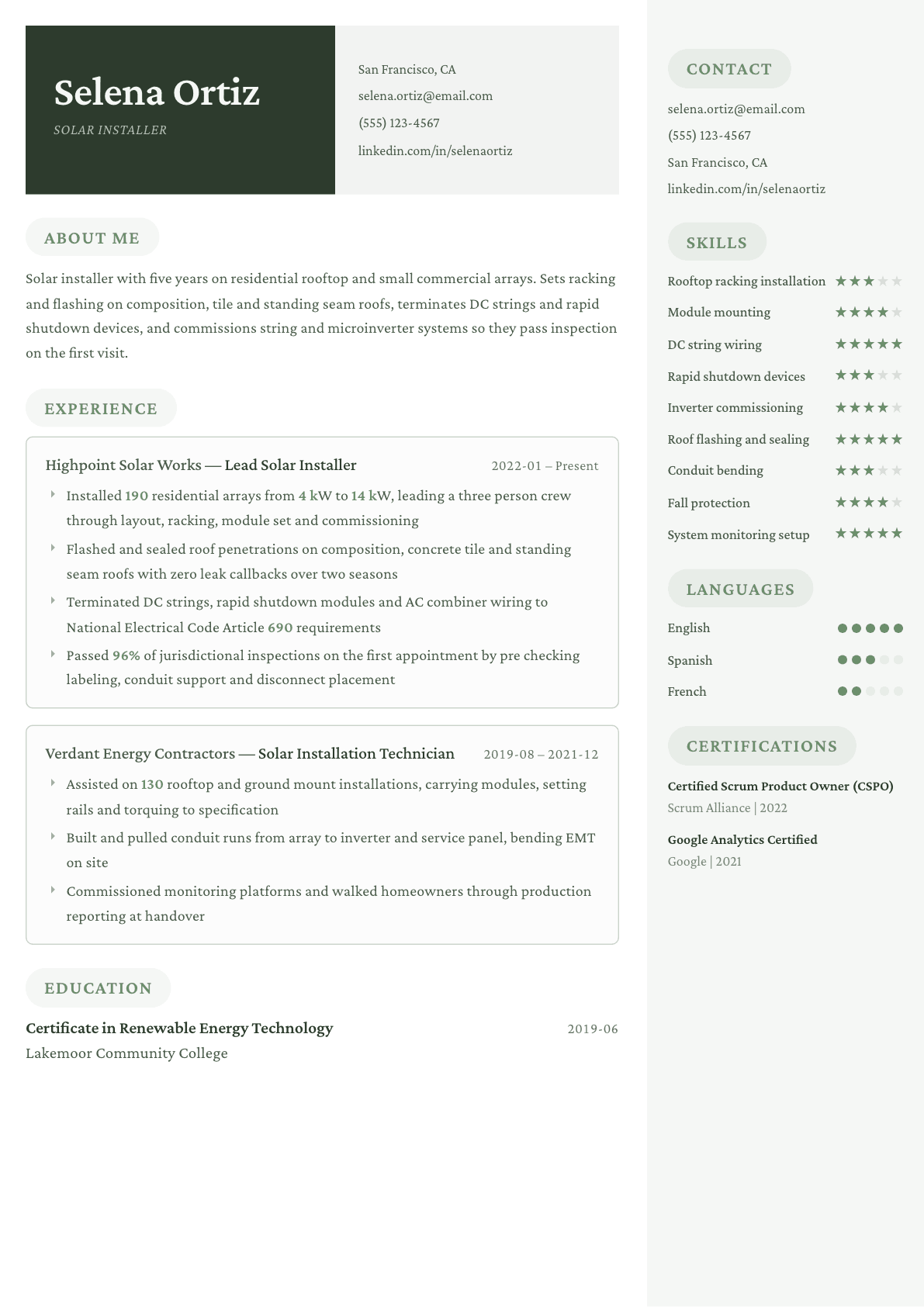
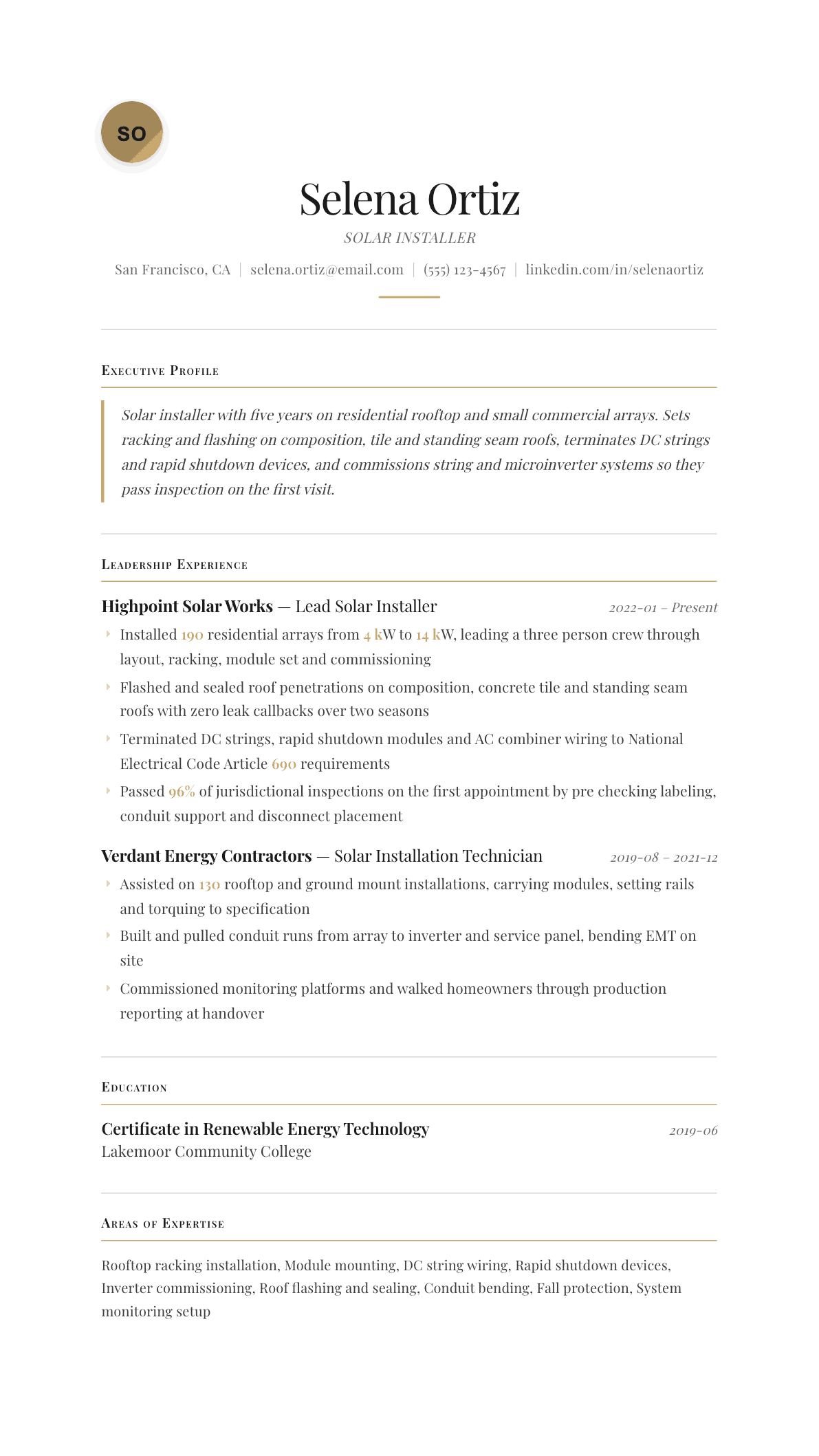
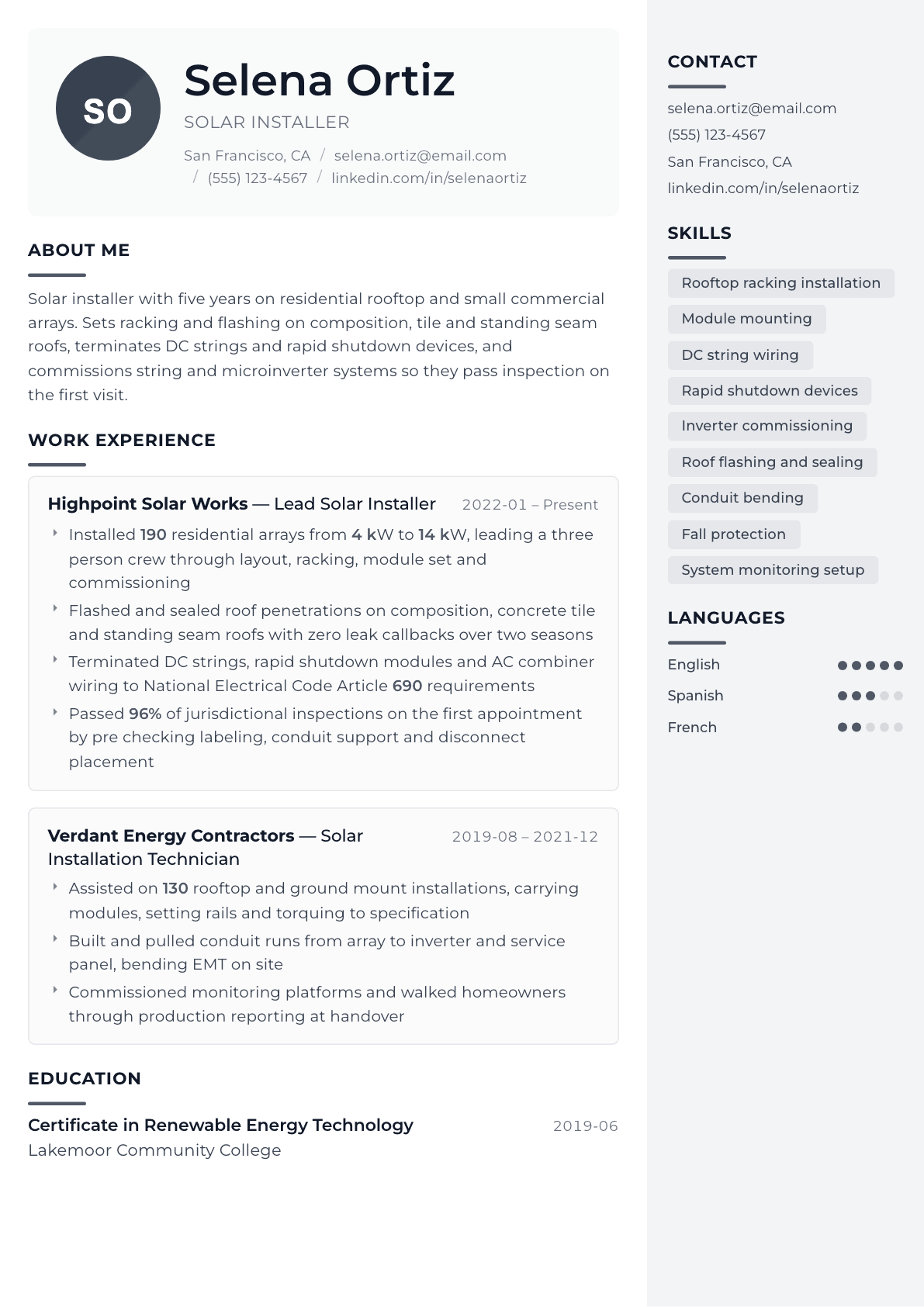
Example Solar Installer summary
Solar installer with five years on residential rooftop and small commercial arrays, leading crews through layout, racking, module set, wiring and commissioning. Works composition, tile and standing seam roofs with a clean leak record, terminates DC strings and rapid shutdown devices to code, and prepares sites so inspections pass on the first appointment. Seeking a crew lead or field supervisor position with a storage focused contractor.
Skills to list on a Solar Installer resume
- Photovoltaic installation
- Racking and mounting systems
- Roof flashing
- DC string wiring
- Rapid shutdown
- String and microinverters
- Conduit bending and pulling
- Grounding and bonding
- System commissioning
- Battery storage installation
- Fall protection
- Blueprint and single line reading
- Torque specification work
- Customer handover
What actually gets this resume read
- Give array counts and system sizes in kilowatts so a hiring contractor can see the volume and scale you have handled.
- Name every roof type you have flashed, because tile and standing seam work is what separates a lead from a helper.
- Show electrical depth: string sizing, rapid shutdown, grounding and bonding, and the code articles you work to.
- Report your first time inspection pass rate, since failed inspections are the cost a solar contractor feels most.
- List your NABCEP credential or your progress toward it, along with fall protection and any electrical license or hours.
- Include battery storage work separately if you have it, naming the systems you have commissioned and their configuration.
How to write a solar installer resume
Solar installation sits between roofing and electrical work, and the resume has to satisfy both sides. A contractor wants to know that you can put penetrations through a roof without creating a leak, and that you can terminate direct current conductors, rapid shutdown devices and grounding correctly enough to pass an inspection the first time.
The person reading is usually an install manager who tracks two costs: callbacks and failed inspections. Both eat margin on a job that was priced tight. A resume that speaks to those two numbers gets a call ahead of one that lists panel brands and enthusiasm for clean energy.
This guide covers the layout, how to write a summary that positions you as helper, installer or lead, how to describe array work with the specifics an install manager recognizes, which credentials carry weight, and the questions that come up when installers move between residential, commercial and storage work.
Format: one page, credentials and roof types visible early
One page, plain formatting. Solar contractors hire in waves and screen quickly, so make the top third of the page carry the summary, the credentials, and the roof and mounting types you have worked on.
If you hold an electrical license or apprenticeship hours, that belongs high on the page as well. Many companies need licensed electrical staff on the interconnection side and will structure a role around a candidate who brings those hours.
- Header: name, city and state, phone, email, driver license class.
- Section order: summary, certifications and licenses, roof and mounting experience, work history, technical skills.
- A career changer from roofing leads with flashing, roof types and fall protection, then electrical training in progress.
Summary: volume, system sizes, and your position on the crew
Give the number of arrays you have installed and the size range in kilowatts. Then state your crew position: helper, installer, lead installer or foreman. An install manager builds crews out of those roles and needs to know which slot you fill.
Close with the differentiator. Tile and standing seam roofs, ground mount and carport structures, battery storage commissioning, or service and repair work on existing systems each open different doors.
Experience: roof, rack, wire, commission
Structure each job around the four stages of an install. Roof: layout from the design, rafter location, penetration flashing and sealing by roof type, and how you protect finished surfaces. Rack: rail runs, mid and end clamps, torque specification, module handling and row alignment.
Wire: string configuration to design, rapid shutdown device wiring, home runs, conduit routing and bending, junction and combiner terminations, grounding and bonding, and the labeling the inspector will read. Commission: inverter startup, monitoring setup, insulation resistance and open circuit voltage checks, and the walkthrough with the homeowner.
Then add the two numbers that matter. First time inspection pass rate tells a manager how much rework your jobs create. Callback and leak history tells him whether your penetrations hold. Both are honest, checkable and rare on a resume.
Commercial and ground mount work should be separated out when you have it, since ballasted flat roof systems, pier and ground screw foundations and larger conductor sizes are a different day than residential rooftop.
- Systems installed, size range, and mounting types.
- Electrical scope you personally terminated and the code articles involved.
- Inspection and callback outcomes across a defined period.
Credentials, licenses and safety
The certification most companies recognize comes from the North American Board of Certified Energy Practitioners. Note whether you hold the associate level or a full installation professional credential, and say if you are accumulating install hours toward it.
Add electrical apprenticeship hours or a journeyman license, fall protection training, construction safety course hours, first aid, and any manufacturer training on inverters, racking systems or battery products. Manufacturer training matters because warranty terms often depend on a trained installer performing the work.
Keywords in solar installation postings
The recurring terms are photovoltaic installation, racking, module mounting, string wiring, rapid shutdown, microinverter, string inverter, conduit bending, grounding and bonding, commissioning, energy storage and fall protection. Use them where they describe work you have done.
Service and operations roles use a different set: troubleshooting, production diagnostics, module replacement, monitoring alerts, arc fault clearing and warranty repair. Tailor the resume when you apply to a service team rather than a new construction crew.
Solar Installer resume summary examples
First season
Solar installation helper with one season carrying modules, setting rails and pulling conduit on residential rooftop crews. Comfortable on pitched roofs with a harness and anchor system, trained in fall protection, and studying for the entry level photovoltaic certification while logging install hours.
Three years installing
Solar installer with three years on residential arrays from 4 kW to 12 kW. Flashes composition and tile roof penetrations, sets racking to torque specification, terminates strings and rapid shutdown devices, and commissions string and microinverter systems with the homeowner monitoring app.
Lead installer
Lead solar installer running a three person crew through layout, racking, module set, wiring and commissioning on residential and small commercial arrays. Works composition, concrete tile and standing seam roofs with no leak callbacks, and prepares sites so jurisdictional inspections pass on the first appointment.
Work experience bullets: before and after
Before: Installed solar panels on houses.
After: Installed 190 residential arrays from 4 kW to 14 kW, leading a three person crew through layout, racking, module set and commissioning on each job.
Array count, size range and crew role tell an install manager exactly where you fit on his schedule.
Before: Attached the racking to the roof.
After: Flashed and sealed roof penetrations on composition, concrete tile and standing seam roofs, with zero leak callbacks reported across two full install seasons.
Roof types plus a callback record answer the risk a contractor carries long after the array is energized.
Before: Wired the panels to the inverter.
After: Terminated DC strings, rapid shutdown modules and AC combiner wiring to National Electrical Code requirements for photovoltaic systems, including grounding, bonding and full labeling.
Code specific electrical scope shows the work was done to inspection standard rather than to a picture.
Before: Jobs usually passed inspection.
After: Passed 96% of jurisdictional inspections on the first appointment by pre checking labeling, conduit support, disconnect placement and rapid shutdown function before the inspector arrived.
A first time pass rate with the checklist behind it is a direct cost saving an install manager can price.
Before: Showed customers how the system worked.
After: Commissioned monitoring platforms and walked homeowners through production reporting, alert behavior and the shutdown procedure before leaving the site.
A structured handover reduces support calls, which is the part of the job most installers skip entirely.
Hard skills
- Photovoltaic array layout
- Racking and mounting installation
- Roof flashing and sealing
- Module handling and torque work
- DC string wiring
- Rapid shutdown device installation
- String and microinverter commissioning
- Conduit bending and routing
- Grounding and bonding
- Battery storage installation
- Fall protection systems
- Single line and site plan reading
Soft skills
- Working safely at height
- Crew leadership on a tight schedule
- Customer handover communication
- Attention to labeling detail
- Coordinating with inspectors
Certifications worth listing
- NABCEP PV Installation Professional (North American Board of Certified Energy Practitioners)
- NABCEP PV Associate (North American Board of Certified Energy Practitioners)
- OSHA 10-Hour Construction Outreach Training (Occupational Safety and Health Administration)
- First Aid and CPR (American Red Cross)
Mistakes that cost solar installer candidates the interview
- Listing module and inverter brands instead of the roof types, mounting systems and electrical scope you handled.
- Skipping the electrical side entirely, which makes the application read as a module carrier rather than an installer.
- Leaving out inspection outcomes when failed inspections are the cost that install managers watch most closely.
- Claiming lead installer experience without saying how many people you ran or which stages you owned.
- Ignoring fall protection and safety training on a job performed almost entirely on a pitched roof.
- Applying to a storage focused contractor with no mention of battery work, commissioning or backup panel wiring.
Solar Installer resume questions
Do I need certification to get hired as a solar installer?
Most companies hire helpers with no credential and train on the job. Certification matters for lead and supervisory roles, and it can be required for certain incentive programs, so note any hours you are logging toward it.
Does roofing experience help on a solar resume?
It helps a great deal. Flashing knowledge, roof type familiarity and comfort working at height are exactly what a contractor worries about with new installers, so lead with that background and pair it with electrical training.
Should I include system sizes on my resume?
Yes, as a range in kilowatts, along with the number of installations. Size range shows whether you have worked residential rooftop only or have moved into larger commercial and ground mount projects with heavier conductors.
How do I show battery storage experience?
Give it its own bullets. Name the system types you have installed, whether you wired backup or critical load panels, how you handled placement and ventilation requirements, and what commissioning steps you completed on site.
What if my only experience is one season as a helper?
Be specific about what you actually did: modules carried and set, rail runs, conduit pulled, harness use, and how many jobs you were on. Volume plus a training block reads far stronger than a vague claim of assisting the crew.
Related resume examples
- Electrician Resume example
- Roofer Resume example
- Solar Energy Engineer Resume example
- HVAC Installer Resume example
- Wind Turbine Technician Resume example
- Apprentice Electrician Resume example