Master Electrician Resume Examples: the lines they read
A Master Electrician Resume That Shows Code and Command
By Mustafa Tarabya, founder of CVBooster · Published · Updated
Master electrician resume examples covering license and permit authority, code responsibility, service work and estimating keywords.
Sample resumes for a master electrician
The same master electrician content laid out in three CVBooster templates, so you can see what the finished document looks like before you write a word.
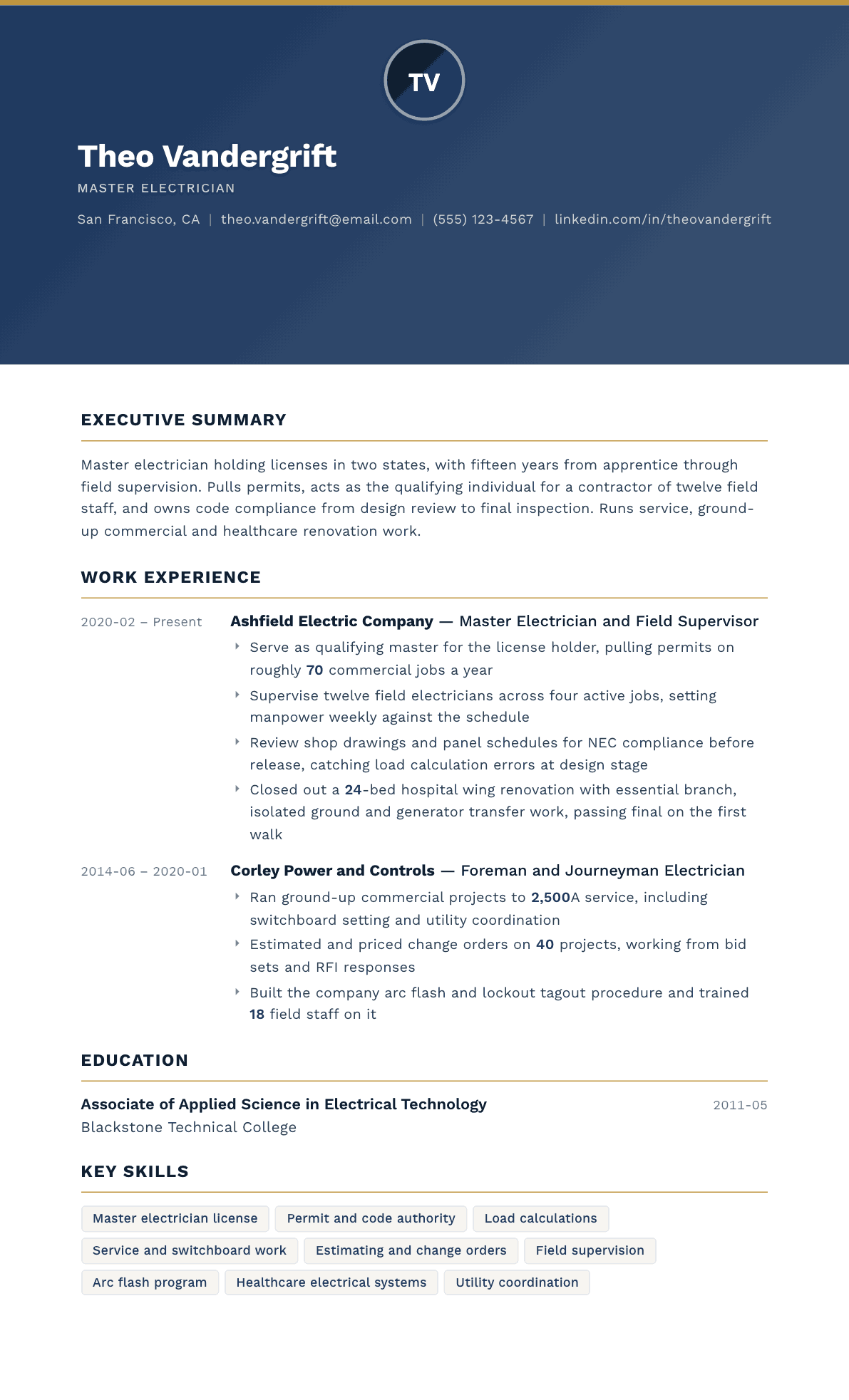
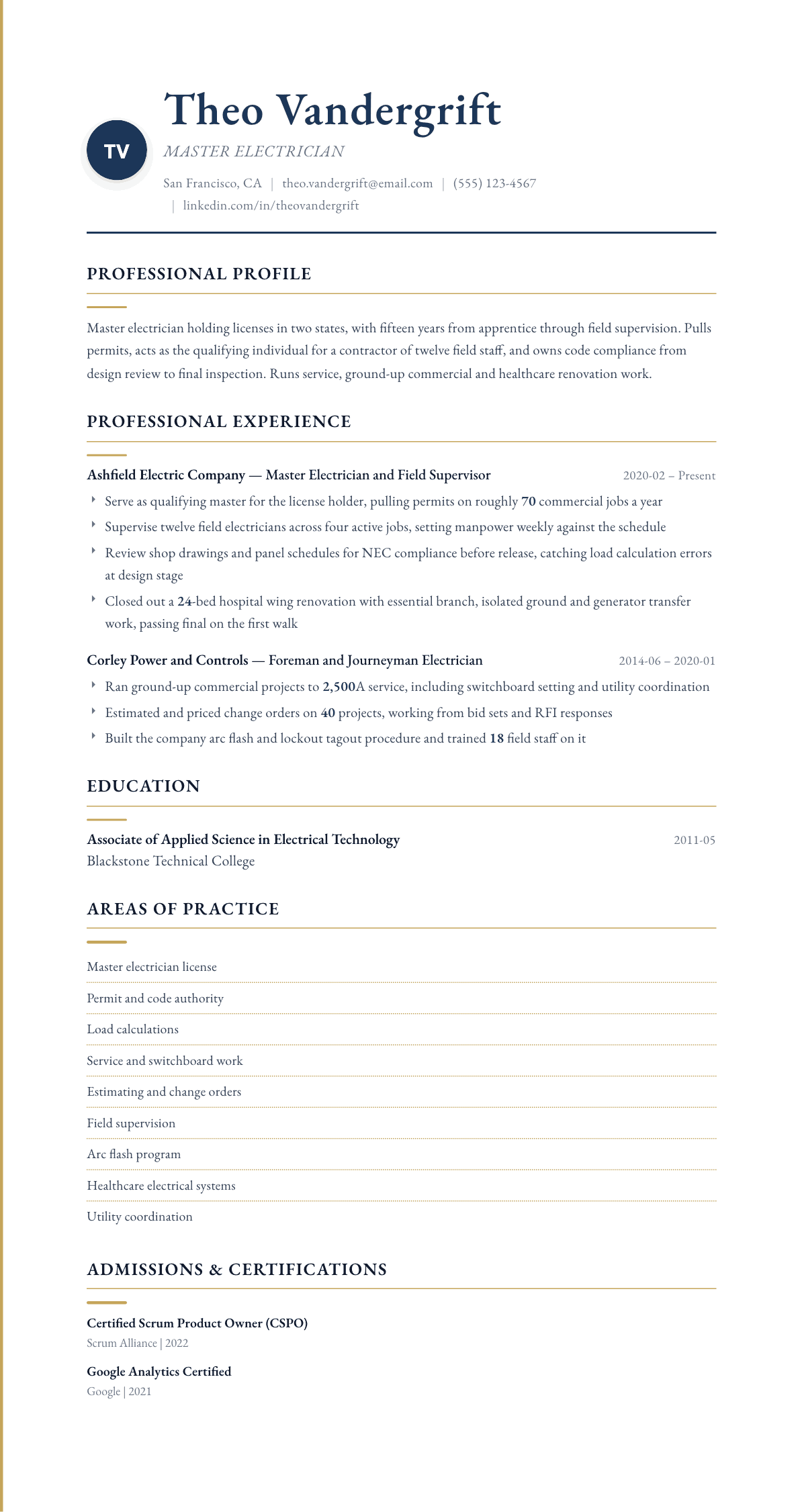
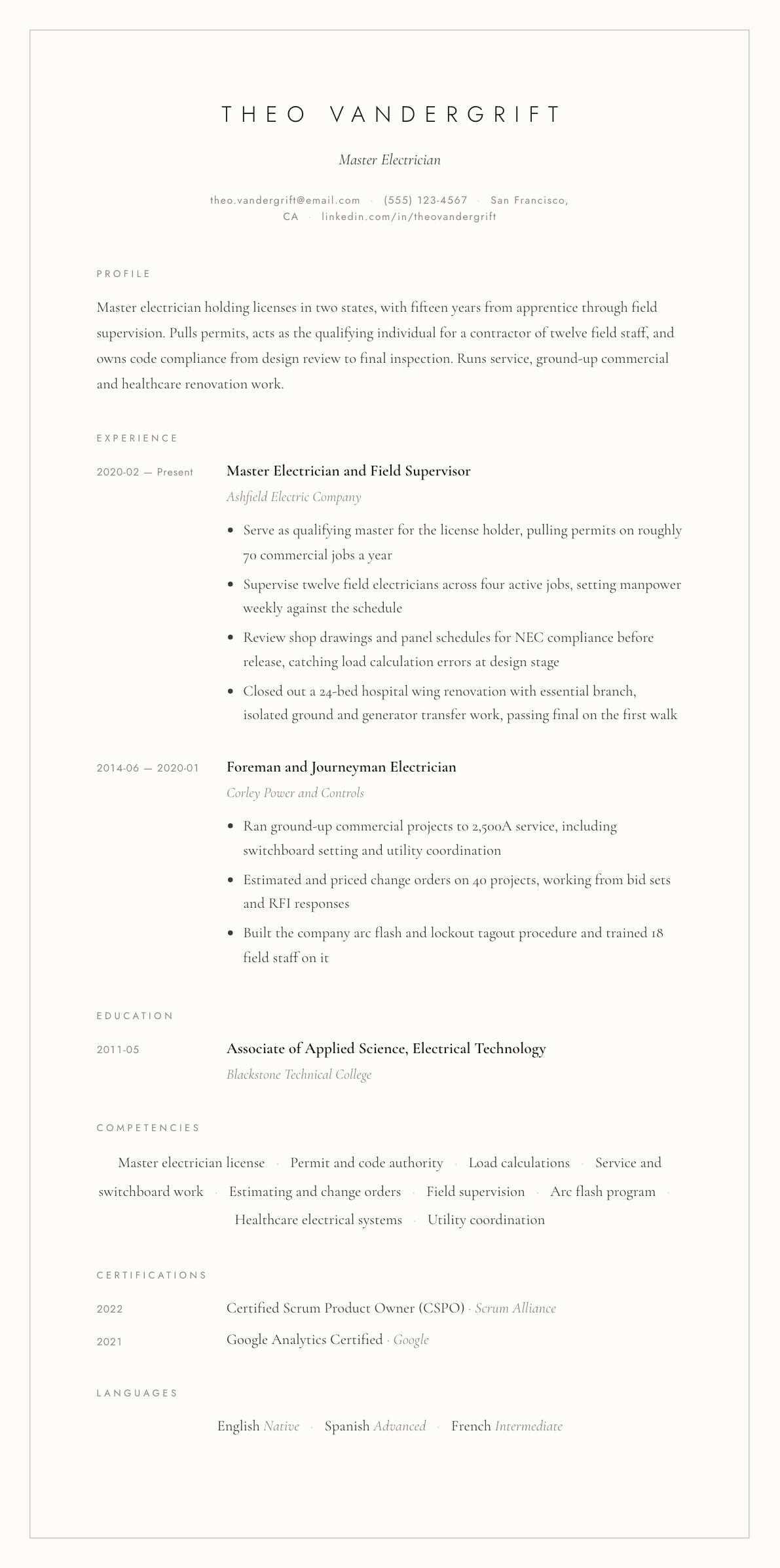
Example Master Electrician summary
Master electrician licensed in two states with fifteen years from apprentice to field supervisor. Acts as the qualifying individual for a commercial contractor, pulls permits, reviews plans against the code and carries jobs from design review through final inspection. Supervises a dozen electricians across concurrent projects and prices change orders. Experienced in healthcare renovation, generator systems and service work up to 2,500A.
Skills to list on a Master Electrician resume
- Master electrician license
- Permit application and closeout
- NEC plan review
- Load calculations
- Service and switchboard installation
- Motor controls and VFDs
- Arc flash and safety programs
- Estimating and change orders
- Field supervision
- Inspector coordination
- Healthcare and essential systems
- Generator and transfer switch work
- Utility coordination
- Apprentice development
- Quality control walkthroughs
What actually gets this resume read
- Lead with the master license, each state you hold it in, and whether you can act as a qualifying individual.
- Say how many permits you pull in a year and who signs off, because that authority is the reason to hire you.
- Show the code work explicitly: load calculations, plan review, inspector negotiation and correction resolution.
- Quantify supervision by field headcount and simultaneous active jobs rather than by a vague leadership claim.
- Include estimating and change order experience if you have it, since many contractors want both in one person.
- Name specialty environments you have worked in, such as healthcare, data rooms, hazardous locations or utility scale.
How to write a master electrician resume
A master electrician resume is read by an owner or a general manager, not by a foreman. The question behind the read is whether you can carry the legal and technical responsibility of the license: pulling permits, standing as the qualifying individual for the company, reviewing designs against the code, and answering to inspectors when something is called out. That responsibility, not years of field time, is what the title is worth.
Because of that, the resume has to look different from a journeyman resume. It should show authority and volume rather than task lists: how many permits a year, how many field staff you direct, how many jobs run at once, what you review before it is built, and how you resolve corrections. Field skills stay on the page, but they move down and get compressed.
This guide sets out the structure that works for master electricians moving between contractors or into a qualifying role, three summaries at different stages, bullets rewritten to show authority, and the questions that come up when a license holder writes a resume for the first time in a decade.
Format: two pages, authority on the first screen
Two pages is standard and appropriate here. The top third of page one must carry the master license and every state it is held in, whether you currently act as a qualifying individual, and the size of the operation you support. An owner reading it should know within seconds whether hiring you solves a licensing problem.
Keep the layout plain and reverse chronological. Put a compact credentials block under the header with license numbers by state, continuing education status, and the code cycles you have worked and tested under. Contractors bidding in several jurisdictions treat that block as the qualification summary.
- Header: name, city and state, phone, email, master license and states.
- Credentials block: license numbers, qualifying individual status, continuing education, code cycles.
- Then experience, notable projects, education and apprenticeship, skills.
Experience: permits, headcount and concurrent jobs
Write each role around three numbers: permits pulled per year, field staff directed, and active jobs carried at once. Those three tell an owner what capacity you have. Add the annual construction volume you supported only in general terms such as the number and type of projects, since a dollar figure invites a conversation you cannot control on paper.
Then describe the review work. Checking panel schedules and load calculations before release, redlining a design engineer drawings, catching undersized feeders or missing selective coordination, and resolving corrections with the authority having jurisdiction. These are the tasks that only the license holder performs, and they should occupy more lines than conduit work.
Keep a compressed field section for credibility. Two or three lines naming the gear and systems you have personally installed prove you did not arrive at the license through paperwork.
Code responsibility and the inspection relationship
State plainly which code cycles you have worked under and how you keep current, including continuing education hours and the courses that carry them. Add local amendment experience by jurisdiction type rather than by year, because a contractor expanding into a neighboring county wants to know you have dealt with different rules before.
Describe how you handle a correction notice: reading it against the section cited, walking it with the inspector, correcting or contesting with a written position, and closing the permit. Contractors have lost weeks to a license holder who argues badly, so a calm and documented process is a selling point.
Estimating, safety programs and business exposure
Many contractors want the master license and estimating in the same person. If you take off from bid sets, price change orders, or write scope letters, give that its own section with the type and number of projects estimated and the bid tools you use. If you do not estimate, say what you do own instead, such as procurement, submittals or closeout.
Safety program ownership carries real weight. Writing an arc flash and lockout tagout procedure, running toolbox talks, coordinating incident energy studies and training field staff are all things an owner would otherwise have to buy from a consultant.
Specialty environments worth naming
Some settings change what a license holder is worth. Healthcare with essential electrical systems and isolated power, hazardous locations with classified wiring methods, data rooms with redundancy requirements, water treatment and industrial process controls, and utility scale work each carry their own rules. Name every one you have carried a permit for, because they are the fastest route to a niche contractor who needs precisely that history.
Master Electrician resume summary examples
Newly licensed master
Master electrician licensed this year after nine years as a journeyman and working foreman on commercial construction. Experienced with load calculations, panel schedules and inspection closeout, and ready to serve as a qualifying individual for a contractor doing ground-up retail and office work.
Qualifying individual
Master electrician licensed in two states, acting as the qualifying individual for a commercial contractor with twelve field electricians. Pulls roughly 70 permits a year, reviews shop drawings and load calculations before release, and closes out projects with the authority having jurisdiction.
Director of field operations
Master electrician with fifteen years from apprentice through field supervision, now directing four concurrent commercial and healthcare projects. Owns code compliance from design review to final inspection, prices change orders, wrote the company arc flash and lockout tagout procedure, and trains field staff on it annually.
Work experience bullets: before and after
Before: Responsible for making sure work met code.
After: Reviewed panel schedules, load calculations and feeder sizing on every job before release, catching undersized neutrals and missing overcurrent coordination at the design stage.
Naming what you review and what you catch converts a compliance claim into a described process.
Before: Pulled permits for the company.
After: Served as the qualifying individual on roughly 70 commercial permits a year across three jurisdictions, from application through final inspection and permit closeout.
Volume, jurisdiction count and the full span of the permit show the capacity an owner is buying.
Before: Managed electricians on multiple job sites.
After: Directed twelve field electricians across four active projects, setting manpower weekly against each schedule and moving crews when a general contractor changed sequence.
Headcount, concurrency and the reason for reallocation make the management claim concrete.
Before: Worked on hospital projects.
After: Carried a 24-bed hospital wing renovation through essential branch wiring, isolated ground receptacles and generator transfer testing, passing final inspection on the first walk.
The specialty systems named here are exactly what a healthcare contractor screens a license holder for.
Before: Improved safety at the company.
After: Wrote the company arc flash and lockout tagout procedure, coordinated an incident energy study, and trained 18 field staff on label interpretation and boundary distances.
A written procedure, a study and a trained headcount replace a vague safety statement with deliverables.
Hard skills
- Master electrician license, multiple states
- Permit application and closeout
- Qualifying individual responsibility
- National Electrical Code plan review
- Load and short circuit calculations
- Service and switchboard installation
- Motor controls and variable frequency drives
- Generator and transfer switch systems
- Healthcare essential electrical systems
- Arc flash and safety program development
- Electrical estimating and change orders
- Field supervision and manpower planning
Soft skills
- Authority without friction
- Inspector relationships
- Written technical positions
- Manpower judgment
- Mentoring license candidates
- Owner communication
Certifications worth listing
- OSHA 30-Hour Construction (OSHA Outreach Training Program)
- Residential Electrical Inspector (International Code Council)
- Commercial Electrical Inspector (International Code Council)
- Adult First Aid, CPR and AED (American Red Cross)
Mistakes that cost master electrician candidates the interview
- Writing a journeyman resume with a master license added at the end, which hides the authority an owner is buying.
- Omitting whether you can act as a qualifying individual, the single fact many contractors are searching for.
- Leaving out permit volume and jurisdictions, so capacity has to be guessed from job titles alone.
- Filling both pages with conduit and termination work that a journeyman on the crew could have written.
- Skipping specialty environments such as healthcare or classified locations that would put you on a short list.
- Failing to mention continuing education status, which a contractor must verify before your license carries their work.
Master Electrician resume questions
How is a master electrician resume different from a journeyman one?
It leads with license authority rather than field tasks. Permits pulled, staff directed, concurrent projects, plan review and inspection closeout occupy the top. Installation work is compressed into a few credibility lines near the bottom.
Should I list my license numbers on the resume?
List the license type, the state and the status. Full numbers are fine on a resume sent directly to a contractor, and many owners expect them, but leave them off a version posted publicly on a job board.
Do I need estimating experience to be hired as a master?
Not always, but many contractors want the license and the estimating seat filled by one person. If you take off and price work, give it a section. If you do not, name the other office duties you own so the gap is answered.
How much field detail belongs on a master electrician resume?
Enough to prove you came up through the trade. Two or three lines naming the gear, voltages and systems you have personally installed does it. Beyond that the field detail crowds out the license responsibilities that justify the title.
What if my license is in one state and the job is in another?
Say so directly and state where you stand on reciprocity or the exam. Contractors will sponsor an application when the rest of the resume fits, but only if they see the situation on the page instead of finding it during onboarding.
Related resume examples
- Electrician Resume example
- Construction Manager Resume example
- Journeyman Electrician Resume example
- Construction Superintendent Resume example
- General Contractor Resume example
- Health and Safety Officer Resume example