Mechanic Resume Examples: free score, then the gap list
Tune Up Your Mechanic Resume for Results
By Mustafa Tarabya, founder of CVBooster · Published · Updated
Mechanic resume examples with expert tips, ATS keywords, and professional templates. See exactly what a winning ase certified mechanic resume looks like.
Sample resumes for a mechanic
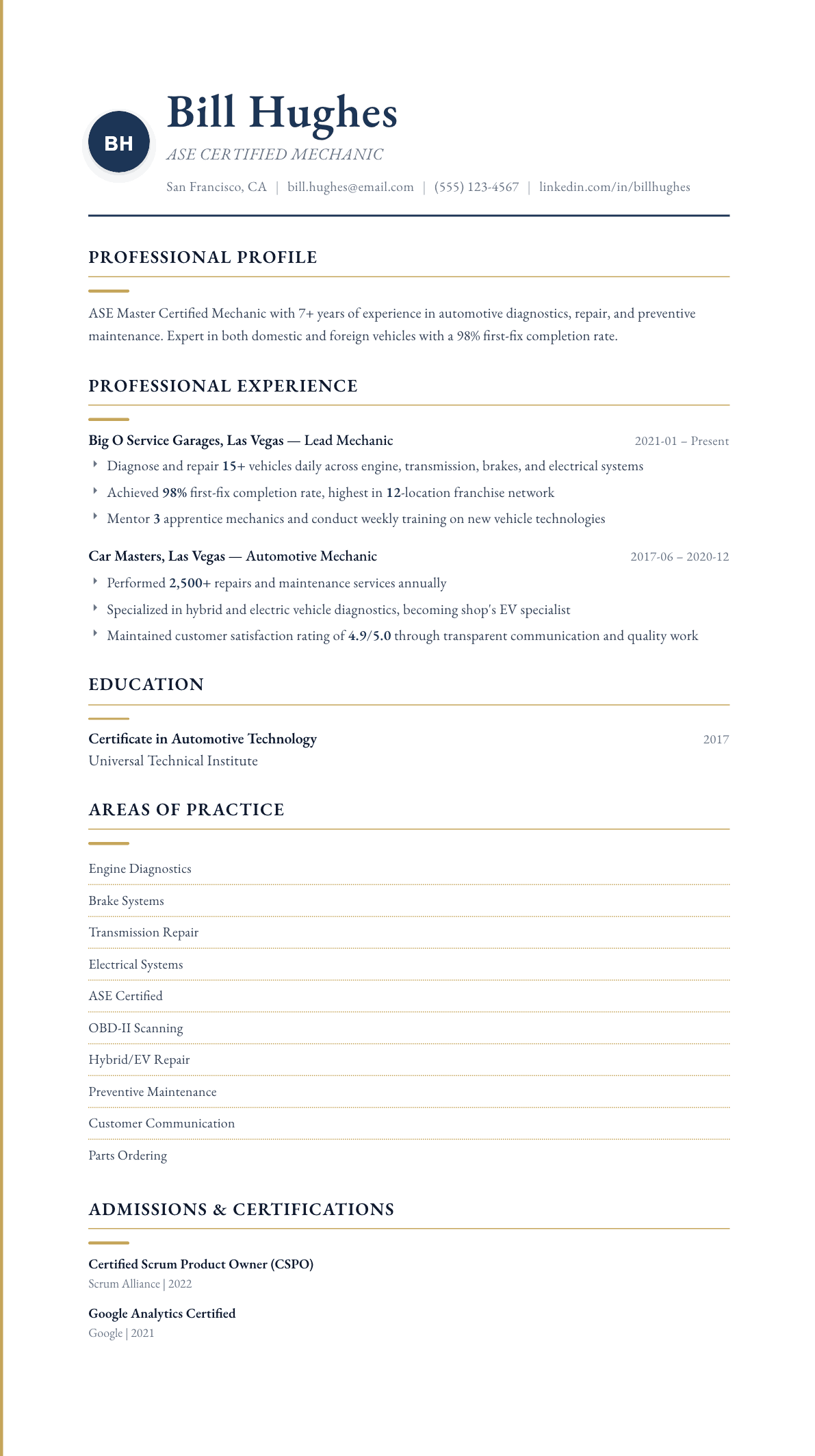
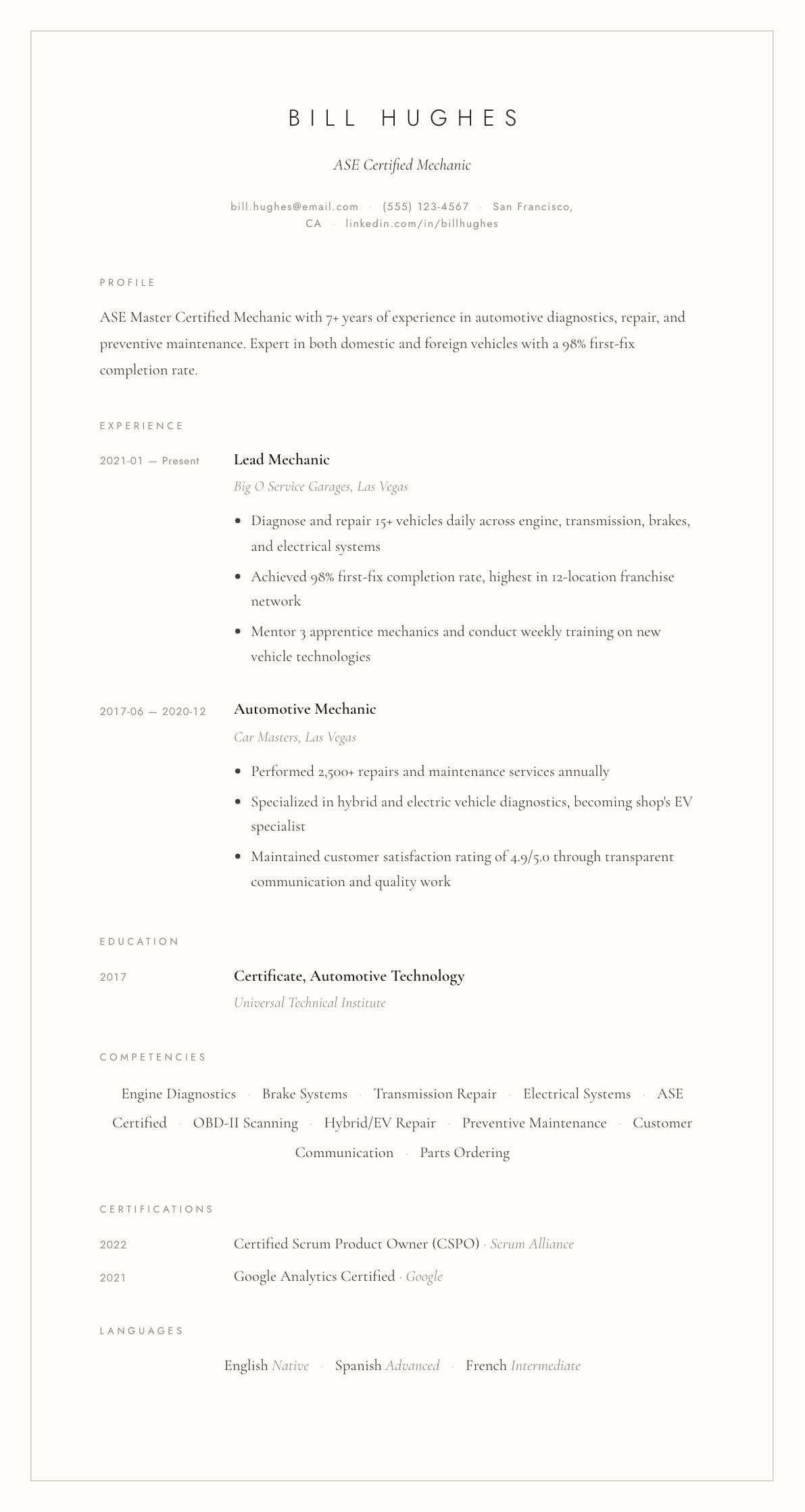
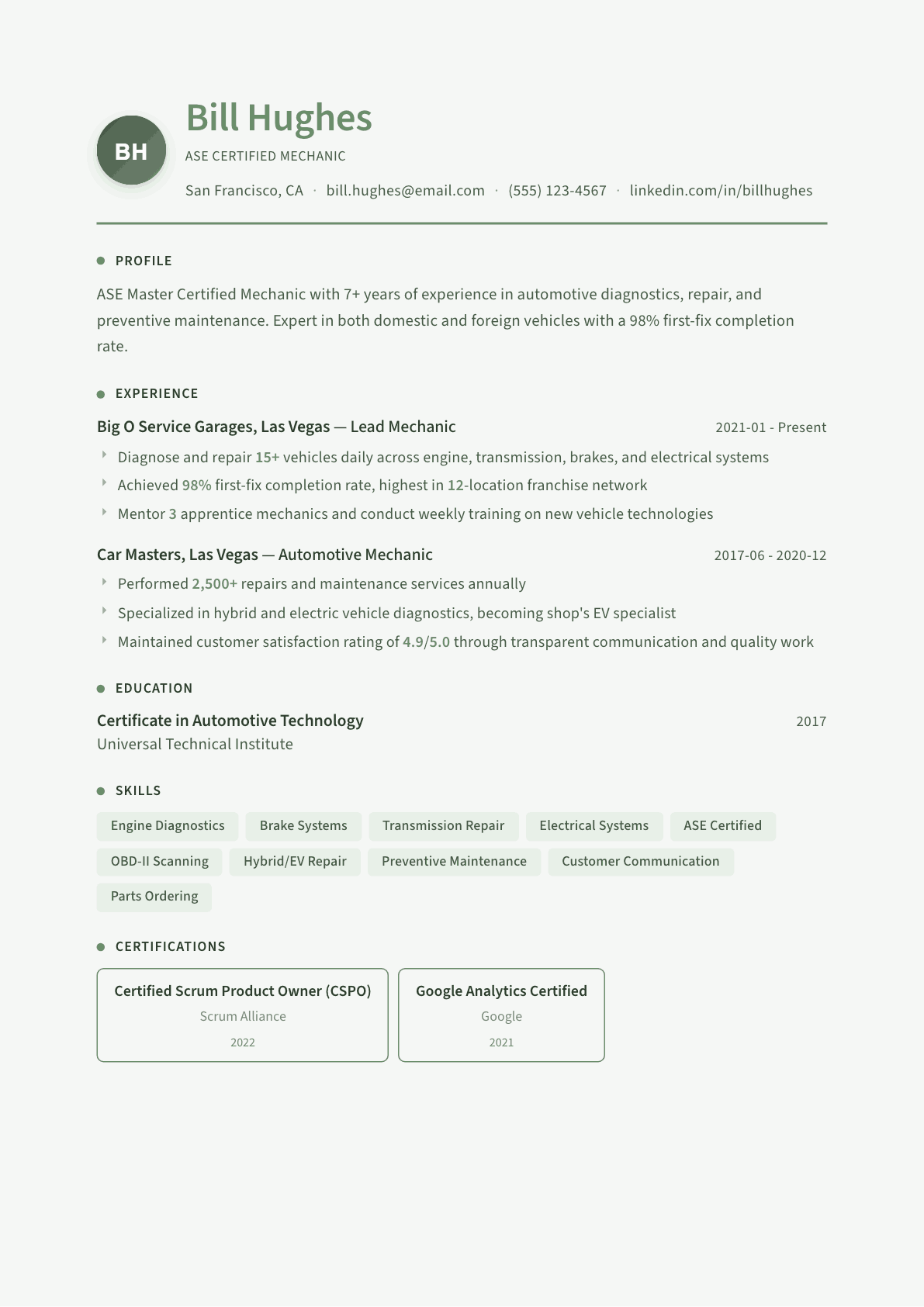
The same mechanic content laid out in three CVBooster templates, so you can see what the finished document looks like before you write a word.
Example Mechanic summary
ASE Master certified technician, 7 years, 15 vehicles a day across engine, transmission, brake and electrical work at a 98% first-fix rate. Became the shop hybrid and EV diagnostic specialist, mentors three apprentices, and holds a 4.9 customer rating on transparent estimates.
Skills to list on a Mechanic resume
- Engine Diagnostics
- Brake Systems
- Transmission Repair
- Electrical Systems
- ASE Certified
- OBD-II Scanning
- Hybrid/EV Repair
- Preventive Maintenance
- Customer Communication
- Parts Ordering
What actually gets this resume read
- List all ASE certifications and specializations.
- Quantify: vehicles serviced daily, first-fix rates, customer ratings.
- Include experience with specific vehicle brands or systems.
- Show specializations (diesel, hybrid/EV, performance).
- Highlight diagnostic tools and technology proficiency.
How to write a mechanic resume
Mechanic is the plainest title in the trade and the hardest one to read from a resume, because it covers everything from a two-bay neighborhood garage to a tire chain, a municipal fleet yard and a performance shop. The owner or shop foreman reading your page is trying to place you: what work were you handed, how independently did you work, and did the customers come back for you specifically.
Independent shops in particular hire for trust as much as skill. The mechanic writes the inspection, the advisor sells it, and the customer decides whether the shop is honest. A resume that only lists repairs misses the half of the job that keeps a small shop alive, which is finding real work on a vehicle and documenting it so the owner believes it.
This guide covers the layout owners and foremen expect, how to write about diagnosis and inspections, three summaries from a first shop job to a lead mechanic, before and after bullets, and the certifications that decide your labor rate.
Format: one page, plain, with certifications and specialties up top
Reverse chronological, one page. Small shops read paper or a phone screen, and larger chains push files through a basic applicant system, so avoid graphics, icons and side columns that scramble when parsed.
Below the header, put two short lines. One for certifications, one for specialties. Specialties are what get you called back: European makes, diesel light duty, transmissions, air conditioning, electrical diagnosis, tires and alignment, or performance and fabrication.
- Header: name, city and state, phone, email, and your own tool set if it is substantial, since shops ask.
- Order: summary, certifications, specialties, experience, education and factory or vendor training.
- Describe each shop in a phrase: independent general repair, franchise dealer, tire and service chain, or fleet yard.
Summary: the work you are handed and the work you can close
Two or three lines. Say the years, the certification level, the makes you know best, and the category of job that lands on your lift. Being the person who gets the electrical gremlins, the check engine lights or the transmission jobs is far more informative than saying you are experienced.
If you are early in the trade, be honest about level and lead with reliability. Shops lose money on mechanics who are quick and careless, so a first summary that promises clean work, complete inspections and steady attendance is more persuasive than an inflated claim.
Experience: the shop, the volume, and the diagnosis
Each job needs the shop type, the bay count, the pay structure and the make mix. Then bullets that show the split between maintenance work and diagnostic work. Owners know the ratio matters: a mechanic who only does brakes and fluids fills a bay, a mechanic who closes diagnostic tickets fills the schedule.
Write diagnostic stories in a compressed form. The complaint, the method, the cause. An intermittent stall traced to a failing crankshaft position sensor by monitoring live data on a road test says more in one line than a paragraph of adjectives.
Cover the customer-facing part too: multi point inspections completed, photographs and notes attached to the repair order, estimates written, and warranty work documented. Approval rates on the work you recommend are a legitimate number to quote if the shop tracked them.
Certifications, training and licenses
ASE credentials set the baseline and often the labor rate. Give the individual titles rather than a vague master claim, and include recertification dates. If you hold the refrigerant handling certificate required for air conditioning work, or a state inspection or emissions license, list those separately since they let a shop bill work it otherwise cannot.
Vendor and manufacturer training counts, including scan tool platform training, transmission rebuild schools and advanced electrical courses. Add anything on high voltage safety, because more shops are being asked to service hybrid and battery electric vehicles than are staffed to do it.
Skills and the words shop postings actually use
Shop postings recycle a small set of phrases: diagnostics, engine repair, brakes, suspension, alignment, electrical, air conditioning, check engine light, maintenance services, tires, and inspections. Use the ones that are true of you, once in the skills line and once inside the work history.
Name the equipment you are fluent on: scan tools and their software subscriptions, alignment racks, tire machines and balancers, brake lathes, welders, and the shop management system where you write your notes. A mechanic who writes a clear repair story saves the advisor an argument and the shop a comeback.
Mechanic resume summary examples
First shop job
Entry-level mechanic with 1 year in a four-bay independent garage performing oil services, brakes, tires, batteries and suspension work. Holds two ASE certifications and the refrigerant handling certificate, works cleanly, completes full inspections on every vehicle, and is training toward engine performance.
Five years, general repair
General repair mechanic with 5 years in independent shops on domestic and Japanese makes, handling engine performance, electrical diagnosis, brakes, suspension and air conditioning. Closes check engine light tickets other technicians pass on, and averages 45 billed hours a week with few comebacks.
Lead mechanic
Lead mechanic with 12 years and a full ASE certification set, running a six-bay independent shop floor: dispatching jobs, quality checking every repair before release, and taking the diagnostic work himself. Rebuilds transmissions in house and trains two junior mechanics on inspection quality.
Work experience bullets: before and after
Before: Performed oil changes, brakes and general repairs.
After: Handled maintenance and general repair on 10 to 15 vehicles a day in a six-bay independent shop, covering brakes, suspension, cooling systems, timing components and air conditioning across domestic and import makes.
Volume, bay count and the actual repair categories give the reader a picture of the workload you sustained.
Before: Diagnosed check engine lights.
After: Resolved driveability complaints by testing fuel trim, live sensor data and misfire counters on a road test before parts were ordered, closing tickets two other shops had already replaced parts on.
Method and outcome demonstrate diagnostic discipline rather than access to a code reader.
Before: Did vehicle inspections for customers.
After: Completed a documented multi point inspection on every vehicle with photographs and measurements attached to the repair order, giving the advisor evidence customers could see before approving work.
It shows you understand that inspection quality is how an independent shop earns trust and revenue.
Before: Rebuilt transmissions.
After: Rebuilt automatic transmissions in house including valve body service, clutch pack replacement and torque converter inspection, road testing each unit and verifying shift quality before delivery.
The rebuild scope and the verification step prove the work was finished properly, not just opened up.
Before: Had good relationships with customers.
After: Explained findings directly to customers at the vehicle when the advisor asked, showing the worn component and the measurement, which turned deferred repairs into scheduled return visits.
A specific behavior with a business result is more credible than a claim about people skills.
Hard skills
- Driveability and check engine diagnosis
- Brake and hydraulic system repair
- Suspension, steering and alignment
- Engine mechanical repair
- Automatic transmission service
- Air conditioning and refrigerant handling
- Electrical and charging system testing
- Cooling and timing component work
- Tire mounting and balancing
- Multi point inspection documentation
- Estimating and repair order writing
- Scan tool and live data analysis
Soft skills
- Honest customer explanations
- Working steadily on flat rate
- Clean and organized bay habits
- Advisor and parts coordination
- Mentoring junior mechanics
- Owning a comeback and fixing it
Certifications worth listing
- ASE A5 Brakes (National Institute for Automotive Service Excellence)
- ASE A6 Electrical/Electronic Systems (ASE certification program)
- ASE A8 Engine Performance (The National Institute for Automotive Service Excellence)
- Section 609 Refrigerant Handling (EPA-approved certification program)
- State vehicle safety inspection license (State inspection authority)
Mistakes that cost mechanic candidates the interview
- Using the bare title mechanic without saying what kind of shop and what kind of vehicles, leaving the reader to guess.
- Listing maintenance services only, which places you at the low end of the labor rate whether or not you belong there.
- Claiming a master level you do not currently hold, which is easy for a foreman to check and ends the conversation.
- Leaving out the specialties that get you requested by name, such as European makes, electrical or transmissions.
- Never mentioning inspections, estimates or repair order notes, half of what an independent shop is buying.
- Adding photographs, graphics or a colored sidebar to a resume that will be printed in black and white in a shop office.
Mechanic resume questions
What is the difference between a mechanic and an automotive technician on a resume?
The titles overlap, but technician is favored by dealers and signals electronic diagnosis, while mechanic is common in independent and fleet shops. Match the wording of the posting and let the bullets carry the real evidence of your level.
Should I list my own tools on a mechanic resume?
A brief line is worth including if you own a full roll cab and specialty equipment, because shops that expect you to bring tools want to know before the interview. Do not itemize sockets. Name only the specialty and diagnostic equipment.
How do I write a mechanic resume with no professional experience?
Lead with your training program, the systems it covered and any shop hours you logged. Then include documented personal work such as engine swaps or brake and suspension rebuilds, described in the same technical style you would use for paid work.
Do employers care about comeback rates?
Yes, more than most candidates realize. A comeback costs the shop the labor twice plus the customer relationship, so a mechanic who can quote a low comeback rate and describe how they quality check work is immediately attractive.
Should I include fleet or equipment work on an automotive mechanic resume?
Include it, but keep it in its own entry so the automotive depth stays clear. Fleet experience signals reliability and preventive discipline, and shops with commercial accounts will read it as an advantage rather than a distraction.
Related resume examples
- Electrician Resume example
- Plumber Resume example
- Construction Manager Resume example
- Automotive Technician Resume example
- Diesel Mechanic Resume example
- Fleet Mechanic Resume example