Plumber Resume Examples: free score, then the gap list
Plumber Resume Examples for Every Plumbing Job
By Mustafa Tarabya, founder of CVBooster · Published · Updated
Plumber resume examples for service, commercial and entry-level plumbing jobs: license block, code and permit bullets, summaries and posting keywords.
Sample resumes for a plumber
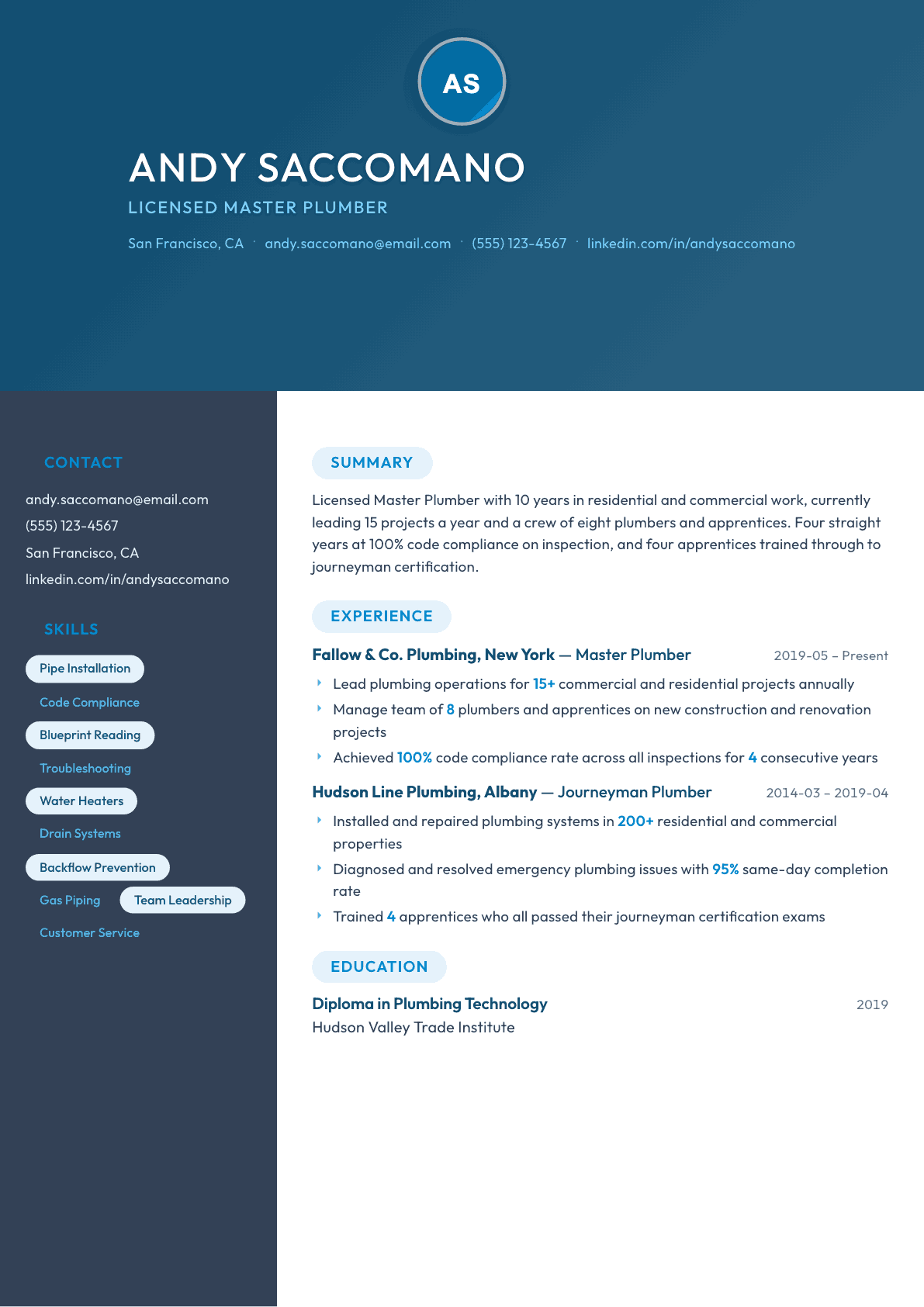
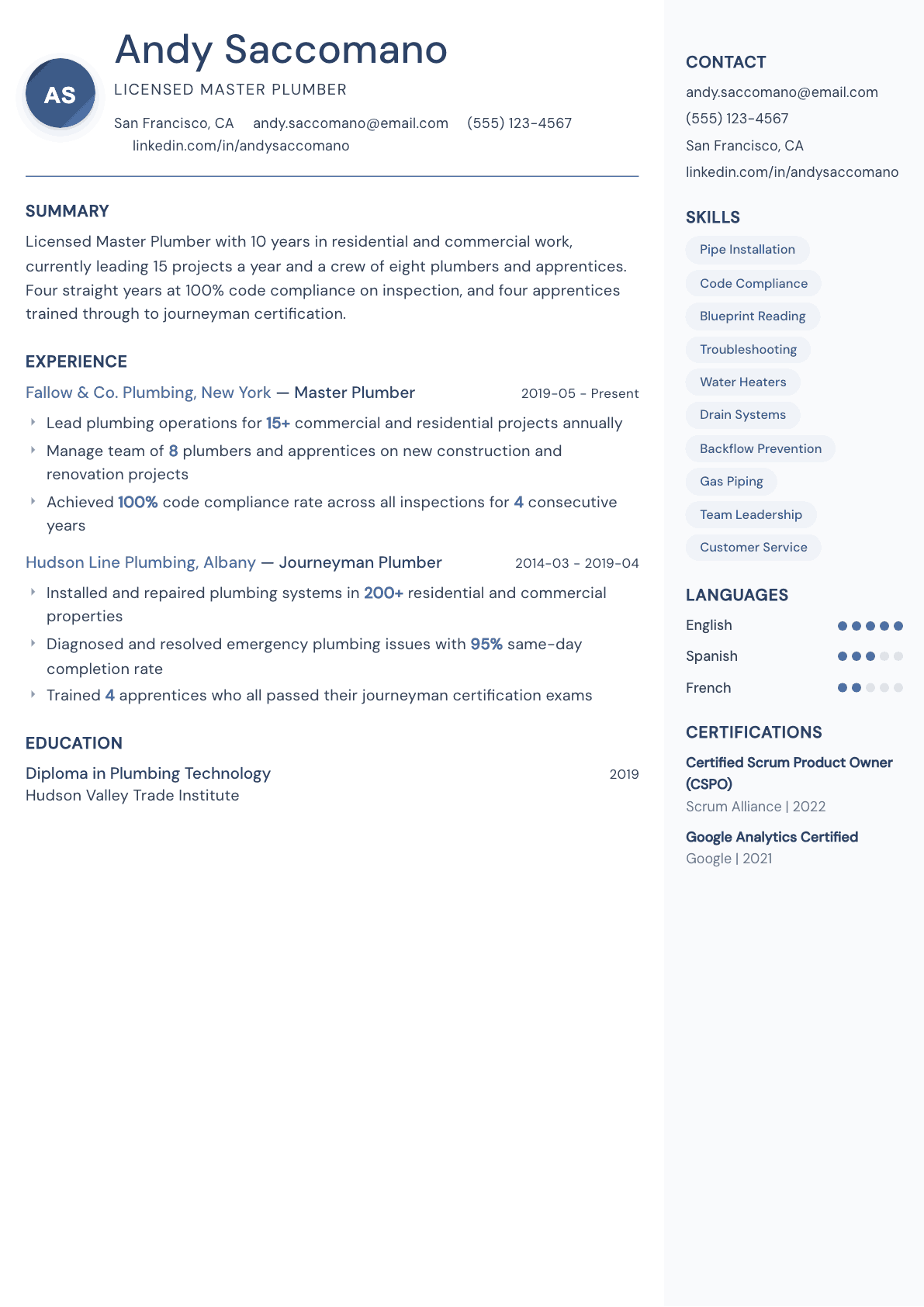
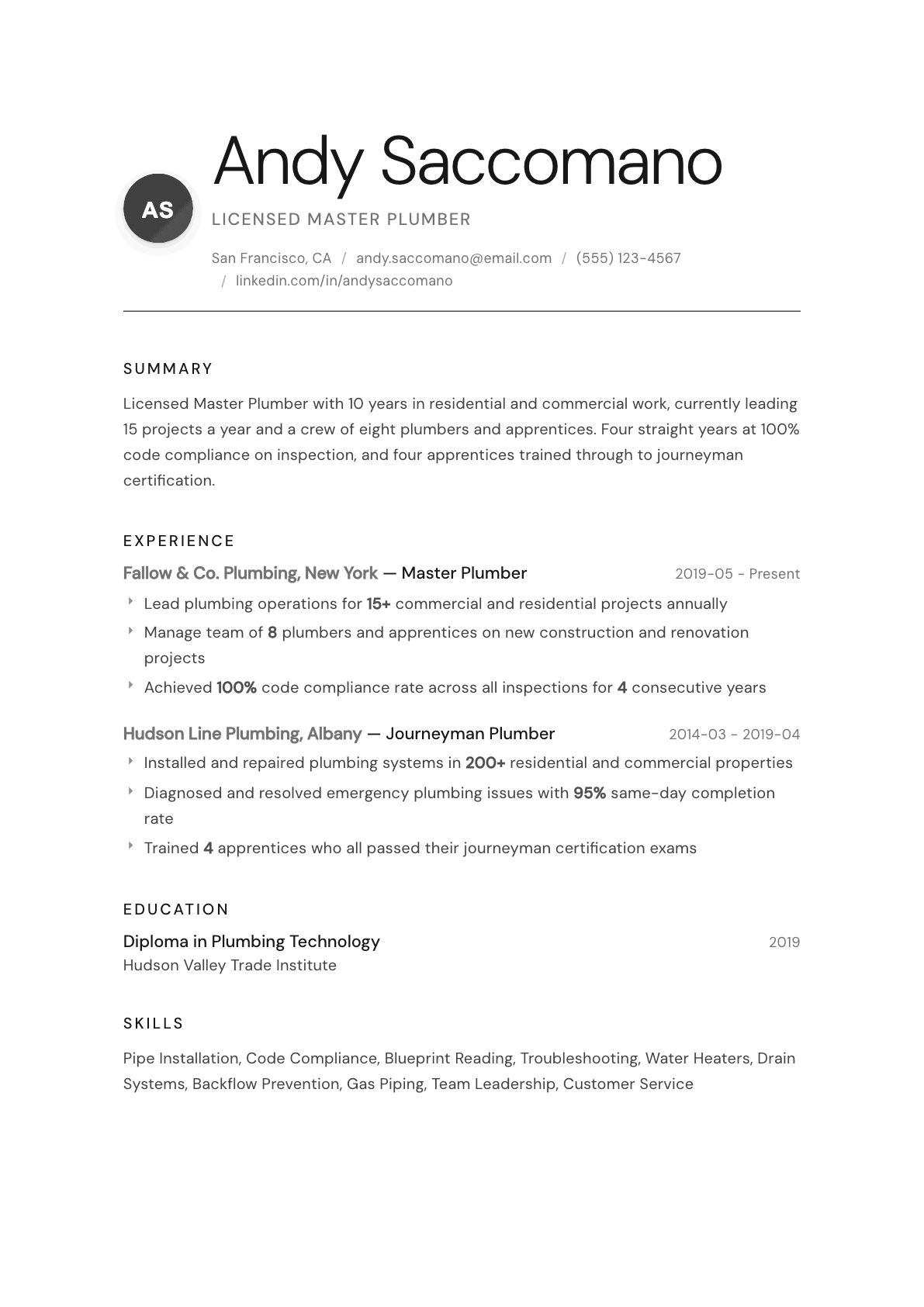
The same plumber content laid out in three CVBooster templates, so you can see what the finished document looks like before you write a word.
Example Plumber summary
Master plumber, 10 years, new construction and renovation on 15 projects a year with a crew of eight. Handles gas piping, backflow prevention and drain systems, closed emergency calls same day 95% of the time as a journeyman, and passes inspection first time.
Skills to list on a Plumber resume
- Pipe Installation
- Code Compliance
- Blueprint Reading
- Troubleshooting
- Water Heaters
- Drain Systems
- Backflow Prevention
- Gas Piping
- Team Leadership
- Customer Service
What actually gets this resume read
- List all licenses (Master, Journeyman) and certifications.
- Show progression through the trade: apprentice to journeyman to master.
- Quantify: projects completed, inspection pass rates, team sizes.
- Include both residential and commercial experience.
- Highlight safety compliance and zero-incident records.
How to write a plumber resume
A plumbing resume is a licensing document before it is a marketing document. The service manager or contractor reading it goes straight to three facts: what license you hold and in which state or city, how many years toward the next one, and whether you have run work unsupervised. Everything else is read through those.
The second question is what kind of plumbing. Residential service, new residential construction, commercial and institutional, industrial process piping and medical gas are separate careers with separate materials, codes and pace. A service plumber diagnosing a failing mixing valve in an occupied home and a commercial plumber roughing in cast iron waste on a hospital floor share a license and almost nothing else.
This guide sets out the resume in the order a plumbing contractor reads it, how to write about permits, inspections and code, three complete plumbing resume samples including one for a first plumbing job, three summaries from apprentice to master, before and after bullets, and the credentials worth listing.
Format: license, hours, and work type before anything else
One page, reverse chronological, no columns. The first block under your name is licensing: apprentice registration, journeyman or master license, the issuing jurisdiction, the license number if you are comfortable including it, and your documented apprenticeship hours. Contractors cannot staff a permit without knowing this.
Then a work type line naming residential service, residential construction, commercial, or industrial, plus specialties such as backflow prevention, gas piping, medical gas, hydronic heating or drain cleaning and camera inspection.
- Header: name, city and state, phone, email, license class and jurisdiction, driver license status for service routes.
- Order: summary, licenses and certifications, work types and specialties, experience, education and apprenticeship.
- For each employer, say whether you ran your own truck, led a crew, or worked under a journeyman.
Summary: license class, work type, and how you are trusted
Three lines. Years in the trade, license class, the work types you have done, and one sentence on autonomy. Running a service truck alone, pulling your own permits, or leading a rough-in crew are the phrases a contractor is looking for, because each one removes supervision cost.
If you are moving from construction into service, or the other way, name it. Service work adds diagnosis, customer contact and selling repairs. Construction adds print reading, layout, production pace and inspection scheduling. A contractor will not assume you can switch.
Experience: systems installed, code passed, and calls closed
Start each entry with the operation: the type of contractor, the projects or the service area, and your role. Then bullets that name systems and materials. Copper, PEX, CPVC, cast iron, no-hub, carbon steel and press fittings all say something about what you have handled, as do water heaters and tankless units, recirculation systems, sump and sewage ejector pumps, backflow assemblies and gas lines.
Show the inspection record. A plumber who says rough-in and final inspections passed on first submission across a run of permits is claiming something a contractor can verify and values highly, because failed inspections cost days and reputation.
For service, quantify the route: calls per day, first-time completion, average ticket if the company shared it, callback rate, and after-hours coverage. For construction, quantify by unit: fixtures set, floors roughed, apartments or homes completed, and schedule performance against the general contractor.
Code, permits and safety
Name the code family your jurisdiction adopts and show how you work with it: fixture unit sizing, venting methods, cleanout placement, backflow protection, thermal expansion, and clearance and support requirements. Do not quote clause numbers on a resume. Show that you size, vent and support correctly and that the inspector agrees.
Safety in plumbing is specific: trench and excavation protection when replacing sewer laterals, confined space in vaults and lift stations, gas line pressure testing and leak checks, torch and hot work permits, and asbestos or lead awareness in older buildings. Add water quality practices such as disinfection after a main repair if you have done that work.
Skills and the keywords in plumbing job postings
Postings repeat a tight vocabulary: installation, repair, service, rough-in, trim out, drain cleaning, water heaters, backflow testing, gas piping, blueprint reading, code compliance and permits. Mirror the ones that apply once in your specialties block and once inside an experience bullet.
List the tooling that indicates level: press tools, threading machines, soldering and brazing, drain machines and jetters, sewer inspection cameras and locators, and pipe fusion if you have run it. Brazing and medical gas work in particular should never be buried, since they need separate qualification and expand what a contractor can bid.
Plumbing resumes samples: service, commercial and entry level, start to finish
Plumbing resumes samples help most when they are complete, so here are three full pages in outline. The people and companies are invented; the order is what to copy. Both open with the license block, because that is the line every contractor reads first, and both say plainly whether the plumber works alone or on a crew.
Sample one, residential service: Luis Ortega, Journeyman Plumber, licensed in the state, clean driving record. Runs his own service truck for a residential and light commercial company, pulls his own permits and carries the backflow tester card.
Sample two, commercial construction: Dana Kowalski, Journeyman Plumber, licensed in the city and state, OSHA construction safety card. Works rough-in and trim on schools, clinics and apartment buildings as a lead under the foreman, reads isometrics and coordinates inspections.
Sample three, a resume for plumbing helper and first-year apprentice jobs: Jordan Hale, Plumbing Helper, registered apprentice, valid driver license, OSHA 10 card. No license yet, so the page leads with the apprenticeship registration, the classroom year completed, and the work he has already done on a crew.
- Service sample, current role: run a service truck alone across a set route, diagnosing leaks, failing mixing valves, water heater faults and drain blockages, and closing most calls on the first visit with parts carried on the truck.
- Service sample: replace tank and tankless water heaters to code, pull the permit and meet the inspector, and walk the homeowner through the repair and the warranty before leaving.
- Service sample: clear and camera main lines, show the owner the footage, and quote lateral repairs the office can schedule the same week.
- Commercial sample, current role: lay out and rough in water, waste and vent on a multi story clinic from the mechanical drawings, in copper, PEX and no hub cast iron.
- Commercial sample: lead two apprentices on underground and rough-in, sign off their documented hours and review each rough-in with them before inspection.
- Commercial sample: track fixture counts against the submittals and flag conflicts with the electrical and duct trades at the weekly coordination meeting.
- Entry sample, current role: plumbing helper for a residential new construction contractor; carries and stages material, cuts and preps PEX and PVC, digs and backfills for underground, and keeps the trailer stocked against the foreman's list.
- Entry sample: works under a journeyman on rough-in for single-family homes, logs his hours with the apprenticeship program each week, and has started setting fixtures at trim under supervision.
- Entry sample, previous role: warehouse associate, forklift certified, which shows the reliability and early starts a contractor screens for.
- All three samples close with skills (materials, systems, testing), certifications with the issuing body, and the apprenticeship program with documented hours and classroom training.
Plumber resume summary examples
Registered apprentice
Registered plumbing apprentice in the third year with roughly 5,000 documented hours across residential service and new construction. Comfortable with copper, PEX and PVC, water heater replacement, fixture set and drain cleaning, and currently completing classroom hours toward the journeyman examination.
Journeyman on service
Licensed journeyman plumber with 7 years, running a residential and light commercial service truck: diagnostics, water heater and tankless replacement, repipes, drain cleaning with camera inspection and backflow testing. Closes 7 to 9 calls a day with a callback rate under 3% and pulls his own permits.
Master plumber
Master plumber with 15 years across commercial and institutional projects, leading crews of six on rough-in and trim for multi-story buildings. Handles permit applications, coordinates inspections, reviews shop drawings against the mechanical plans, and mentors apprentices toward their journeyman license.
Work experience bullets: before and after
Before: Installed and repaired plumbing systems.
After: Roughed in and trimmed out water, waste and vent systems in copper, PEX and no-hub cast iron across a 60-unit apartment build, setting fixtures and water heaters through to final inspection.
Materials, project scale and the full sequence from rough-in to final show what stage of work you own.
Before: Made sure work met code.
After: Sized, vented and supported every rough-in to the adopted plumbing code and cleared 40 consecutive rough and final inspections without a correction notice.
An inspection record is verifiable evidence of code competence, which the word compliant is not.
Before: Went on service calls and fixed customer problems.
After: Ran a service truck covering 7 to 9 residential calls a day, diagnosing leaks, failing mixing valves, pressure problems and drain blockages, and completing most repairs on the first visit with parts carried on the truck.
Call volume, the fault types and first-visit completion describe a service plumber a dispatcher can rely on.
Before: Trained apprentices.
After: Supervised two apprentices through soldering, press fitting and drain machine work, signing off their documented hours and reviewing each rough-in with them before the inspector arrived.
The specific skills and the hour documentation prove structured training rather than casual help.
Before: Did sewer line replacements.
After: Replaced residential sewer laterals from cleanout to main, locating lines with a camera and transmitter, shoring the excavation to depth and restoring the surface after the municipal inspection.
Locating, shoring and inspection show the whole job including the safety and regulatory steps most candidates omit.
Hard skills
- Water, waste and vent rough-in
- Fixture trim out and setting
- Copper soldering and brazing
- PEX and press fitting systems
- Water heater and tankless installation
- Gas piping and pressure testing
- Backflow prevention testing
- Drain cleaning, jetting and camera inspection
- Sewer lateral excavation and repair
- Blueprint and isometric reading
- Permit application and inspection scheduling
- Hydronic and recirculation systems
Soft skills
- Explaining repairs to homeowners
- Working clean in occupied homes
- Crew leadership on a rough-in
- Coordination with general contractors
- On-call reliability
- Careful documentation of hours and materials
Certifications worth listing
- Journeyman Plumber License (State or local plumbing licensing board)
- Master Plumber License (State plumbing board)
- Backflow Prevention Assembly Tester (American Society of Sanitary Engineering)
- Medical Gas Installer, ASSE 6010 (American Society of Sanitary Engineering certification program)
- OSHA 10-Hour Construction Outreach (OSHA Outreach Training Program provider)
Mistakes that cost plumber candidates the interview
- Omitting the license class and jurisdiction, which is the first thing a plumbing contractor checks and the fastest reason to be skipped.
- Not stating apprenticeship hours, since hours are the currency that determines when you can sit for the next examination.
- Blurring residential service and commercial construction together, so a contractor cannot tell which crew you belong on.
- Listing materials without any project scale, leaving the reader unsure whether you did one repipe or sixty units.
- Skipping the inspection record when it is the most objective proof of code competence available to you.
- Leaving out backflow, medical gas or gas piping qualifications, which directly expand what your employer is allowed to bid.
Plumber resume questions
Should I put my plumbing license number on my resume?
Include the license class, the issuing jurisdiction and the expiry at minimum. The number itself is public in most states and adding it speeds up verification, so include it unless you have a specific reason to withhold it until an offer stage.
How do I list apprenticeship hours?
Give the program or contractor, the years, the approximate documented hours and the classroom instruction completed. Hours are the formal measure of progress in this trade, so present them as a qualification rather than hiding them inside a job description.
How do I write a resume for plumbing jobs with no license yet?
Lead with your apprenticeship registration or the program you have applied to, classroom hours completed, a valid driver license and any safety card. Then list crew work as a helper: materials you have cut and joined, rough-in you assisted on, and the journeyman you worked under. Reliability belongs in one plain line.
What do good examples of plumbing resumes have in common?
They open with the license class and jurisdiction, name the work type in one line, and say whether the plumber runs a truck alone, leads a crew or works under a journeyman. The bullets then name materials, project scale and inspections passed. The two complete samples on this page, one service and one commercial, follow that order.
What certifications add the most to a plumber resume?
Backflow prevention assembly testing and medical gas installation are the two that most directly let an employer bid work they otherwise cannot. Gas piping qualification, confined space and excavation safety training round out the list for most contractors.
Related resume examples
- Electrician Resume example
- Mechanic Resume example
- Construction Manager Resume example
- Appliance Repair Technician Resume example
- Elevator Technician Resume example
- Maintenance Technician Resume example