Emergency Management Director Resume Examples: free score
Prepare for Success with an Emergency Management Director Resume
By Mustafa Tarabya, founder of CVBooster · Published · Updated
Create an emergency management director resume showcasing your disaster preparedness, response coordination, and recovery leadership.
Sample resumes for a emergency management director
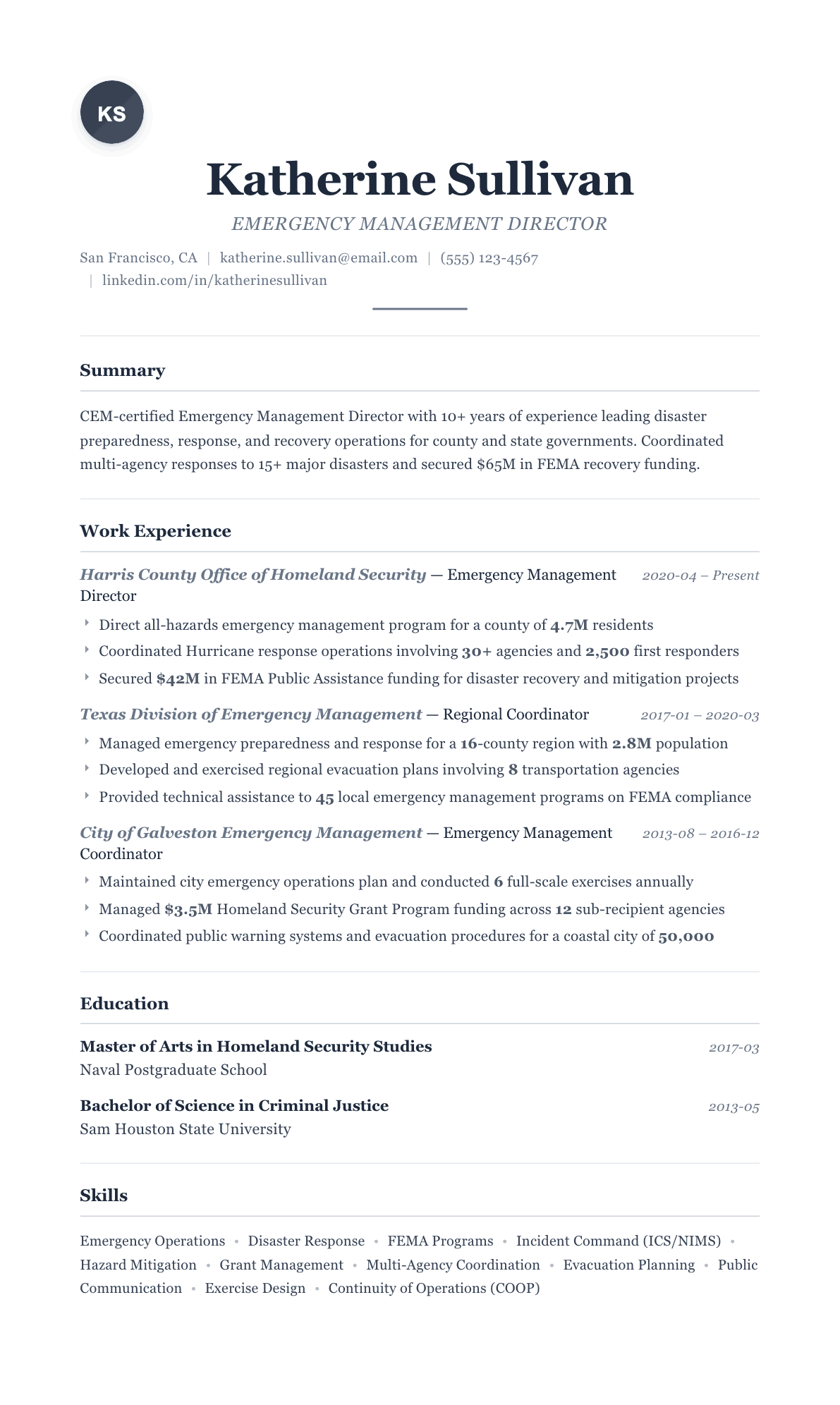
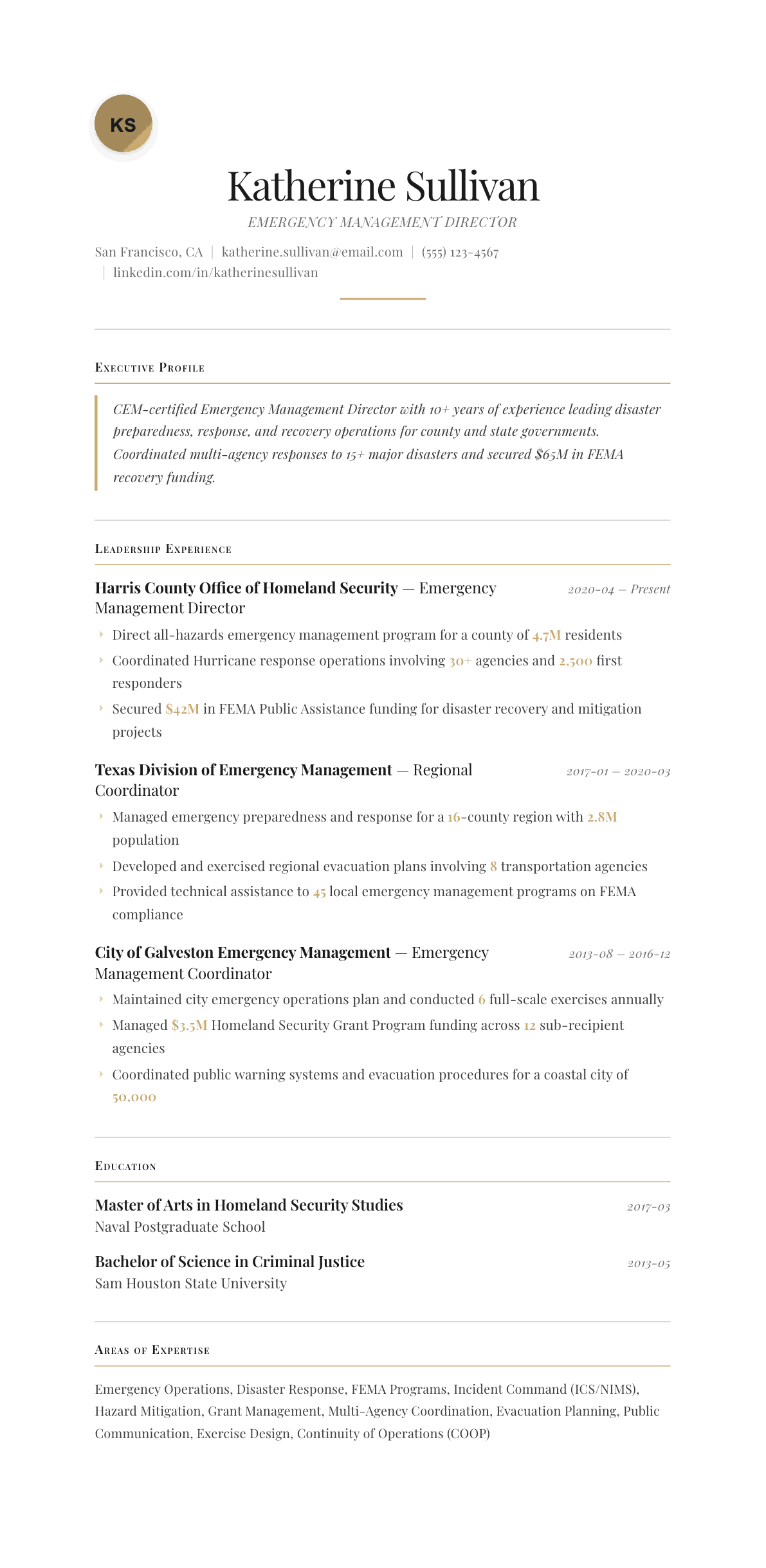
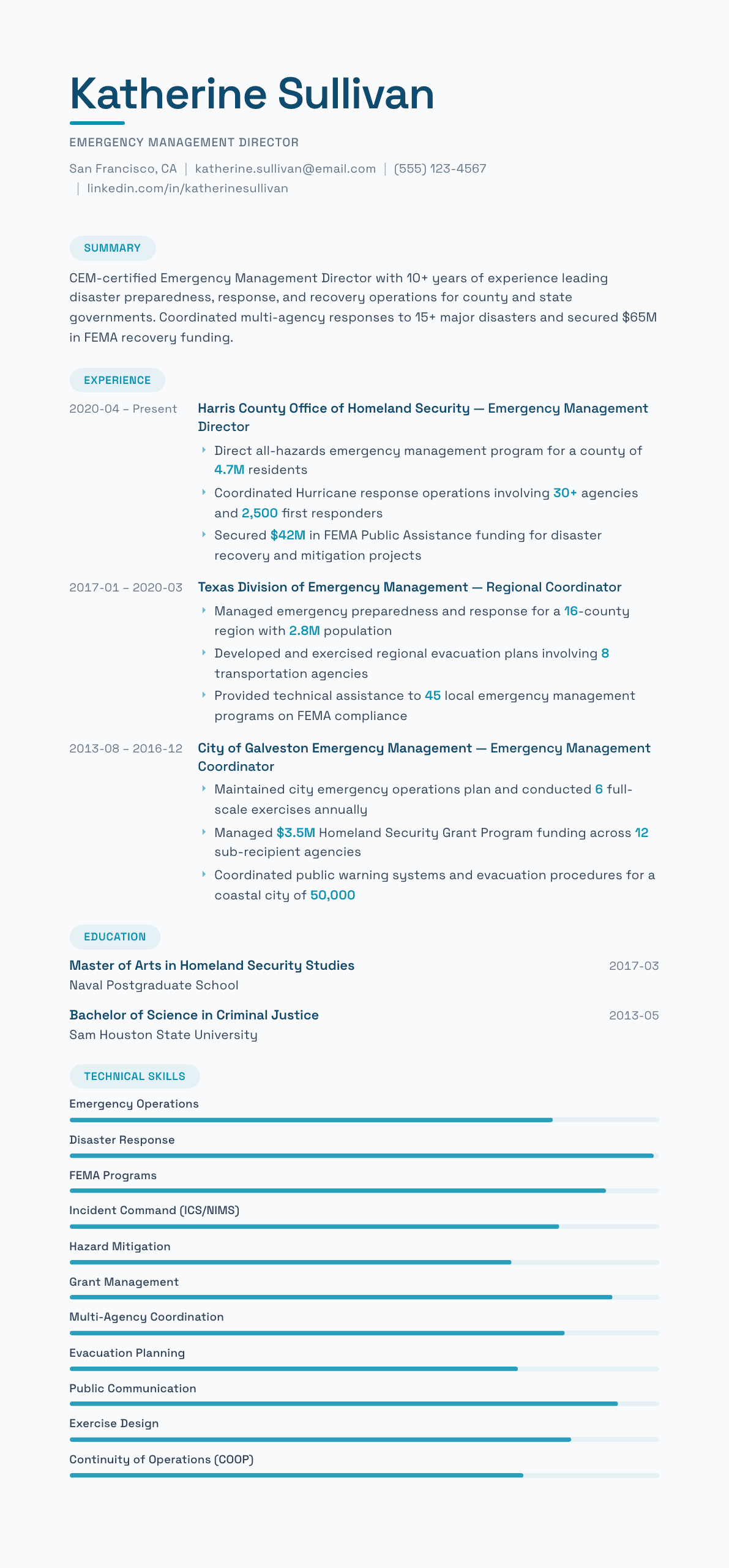
The same emergency management director content laid out in three CVBooster templates, so you can see what the finished document looks like before you write a word.
Example Emergency Management Director summary
CEM-certified Emergency Management Director with 10 years of experience directing all-hazards preparedness, response, and recovery operations. Coordinated multi-agency responses to 15+ major disasters and secured $65M in FEMA funding. Seeking a regional or state emergency management leadership role.
Skills to list on a Emergency Management Director resume
- Emergency Operations
- Disaster Preparedness
- FEMA Programs
- ICS / NIMS
- Hazard Mitigation
- Evacuation Planning
- Multi-Agency Coordination
- Grant Management
- Exercise Design
- Public Alert Systems
- Continuity of Operations
- Recovery Management
- Damage Assessment
- Crisis Communications
- Community Resilience
What actually gets this resume read
- Lead with your CEM or AEM certification. These are the industry-standard credentials.
- Quantify your impact: population served, FEMA dollars secured, number of agencies coordinated.
- List specific disasters you have managed: hurricanes, floods, wildfires, pandemics, active shooter incidents.
- Highlight exercise design and execution experience (tabletop, functional, full-scale).
- Include grant management experience with FEMA, DHS, and state homeland security programs.
- Mention your ICS/NIMS qualifications and any Type 1, 2, or 3 incident command experience.
How to write a emergency management director resume
An emergency management director resume is read by people who have stood in an activated operations center and know exactly which parts of the job are hard. The county administrator or public safety chief screening you is checking three things: the hazards you have actually worked, the position you held in the incident command structure when it mattered, and whether you can pass a grant audit.
Candidates lose on the second and third points. Plenty of resumes list disasters the jurisdiction experienced without saying whether the writer ran the operations section, sat in the planning section or answered a phone. Plenty describe grant funded programs without mentioning the subrecipient monitoring, the period of performance or the closeout that a federal audit will test.
This guide covers the layout emergency management panels expect, how to write incident experience so the ICS position is unmistakable, how to present planning, exercise and mitigation work as separate disciplines, and the questions coordinators ask when they move up to director.
Format: two pages, credentials and incident history visible early
Two pages for a director role, more if the posting uses a federal format. Emergency management hiring is credential heavy, so put a qualifications block under the summary carrying your CEM or AEM status, your ICS and NIMS course completions with course numbers, and any position task book you have completed.
Then give incident history its own section rather than scattering it through job entries. A short table style list of events with the year, the hazard, the jurisdiction and the position you filled tells a panel more in ten lines than two pages of narrative. Directors are hired on the strength of that list.
- Header: name, credentials such as CEM, city and state, phone, email.
- Order: summary, credentials and ICS qualifications, incident history, professional experience, grants and programs, education.
- Include your position qualifications by name, for example planning section chief or operations section chief on a Type 3 team.
Summary: jurisdiction, hazard profile, and the seat you take when it activates
Name the jurisdiction type and population served, the hazard profile you plan against, and the position you fill during an activation. A director for a coastal county planning against hurricanes and storm surge and one for an inland county planning against wildfire and flooding run entirely different programs, and the title alone hides that.
If you are coming from fire, law enforcement, the military or public health, name the crossing and lead with the overlap: incident command experience, multi agency coordination, continuity planning, logistics under austere conditions, and public information during an event. Emergency management draws most of its directors from those tracks and panels expect the transition to be stated.
Experience: activations, the coordination structure, and what you decided
For each activation, give the hazard, the duration, the activation level, the number of agencies coordinated, and your position in the structure. Then write the decision you owned: an evacuation recommendation, a shelter opening threshold, a resource request through the state, a curfew recommendation to elected officials, a transition from response to recovery.
Say what the operations center itself looked like under you. WebEOC or another incident management platform, a common operating picture, resource request tracking, situation reports on a set cycle, a documented battle rhythm. Directors are judged on whether the center runs on a discipline or on personality.
Recovery is where many resumes stop too early, and it is the phase that takes the longest. Damage assessment teams deployed, a joint preliminary damage assessment with state and federal partners, a disaster declaration request package, public assistance project worksheets, individual assistance coordination, long term recovery committees stood up.
Planning, exercises and mitigation: three separate disciplines
Name the plans you wrote or rewrote rather than saying you maintained plans. An emergency operations plan and its hazard annexes, a continuity of operations plan, a threat and hazard identification and risk assessment, a hazard mitigation plan submitted for state and federal approval, a mass casualty or mass fatality annex, a debris management plan with a pre approved contractor.
Exercises follow a recognized progression, so use it. Seminar, workshop, tabletop, drill, functional, full scale. Say which you designed, which you evaluated, how many players and agencies took part, and what changed in the improvement plan afterward. An exercise with no corrective action tracked is a rehearsal, and evaluators know it.
Mitigation is the part that separates a program manager from a director. A mitigation plan adopted by the governing body, an acquisition and demolition project for repetitive loss properties, a safe room grant, a stream restoration, a community rating system class improvement that lowered flood insurance premiums for residents.
Grants and compliance: the audit trail matters as much as the award
Say which programs you have administered by name, such as the Emergency Management Performance Grant, the Homeland Security Grant Program, Public Assistance, Hazard Mitigation Assistance or a state matching program. Then show the administration, not just the award: application development, subrecipient agreements, quarterly reporting, procurement under federal rules, period of performance extensions, monitoring visits and closeout.
Panels care about clean audits because a finding costs the jurisdiction money. If you have carried a program through a single audit or a state monitoring visit with no findings, say so. If you inherited findings and cleared them, that story is stronger still.
Emergency Management Director resume summary examples
Emergency management coordinator
Emergency management coordinator for a county of 70 thousand residents with a flood and severe storm hazard profile. Holds Associate Emergency Manager status and ICS 300 and 400. Wrote two hazard annexes, ran four tabletop exercises and served as planning section chief during three operations center activations.
Deputy director
Deputy emergency management director for a coastal county of 240 thousand residents. Certified Emergency Manager qualified as operations section chief on a Type 3 incident management team. Led two hurricane activations, coordinated 19 agencies, and administered performance and homeland security grant programs through a clean state monitoring visit.
Director
Emergency management director with sixteen years across county and state programs, currently leading a division of eleven staff. Managed nine declared disasters covering hurricanes, wildfire and a pandemic response, secured two federal declarations, and delivered a hazard mitigation plan and a repetitive loss acquisition project.
Work experience bullets: before and after
Before: Responded to multiple disasters affecting the county.
After: Served as operations section chief for a 14 day hurricane activation coordinating 19 agencies, three shelters and a debris mission across the unincorporated county.
The named ICS position, the duration and the agency count tell a panel exactly what seat you can fill.
Before: Managed emergency management grants for the jurisdiction.
After: Administered the Emergency Management Performance Grant and two homeland security subawards, including subrecipient agreements, quarterly reporting and closeout, with no findings across two state monitoring visits.
Program names plus the monitoring outcome prove you can survive an audit, which is what the money depends on.
Before: Conducted training and exercises for staff and partners.
After: Designed and evaluated a full scale exercise with 240 players from 12 agencies simulating a chemical release, and tracked all 17 improvement plan corrective actions to closure within the following year.
Exercise type, scale and corrective action closure show a program that learns instead of one that rehearses.
Before: Updated the county emergency operations plan.
After: Rewrote the emergency operations plan and six hazard annexes to align with the national planning framework, ran the review through eight partner agencies and secured adoption by the board of commissioners.
A rewrite, a partner review and a governing body adoption make the plan a completed project rather than a maintained document.
Before: Worked on hazard mitigation projects.
After: Delivered a repetitive loss acquisition and demolition project covering 22 flood prone properties, and led a community rating system application that improved the class rating for residents.
A completed mitigation project with a benefit residents can feel is the strongest evidence a director can offer.
Hard skills
- Incident command system and NIMS implementation
- Emergency operations center management
- Emergency operations plan and annex development
- Continuity of operations planning
- Threat and hazard identification and risk assessment
- Hazard mitigation planning and project delivery
- Exercise design and evaluation
- Damage assessment and declaration requests
- Public assistance and individual assistance programs
- Federal grant administration and subrecipient monitoring
- WebEOC and incident management platforms
- Mass care and sheltering coordination
- Public warning and alert systems
Soft skills
- Decision making under incomplete information
- Multi agency coordination
- Briefing elected officials
- Sustained operations endurance
- Volunteer and partner relationship management
- Calm public communication
Certifications worth listing
- Certified Emergency Manager (CEM) (International Association of Emergency Managers)
- Associate Emergency Manager (AEM) (International Association of Emergency Managers)
- Master Exercise Practitioner (FEMA Emergency Management Institute)
- Professional Development Series (FEMA Emergency Management Institute)
- Certified Floodplain Manager (CFM) (Association of State Floodplain Managers)
- Certified Business Continuity Professional (CBCP) (DRI International)
Mistakes that cost emergency management director candidates the interview
- Listing disasters the jurisdiction experienced without naming the incident command position you personally filled.
- Describing grant awards while omitting the monitoring, procurement and closeout work that an audit tests.
- Reporting exercises with no improvement plan follow through, which tells an evaluator the program does not close its gaps.
- Leaving ICS and NIMS course completions off, when many announcements screen on those course numbers directly.
- Stopping the story at response and never covering recovery, which is where most of the workload and the money sit.
- Writing a one page resume for a federal or state announcement that expects the longer format with hours and supervisors.
Emergency Management Director resume questions
Do I need a Certified Emergency Manager credential to be hired as a director?
Not always, but it appears in many announcements as required or preferred and it settles the question of professional standing. If you are not yet eligible, hold the Associate Emergency Manager credential and list your ICS qualifications and completed position task books instead.
How do I show incident experience if my jurisdiction has had few declared disasters?
Use planned events and smaller activations. Large public gatherings, severe weather watches, hazardous materials incidents, utility failures and search operations all exercise the same structure. Name the position you held and the coordination involved rather than the size of the headline.
How should military or fire service candidates present their background?
Translate rank and unit language into emergency management functions. Logistics under austere conditions, operations planning, multi agency liaison and continuity work all map directly. Then add the civilian credentials, the ICS course numbers and any grant experience, since those are the gaps panels probe.
Should I list every FEMA independent study course I have completed?
No. List the position specific and classroom courses that matter, such as ICS 300, ICS 400, the all hazards position courses and the master exercise track. A long list of independent study numbers crowds out the incident history a panel actually reads.
How do I describe a response that went badly?
Describe it honestly through the after action process. Name the gap that surfaced, the corrective actions you owned and what changed before the next event. Panels have all lived through difficult activations and a candidate who can analyze one reads as more capable, not less.
Related resume examples
- Fire Chief Resume example
- Public Health Director Resume example
- City Manager Resume example
- Emergency Management Coordinator Resume example
- Public Information Officer Resume example
- Public Works Director Resume example