Public Information Officer Resume Examples: free score
Write a Public Information Officer Resume That Holds Up Under Pressure
By Mustafa Tarabya, founder of CVBooster · Published · Updated
Public information officer resume example plus keywords and a guide covering media relations, incident command, records requests and crisis messaging.
Sample resumes for a public information officer
The same public information officer content laid out in three CVBooster templates, so you can see what the finished document looks like before you write a word.
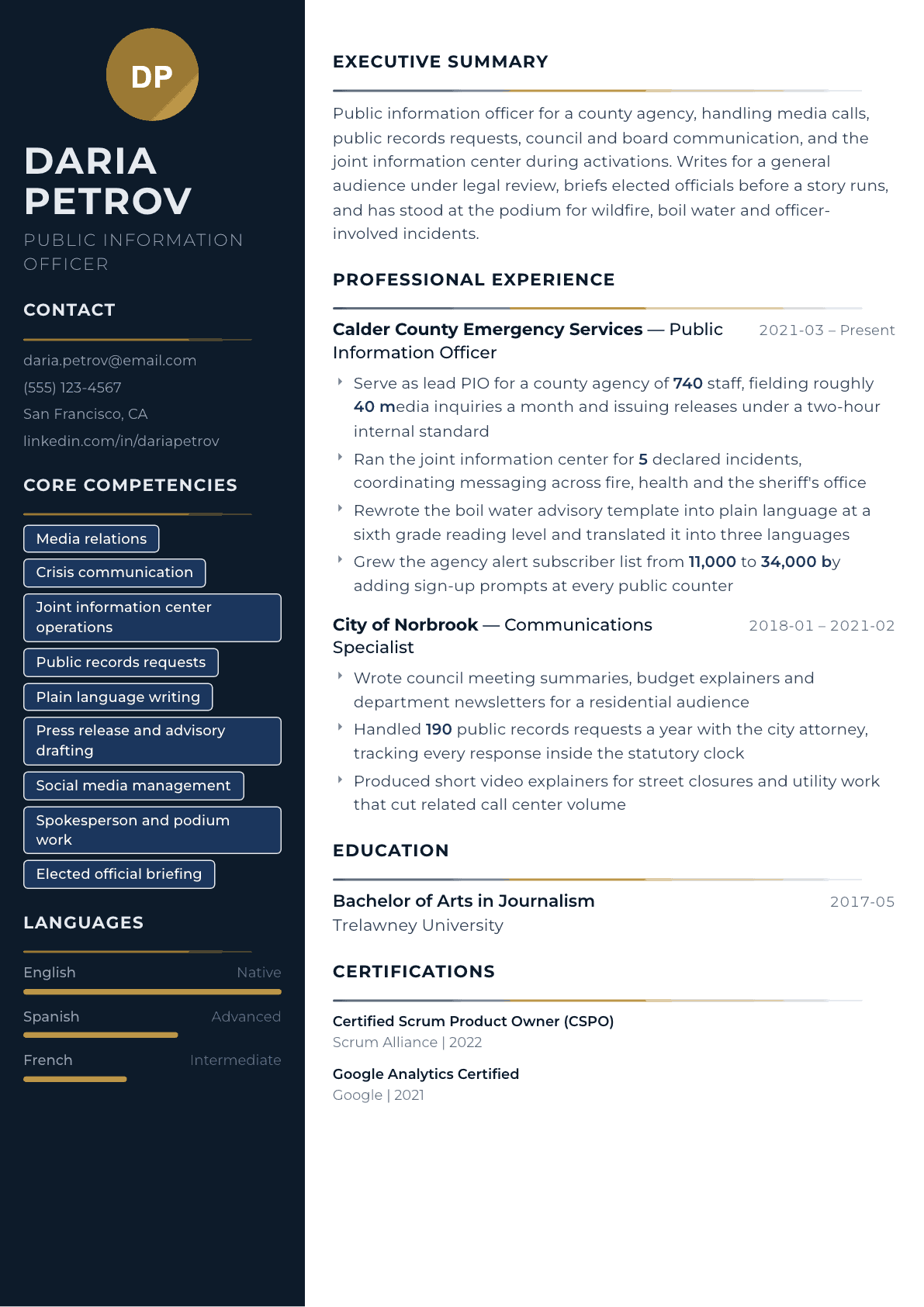
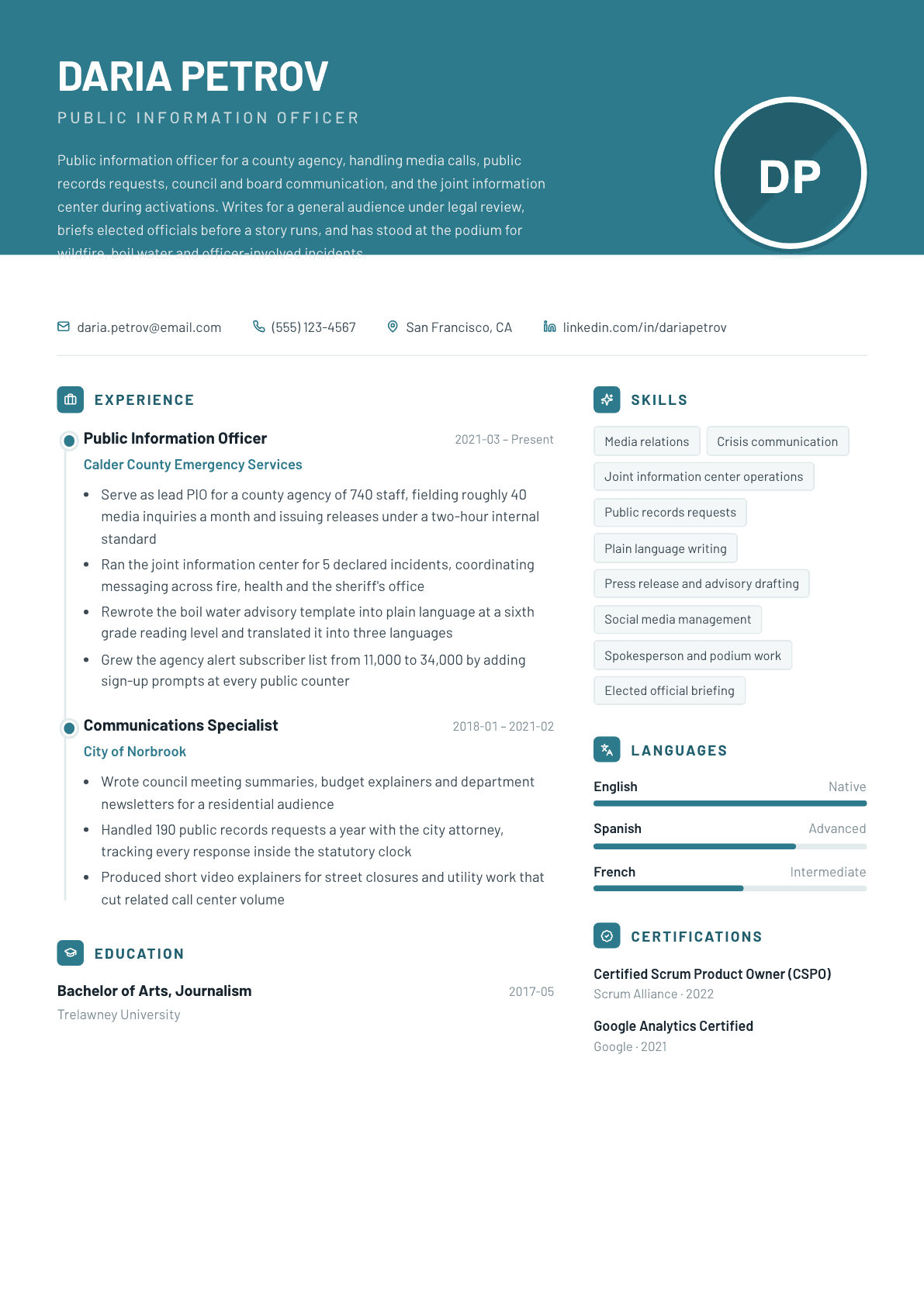
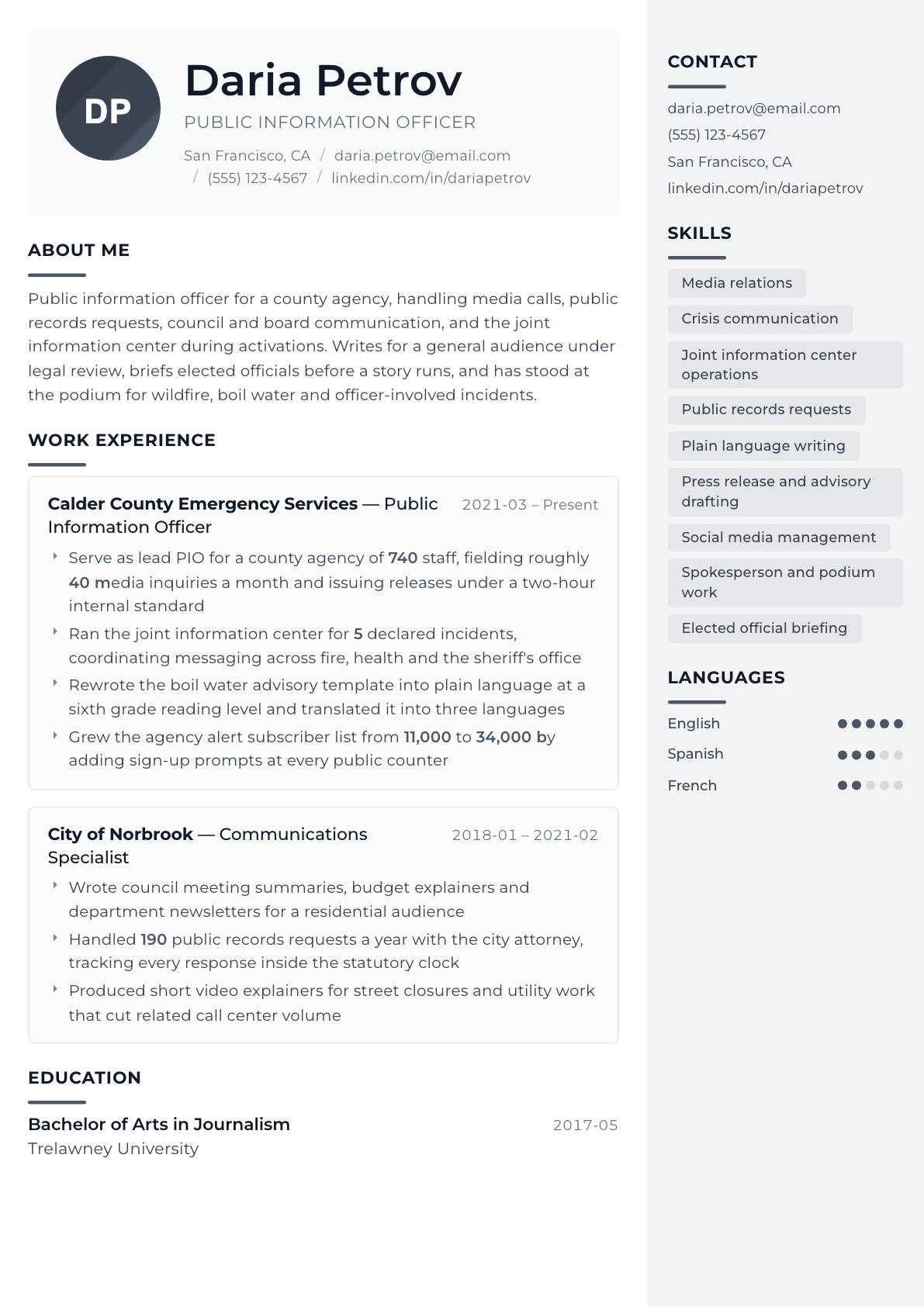
Example Public Information Officer summary
Public information officer with seven years across city and county government, leading media relations, records requests and the joint information center during declared incidents. Has taken the podium for wildfire, water advisory and law enforcement events, rewrites technical notices into plain language with translations, and briefs elected officials before a story breaks. Trained in incident command and experienced with alert systems and council communication.
Skills to list on a Public Information Officer resume
- Media relations and pitching
- Crisis and emergency communication
- Joint information center operations
- Incident command system roles
- Press release and media advisory drafting
- Spokesperson and on-camera delivery
- Public records request handling
- Plain language and readability editing
- Multilingual message coordination
- Emergency alert system administration
- Social media and community management
- Elected official and executive briefing
- Video and photo production
- Community meeting facilitation
- Message testing and after action review
What actually gets this resume read
- Name the incidents you have spoken on, because a hiring panel wants proof you have faced live cameras.
- Give your media inquiry volume and your internal turnaround standard, not a claim about responsiveness.
- Show joint information center experience and your incident command training level by course number.
- Explain how you handle public records requests inside the statutory clock alongside the legal office.
- Include plain language work: reading level targets, translations and accessibility of your advisories.
- List the channels you own, from the alert system to the council agenda page, with subscriber numbers.
How to write a public information officer resume
The panel hiring a public information officer is picturing the worst night of the year. A water main has failed, a fire has jumped a ridge, or an officer has fired a weapon, and the agency director needs someone who can stand in front of cameras at midnight, say only what is confirmed, and hold the trust of a community that is already angry.
That is why marketing language dies on this page. Engagement rates and campaign impressions are not what a city manager is buying. She is buying accuracy under pressure, a working relationship with reporters who will call whether you answer or not, and enough legal instinct to know what cannot be said while an investigation is open.
This guide covers what belongs in a government communications resume, how to write incident work without overclaiming, summaries for three career stages, before and after bullets drawn from real agency work, and the questions communicators ask when they cross over from newsrooms or private sector marketing.
Format: one page for most, with incident work visible above the fold
One page under eight years, two after that, reverse chronological. Public sector human resources screens against a posted list of minimum qualifications, so every listed requirement should be findable on your page using the words the posting used. That is a mechanical exercise, and skipping it is why strong communicators get screened out before a panel sees them.
Add a compact incident block near the top listing the events you have been the voice on, by type and scale rather than by narrative. A reader who sees wildfire, boil water advisory, officer involved shooting and a multi-agency search in one block knows immediately whether you have stood where this job will put you.
- Header line: name, city and state, phone, work-appropriate email, and a portfolio link holding releases and clips.
- Incident block: event type, your role, and whether you staffed a joint information center or worked alone.
- Training line: incident command system course numbers completed, since agencies check them against the position description.
- Career changers from journalism put beat coverage and deadline volume before any communications job.
Summary: agency type, audience, incident role, records work
Three or four lines. Name the level of government and the agency type, the population you communicate to, the incidents you have spoken on, and whether you handle public records requests. Those four facts describe the actual job in most jurisdictions, where the communications shop and the records desk sit in the same office.
If you are coming out of a newsroom, say it and use it. A reporter knows how a story is built, what a deadline does to a request for comment, and which non-answer will produce a worse headline than the truth. Write that as an advantage rather than hoping a panel infers it.
Experience: volume, turnaround, and who you speak for
Open each job with the agency, its staff size or population served, and who you reported to. Reporting to the director or the city manager is materially different from reporting to a marketing manager two levels down, because it decides whether you learn about an incident at the start or after the story runs.
Then quantify the ordinary work. Media inquiries a month and your internal turnaround standard. Releases and advisories issued. Public records requests handled and whether you tracked them against the statutory clock with the attorney. Council or board meetings supported. Alert system subscribers gained. These are unglamorous numbers, and they are exactly what a panel uses to tell a real government communicator from a candidate with a portfolio of glossy campaigns.
Write incident work carefully. Say what position you filled, whether the joint information center was single agency or multi-agency, how many partner organizations coordinated messaging through you, and what you produced during the operational period. Do not claim credit for the response itself. A panel that has run an incident can hear the difference instantly.
Plain language, translation and accessibility
Government messages fail when they are technically correct and unreadable. If you have rewritten advisories to a target reading level, coordinated translations, added captioning, or restructured a notice so the action a resident must take appears in the first sentence, put it on the page. That work is invisible in most portfolios and highly valued by anyone who has watched a public health notice fail to reach half the people it was written for.
Say how you verify. A message tested with a community group, run past the operations staff for technical accuracy, and cleared by counsel before release describes a process. A message you simply wrote well describes a hope.
Keywords a public sector panel screens for
Postings recycle the same terms: media relations, crisis communication, joint information center, incident command system, public records, plain language, spokesperson, community engagement, emergency notification, strategic communications plan and after action report. Mirror them once each where the work is described, using the posting's exact phrasing rather than a private sector synonym.
Name your tools too, in one short line: the alert and notification platform, the records request tracking system, the agenda management system, the social platforms you administer and the video tools you edit in. Agencies buy a small number of products, and knowing one already saves a transition.
Public Information Officer resume summary examples
Coming from a newsroom
Local government reporter with three years covering city hall, public safety and utilities, filing daily on deadline and building sources across four agencies. Trained in incident command through introductory courses, and seeking a public information officer role where beat knowledge and plain language writing transfer directly.
Agency public information officer
Public information officer for a county agency of 740 staff, handling roughly 40 media inquiries a month under a two-hour internal turnaround standard, 190 public records requests a year with the attorney, and the joint information center during five declared incidents including wildfire and a boil water advisory.
Communications director for a jurisdiction
Communications director for a city of a quarter million residents, leading a team of six across media relations, digital channels, records and emergency notification. Has served as lead spokesperson for law enforcement incidents and severe weather events, and rebuilt the crisis communication plan with annual exercise testing.
Work experience bullets: before and after
Before: Handled media inquiries for the agency.
After: Fielded roughly 40 media inquiries a month as the named contact for a county agency of 740 staff, meeting a two-hour internal response standard even when the answer was a confirmed no comment.
Volume, standard and the honest note about non-answers show a working process instead of a job duty.
Before: Supported communications during emergencies.
After: Ran the joint information center for five declared incidents, coordinating a single approved message across fire, public health and the sheriff's office through each operational period.
Naming the structure, the incident count and the partner agencies proves you held a defined role rather than helped out.
Before: Wrote clear public notices.
After: Rewrote the boil water advisory template into plain language at a sixth grade reading level, moved the required resident action into the first sentence, and had it translated into three languages before the next event.
A reading level target, a structural change and translation turn clarity into work a panel can picture.
Before: Managed public records requests.
After: Processed 190 public records requests a year alongside the city attorney, logging every response inside the statutory clock and building a redaction checklist that cut repeat legal review.
The volume, the legal partnership and the deadline discipline address the part of the job most candidates ignore.
Before: Grew the agency social media following.
After: Grew emergency alert subscribers from 11K to 34K by adding sign-up prompts at every public counter, on utility bills and at the end of each community meeting.
Alert subscribers are an operational asset, and the method shows persistent groundwork rather than a viral post.
Hard skills
- Media relations and reporter management
- Crisis and emergency communication
- Joint information center operations
- Incident command system roles
- Press release and media advisory writing
- On-camera and podium delivery
- Public records request processing
- Plain language and readability editing
- Emergency alert and notification systems
- Social media administration for a public agency
- Video and photo production
- Council and board meeting communication
- After action reporting and message review
Soft skills
- Holding the line on unconfirmed information
- Briefing an elected official who does not want to hear it
- Composure at a hostile press conference
- Building reporter trust before you need it
- Working inside legal limits without sounding evasive
Certifications worth listing
- Accreditation in Public Relations (APR) (Universal Accreditation Board)
Mistakes that cost public information officer candidates the interview
- Filling the page with impressions and engagement rates when the panel is hiring for accuracy under pressure.
- Claiming credit for an emergency response instead of naming the communications position you actually filled.
- Leaving out public records work, which is often half the job in a small or mid-size jurisdiction.
- Skipping incident command course numbers when the position description lists them as a requirement.
- Describing yourself as a storyteller, a word that tells a city manager nothing about what you do at two in the morning.
- Hiding a newsroom background instead of writing it as the source of your deadline instincts and source relationships.
Public Information Officer resume questions
How do I move from journalism into a public information officer role?
Translate your beat into agency terms: the departments you covered, the records you requested, the deadlines you met and the officials you interviewed. Then add incident command training, because that is the one qualification newsrooms never give you and government postings almost always list.
Should I include writing samples with a government application?
Yes, and choose them deliberately. A routine release, a difficult incident statement and a plain language advisory show more range than three polished features. Many jurisdictions ask for samples anyway, so having a curated set ready keeps you from scrambling.
How much detail can I give about a sensitive incident?
Only what was already public. Describe your role, the structure you worked in and the products you issued, and keep out anything that was never released. A panel of public officials will respect the restraint far more than a detailed account.
Does social media experience matter for this job?
It matters as a channel you administer, not as a career identity. Show that you run official accounts under a records retention policy, publish emergency information quickly, and handle comment moderation within the legal limits that apply to a government page.
What if my agency never had a real crisis?
Use exercises and near events. Tabletop participation, a drill where you staffed the message role, a planned protest, a severe weather watch or a major construction closure all show preparation. Say what you practiced and what the after action review changed.
Related resume examples
- Public Affairs Specialist Resume example
- Emergency Management Director Resume example
- Communications Manager Resume example
- City Clerk Resume example
- Emergency Management Coordinator Resume example
- Fire Chief Resume example