Emergency Management Coordinator Resume Examples: free
Write an Emergency Management Coordinator Resume That Reads Like a Plan
By Mustafa Tarabya, founder of CVBooster · Published · Updated
Emergency management coordinator resume example with EOC, exercise design and mitigation keywords, plus a guide to writing activations and plans.
Sample resumes for a emergency management coordinator
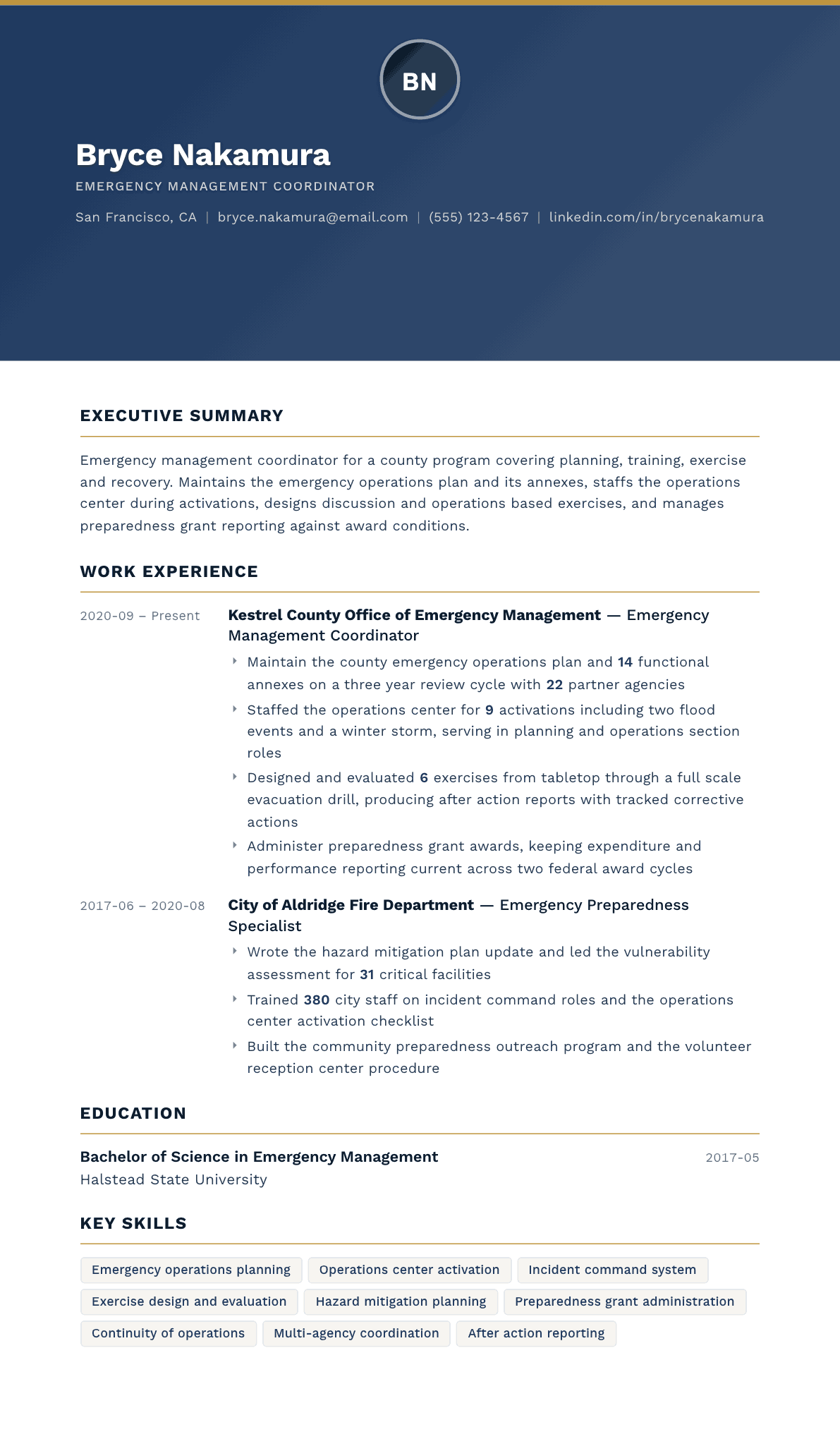
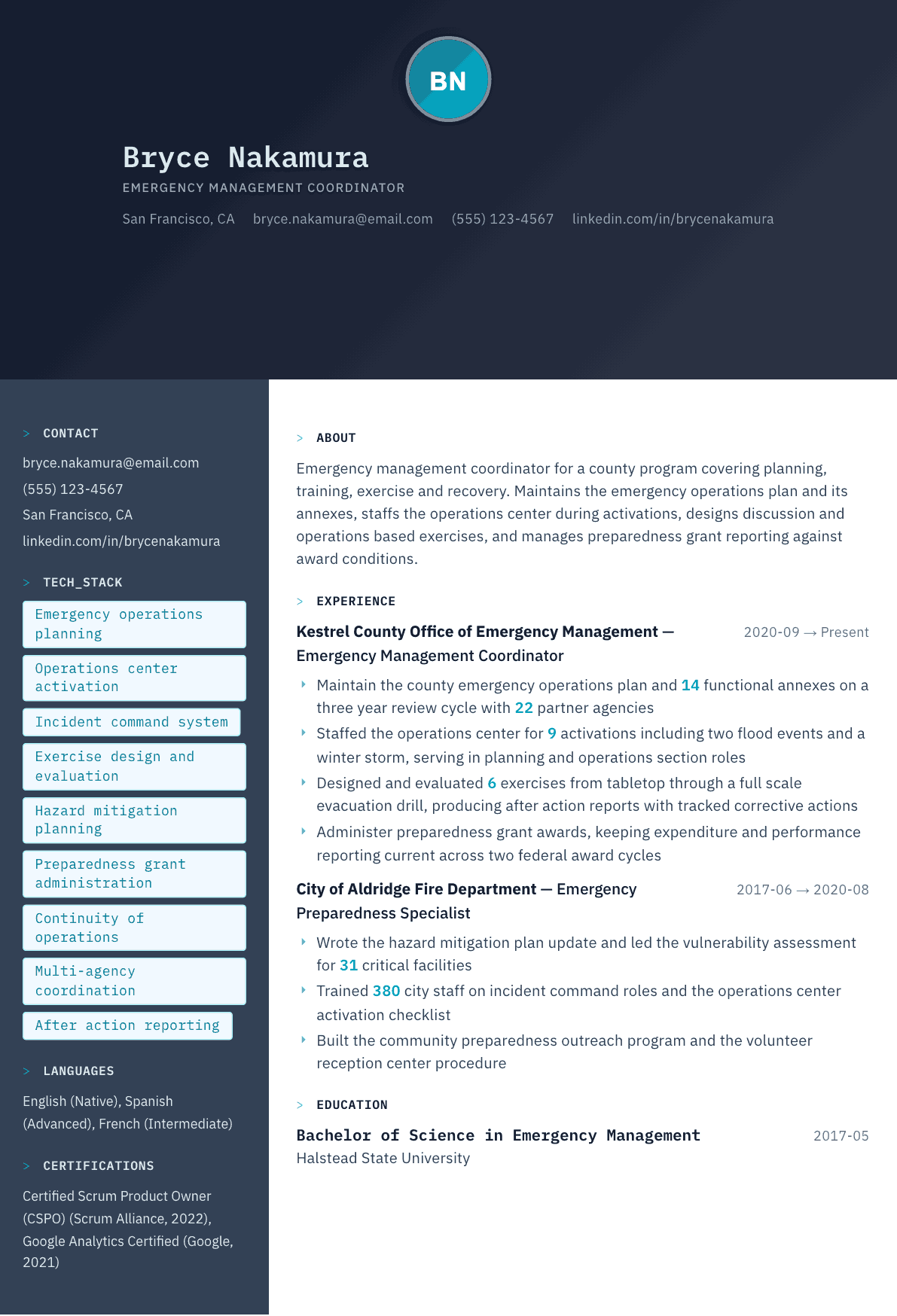
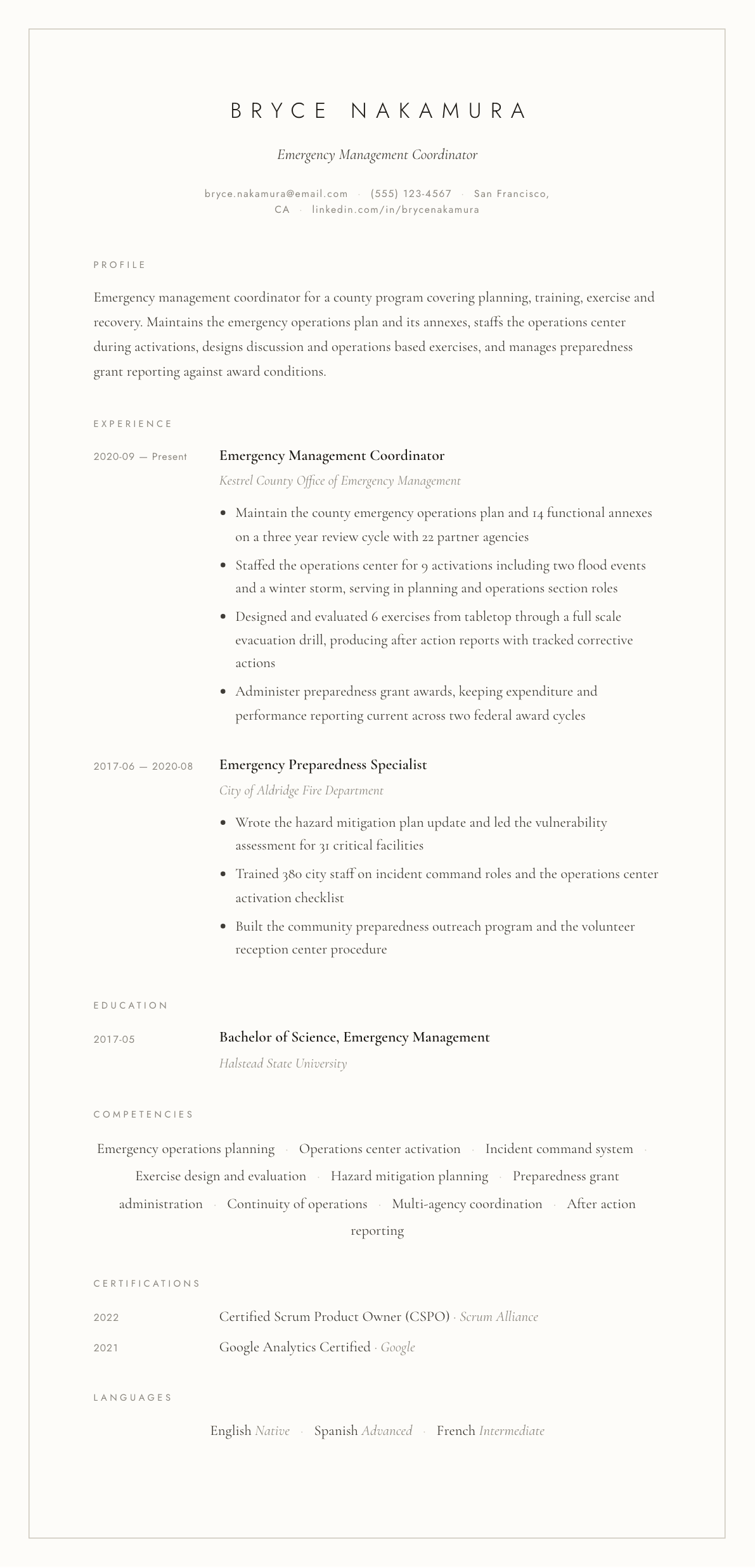
The same emergency management coordinator content laid out in three CVBooster templates, so you can see what the finished document looks like before you write a word.
Example Emergency Management Coordinator summary
Emergency management coordinator with eight years across county and municipal programs, owning the emergency operations plan and its annexes, staffing the operations center through flood and winter storm activations, and designing exercises from tabletop to full scale. Writes after action reports with corrective actions that actually close, administers preparedness grant awards through federal reporting cycles, and trains staff on incident command roles. Bachelor of Science in Emergency Management.
Skills to list on a Emergency Management Coordinator resume
- Emergency operations plan development
- Emergency operations center management
- Incident command system positions
- Hazard vulnerability analysis
- Hazard mitigation planning
- Continuity of operations planning
- Exercise design and facilitation
- After action report and corrective action tracking
- Preparedness grant management
- Damage assessment
- Public warning and notification systems
- Volunteer and donations management
- Shelter operations coordination
- Interagency mutual aid agreements
- Community preparedness outreach
What actually gets this resume read
- Count your activations and name the hazards, because a director hires on real operations center hours.
- State the section and position you held during each activation rather than saying you supported the response.
- List your incident command and position specific training by course number, since panels check them.
- Show exercise work across the full progression from seminar and tabletop up to functional and full scale.
- Give the plans you own by name, their review cycle, and how many partner agencies sign off on them.
- Include grant administration detail: the award program, reporting cadence and any monitoring visit outcome.
How to write a emergency management coordinator resume
Emergency management is judged on two things: the plan that exists before anything happens, and how the person who wrote it performs at three in the morning when the plan meets reality. A director hiring a coordinator is checking both. She wants documents that partner agencies actually signed, and she wants operations center hours that were logged during a real event rather than a drill.
Resumes in this field tend to fail in one of two directions. Some list every course completed and nothing else, which reads as a training record rather than a career. Others describe responses in heroic terms without ever naming the position held, which anyone who has staffed an operations center recognizes as a candidate who was in the room but not on the chart.
This guide covers the sections a program director reads first, how to write activations and exercises so they can be verified, summaries for a new coordinator, a settled one and a program manager, before and after bullets, and the questions people ask when they come in from fire, public health or the military.
Format: one or two pages, with activations and training visible early
Reverse chronological, one page under about six years and two pages after. Emergency management hiring runs through a public sector human resources office that scores against posted minimum qualifications, so every stated requirement should appear on your page in the words the posting used. This is mechanical and it decides whether a director ever sees the resume.
Build two compact blocks near the top. One lists activations: hazard type, the position you filled, and the operational periods you covered. The other lists training by course number, because position specific credentials are checked against the job description rather than admired. Together they answer the two questions a director has before she reads a single job description.
- Activation block: hazard, jurisdiction, incident command position filled, and duration.
- Training block: independent study and classroom course numbers, plus any position specific or all-hazards course completed.
- Each job names the jurisdiction size, the program scope and whether the office was standalone or inside fire or public safety.
- Career changers from fire, public health or the military translate their billet into the plain function it performed.
Summary: program scope, activations, plans owned, grant dollars
Four lines. Name the jurisdiction and population served, the four program phases you cover, how many activations you have staffed and in what positions, and which plans you own outright. A director can staff a whole program in her head from those facts.
Coordinators come from many directions, and the summary is where you resolve it. A fire captain moving into emergency management should say what carries: incident command fluency, mutual aid relationships and operational credibility with responders. A public health planner should say the opposite half: continuity planning, exercise design and grant compliance. Both are valid, and a director wants to know which half she is getting.
Experience: activations first, planning second, both with numbers
Open each position with the office, the jurisdiction population, the number of partner agencies in your coordination structure and whether you reported to a county administrator, a fire chief or a public safety director. Reporting line matters in this field because it determines how much authority the coordinator role actually carries.
Then write activations properly. Hazard, dates or duration in operational periods, the section and position you filled, what you produced, and what the after action review found. A coordinator who says she served in the planning section and wrote the incident action plan for six operational periods during a flood has said something a director can picture and check. "Supported emergency response efforts" has not.
Planning work needs the same discipline. Name the plans you own, their revision cycle, how many partner agencies review and sign them, and what changed in the last update. An emergency operations plan with fourteen functional annexes on a three year cycle across twenty-two agencies is a real workload, and stating it that way is more persuasive than calling yourself detail oriented.
Exercises, corrective actions and grant compliance
Exercise work is the clearest proof of competence in this field because it is documented by design. Show the progression: seminars and workshops, tabletops, drills, functional exercises and full scale events. For each, say the participant count, the agencies involved, your role as designer, facilitator or evaluator, and the after action report you produced.
Then the part almost everyone skips: corrective actions. Anyone can run an exercise and publish findings. A coordinator who tracked corrective actions to closure, reported progress to a preparedness committee and pulled a repeat finding out of the next cycle is describing the discipline that actually improves a program. Write that as a tracked, closed count rather than an intention.
Grant administration belongs here too. Name the award program, the reporting cadence, whether you built the investment justification, and how any monitoring visit closed. Preparedness funding pays for much of what a small office does, and a coordinator who has kept expenditure and performance reporting clean through an audit is a low-risk hire.
Keywords a preparedness posting screens for
The vocabulary is standardized and you should use it exactly: emergency operations plan, functional annex, emergency operations center, incident command system, national incident management system, hazard vulnerability analysis, hazard mitigation plan, continuity of operations, exercise design, after action report, improvement plan, damage assessment, mass care, mutual aid and public warning.
Add a systems line naming the products you work in: the incident management software your operations center runs, the mass notification platform, the resource request and tracking system, and any mapping tool you use for damage assessment or vulnerability work. These are the pieces a new coordinator otherwise spends her first quarter learning.
Emergency Management Coordinator resume summary examples
New to the program
Emergency management graduate with a county internship supporting two exercise cycles and the hazard vulnerability analysis for thirty-one critical facilities. Completed the introductory and intermediate incident command courses, staffed a winter storm activation in a documentation role, and seeking a coordinator position in a county or municipal office.
County coordinator
Emergency management coordinator maintaining a county emergency operations plan with fourteen functional annexes across twenty-two partner agencies. Staffed nine activations including two floods and a winter storm in planning and operations section roles, designed six exercises from tabletop to full scale, and administers preparedness grant reporting through two federal award cycles.
Program manager
Emergency management program manager for a jurisdiction above three hundred thousand residents, supervising four planners across preparedness, mitigation, response and recovery. Has run the operations center as section chief through declared disasters, led two hazard mitigation plan updates to state approval, and closed a federal grant monitoring visit without findings.
Work experience bullets: before and after
Before: Assisted with emergency response during severe weather events.
After: Staffed the county operations center for nine activations including two flood events and a winter storm, filling planning and operations section roles across multiple operational periods.
The activation count and the named section positions let a director place you on an organization chart.
Before: Maintained the county emergency plan.
After: Owned the emergency operations plan and its fourteen functional annexes on a three year review cycle, coordinating revision and sign-off with twenty-two partner agencies.
Annex count, review cycle and partner sign-off describe the real coordination workload behind plan maintenance.
Before: Ran training exercises for staff.
After: Designed and evaluated six exercises from tabletop through a full scale evacuation drill, producing after action reports and tracking every corrective action to closure before the next cycle.
The exercise progression plus closed corrective actions shows a program that improves rather than one that documents.
Before: Managed grant funding for the office.
After: Administered preparedness grant awards across two federal cycles, keeping expenditure and performance reporting current and closing the most recent monitoring visit with no findings.
Reporting discipline and a clean monitoring outcome are what a director fears losing when she hires wrong.
Before: Trained city employees on emergency procedures.
After: Trained 380 city staff on incident command roles and the operations center activation checklist, then validated the training through a functional exercise that cut activation setup time.
A participant count plus a validation step turns training delivery into a measurable readiness gain.
Hard skills
- Emergency operations plan and annex development
- Emergency operations center management
- Incident command system position roles
- Hazard vulnerability analysis
- Hazard mitigation plan development
- Continuity of operations planning
- Exercise design, facilitation and evaluation
- After action report and improvement plan tracking
- Preparedness grant administration
- Damage assessment and recovery documentation
- Mass notification and public warning systems
- Shelter and mass care coordination
- Mutual aid and interagency agreements
Soft skills
- Steadiness through long operational periods
- Getting sign-off from agencies that do not report to you
- Briefing elected officials during an active event
- Saying what the plan cannot do before it is tested
- Rotating and resting a team you also work in
Certifications worth listing
- Certified Emergency Manager (CEM) (International Association of Emergency Managers)
- Associate Emergency Manager (AEM) (International Association of Emergency Managers)
- Professional Continuity Practitioner (PCP) (Federal Emergency Management Agency)
Mistakes that cost emergency management coordinator candidates the interview
- Listing course numbers as the whole resume, which reads as a training transcript rather than an operational career.
- Describing response work without naming the incident command position you filled, the detail every director checks first.
- Publishing exercise counts with no corrective action closure, which is where preparedness programs actually improve.
- Leaving grant administration off the page when preparedness funding pays for most of what a small office does.
- Writing plans as a document count rather than as a coordination job across agencies that do not report to you.
- Carrying military or fire terminology onto a civilian application without translating the billet into its plain function.
Emergency Management Coordinator resume questions
How do I show emergency operations center experience if my activations were short?
Count them honestly and describe them by operational period rather than by days. A four hour activation where you built the incident action plan tells a director more about your capability than a week spent answering phones without a defined position.
Which training courses should I list on the resume?
List the incident command and national incident management system courses by number, plus any position specific or all-hazards program you completed. Leave off short awareness webinars, since a long low-value list dilutes the credentials a director is actually looking for.
Do I need the Certified Emergency Manager credential?
Not for most coordinator postings, though many prefer it and some senior roles require it. If you are working toward it, say so with your current status, because the credential takes documented experience and references that take time to assemble.
How do I move from fire or public health into emergency management?
Name the transferable half explicitly. From fire, that is incident command fluency and mutual aid relationships. From public health, that is continuity planning, exercise design and grant compliance. Then show you have filled the gap through coursework or a secondary assignment.
Should I include volunteer or community preparedness work?
Yes, when you led it. Building a volunteer reception center procedure, running a community preparedness program or coordinating donations management are real functions that appear in plans, and small offices depend on a coordinator who has done them.
Related resume examples
- Emergency Management Director Resume example
- Fire Chief Resume example
- Public Works Director Resume example
- Homeland Security Analyst Resume example
- Public Information Officer Resume example
- Field Organizer Resume example