Fire Chief Resume Examples: free ATS score and gap list
Command Your Career with a Fire Chief Resume
By Mustafa Tarabya, founder of CVBooster · Published · Updated
Build a fire chief resume that demonstrates your leadership, emergency management expertise, and department administration capabilities.
Sample resumes for a fire chief
The same fire chief content laid out in three CVBooster templates, so you can see what the finished document looks like before you write a word.
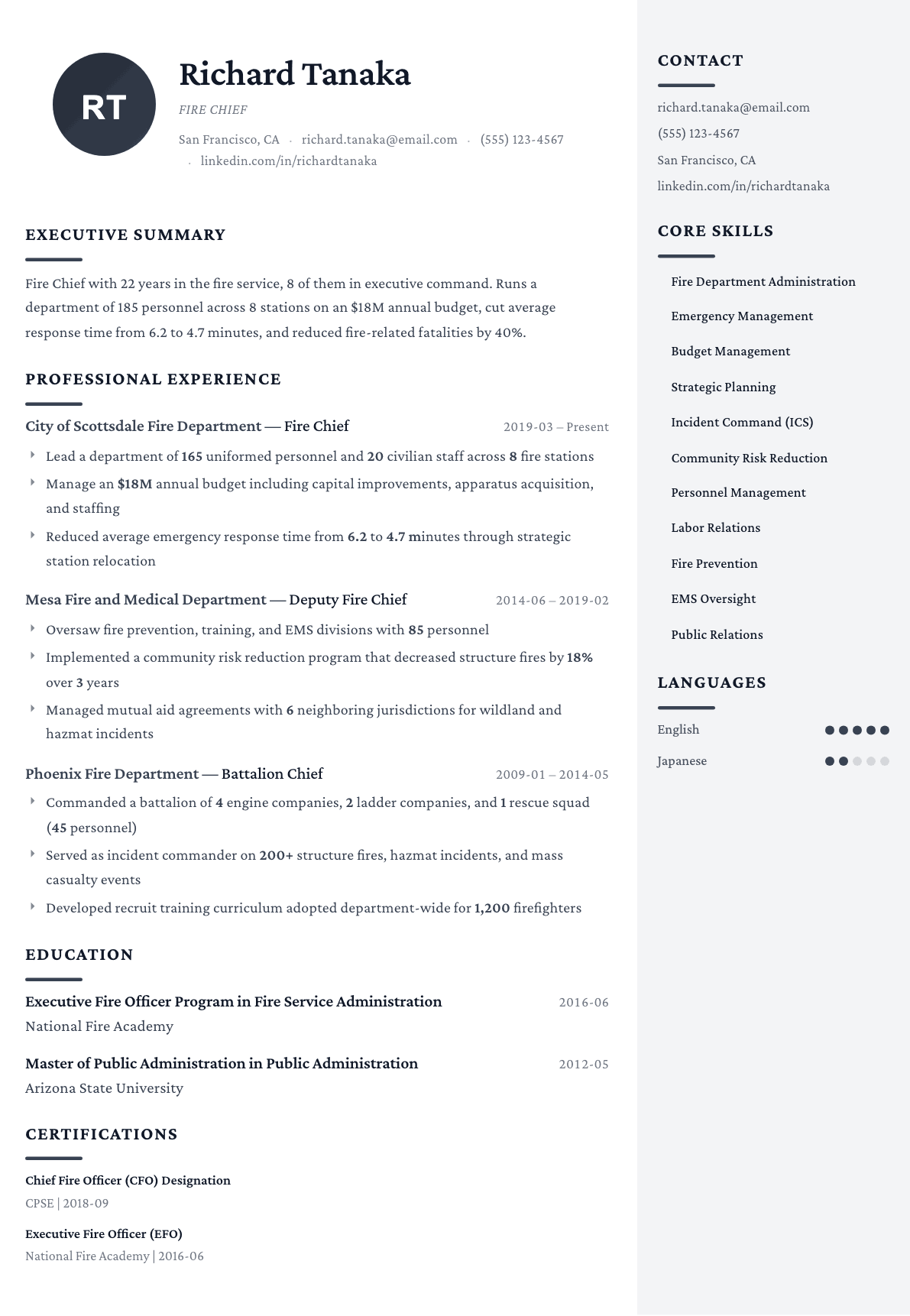
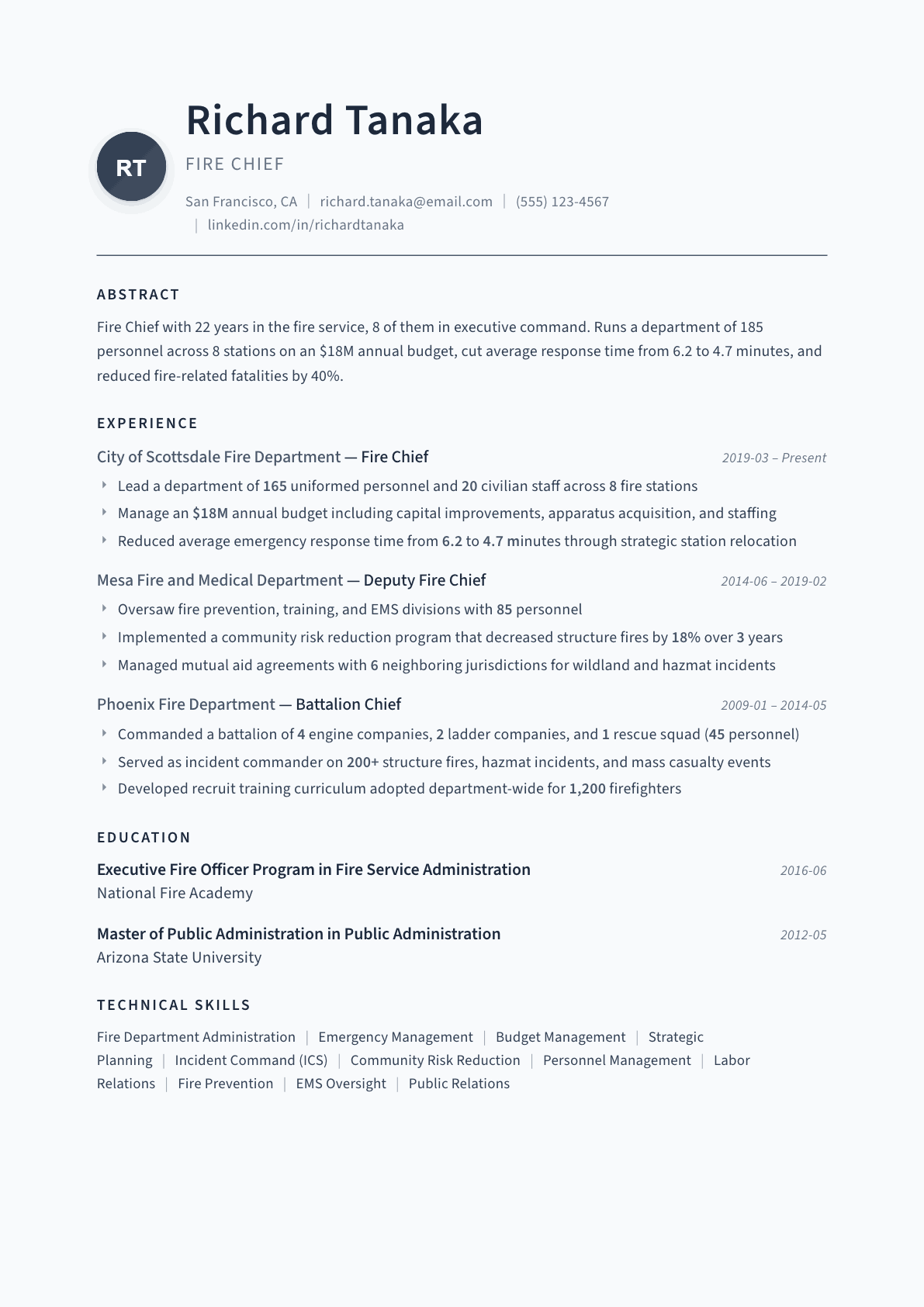
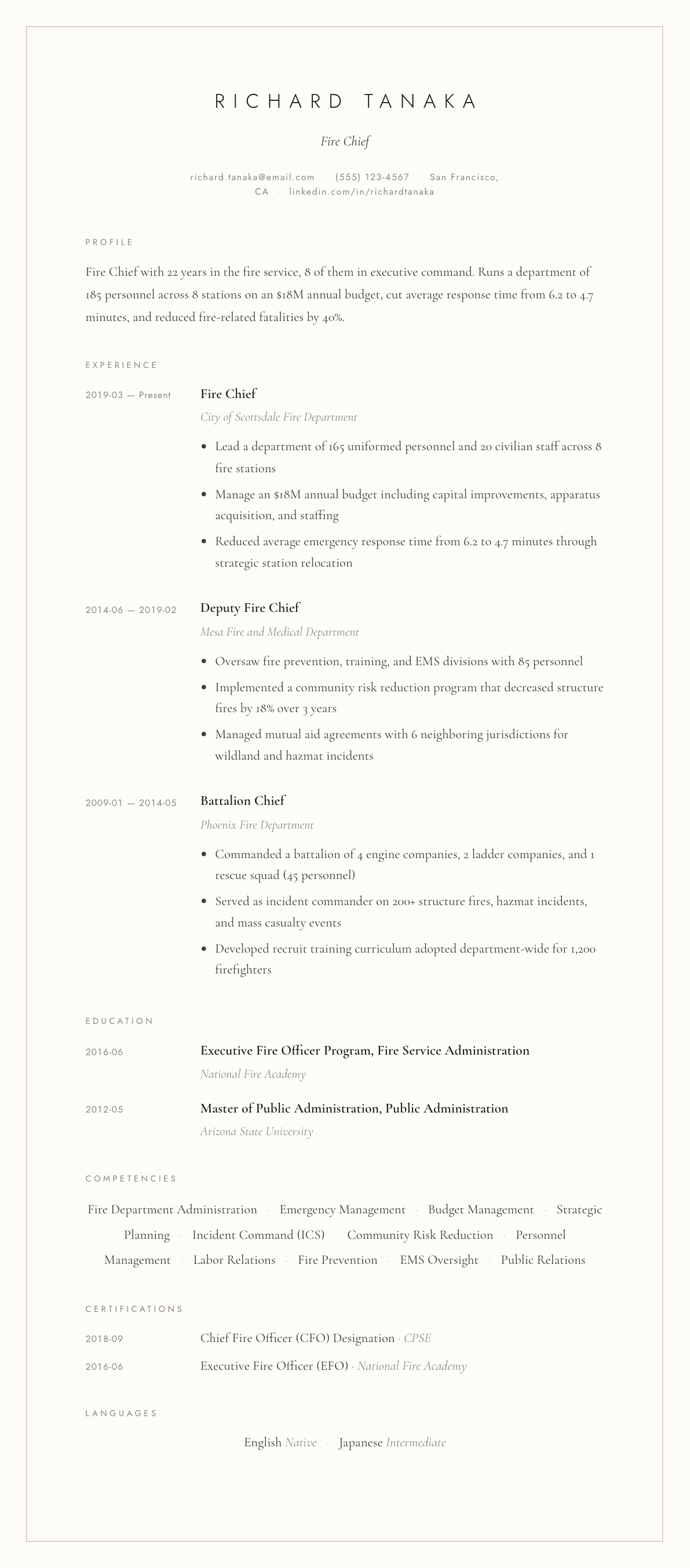
Example Fire Chief summary
Fire Chief, 22 years in the fire service and 8 in executive command, leading a 185-person department on an $18M budget. Cut response times by 25% and fire fatalities by 40% through station relocation and community risk reduction. Seeking a fire chief post in a growing metropolitan department.
Skills to list on a Fire Chief resume
- Fire Department Administration
- Emergency Response
- Incident Command System (ICS)
- Budget Management
- Strategic Planning
- Community Risk Reduction
- Personnel Management
- Labor Relations
- Fire Prevention & Investigation
- EMS Administration
- Mutual Aid Coordination
- Public Speaking
- Grant Management
- Accreditation (CPSE)
What actually gets this resume read
- Lead with your command-level accomplishments: response time improvements, fatality reductions, budget management.
- Include your Executive Fire Officer (EFO) and Chief Fire Officer (CFO) designations prominently.
- Quantify department metrics: personnel count, station count, call volume, budget size.
- Highlight community risk reduction programs and prevention initiatives you have implemented.
- Mention labor relations experience, mutual aid coordination, and interagency collaboration.
- Include ICS qualifications and major incident command experience.
How to write a fire chief resume
A fire chief resume goes to a city manager, a board of fire commissioners or a district board, usually through an assessment center process rather than a simple interview. The people reading it are accountable for a department they cannot operate themselves, so they screen for evidence that you can run a budget, manage a labor relationship, command a major incident and stand in front of a council when something goes wrong.
Operational credibility is assumed at this level. What is not assumed is administrative competence. The resumes that fail are the ones that read like a battalion chief promotion packet: rich on incident command and fireground tactics, silent on capital planning, accreditation, staffing models, EMS billing, response time analysis and the political work of asking for a station.
This guide covers the layout hiring panels and assessment centers expect, how to present department scale and response performance without inflating either, how to write labor and community risk reduction work, and the questions deputy and assistant chiefs ask when they compete for their first chief position.
Format: two to three pages, department profile before duties
Chief level searches accept a longer document, and many require a supplemental questionnaire alongside it. Two to three pages is the working range. Keep the layout conventional, because panels often print and score packets side by side against a rubric drawn from the position profile.
Open each position with a department profile line. Population protected, square miles, number of stations, uniformed and civilian personnel, apparatus, annual call volume, the fire and EMS split, whether transport is provided, the ISO Public Protection Classification, and whether the department is career, combination or volunteer. A chief of a combination district and a chief of a career metropolitan department are answering different questions every day.
- Header: name, designations such as CFO and EFO, city and state, phone, email.
- Order: profile summary, professional experience, command and incident qualifications, certifications and designations, education, professional and community service.
- List state fire officer certification levels and the accrediting body, since panels check them against the position profile.
Summary: department scale, the mandate, and your command qualification
Say what you have run and what you were hired to fix. Departments recruit chiefs against a problem: a failed accreditation, a station that needs to be built, an EMS transition, a staffing shortfall, a discipline culture that has damaged public trust, a merger with a neighboring district. Name the mandate you carried and the state the organization was in when you took it.
Add your incident command qualification explicitly. Type of incident management team, complex incident experience, unified command with law enforcement and emergency management, and any state or federal deployment. A chief who has commanded a multi alarm structure fire, a wildland interface event and a mass casualty incident should say all three.
Experience: budget, staffing model, and response performance
Lead with administration because that is the gap panels test. Budget development and defense before a council or board, capital replacement schedules for apparatus and self contained breathing apparatus, station construction or renovation, grant applications for staffing and equipment, EMS billing and cost recovery, and the annual audit relationship.
Staffing is the next block. Minimum staffing levels, unit staffing per apparatus, overtime management, an academy or recruit class you ran, promotional processes designed, lateral hiring, and a succession plan for company and chief officers. Say plainly whether you have opened a station or added a company and how it was funded.
Response performance needs care and honesty. Turnout and travel time distributions rather than averages, the standard of cover, effective response force assembly, unit hour utilization for EMS, and what you changed to move any of them: a station relocation, a dynamic deployment model, a peak demand unit, an automatic aid agreement. Panels distrust unsupported improvement claims because response times move with call volume and traffic as much as with management.
Labor, discipline and community risk reduction
Name the bargaining unit, the number of agreements settled, and what the settlements addressed in structure rather than figures: staffing language, health cost sharing, a shift schedule change, a promotional process. Say whether you have carried an impasse through fact finding or arbitration and whether the relationship stayed workable afterward.
Discipline and accountability belong on the page even though most candidates avoid them. A department that has had a serious personnel matter needs a chief who can describe how due process was followed and what changed in policy or training as a result. Panels read that as maturity rather than as a liability.
Community risk reduction is what distinguishes a modern chief. A risk assessment driving inspection frequency, a smoke alarm installation program, a hoarding or fall prevention referral partnership, a community paramedicine program, a juvenile firesetter intervention, and pre incident planning for target hazards. Say what the intervention changed.
Designations, accreditation and the vocabulary panels look for
The Chief Fire Officer designation and the Executive Fire Officer program are the two markers that most consistently appear in chief announcements, and both belong near the top. Add fire officer certification levels, instructor and inspector certifications, paramedic or EMT credentials, and any accreditation work such as leading a department through an agency accreditation cycle or a self assessment.
Recurring announcement vocabulary includes standard of cover, community risk assessment, accreditation, ISO classification, mutual and automatic aid, incident command, apparatus replacement, capital improvement, succession planning, labor relations, and public trust. Mirror the wording of the position profile where your record supports it.
Fire Chief resume summary examples
Battalion or deputy chief seeking first chief post
Deputy fire chief for a career department of 92 personnel across four stations protecting 58 thousand residents. Owns the operations division, the recruit academy and the apparatus replacement schedule. Commanded 14 multiple alarm incidents, completed the Executive Fire Officer program and holds Fire Officer III certification.
Chief of a small department
Fire chief of a combination district with 3 stations, 41 career and 28 paid on call personnel, and roughly 4200 annual calls. Hired to stabilize staffing: opened one station, settled two labor agreements, built an apparatus replacement plan and improved the ISO classification by one class.
Chief of a metropolitan department
Fire chief with 24 years of service, currently leading a career department of 380 uniformed personnel across 11 stations protecting 210 thousand residents with transport EMS. Holds Chief Fire Officer designation, led the department through an accreditation cycle and commanded a wildland interface evacuation in unified command.
Work experience bullets: before and after
Before: Managed the fire department and its personnel.
After: Led a career department of 380 uniformed and 22 civilian staff across 11 stations, including operations, training, fire prevention, EMS and logistics divisions, protecting 210 thousand residents.
Scale and structure let a panel place your experience against their own department instead of guessing.
Before: Improved emergency response times.
After: Cut 90th percentile turnout time from 96 to 68 seconds through a station alerting upgrade and a documented dispatch to door standard, and reported the distribution quarterly to the council.
A percentile with a named mechanism and a reporting cycle is credible where an average and a claim are not.
Before: Handled the department budget.
After: Built and defended the annual operating budget before the council, established a 15 year apparatus replacement schedule funded through a capital reserve, and secured a federal staffing grant that added a fourth engine company.
Budget defense, a funded replacement plan and a grant that added a company prove administrative capability at chief level.
Before: Worked with the union on labor issues.
After: Negotiated three successive agreements with the local, including a shift schedule change and revised minimum staffing language, and resolved one impasse through fact finding with no service disruption.
Naming what the contracts addressed and how the impasse ended answers what a board most wants to know.
Before: Started community fire safety programs.
After: Built a community risk reduction division that targeted inspections by risk score, installed smoke alarms in 1400 homes in the two highest risk districts and launched a fall prevention referral with the county health department.
Targeting by risk and a specific partnership show a strategy rather than a set of public events.
Hard skills
- Fire department budget development and defense
- Standard of cover and deployment analysis
- Apparatus and capital replacement planning
- Incident command at complex incidents
- Fire and EMS operations management
- Community risk reduction programming
- Fire code enforcement and prevention oversight
- Agency accreditation and self assessment
- Collective bargaining and grievance administration
- Recruit academy and promotional process design
- Mutual and automatic aid agreements
- Federal and state grant applications
- EMS quality assurance and cost recovery
Soft skills
- Command presence under pressure
- Council and board communication
- Difficult personnel conversations
- Public accountability after a serious incident
- Mentoring company and chief officers
- Coalition building with neighboring agencies
Certifications worth listing
- Chief Fire Officer (CFO) Designation (Center for Public Safety Excellence)
- Executive Fire Officer Program (National Fire Academy)
- Fire Officer I through IV (National Board on Fire Service Professional Qualifications)
- Fire Officer Certification (State fire training agency accredited by IFSAC or Pro Board)
- Paramedic Certification (National Registry of Emergency Medical Technicians)
- Certified Emergency Manager (CEM) (International Association of Emergency Managers)
Mistakes that cost fire chief candidates the interview
- Writing a tactical resume full of fireground work and leaving budget, capital planning and labor relations almost untouched.
- Omitting the department profile, so a board cannot tell whether you have run a three station district or a metropolitan service.
- Quoting average response times, which experienced panels discount in favor of percentile distributions.
- Avoiding any mention of discipline or a difficult personnel matter, when handling one well is part of the job description.
- Listing designations only in an education block instead of after your name where a panel scanning packets will see them.
- Failing to name the accreditation or classification work, which is often written into the position profile as a priority.
Fire Chief resume questions
Do I need the Executive Fire Officer program to become a fire chief?
It is not universally required, but it appears in many announcements as preferred and it signals executive preparation beyond operations. If you have not completed it, strengthen the packet with the Chief Fire Officer designation, a degree in public administration and documented budget and labor experience.
How much detail should I give about incident command experience?
Enough to show the range and the complexity. Name the incident types you have commanded, whether you have worked in unified command with law enforcement or emergency management, and any deployment on a formal incident management team. Avoid a long list of routine calls.
How should a candidate from a combination department apply to a career one?
Address the difference openly and lead with what transfers: budget defense, capital planning, staffing models, code enforcement and community risk reduction. Then acknowledge the labor and staffing scale difference and point to any collective bargaining or large incident command experience you hold.
Should I include the assessment center exercises I have completed?
Yes if you have participated in formal assessment processes, since panels use them and the experience is relevant. List the role, the process and the outcome briefly. It also helps to note any assessor work you have done for another department.
How do I present a department problem I inherited?
State the condition factually, describe the plan and name what changed under you. Boards hire chiefs to fix things, so an inherited staffing crisis or a failed inspection program that you turned around is stronger evidence than a record with no visible difficulty in it.
Related resume examples
- Emergency Management Director Resume example
- City Manager Resume example
- Public Health Director Resume example
- Emergency Management Coordinator Resume example
- Public Information Officer Resume example
- Public Administrator Resume example