Field Organizer Resume Examples: the lines they read
Build a Field Organizer Resume That Shows Real Turf Numbers
By Mustafa Tarabya, founder of CVBooster · Published · Updated
Field organizer resume example with turf metrics, volunteer recruitment keywords and a guide to writing contact rates, shifts and GOTV work.
Sample resumes for a field organizer
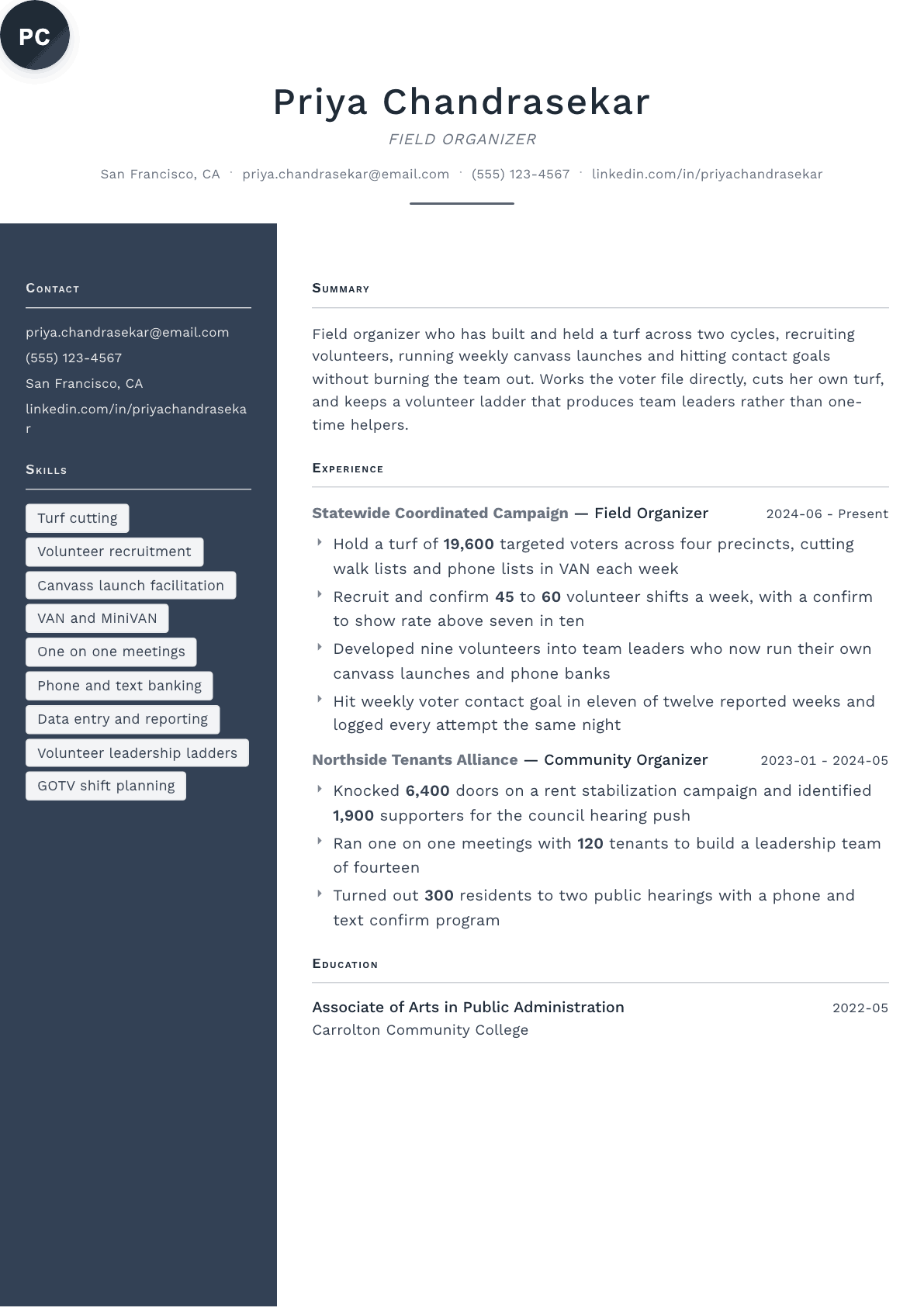
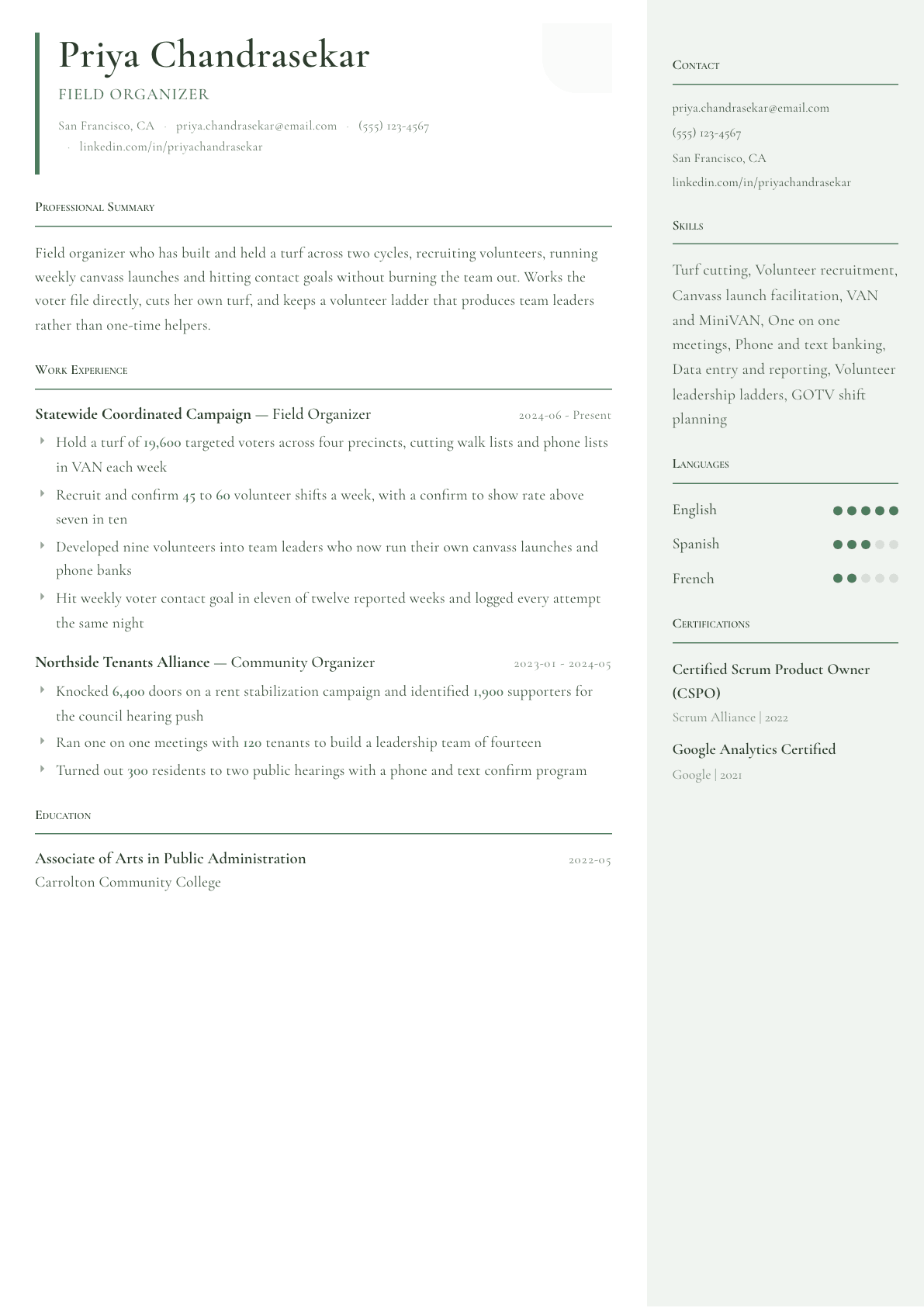
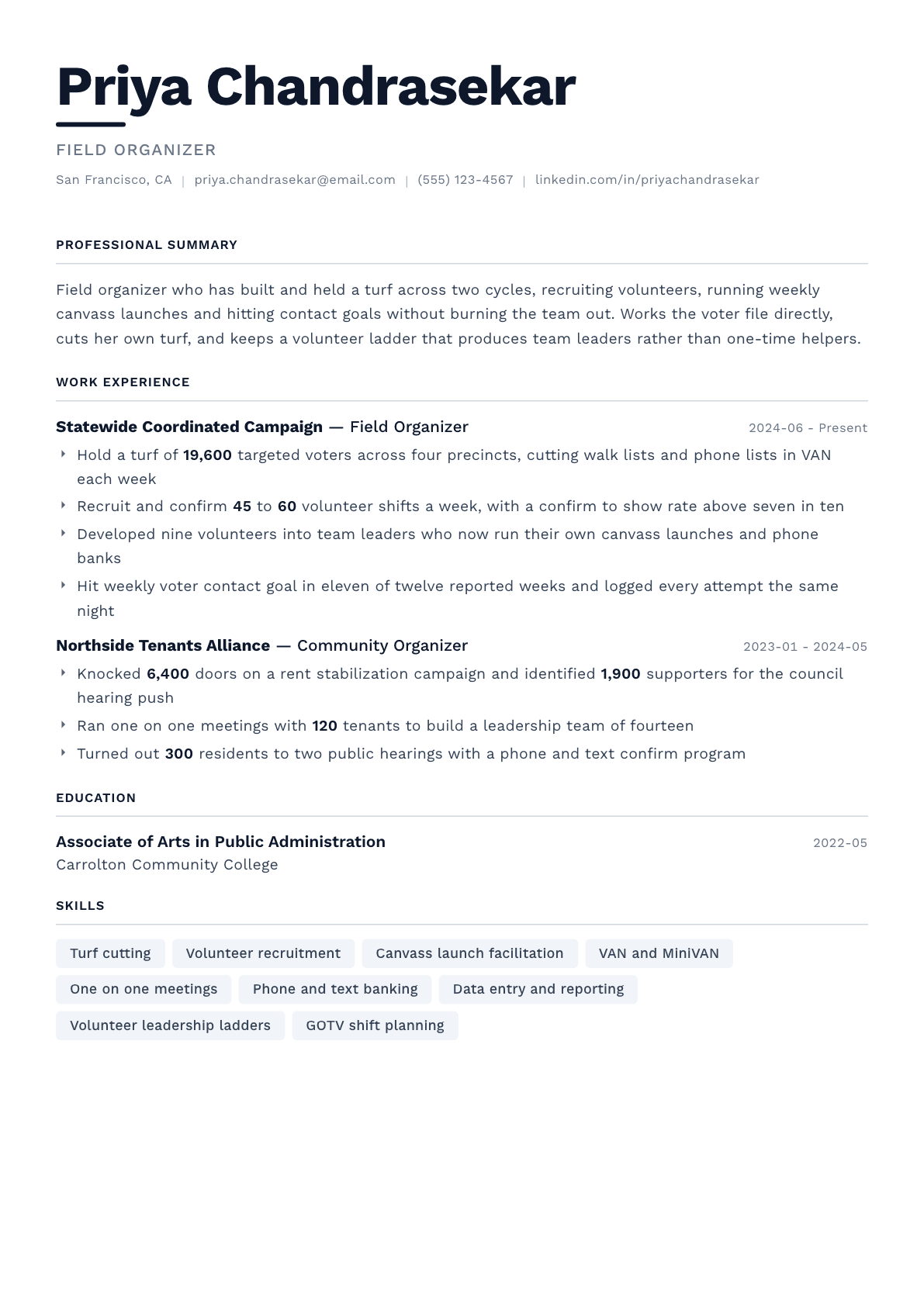
The same field organizer content laid out in three CVBooster templates, so you can see what the finished document looks like before you write a word.
Example Field Organizer summary
Field organizer with two cycles holding a four precinct turf, cutting walk lists in the voter file and running weekly canvass launches. Recruits and confirms volunteer shifts at a rate the field director uses as a benchmark, and has developed nine volunteers into team leaders who run their own programs. Hits weekly contact goals and enters every attempt the same night.
Skills to list on a Field Organizer resume
- Turf cutting and list management
- Volunteer recruitment and confirms
- One on one organizing meetings
- Canvass launch facilitation
- Phone bank and text bank programs
- MiniVAN and VAN data entry
- Volunteer leadership development
- Voter identification scripts
- GOTV shift building
- Relational organizing
- Community meeting turnout
- Data hygiene and nightly reporting
- Bilingual voter outreach
- Event logistics on a small budget
What actually gets this resume read
- Give the size of your turf in targeted voters or households, because that is how a field director compares organizers.
- Report weekly voter contact goals and how often you hit them, not just the total doors your team knocked.
- Name your confirm to show rate for volunteer shifts, since that number tells a director you can hold a program.
- Count the volunteers you moved up the ladder into team leaders, which is the real output of organizing work.
- Say which voter file tools you cut turf in yourself, including the mobile canvassing app your team used.
- Put labor, tenant, issue and electoral organizing in separate jobs so a reader can see the range you carry.
How to write a field organizer resume
Field organizer hiring moves fast and the person reading your resume is usually a field director with a stack of applications and a training already scheduled. She is not looking for eloquence. She is looking for evidence that you can hold a turf, recruit volunteers who actually show up, and enter your data the same night without being chased.
Most applicants write about caring deeply and knocking a lot of doors. Neither sentence separates one candidate from another. What separates them is the shape of a week: how many shifts confirmed, how many showed, how many volunteers moved from a first canvass to running a launch, and whether the weekly contact goal was met or missed with a reason.
This guide lays out how a field director reads the page, with summaries for a first-time organizer, an organizer with a cycle behind her and a lead who supervises others, before and after bullets built on turf metrics, and answers to the questions organizers ask between cycles.
Format: one page, campaign or organization first, turf second
Keep it to one page. Organizing careers are made of short intense stints, so a reader wants the campaign or organization name, the position, the dates and the geography in a tight block, then three or four bullets of numbers. Anything longer buries the metrics that decide the call.
If you have organized in different arenas, label them clearly. Electoral, labor, tenant, faith-based and issue campaigns share a craft but not a rhythm, and a director hiring for a coordinated campaign wants to know instantly whether you have worked to a deadline you cannot move.
- Each job header names the campaign or organization, your title, the region or precincts, and the months worked.
- Follow the header with a turf line: targeted voters or households, number of precincts, and the office or organizing committee you reported into.
- Keep an arena label on every entry so electoral, labor and community work are not blurred together.
- New organizers put volunteer canvassing, student organizing or campus work in the same format as paid roles.
Summary: turf size, contact goal performance, volunteer output
Three lines that answer what a director asks in the phone screen: how big was your turf, did you hit your weekly contact goal, and how many volunteers did you develop into leaders. If you have organized in a second language or in a specific community, put that in the first line, because coordinated campaigns assign turf around exactly that.
Avoid the summary that lists values. The director already assumes commitment or you would not be applying to a job with these hours. What she cannot assume is that you can run a launch on your own when the regional director is in another county.
Experience: the numbers a field director checks
Write bullets around the metrics the program actually tracks. Weekly voter contact goal and how often you hit it. Volunteer shifts recruited, confirmed and shown, with the confirm to show rate. Number of one on one meetings held. Number of volunteers who took on a role beyond canvassing. Doors and calls belong on the page, but a raw door count without a contact rate is the weakest number an organizer can offer.
Add the operational work that keeps a turf running: cutting your own lists, staffing a launch site, managing packet returns, entering data before the nightly cutoff, and handling a volunteer who quit mid-week. Directors have been burned by organizers who could talk and not administer, so evidence of both is what gets you hired.
For get out the vote, describe the shift plan you built rather than saying you helped with GOTV. How many shifts you needed, how many you filled, how you covered the gaps, and what your turf did against the plan.
Volunteer development: the part that proves you can organize
Recruiting is not organizing. Developing is. The strongest section of a field organizer resume names the volunteers who moved up: the neighbor who started as a canvasser and ended running a weekly phone bank, the student who took on a campus team, the retiree who became your data captain. Give the count and describe the ladder you used.
One on one meetings are the mechanism, so put a number on them and say what you did with the information. A director reads that as someone who builds a team rather than someone who calls the same six people every week until they stop answering.
- Count one on one meetings held and how many turned into a committed role.
- Name the volunteer roles you created: canvass captain, phone bank host, data entry lead, site captain.
- Give retention across weeks rather than a single event turnout number.
- Describe how you handled a leader who burned out, since directors know it happens in every turf.
Tools, data discipline and keywords
Name the systems you have used yourself: the voter file, the mobile canvassing app, the dialer, the peer to peer texting platform and any relational organizing app. Say whether you cut your own turf or received lists from a data director, because those are two different skill levels and a director will find out in week one.
Data discipline deserves its own line. Nightly entry, packet reconciliation, clean tagging of results and reporting on time are unglamorous and are exactly why some organizers get rehired every cycle. Use the field vocabulary a posting uses: turf, universe, cut, chase, ID rate, contact rate, confirm, flake rate, launch.
Field Organizer resume summary examples
First paid organizing job
Volunteer canvasser turned student organizer who built a campus team of 22 and ran weekly canvasses through the 2024 general election. Knocked 3,800 doors, held 40 one on one meetings and recruited six students into captain roles. Fluent in Spanish and looking for a first paid turf.
One cycle in
Field organizer holding a four precinct turf of roughly 19K targeted voters, cutting lists in the voter file and running two canvass launches and one phone bank a week. Hit weekly contact goal in 11 of 12 reported weeks in 2024 and developed nine volunteers into team leaders who now run their own shifts.
Organizing lead
Regional organizing lead supervising six organizers across a metro area, setting turf targets, running weekly one on ones with staff and auditing data entry before the nightly cutoff. Built the GOTV shift plan that filled 92% of required shifts in 2022 and trained two cohorts of new organizers.
Work experience bullets: before and after
Before: Knocked on doors and made phone calls for the campaign.
After: Held a four precinct turf of roughly 19K targeted voters, cutting walk and phone lists weekly and logging every attempt in the voter file before the nightly data cutoff.
Turf size and self-cut lists tell a director your level, where a door count alone tells her nothing.
Before: Recruited volunteers to help with canvassing.
After: Recruited and confirmed 45 to 60 volunteer shifts a week across two canvass launches and one phone bank, holding a confirm to show rate above seven in ten through the fall.
Confirmed shifts and show rate are the numbers a field program is actually managed against.
Before: Built relationships with community volunteers.
After: Held 120 one on one meetings over the cycle and developed nine volunteers into captains who now run their own launches and phone banks without staff present.
The meeting count plus the leaders produced shows organizing rather than friendly conversation.
Before: Helped with get out the vote weekend.
After: Built a GOTV shift plan requiring 84 shifts across four days, filled 78 of them from the volunteer file, and covered the remaining gaps with a same-day relational push through captains.
A plan with a target, an actual and a gap-closing method reads as ownership of the weekend.
Before: Entered data from canvassing.
After: Reconciled every packet the night it returned, cleaning result codes and flagging bad addresses so the regional turf report ran clean for 12 straight weeks.
Data discipline is the quiet reason organizers get rehired, and the specifics make the claim checkable.
Hard skills
- Turf cutting and list management
- Voter file and mobile canvassing apps
- Volunteer recruitment and confirmation calls
- One on one organizing meetings
- Canvass launch facilitation
- Phone bank and peer to peer texting programs
- Volunteer leadership ladders
- GOTV shift planning
- Data entry and packet reconciliation
- Voter identification scripting
- Relational organizing tools
- Community meeting turnout
- Bilingual voter outreach
Soft skills
- Asking directly for a commitment and waiting through the silence
- Staying steady when a launch has three volunteers instead of fifteen
- Listening long enough to find what a volunteer actually wants
- Working alone in a turf far from the office
- Giving hard feedback to a volunteer you like
Mistakes that cost field organizer candidates the interview
- Leading with a raw door count and no turf size, contact rate or goal performance to put it in context.
- Describing volunteer recruitment without a confirm to show rate, which is the number every field director asks for.
- Omitting volunteer leadership development, the single output that distinguishes organizing from canvassing.
- Blurring electoral, labor and community organizing into one entry when the hiring rhythm for each is different.
- Saying you used the voter file without stating whether you cut your own lists or worked from someone else's.
- Filling the page with mission language when the reader is checking whether you can hold a turf alone.
Field Organizer resume questions
How do I get a field organizer job with only volunteer experience?
Write your volunteer work with the same metrics a paid role would carry: shifts you personally recruited, meetings you held, people you brought back a second time. A director hires on demonstrated behavior, and unpaid work counts when it is measured the same way.
What is more important, door counts or volunteer numbers?
Volunteer numbers, in almost every program. A high personal door count from an organizer who recruited nobody signals someone doing the work alone, which does not scale into a turf that has to reach thousands of voters in a fixed number of weeks.
Should I list every campaign I have worked on?
List the ones where you held responsibility, and group brief stints into a single line if they are short. A page of two-week assignments raises questions about whether you finish cycles, which is a real concern for anyone hiring into a deadline.
How do I show organizing experience from labor or tenant work?
Translate it into the same units. Members signed, meetings held, leaders identified, turnout to an action, and retention across months all map onto electoral field metrics. Keep the sector label so the reader knows the context you built those numbers in.
What should I say about a campaign that ended badly?
Say what you ran and what your turf produced, and leave internal conflict off the page. If you left early, be ready to explain it in conversation rather than annotating the resume, since a clean date range with real numbers rarely raises a flag on its own.
Related resume examples
- Community Organizer Resume example
- Political Campaign Manager Resume example
- Community Development Manager Resume example
- Public Affairs Specialist Resume example
- Emergency Management Coordinator Resume example
- Public Health Director Resume example