Political Campaign Manager Resume Examples: free score
Write a Political Campaign Manager Resume That Wins the Race
By Mustafa Tarabya, founder of CVBooster · Published · Updated
Political campaign manager resume example, keyword list and writing guide covering budgets, vote goals, field plans, media buys and results.
Sample resumes for a political campaign manager
The same political campaign manager content laid out in three CVBooster templates, so you can see what the finished document looks like before you write a word.
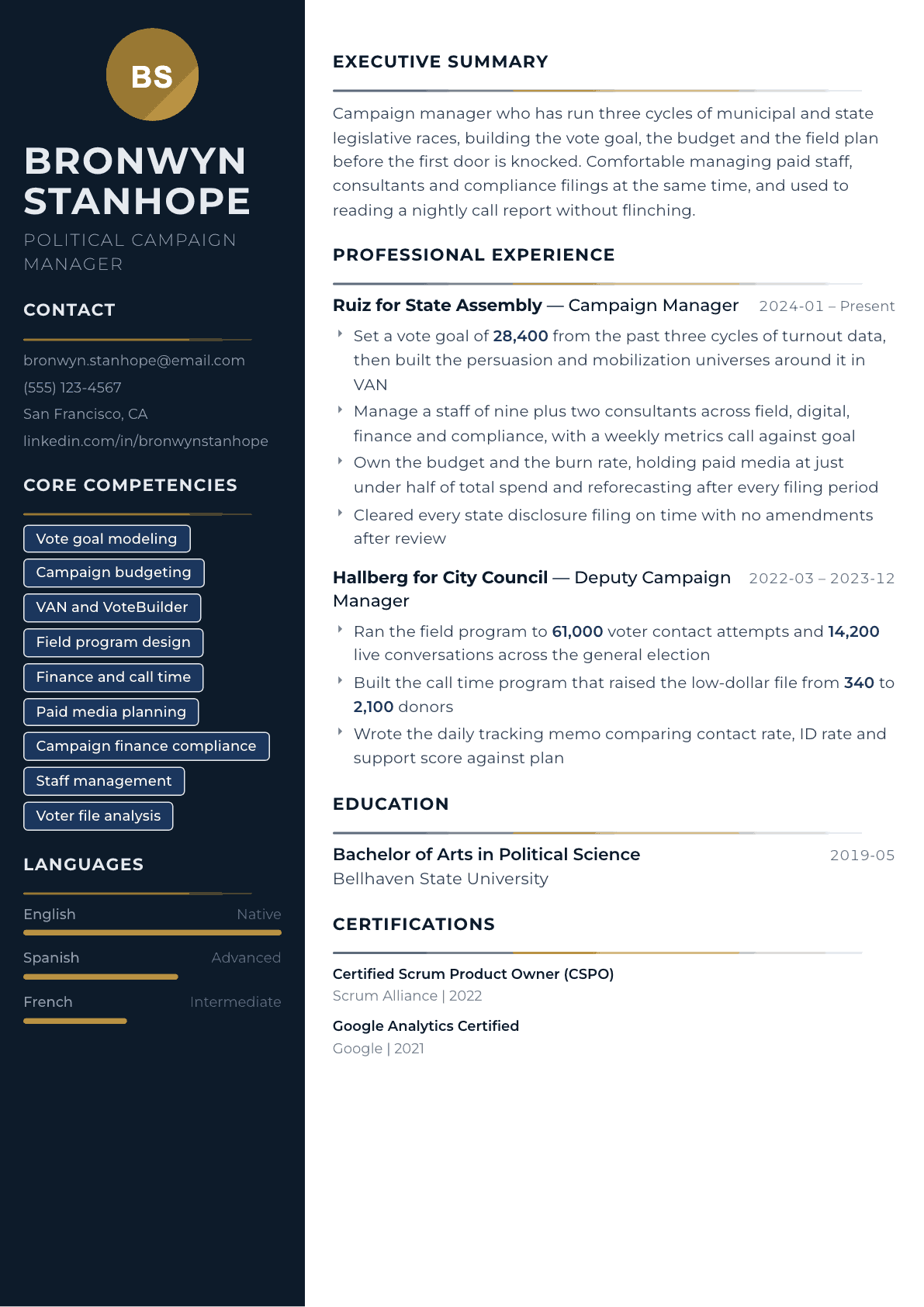
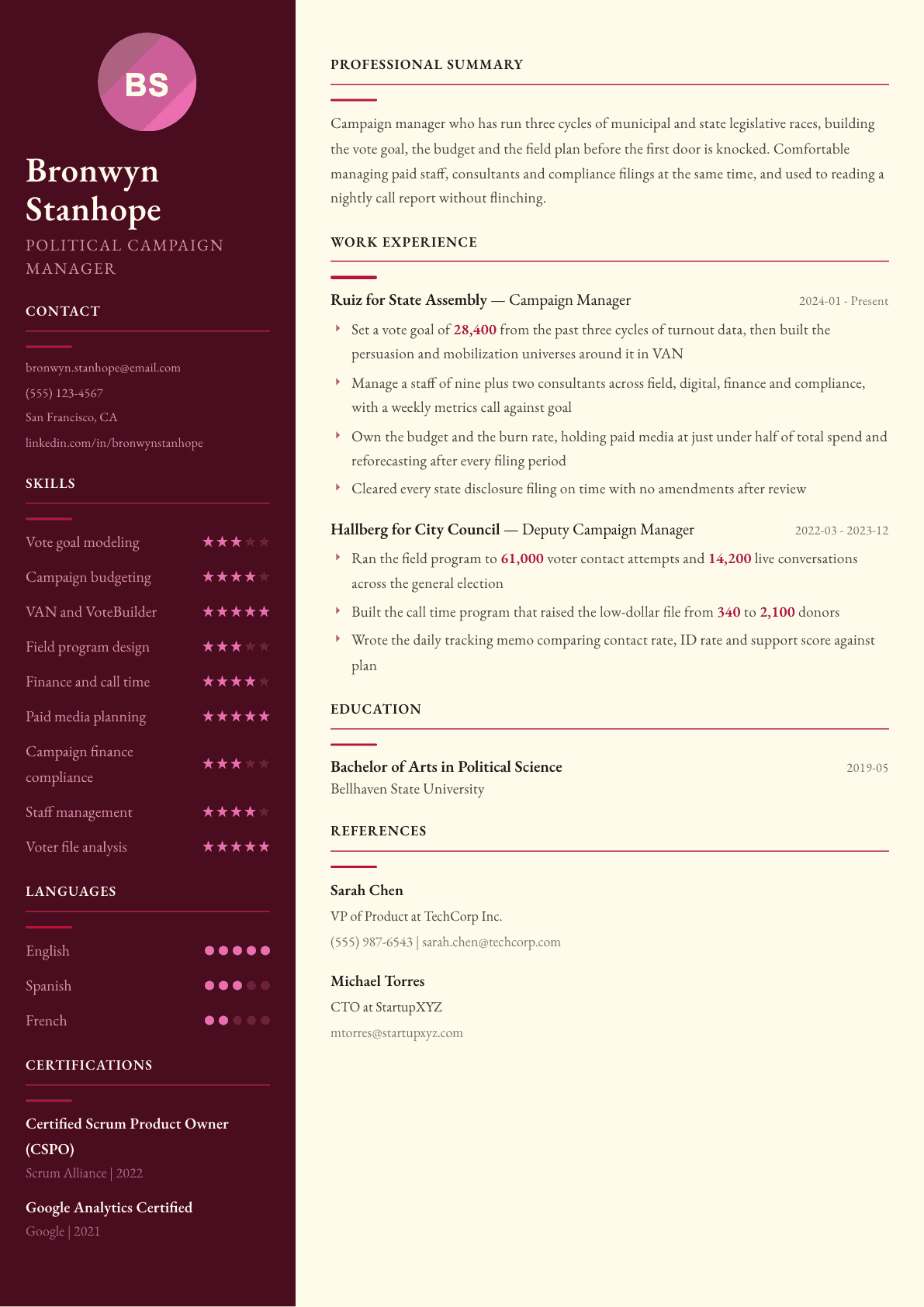
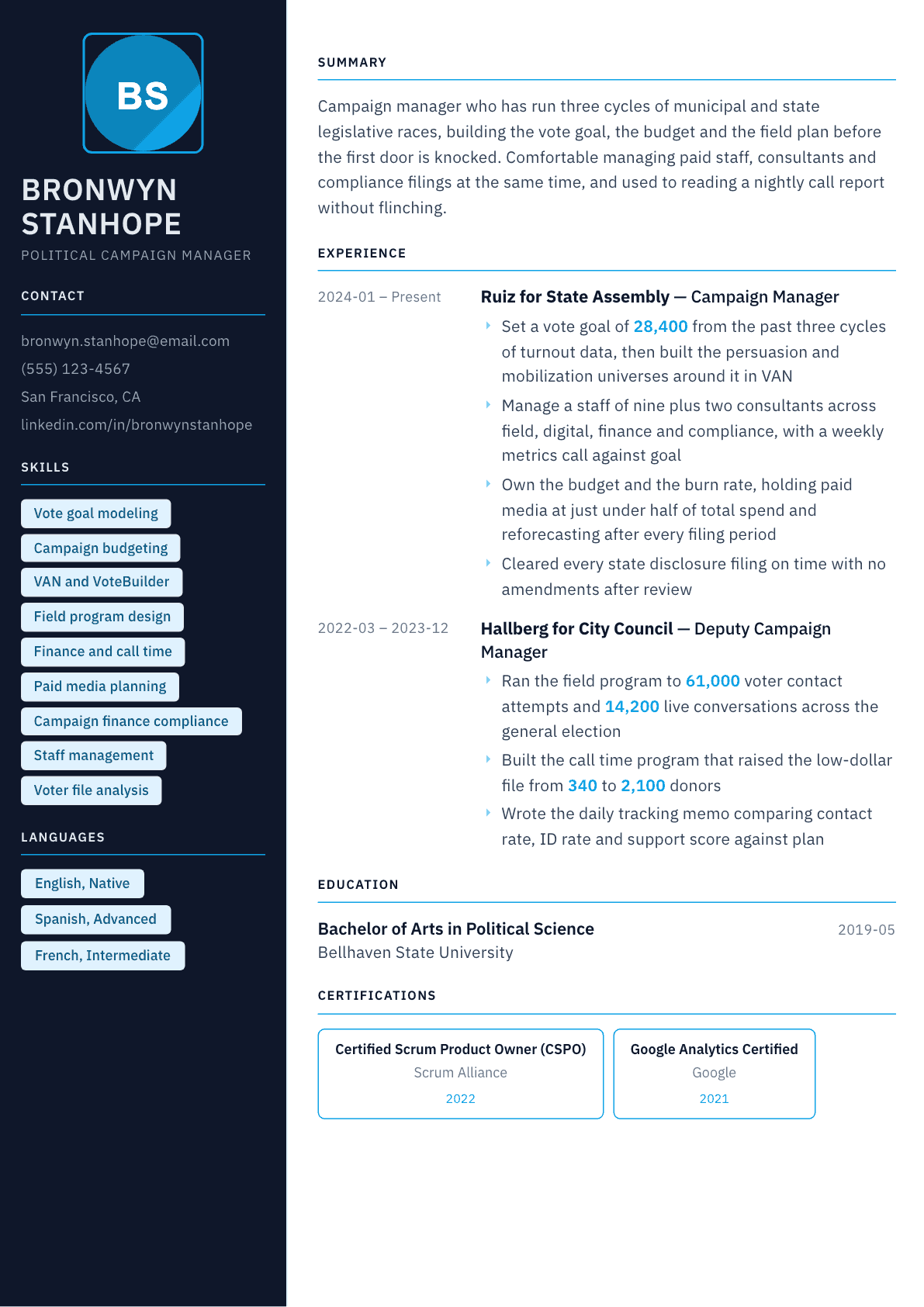
Example Political Campaign Manager summary
Campaign manager with three cycles running municipal and state legislative races from the vote goal outward. Builds the budget, the field plan and the finance plan in the same week, manages staff and consultants against a weekly metrics call, and keeps disclosure filings clean. Won a targeted assembly seat by expanding the low-dollar donor file and holding the early vote chase to plan.
Skills to list on a Political Campaign Manager resume
- Vote goal and turnout modeling
- Campaign budget and burn rate
- Field plan design
- Voter contact universe building
- VAN and VoteBuilder administration
- Predictive dialer programs
- Call time and finance plans
- Paid media and cable buys
- Digital fundraising
- Campaign finance reporting
- Volunteer recruitment pipelines
- Message discipline and rapid response
- Endorsement and coalition work
- Absentee and early vote chase
- Election day poll coverage
What actually gets this resume read
- Open every campaign with the office, the district size and whether the race was a primary, general or special election.
- Give the vote goal you set and the result you got, because a manager is judged on the margin and nothing else.
- State the budget you controlled and the staff you managed, since those two numbers size the race for a reader.
- Name the voter file and dialer tools you have actually administered, not just the ones you clicked through once.
- Show your compliance record, because a treasurer or campaign counsel wants to know you file clean and on time.
- Separate the races you managed from the ones where you ran a single department, and never blur the two.
How to write a political campaign manager resume
A campaign manager resume is read under time pressure by a candidate, a party committee staffer or a general consultant who is trying to fill a seat before filing closes. All three want the same three facts in the first ten seconds: what offices you have run for, how big the races were, and whether your candidates won. Everything else on the page is supporting evidence.
The resumes that lose are the ones written like advocacy. Long paragraphs about believing in the work, a list of causes, no vote goal, no budget, no staff count. A committee hires on capacity: can this person set a target, build a plan to reach it, spend money against it and file the reports that keep the candidate out of trouble.
This guide covers what a campaign hiring conversation actually checks, section by section, with summaries for a first-time manager, a manager two cycles in and a senior operative, before and after bullets drawn from real campaign metrics, and the questions operatives ask when the cycle ends and they rewrite the page.
Format: organize by cycle, lead with office and outcome
Reverse chronological by cycle, one page until you have run four or five races. Campaign work is short and dense, so a reader needs the cycle year, the office, the district and the result grouped tightly rather than spread across a narrative. Put the result on the same line as the race so nobody has to hunt for it.
Volunteer and paid roles both count, but label them honestly. A committee staffer who discovers that your role listed as manager was actually an unpaid volunteer coordinator will stop reading, and the political world is small enough that the correction travels.
- Each entry opens with the campaign name, the office sought, the district or jurisdiction, the cycle and the margin.
- Group races into managed, senior staff and junior staff so a reader sees your ladder at a glance.
- A short results block near the top can list win and loss records across the cycles you have worked.
- Add a line for party committee, caucus or independent expenditure work if you have crossed between them.
Summary: office level, budget size, staff, and the plan you built
Four facts belong in the first three lines: the level of office you have managed, the size of the budget you controlled, the number of staff you directed, and the piece of the plan you personally built. A summary that opens with a passion for democracy tells a candidate nothing about whether you can run a payroll and a mail calendar in the same week.
If you are moving up a level, say so directly. A city council manager targeting a congressional race should name the transferable pieces: the vote goal method, the finance program, the compliance discipline, and be clear about what will be new, since the reader will spot the gap anyway.
Experience: the vote goal, the budget, the field program, the filings
Each managed race needs four numbers. The vote goal you set and where it came from. The budget you controlled and roughly how it split between paid media, field and overhead. The staff and consultant team you directed. The voter contact totals your field program produced. Those four numbers describe a campaign more precisely than any adjective available to you.
Then write bullets on the decisions rather than the tasks. Reallocating a media buy after tracking moved, cutting a field office that was underperforming, restructuring call time when the finance plan slipped, deciding to chase early vote earlier than the consultant recommended. Those are the moments a candidate wants to know you can handle.
Losses belong on the page. Every operative has them, and a manager who lists only wins reads as someone hiding races. Write the loss with the margin and, if it was a hard district, the baseline you outperformed.
Money, compliance and the parts that end careers
A candidate is personally exposed when disclosure reports are late or wrong, so compliance is not an administrative footnote on this resume. Name the filing jurisdiction and the reporting schedule you managed, whether you worked with a compliance firm or a treasurer, and state your record of on-time filings without amendments if you have one.
On the finance side, give what you can verify: the amount raised under your management as a range, the donor file growth, the number of call time hours you held the candidate to each week. Managers are frequently fired over fundraising, so a reader will look hard at this block.
- Name the compliance software or firm you worked with and the filing calendar you owned.
- Give donor file growth and low-dollar program results rather than only a total raised.
- Say whether you or a finance director ran call time, and how many hours a week the candidate held.
- Note any audit, inquiry or amendment you handled and how it closed.
Tools and keywords committees screen on
Party and campaign postings recycle a tight vocabulary: vote goal, universe, persuasion, mobilization, contact rate, ID rate, chase, cut turf, burn rate, buy, tracking. Use those words where the work is shown, not in a keyword block. Name the voter file environment you have administered, the dialer, the texting platform, the compliance system and the digital fundraising platform, because a manager who needs training on all of them is a slower hire in a race with a fixed end date.
Add the constituencies and coalitions you have organized, and any second language you campaign in. A district with a large non-English speaking population will hire on that line alone when the rest of the pile looks similar.
Political Campaign Manager resume summary examples
First race as manager
Campaign operative who moved from field director to manager on a 2023 city council race, setting a vote goal of 9,400 and running a staff of four. Built the field plan, the call time schedule and the compliance calendar, and filed every disclosure report on time. Won by 6 points in an open seat.
Two cycles managing
Campaign manager with two cycles managing state legislative races, directing staffs of eight to eleven and budgets built around a vote goal drawn from three cycles of turnout data. Ran field, finance, paid media and compliance under one weekly metrics call. Won a 2024 toss-up seat and outperformed the district baseline by 4 points in a 2022 loss.
Senior operative
Senior campaign manager who has run congressional and statewide primary campaigns, managed consultant teams across media, mail, polling and digital, and served as a regional director for a coordinated campaign. Hires and trains first-time managers, and has closed two committee audits with no amendments since 2021.
Work experience bullets: before and after
Before: Managed all aspects of the campaign.
After: Managed a state assembly campaign against a vote goal near 28K with a staff of nine, two consultants and a budget split roughly half to paid media and a third to field.
The target, the team and the spending split describe a real campaign that a committee can compare to its own races.
Before: Oversaw the field program.
After: Directed a field program that produced 61K contact attempts and 14.2K live conversations, tracking contact rate and support score against plan in a nightly report.
Attempts and live conversations are different numbers, and reporting both signals that you know which one matters.
Before: Helped with fundraising.
After: Held the candidate to 12 call time hours a week and rebuilt the low-dollar program, growing the donor file from 340 to 2,100 contributors before the primary.
Call time discipline and donor file growth are the two fundraising facts a candidate actually asks about.
Before: Made sure we followed campaign finance rules.
After: Owned the state disclosure calendar across six reporting periods, working with the treasurer to file on time with no amendments and clearing one commission inquiry in writing.
Naming the periods, the partner and the inquiry outcome converts a compliance claim into a verifiable record.
Before: Adjusted our strategy during the campaign.
After: Shifted a quarter of the cable buy into connected television and mail in the final three weeks after tracking showed no movement with voters under 45, and closed a 7 point gap to a 2 point win.
A specific reallocation with the evidence behind it and the result shows judgment rather than restlessness.
Hard skills
- Vote goal and turnout modeling
- Campaign budgeting and burn rate management
- Field plan design and turf allocation
- Voter file administration
- Predictive dialer and texting programs
- Finance plan and call time management
- Paid media planning and reallocation
- Digital fundraising operations
- Campaign finance disclosure filing
- Polling and tracking interpretation
- Early and absentee vote chase
- Election day poll coverage planning
- Staff hiring and payroll oversight
Soft skills
- Delivering bad numbers to a candidate without softening them
- Holding a consultant team to one plan
- Keeping staff functional through a losing stretch
- Deciding quickly with partial information
- Discretion about internal campaign conflict
Mistakes that cost political campaign manager candidates the interview
- Listing races without the office, the district or the outcome, which forces a committee staffer to look each one up.
- Hiding losses, when every experienced operative has them and the omission is obvious to anyone who checks.
- Claiming the manager title for a race where you actually ran a single department.
- Writing about beliefs and causes instead of the vote goal, the budget and the staff you directed.
- Leaving compliance off the page entirely, when late filings are what get a manager fired mid-cycle.
- Using internal campaign jargon with no context, so a reader outside your state cannot decode the entry.
Political Campaign Manager resume questions
Should I list campaigns I lost?
Yes. A resume of only wins reads as incomplete to anyone who has worked a cycle. List the loss with the margin, and if you ran in a hostile district, name the baseline partisan performance you beat so the number has context.
How do I show experience if my races were small?
Give the mechanics rather than the scale. A city council race with a real vote goal, a field plan, a finance plan and clean filings demonstrates the same competencies as a larger race, and a committee reads process discipline as the transferable part.
What do party committees look for that candidates do not?
Committees screen for reliability across a slate: on-time reporting into their data systems, clean compliance, and managers who do not create problems that reach the state party. Candidates screen for fundraising and message. Write for both audiences.
How should I handle confidential campaign information?
Describe internal polling, strategy and donor information at a level your former candidate would accept in public. Use ranges instead of exact figures where the data was never disclosed, and never name a donor or a private poll result on a resume.
Can campaign experience translate to a non-campaign job?
It translates well if you rewrite it. Replace cycle jargon with the general management underneath: budget ownership, staff supervision, deadline-driven reporting, vendor management and communications under scrutiny. Keep one line that names the campaign context so the intensity is still visible.
Related resume examples
- Field Organizer Resume example
- Political Consultant Resume example
- Legislative Assistant Resume example
- Public Affairs Specialist Resume example
- NGO Program Officer Resume example
- Foreign Service Officer Resume example