Public Affairs Specialist Resume Examples: free score
Shape the Narrative with a Public Affairs Specialist Resume
By Mustafa Tarabya, founder of CVBooster · Published · Updated
Build a public affairs specialist resume that highlights your media relations, strategic communications, and government outreach expertise.
Sample resumes for a public affairs specialist
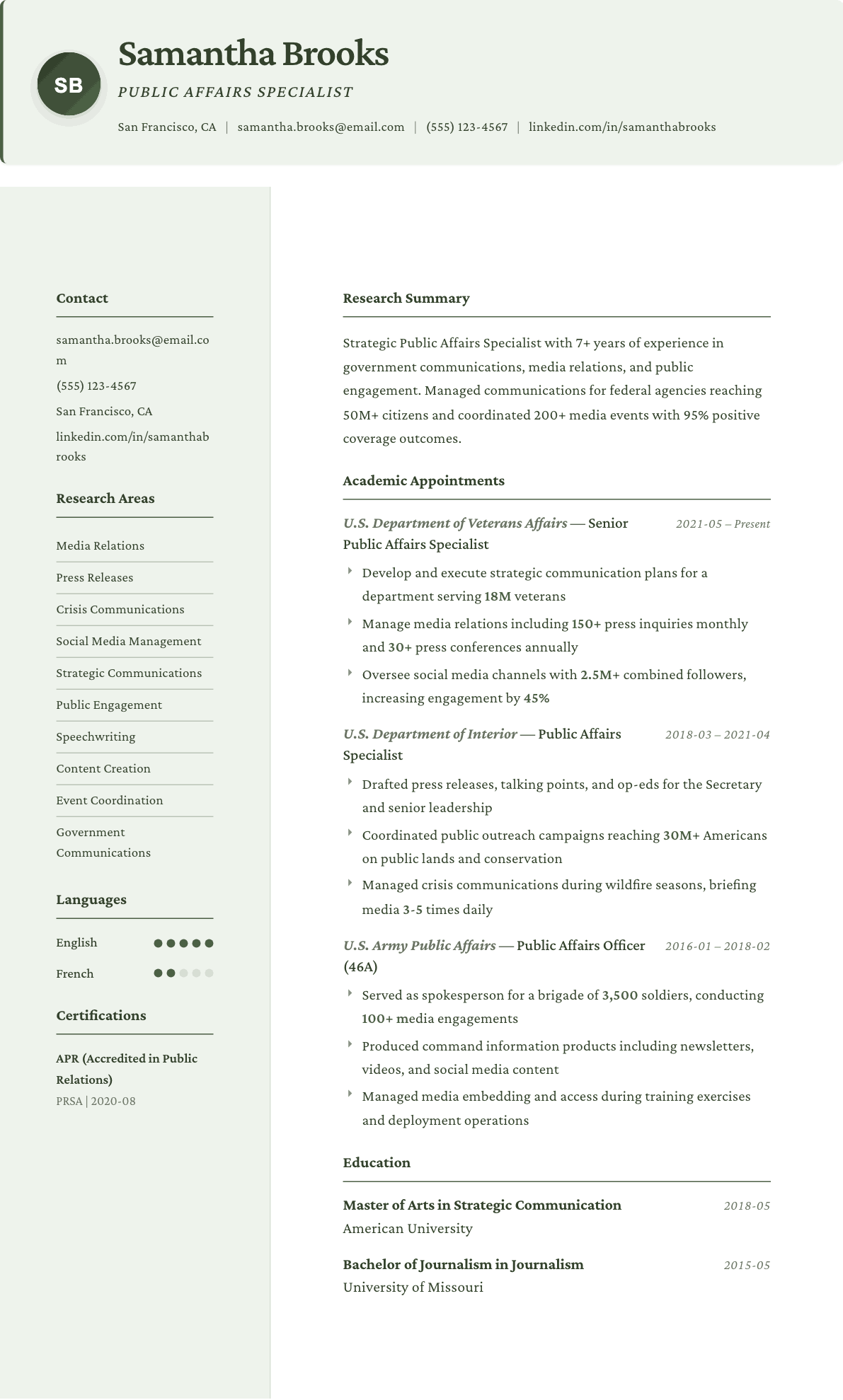
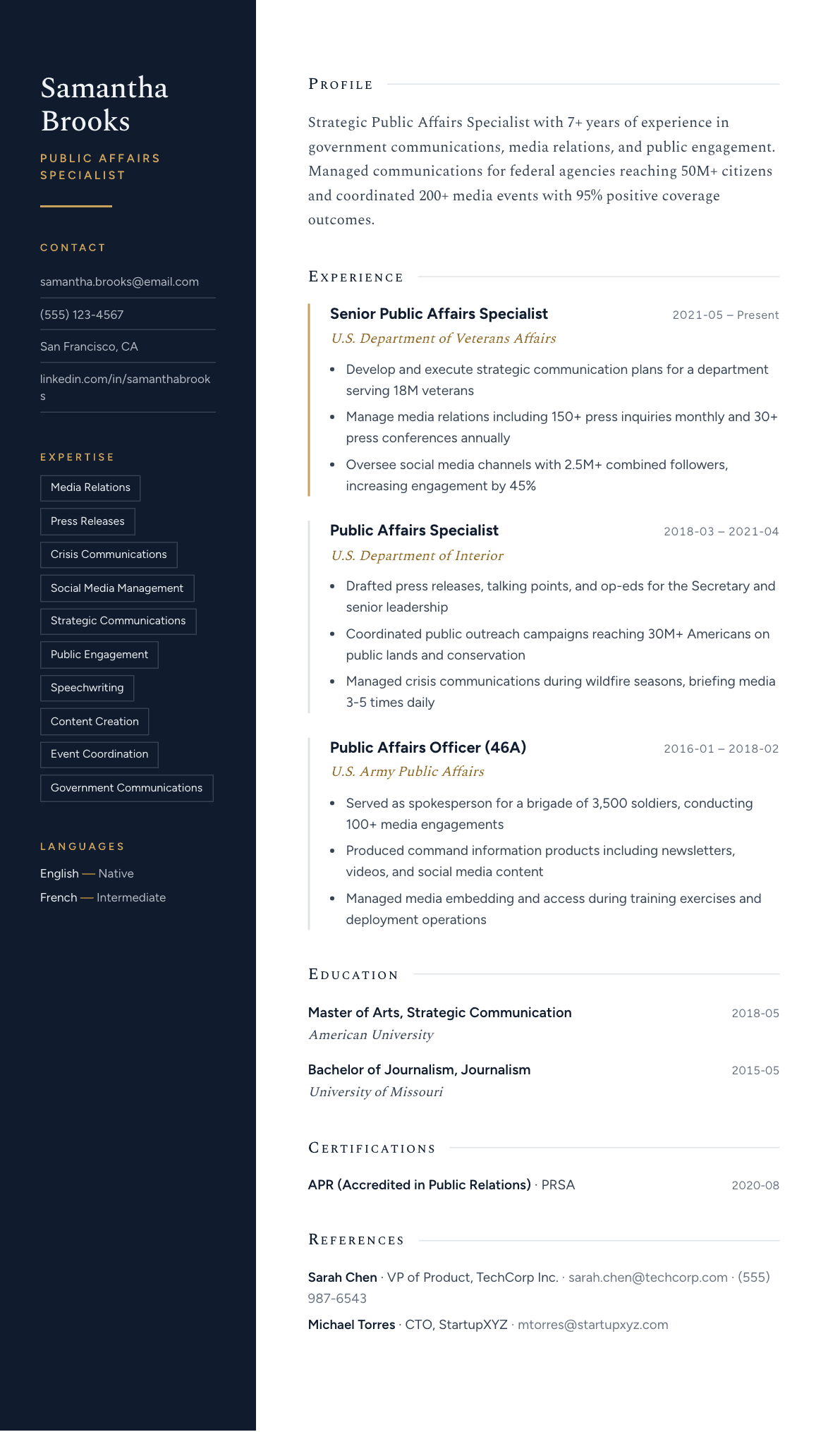
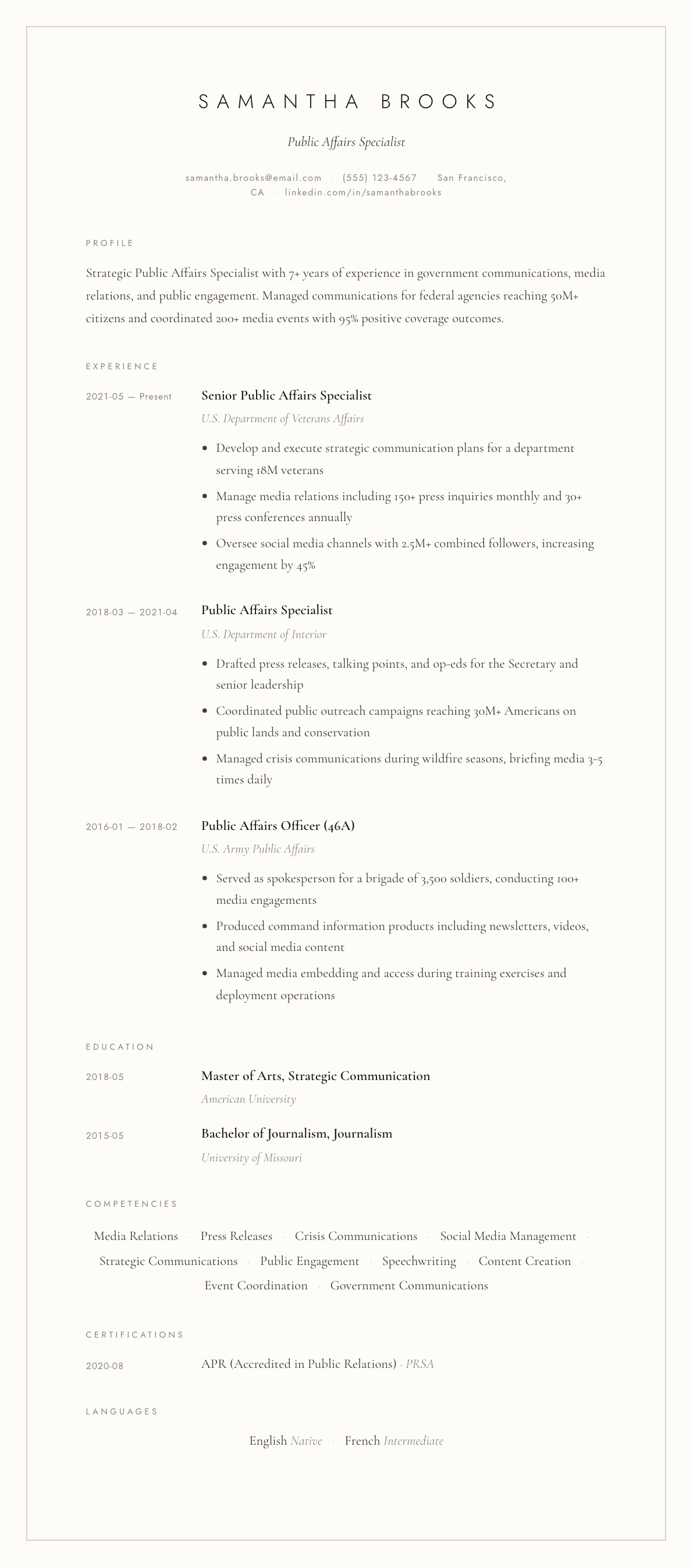
The same public affairs specialist content laid out in three CVBooster templates, so you can see what the finished document looks like before you write a word.
Example Public Affairs Specialist summary
Strategic Public Affairs Specialist with 7 years of government communications experience serving federal agencies reaching 50M+ citizens. Expert in media relations, crisis communications, and digital engagement with a 95% positive coverage rate. Seeking a communications director role in federal or state government.
Skills to list on a Public Affairs Specialist resume
- Media Relations
- Strategic Communications
- Crisis Communications
- Press Conference Management
- Social Media Strategy
- Speechwriting
- Content Creation
- Public Engagement
- Event Planning
- FOIA Processing
- Video Production
- Congressional Relations
- Brand Management
- Analytics & Reporting
What actually gets this resume read
- Quantify your communications reach: audience size, media impressions, social media followers, engagement rates.
- Highlight crisis communications experience. This is the most valued skill in government public affairs.
- Include specific media outlets and journalists you have worked with (without naming confidential contacts).
- Mention experience with FOIA requests, congressional inquiries, and interagency coordination.
- Show progression from content creation to strategic communications planning.
- List tools and platforms: Meltwater, Cision, Hootsuite, Adobe Creative Suite, video production.
How to write a public affairs specialist resume
A public affairs specialist resume is read by a communications director who has been burned before. She has hired people with beautiful portfolios who froze the first time a reporter called at seven in the evening about something the agency did wrong. So she reads past the content samples looking for evidence of judgment under pressure: a crisis you worked, a statement you cleared through counsel, a correction you issued, a spokesperson you prepared.
The second thing she checks is whether you understand that government communication is not marketing. There are records laws, information request obligations, ethics restrictions on political activity, clearance chains and a duty to publish things the organization would rather not publish. A candidate who writes only about engagement and brand voice signals that she has never worked inside those constraints.
This guide covers the structure public affairs hiring managers expect, how to present media relations and crisis work as evidence, how to quantify reach without inflating it, how military and agency backgrounds translate, and the questions specialists ask when they move between government, nonprofit and corporate communication.
Format: two pages, with a products and portfolio section
Two pages for anyone past a first role, and a longer federal format if the announcement calls for one. Add a short products section listing the kinds of material you produce with a portfolio reference: press releases, statements, talking points, speeches, opinion pieces, video packages, social content, internal messaging and web copy.
Keep the resume itself plain even though the field is creative. A designed layout invites the reader to judge you as a designer and often breaks in the application system. Let the portfolio carry the visual proof and let the resume carry the record.
- Header: name, city and state, phone, email, portfolio link.
- Order: summary, professional experience, communication products, technical skills, education, certifications and training.
- For federal applications include hours per week, supervisor details and the grade for each position.
Summary: the organization, the audience, the risk level
Say what kind of organization you have spoken for, who the audience is and how exposed the work is. A public affairs specialist at a health department during an outbreak, one at a transit agency during a service failure and one at a research institution promoting findings are doing recognizably different jobs.
Name your spokesperson status directly. Whether you have been on record with reporters, whether you have appeared on camera, whether you have handled a briefing room and whether you prepare principals for interviews. Many candidates leave this ambiguous, and it is one of the first things a hiring manager wants settled.
Media relations and crisis: the two blocks that decide the hire
For media relations, describe the beat and the cadence rather than a general claim of press contact. Local television, trade press, national desks, a specialist beat reporter who covers your agency full time. Say how many inquiries you handle in a typical week, your response time standard, and whether you draft the statements you issue or route them for clearance.
For crisis work, name the events. A service disruption, a public health incident, a data breach, an officer involved incident, a natural disaster response, a leadership resignation, an audit finding that went public. Describe your role in the structure, how quickly the first statement went out, how the clearance chain worked with legal and leadership, and what the follow up looked like once the story cooled.
Include the uncomfortable parts. A correction issued, a pre publication conversation with a reporter about an error, a story you could not stop and how you handled the aftermath. Communications directors trust candidates who can talk about the bad days in specific terms.
Compliance work: records, requests and political activity rules
Government communication carries legal obligations that private sector candidates often do not know exist. Name your experience with information requests: reviewing responsive records, coordinating with counsel on withholding, preparing leadership for a release that will generate coverage. Add congressional or council inquiry responses, and any experience with a records retention obligation covering official social accounts.
Ethics and political activity restrictions belong here too. Saying that you have managed official accounts within political activity limits, or separated official communication from a campaign period, tells a public sector hiring manager that you will not create a problem in an election year.
Measurement, tools and the language of the posting
Report reach honestly. Impressions and follower counts are weak evidence on their own, so pair them with something that shows effect: an increase in applications for a program after a campaign, calls to a hotline after a public safety message, attendance at a public meeting, a correction rate on coverage, or a share of stories that carried the organization key message.
Name the platforms you administer, the media monitoring service, the design and video tools, the content management system for the public website, and any accessibility and plain language standards you write to. Recurring posting vocabulary includes strategic communications, media relations, crisis communications, public information officer, spokesperson, community engagement, internal communications, message development and stakeholder outreach.
Public Affairs Specialist resume summary examples
Communications coordinator
Public affairs coordinator at a county agency writing press releases, managing three social accounts and supporting the public information officer during two severe weather activations. Drafted 40 releases in a year and built the plain language style guide now used across the department. Journalism degree.
Public information officer
Public affairs specialist and on record spokesperson for a transit agency, handling roughly 25 media inquiries a week across local and trade press. Led communications for two major service disruptions, prepared executives for televised interviews and coordinated records request releases with counsel.
Communications director
Public affairs lead with twelve years across a state health department and a federal agency, currently directing a team of seven. Ran communications during a multi week outbreak response, rebuilt the crisis notification protocol and manages congressional inquiry responses alongside the public website and social program.
Work experience bullets: before and after
Before: Handled media relations for the organization.
After: Served as on record spokesperson for roughly 25 media inquiries a week across local television and two trade outlets, with a same day response standard and statements cleared through counsel.
Spokesperson status, volume, beat and clearance route answer exactly what a communications director needs to know.
Before: Managed crisis communications during incidents.
After: Led communications through a four day service disruption: issued the first public statement within 90 minutes, ran hourly updates across three channels and prepared the executive director for two televised interviews.
Timing, cadence and the executive preparation show how you actually operate when a story is moving.
Before: Grew the social media following.
After: Rebuilt the social program around service alerts and plain language explainers, and traced a rise in program applications to a four week campaign that ran alongside a community meeting series.
A behavioral outcome connected to a campaign is far stronger evidence than an audience number on its own.
Before: Responded to public records requests.
After: Reviewed responsive records on 60 information requests, coordinated withholding decisions with counsel and prepared leadership briefings ahead of three releases that generated coverage.
Volume plus the legal coordination and the anticipation of coverage prove compliance work most candidates never mention.
Before: Wrote speeches and talking points for leadership.
After: Wrote remarks and question and answer preparation for the agency head for legislative testimony, two public hearings and a town hall on a contested facility siting.
Naming the venues, including a contested one, shows the writing was done under real scrutiny.
Hard skills
- Media relations and spokesperson duties
- Crisis communications planning and execution
- Press release and statement writing
- Speechwriting and executive preparation
- Message development and audience research
- Social media program management
- Media monitoring and analysis
- Public records and information request coordination
- Congressional and council inquiry responses
- Plain language and accessibility standards
- Web content management
- Video and photo production
- Internal and employee communications
Soft skills
- Composure with a hostile reporter
- Judgment about what to say and when
- Working across legal and leadership clearance chains
- Rapid writing at any hour
- Building trust with beat reporters
- Coaching reluctant executives
Certifications worth listing
- Accredited in Public Relations (APR) (Universal Accreditation Board)
- Accreditation in Public Relations and Military Communication (APR+M) (Universal Accreditation Board)
- Communication Management Professional (CMP) (Global Communication Certification Council)
- Public Information Officer Training (FEMA Emergency Management Institute)
Mistakes that cost public affairs specialist candidates the interview
- Leaving spokesperson status unstated, so a hiring manager cannot tell whether you have ever been on record with a reporter.
- Reporting impressions and follower counts alone, which experienced directors treat as decoration rather than evidence.
- Skipping records requests, inquiry responses and political activity limits, the compliance work that defines public sector communication.
- Writing only about successful campaigns and never about a crisis, a correction or a story that went badly.
- Sending a heavily designed resume that breaks in the application system and invites judgment of the layout instead of the record.
- Naming individual reporters or confidential contacts, which reads as a breach of the relationships you are claiming to have.
Public Affairs Specialist resume questions
How do I show crisis communications experience if I have not worked a major disaster?
Use the smaller events. A service outage, a critical audit, a contentious public meeting, a leadership departure or a social media flare up all test the same abilities. Describe the timeline, the clearance chain and what you would change, which is what the interview will explore anyway.
Should I include a portfolio with a public affairs resume?
Yes, and link it from the header. Include a press release, a crisis statement, a short speech or remarks, and one visual or video piece. Pick work you can discuss in detail, including the constraints you wrote under and the clearance it went through.
How does a military public affairs background translate to civilian roles?
Strip the unit language and describe function, audience and scale. Command information becomes internal communications, community relations becomes public engagement, and media operations becomes media relations. Keep deployment communications work, since it demonstrates operating under pressure with limited resources.
What metrics actually matter for a public affairs specialist?
Ones tied to behavior or accuracy: program applications after a campaign, hotline calls after a safety message, attendance at a hearing, the share of coverage that carried your key message, and response times on inquiries. Reach figures belong beside those, not instead of them.
Do I need an accreditation to advance in public affairs?
It is not required, but accreditation signals formal grounding in ethics, research and planning rather than only production skill. It carries the most weight in government and nonprofit hiring, where a panel scoring a rubric can credit a recognized credential directly.
Related resume examples
- Legislative Assistant Resume example
- Diplomat Resume example
- Policy Analyst Resume example
- Public Information Officer Resume example
- City Manager Resume example
- Government Relations Manager Resume example