Community Organizer Resume Examples: what gets the call
Build Power with a Community Organizer Resume
By Mustafa Tarabya, founder of CVBooster · Published · Updated
Build a community organizer resume showcasing your grassroots mobilization, leadership development, and community power-building skills.
Sample resumes for a community organizer
The same community organizer content laid out in three CVBooster templates, so you can see what the finished document looks like before you write a word.
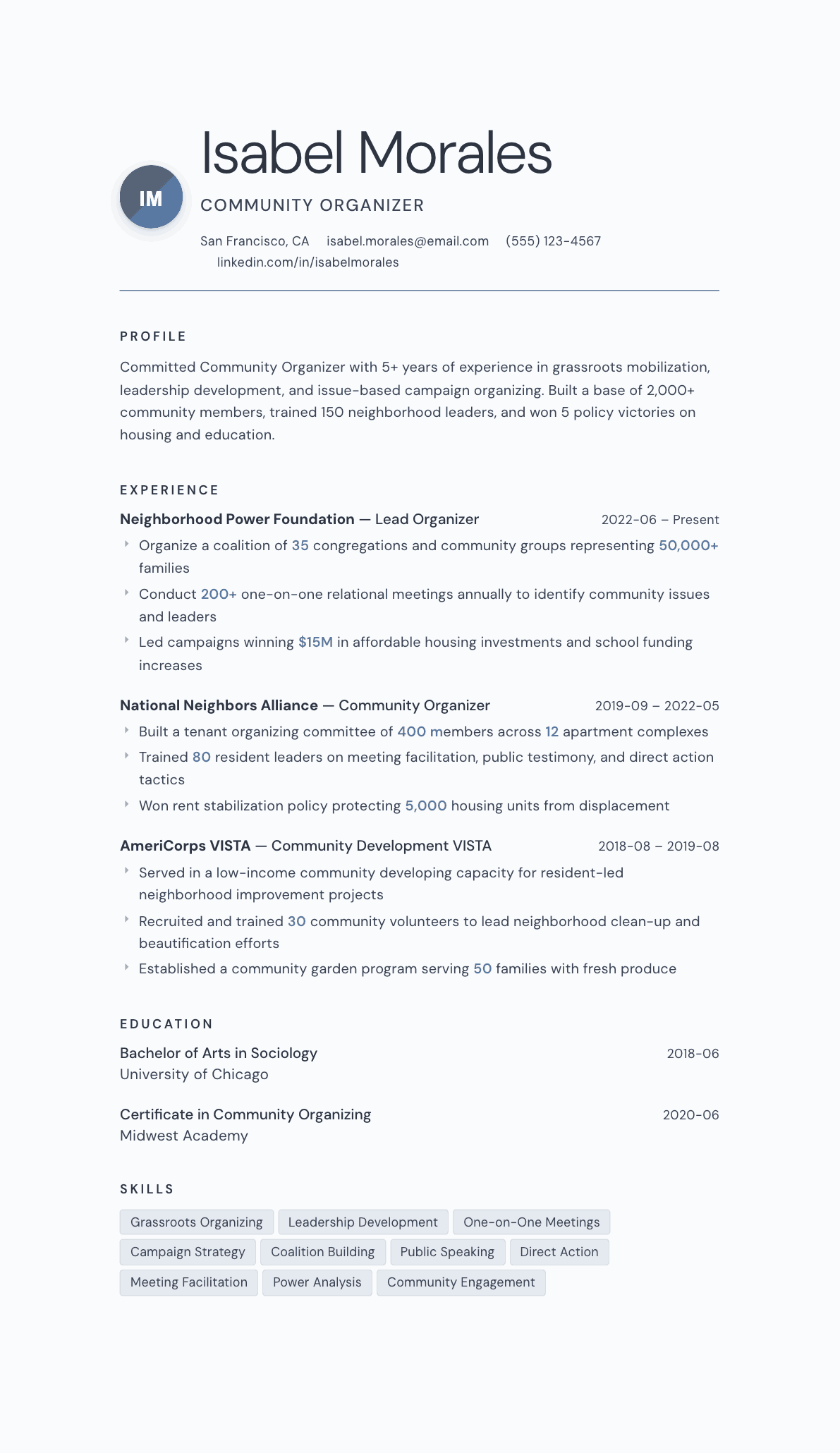
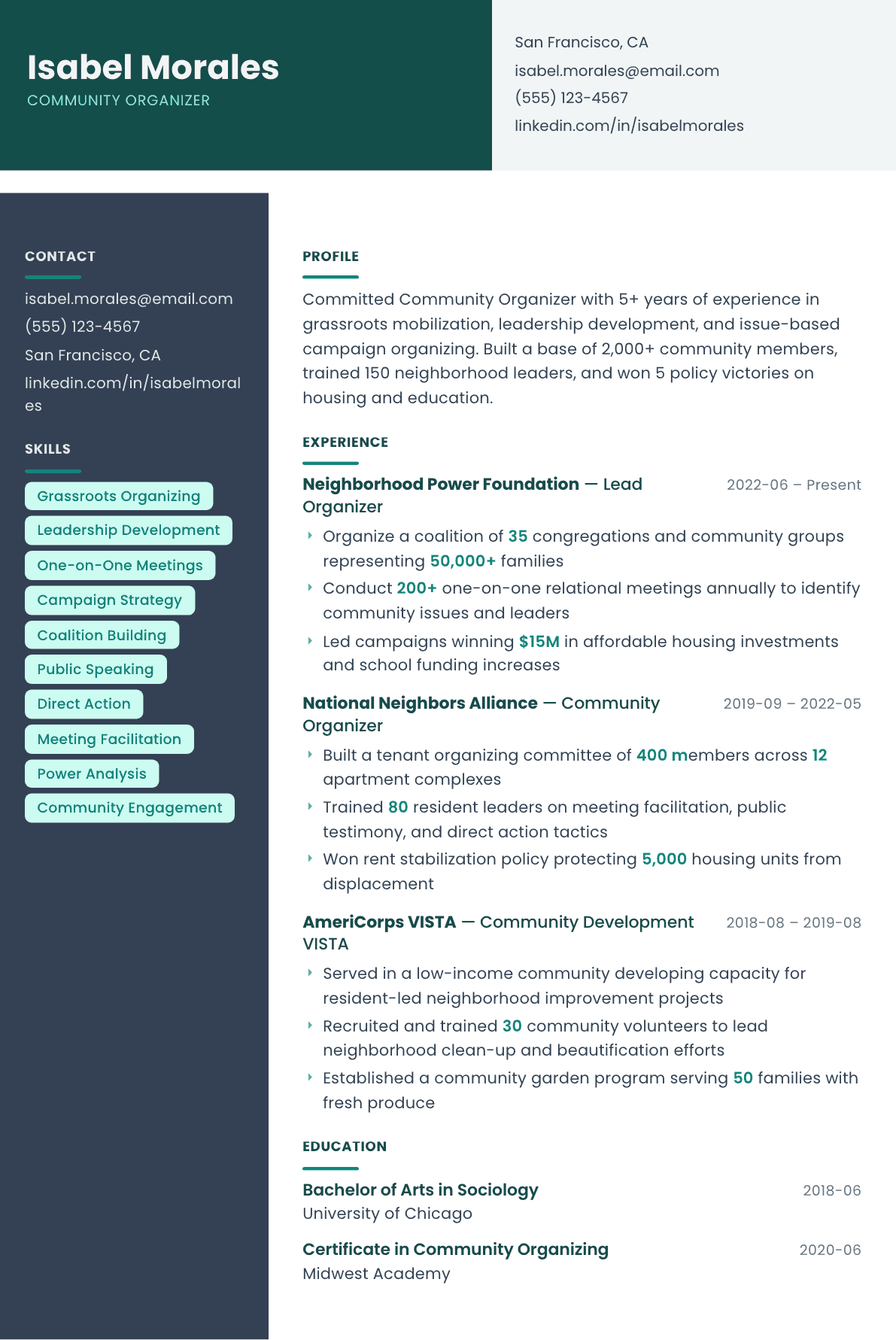
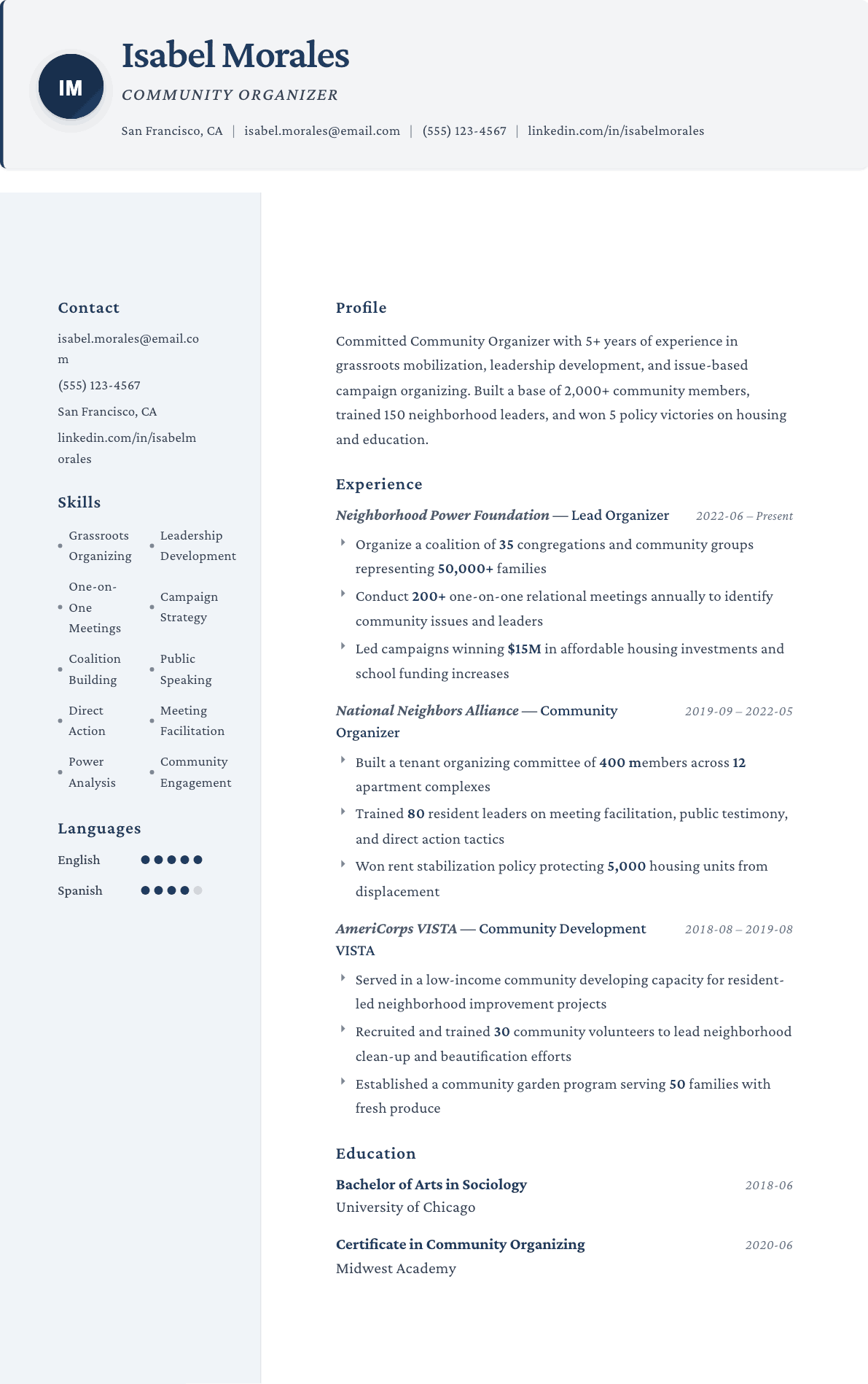
Example Community Organizer summary
Committed Community Organizer with 5 years of grassroots organizing experience building power in low-income communities. Trained 150 leaders, organized 2,000+ members, and won 5 policy victories. Seeking a lead organizer role at a community-based organization.
Skills to list on a Community Organizer resume
- Grassroots Organizing
- Leadership Development
- One-on-One Relational Meetings
- Campaign Strategy
- Coalition Building
- Direct Action Planning
- Public Speaking
- Meeting Facilitation
- Power Analysis
- Voter Engagement
- Community Assessment
- Conflict Resolution
- Media Relations
- Digital Organizing
What actually gets this resume read
- Highlight your base-building results: number of members organized, leaders trained, coalition partners.
- Quantify campaign wins: policies changed, dollars invested, units of housing protected.
- Emphasize leadership development: how many leaders you have trained and what they went on to accomplish.
- Include one-on-one meeting volume and relational organizing approach.
- Show experience across organizing methods: door-knocking, house meetings, direct action, digital.
How to write a community organizer resume
A community organizer resume is judged on one question: can this person build a base and move an institution. The lead organizer or executive director reading it wants to see how many people you recruited into a durable organization, how many of them you turned into leaders who ran their own actions, and what the target actually conceded. Everything else is context.
That is why the usual organizing resume fails. It describes values, coalitions attended and events held, but never the number of one-to-ones conducted, the size of the base built, the turnout at the action, or the decision the city council changed. Organizing is a craft with countable units, and the people who hire organizers count them.
This guide covers the sections a base-building organization reads in order, the campaign vocabulary that signals you were trained rather than self-taught, summaries for a first-year organizer through a lead organizer, and the rewrites that turn activity into power.
Format: campaigns first, one page until you have run your own
Use reverse-chronological order and keep the whole thing to one page until you have led a campaign end to end. Organizing directors read fast and hire on referrals, so the resume mostly has to confirm that the story you told in the interview is real and has dates attached.
Name the organizing tradition you were trained in, because it tells a hiring organizer what your habits are. Broad-based congregational organizing, tenant organizing, labor organizing, electoral field and issue advocacy all use different tools, and a director who runs relational meetings wants to know if you already do them.
- Header: name, city, phone, email, and any languages you organize in, since turf assignments follow language.
- Order: summary, organizing experience, campaigns and wins, training, education, skills.
- Add a short training line for the institutes you attended, since they function as credentials in this field.
- Keep a separate campaign list only if your job titles hide the campaigns you ran.
Summary: tradition, turf, base size, one win
Two or three lines. Say what kind of organizing you do, the constituency and geography, roughly how large a base you have built, and one concrete win with the target named. A director can tell within a sentence whether you have done doors, one-to-ones and public meetings, or whether you have mostly done communications for an organization that organizes.
Avoid the language of passion. Every applicant cares about justice, so caring is not a differentiator. Being able to turn out four hundred people to a public accountability session on a Tuesday night is.
Experience: one-to-ones, leaders developed, turnout, target, concession
Give each job the organization, the constituency, and the turf: neighborhoods, congregations, buildings, campuses or worksites. Then write bullets around the four numbers organizers actually track. How many relational one-to-one meetings you held in a year. How many leaders you identified and trained, and what those leaders then ran without you. How many people you turned out to the largest action. What the decision maker agreed to and in what forum.
Write the campaign as a sequence, not a slogan. Research on the target, a listening process that surfaced the issue, a leader team that carried it, an escalation, and a negotiated commitment. That sequence is the thing a hiring organizer is testing for, because it is what distinguishes organizing from mobilizing.
If a campaign lost, you can still use it. Name what you built that outlasted the loss: a standing tenant association, a leader team that stayed together, a relationship with an official who later moved.
- Turf and constituency in the job line, not buried in a bullet.
- One-to-one counts per year, because that is the unit of the work.
- Leaders developed and what they chaired, testified at, or negotiated.
- Turnout at your largest action with the venue and the target present.
- The concession, in the words of the public commitment.
Skills and tools: the database matters more than you think
Organizations run their base out of a database, and a candidate who already knows theirs saves a month. Name the ones you have used: VAN or VoteBuilder, EveryAction, Action Network, PDI, Salsa, Airtable, and the texting and phone platforms such as Hustle, Spoke or ThruText. Say what you did in them, like building cut turf, running a tagging scheme for leader levels, or cleaning a list after a canvass.
Add the field craft: door canvassing, phone banking, house meetings, power analysis, turf cutting, base charting, public testimony preparation, and running an accountability session. Language skills go here too, with the level and the community you use them with.
Training and education: the institutes count
Organizing hires on apprenticeship. National training weeks and institutes carry weight with directors who came through them, so list the training body and the length. Degrees matter less, and a degree in an unrelated field is not a problem in this work as long as the campaign record is there.
Service terms belong here or in experience, whichever shows the work better. A year of full-time service organizing in a neighborhood is real organizing experience, so give it bullets rather than a single line.
Community Organizer resume summary examples
First organizing job
Community organizer with 1 year of tenant organizing in a 6-building portfolio, plus a year of full-time service work in the same neighborhood. Held 180 one-to-ones, built a 90-member tenant committee, and turned out 120 residents to a code enforcement hearing. Bilingual in Spanish.
Four years in
Issue organizer with 4 years building a housing base across 14 apartment complexes and 3 congregations. Trained 40 resident leaders who chair their own building meetings, and won a city rent registry ordinance after a 400-person accountability session with the council housing committee.
Lead organizer
Lead organizer with 9 years in broad-based organizing, currently directing a 35-institution coalition and supervising 4 organizers. Built a leader team that negotiated a school funding agreement with the district superintendent, and rebuilt dues income after two member institutions left.
Work experience bullets: before and after
Before: Organized the community around housing issues.
After: Built a tenant organizing committee of 90 residents across 6 buildings by holding 180 one-to-one meetings in the first year, then handed the monthly meeting to 4 building captains.
The one-to-one count, the committee size and the handoff show the actual craft rather than a topic area.
Before: Attended city council meetings to advocate for residents.
After: Prepared 12 residents to testify at the council housing committee, ran the turnout that filled the chamber, and secured a public commitment from the committee chair to introduce a rent registry.
Attendance is passive; preparing testifiers, filling the room and naming the commitment is a campaign.
Before: Trained volunteers on organizing skills.
After: Ran a 6-session leadership institute for 40 resident leaders on relational meetings, power analysis and running an agenda, after which leaders chaired 9 of 11 public meetings that year.
Naming the curriculum and what leaders then ran without you proves leadership development, not a workshop.
Before: Built coalitions with local partners.
After: Recruited 8 congregations and 3 immigrant service organizations into a dues-paying coalition, and set up a delegates assembly that met every 6 weeks with each institution sending 2 leaders.
A coalition with dues, delegates and a meeting rhythm is an organization; a partner list is a mailing list.
Before: Used a database to track community contacts.
After: Rebuilt the contact list in EveryAction with a leader-level tagging scheme, cut walk turf for 3 canvasses, and cleaned 2,400 records so turnout calls stopped hitting disconnected numbers.
Naming the platform and the specific data work tells a director you can run their base infrastructure on day one.
Hard skills
- One-to-one relational meetings
- Door canvassing and turf cutting
- Power analysis and target research
- Leadership development curriculum
- Public accountability sessions
- Coalition and institutional recruitment
- Phone and text banking programs
- EveryAction and VAN
- Action Network
- Turnout tracking and base charting
- Public testimony preparation
- Campaign planning and escalation
Soft skills
- Listening for self-interest
- Agitation and challenge
- Conflict tolerance
- Meeting facilitation
- Discipline about follow-up
- Coaching leaders in public
Mistakes that cost community organizer candidates the interview
- Writing about issues you care about instead of the base you built and the target you moved.
- Reporting event attendance as if it were turnout, when a director wants to know who you could turn out again next month.
- Leaving out one-to-one counts, which is the one number that tells an organizer whether you did the work or supervised it.
- Calling a partner list a coalition when the member institutions never sent delegates or paid dues.
- Hiding the campaign inside a job title such as program associate, so the reader never learns you ran the housing fight.
- Listing every march and rally attended, which reads as a volunteer history rather than a professional record.
- Claiming a policy win without naming the body that passed it or the commitment that was made in public.
Community Organizer resume questions
How do I show organizing experience if all of it was volunteer?
Give it the same treatment as a job: the organization, the turf, the dates, the hours per week, and the same numbers you would use for paid work. Volunteer organizing that built a committee and won something counts with directors, who care about the record rather than the payroll.
Should I put campaign wins in a separate section?
Only if your titles hide them. When one job covered three campaigns, a short campaigns section with the issue, the target and the outcome makes the record legible. Otherwise keep wins inside the job where they happened so the reader sees the sequence.
What if my biggest campaign lost?
Write what survived the loss. A standing tenant association, a leader team that stayed together, an official who moved later, or a research file the next campaign used. Directors have all lost campaigns, and they judge organizers on what was built, not only on the vote.
Do I need a degree to be hired as a community organizer?
Most base-building organizations hire on apprenticeship and referral rather than credentials. List your degree if you have one, but put training institutes, service terms and the campaign record above it, because that is what a lead organizer reads first.
How much political language belongs on the resume?
Enough to place you in a tradition, not enough to sound like a manifesto. Name the constituency, the issues and the organizations. Save analysis of the political moment for the cover letter and the interview, where a director can actually argue with you about it.
Related resume examples
- Advocacy Specialist Resume example
- Outreach Coordinator Resume example
- Volunteer Coordinator Resume example
- Pastor Resume example
- Case Manager Resume example
- Career Coach Resume example