Financial Aid Counselor Resume Examples: free ATS score
Build a Financial Aid Counselor Resume Around Verification and Awarding
By Mustafa Tarabya, founder of CVBooster · Published · Updated
A financial aid counselor resume example with FAFSA and verification keywords, a written summary, aid packaging bullets, and interview-ready tips.
Sample resumes for a financial aid counselor
The same financial aid counselor content laid out in three CVBooster templates, so you can see what the finished document looks like before you write a word.
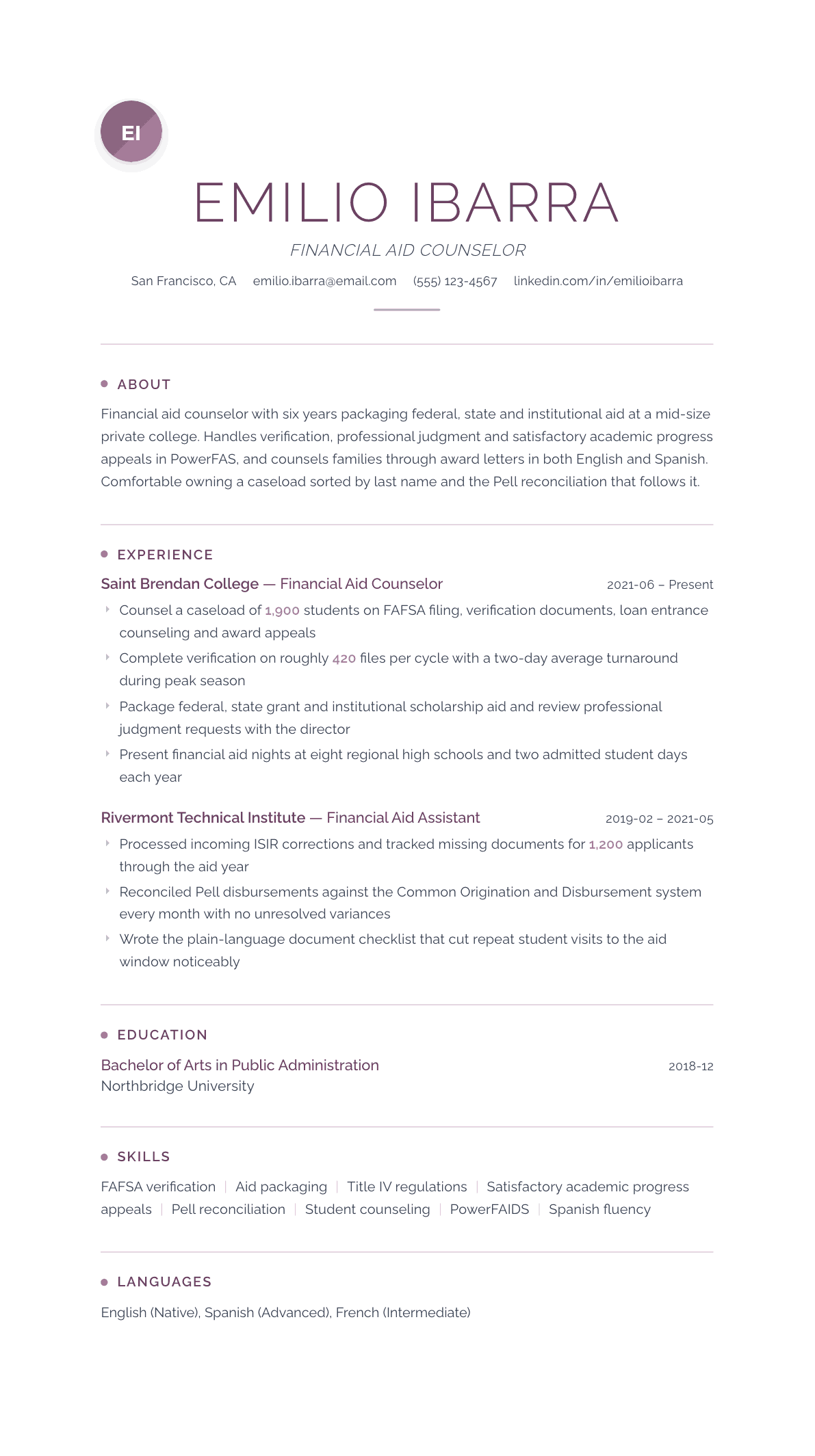
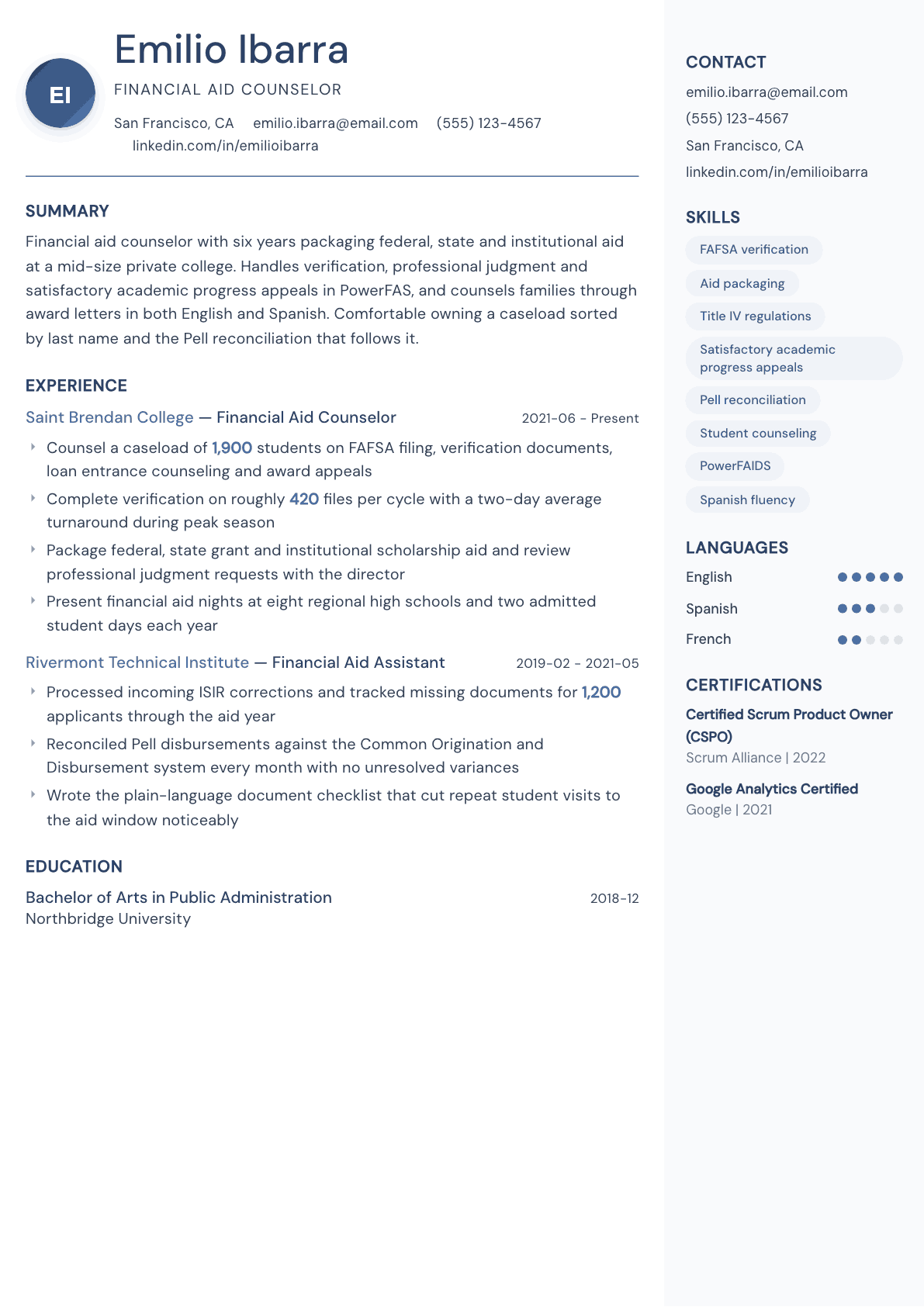
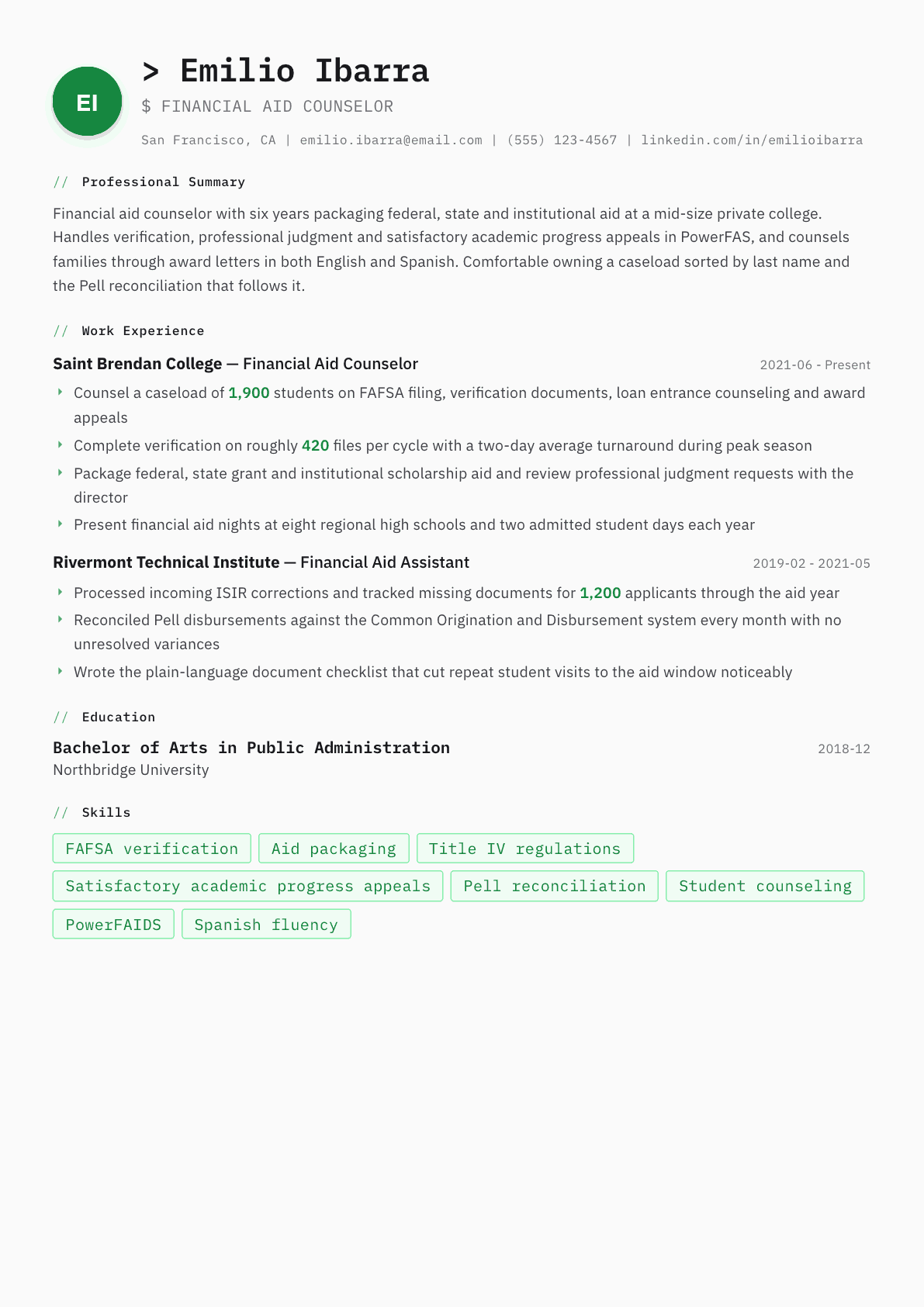
Example Financial Aid Counselor summary
Financial aid counselor with six years of Title IV experience at a private college and a technical institute. Manages a caseload of nearly two thousand students through FAFSA filing, verification, packaging and appeals, and reconciles Pell disbursements monthly without variances. Bilingual in English and Spanish, and a regular presenter at high school financial aid nights. Looking for an assistant director opening.
Skills to list on a Financial Aid Counselor resume
- FAFSA and ISIR processing
- Verification
- Title IV compliance
- Aid packaging
- Professional judgment
- Satisfactory academic progress
- Federal Direct Loan counseling
- Pell Grant reconciliation
- PowerFAIDS
- Banner Financial Aid
- Common Origination and Disbursement
- NSLDS
- Scholarship administration
- Student and family counseling
- Financial literacy workshops
What actually gets this resume read
- Say how large your caseload was and how it was divided, because a counselor with two thousand students works very differently from one with three hundred.
- Name the aid management system and the federal tools you actually used: PowerFAIDS, Banner Financial Aid, COD, NSLDS and the FSA Partner Connect portal.
- Show verification volume and turnaround time, since directors read that as the clearest proxy for whether you can hold the season.
- Separate what you decided from what you processed: professional judgment recommendations and appeal reviews carry more weight than document tracking.
- Mention outreach work such as FAFSA nights, high school visits and loan counseling sessions, because most offices carry a community education load.
- List languages you counsel in, as bilingual counselors are screened for directly at institutions with large first-generation populations.
How to write a financial aid counselor resume
A financial aid counselor resume gets read by a director who is short-staffed heading into peak season. She is looking for two things: whether you can hold a caseload through verification without falling behind, and whether you can sit across from an angry parent and explain an award letter without creating a compliance problem.
Those are different halves of the job, and most resumes only show one. Files that lead with warmth and student support leave the director wondering whether you can process. Files that read like a queue report leave her wondering whether you can counsel. Write for both, and be explicit about the federal work: verification, professional judgment, satisfactory academic progress, packaging, reconciliation.
Below is the section order aid searches expect, three summaries from assistant through senior counselor, before-and-after bullets drawn from real aid office language, and the questions counselors ask when they are preparing to move offices.
Format: one to two pages, federal work visible immediately
One page under five years, two after. Reverse chronological, single column, plain headings. Aid offices sit inside enrollment divisions that use large applicant tracking systems, so avoid tables and text boxes that scramble the parse.
Directly under the summary, add a short block naming the aid management system, the federal systems you have used, and the aid types you have packaged. That block is what a director scans before deciding whether to keep reading.
- Header: name, city and state, phone, email, and any languages you counsel in.
- Sections in this order: summary, systems and aid types, experience, education, training and certifications.
- Give each institution its sector and size: public two-year, private nonprofit, proprietary, and the enrollment.
Summary: caseload, aid types, systems, one counseling strength
Three or four lines. Name the caseload size and how it was divided, whether by alphabet, by class year, by program or by campus. Name the aid types you package: federal grants, direct loans, state grant programs, institutional scholarships, and any veterans or tribal aid you administer.
Then one counseling detail that is true of you and not of everyone. Bilingual counseling, first-generation family outreach, appeal panels you sit on, or dual-enrollment aid are the kinds of specifics that get a file pulled from the pile.
Experience: the season, not the job description
The aid year has a shape, and your bullets should follow it. FAFSA filing outreach and ISIR loading. Verification and document collection. Packaging and award notification. Disbursement and reconciliation. Appeals, satisfactory academic progress reviews and professional judgment. Return of Title IV funds when a student withdraws. Name which of those you personally handled.
Verification is where directors look hardest, so give the numbers: files completed per cycle, average turnaround, and how you handled peak weeks. Turnaround is the metric that predicts whether a counselor can survive August.
Counseling work needs evidence too. Sessions delivered, high schools visited, workshops presented, exit and entrance loan counseling completed, and any plain-language material you wrote. Aid offices constantly rewrite documents that students cannot read, and a counselor who does that well is valuable beyond the caseload.
Compliance: show judgment, not just processing
Title IV work is regulated, and the counselors who advance are the ones trusted with the gray areas. Professional judgment recommendations, dependency override reviews, satisfactory academic progress appeals and unusual enrollment history resolutions all show that you can apply a rule to a messy situation and document the reasoning.
Name the reconciliation work as well. Monthly Pell reconciliation against the Common Origination and Disbursement system, direct loan reconciliation, and clean program review or audit outcomes are the lines that mark a counselor as low risk to hire.
- State whether you recommended or approved professional judgment decisions.
- Include any audit, program review or state compliance visit you helped prepare for.
- Note training you completed through the federal training conference or a state aid association.
Keywords aid postings actually use
Read three job postings and you will see the same phrases: FAFSA, verification, Title IV, packaging, satisfactory academic progress, professional judgment, Return of Title IV, cost of attendance, need analysis, student loan counseling. Use the exact wording once in the skills block and once in a bullet.
Add the platforms by name: PowerFAIDS, Banner Financial Aid, Colleague Financial Aid, PeopleSoft, the Common Origination and Disbursement system, NSLDS, the FSA Partner Connect portal, and any document imaging or workflow tool such as Perceptive Content or Slate. Those names are frequently the difference between a screened resume and an interview call.
Financial Aid Counselor resume summary examples
Aid assistant
Financial aid assistant with two years processing ISIR corrections, tracking missing documents and answering front-counter questions for 1,200 applicants. Trained on verification requirements and Pell reconciliation, and wrote the plain-language document checklist now given to every new applicant.
Counselor, five years in
Financial aid counselor managing a caseload of 1,900 students through FAFSA filing, verification, packaging and appeals at a private college. Completes roughly 420 verification files per cycle with a two-day turnaround, and counsels families in English and Spanish through award letters and loan options.
Senior counselor
Senior financial aid counselor and professional judgment reviewer with nine years across a public two-year college and a private university. Owns satisfactory academic progress appeals, Return of Title IV calculations and monthly Pell reconciliation, and trains new counselors each summer before peak season.
Work experience bullets: before and after
Before: Assisted students with financial aid questions.
After: Counseled a caseload of 1,900 students and families on FAFSA filing, verification documents, award comparison and federal loan borrowing limits.
The caseload size and the actual topics show the volume and depth behind the word assisted.
Before: Completed verification files.
After: Completed roughly 420 verification files per aid cycle with a two-day average turnaround, including conflicting information resolution and tax transcript review.
Volume, turnaround and the hard part of the work are exactly what an aid director screens for.
Before: Helped with professional judgment cases.
After: Reviewed professional judgment and dependency override requests, documented the supporting evidence, and recommended adjustments to the director for final approval.
It shows regulated judgment and states clearly where your authority ended, which reads as compliance awareness.
Before: Did outreach at local high schools.
After: Presented FAFSA nights at eight regional high schools and two admitted student days a year, reaching families in both English and Spanish.
Counting the events and naming the languages turns outreach into measurable community work.
Before: Reconciled Pell each month.
After: Reconciled Pell disbursements against the Common Origination and Disbursement system monthly and closed every award year with no unresolved variance.
Naming the federal system and the clean close is the reconciliation claim a director can trust.
Hard skills
- FAFSA and ISIR processing
- Verification
- Title IV regulations
- Need analysis and cost of attendance
- Aid packaging
- Federal Direct Loan counseling
- Pell Grant reconciliation
- Return of Title IV calculations
- Satisfactory academic progress review
- Professional judgment documentation
- PowerFAIDS
- Banner Financial Aid
- Common Origination and Disbursement
- Scholarship and state grant administration
Soft skills
- De-escalation with families
- Plain-language explanation
- Confidentiality
- Caseload prioritization
- Public presentation
- Documentation discipline
Certifications worth listing
- NASFAA Professional Credential (National Association of Student Financial Aid Administrators)
- Certified Financial Aid Administrator (National Association of Student Financial Aid Administrators)
Mistakes that cost financial aid counselor candidates the interview
- Describing the role as helping students without ever naming verification, packaging or reconciliation, which reads as front-counter only.
- Leaving the aid management system off the page when directors screen on PowerFAIDS or Banner before anything else.
- Giving no caseload size, so the reader cannot tell a three-hundred-student program from a two-thousand-student alphabet split.
- Skipping turnaround times, which is the clearest evidence that you can carry the season without a backlog.
- Claiming compliance knowledge without a single regulated decision, appeal review or audit preparation to show for it.
- Omitting languages you counsel in, which many institutions treat as a scored qualification rather than a bonus.
Financial Aid Counselor resume questions
How much regulatory detail belongs on the resume?
Enough to prove you work inside the rules daily. Name verification, satisfactory academic progress, professional judgment and Return of Title IV, but keep citation numbers off the page. The interview is where regulatory depth gets tested properly.
Should I include the caseload size if it was small?
Yes. A small caseload at a graduate or specialty institution often means deeper counseling and more complex packaging. State the size and add the complexity, such as consortium agreements, study abroad aid or program-specific state grants.
Is the NASFAA credential worth listing?
List every credential you have earned, by topic area. Directors read them as proof that your knowledge was tested rather than absorbed from a colleague, and some postings score candidates directly on which modules you completed.
How do I move from aid assistant to counselor?
Show the counseling half of the work you already do. Document verification files you resolved independently, students you advised through appeals, and any outreach presentation you delivered. Those bullets are what turn a processing file into a counseling file.
Do I need experience with a specific state grant program?
It helps within that state and matters little outside it. If you are relocating, name the federal work first, then note the state program you administered as evidence that you can learn a new state framework quickly.