Training Specialist Resume Examples: what gets the call
Write a Training Specialist Resume That Shows Real Delivery
By Mustafa Tarabya, founder of CVBooster · Published · Updated
Training specialist resume examples with facilitation and design keywords, evaluation proof points, and a section by section writing guide.
Sample resumes for a training specialist
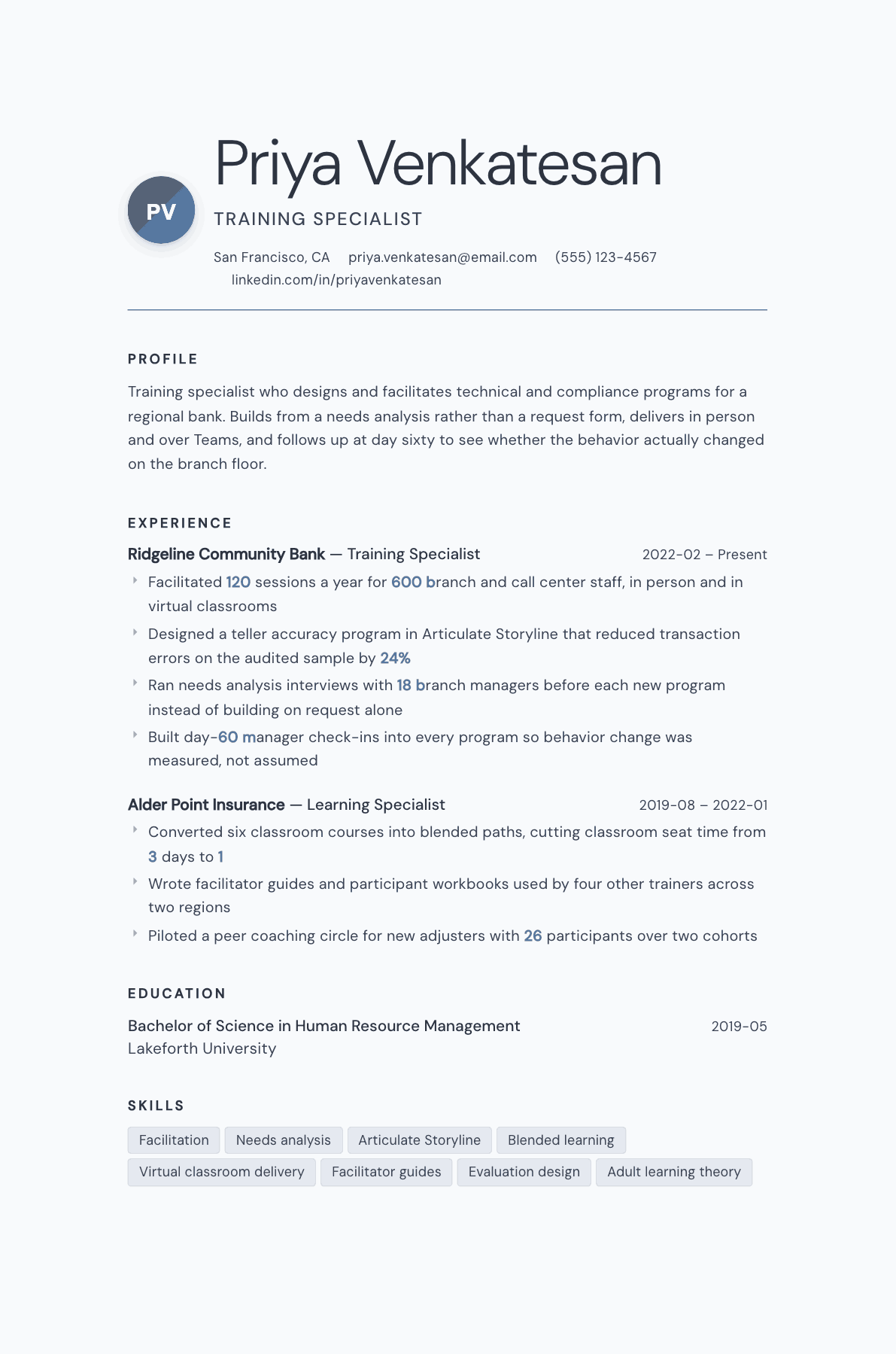
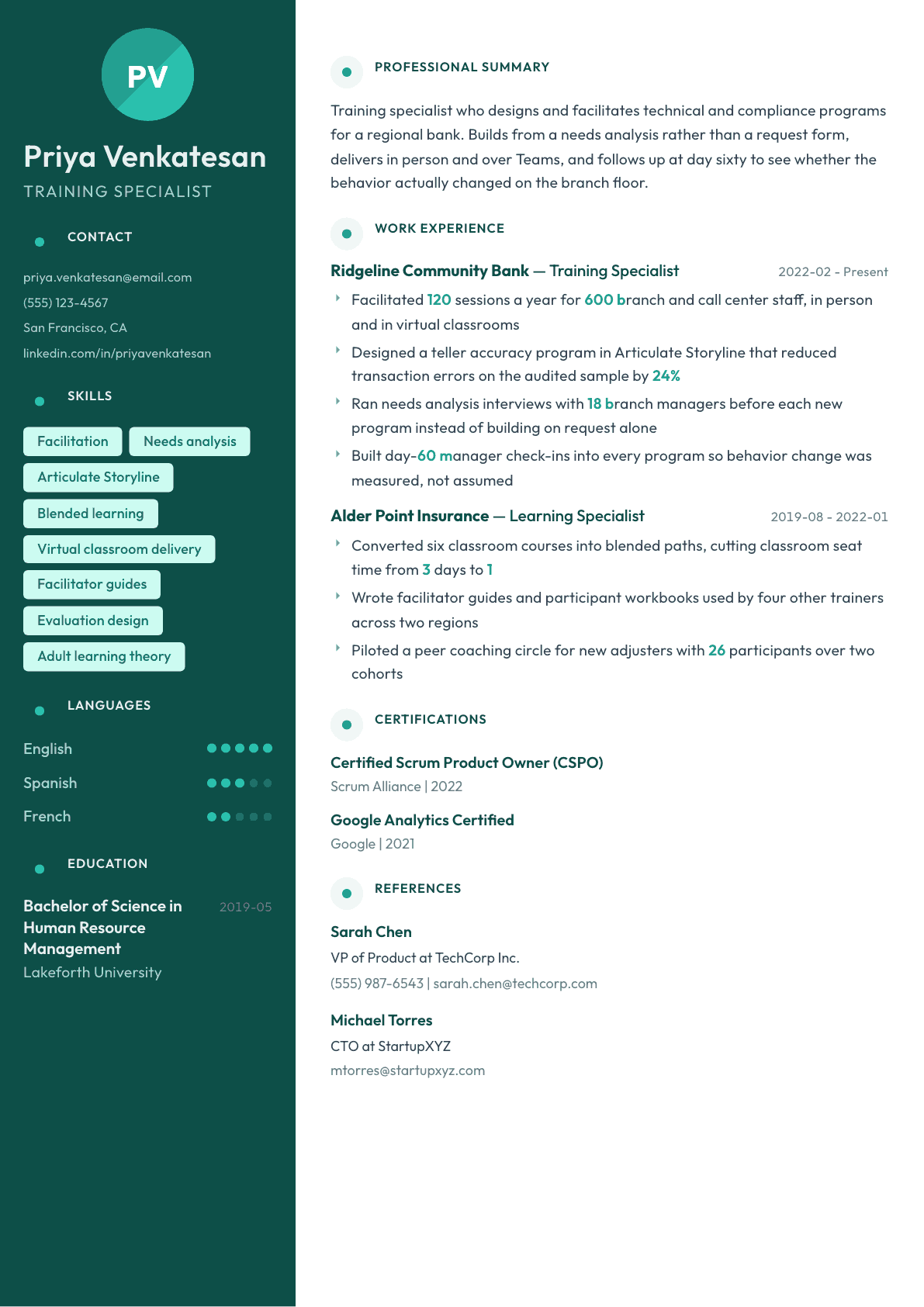
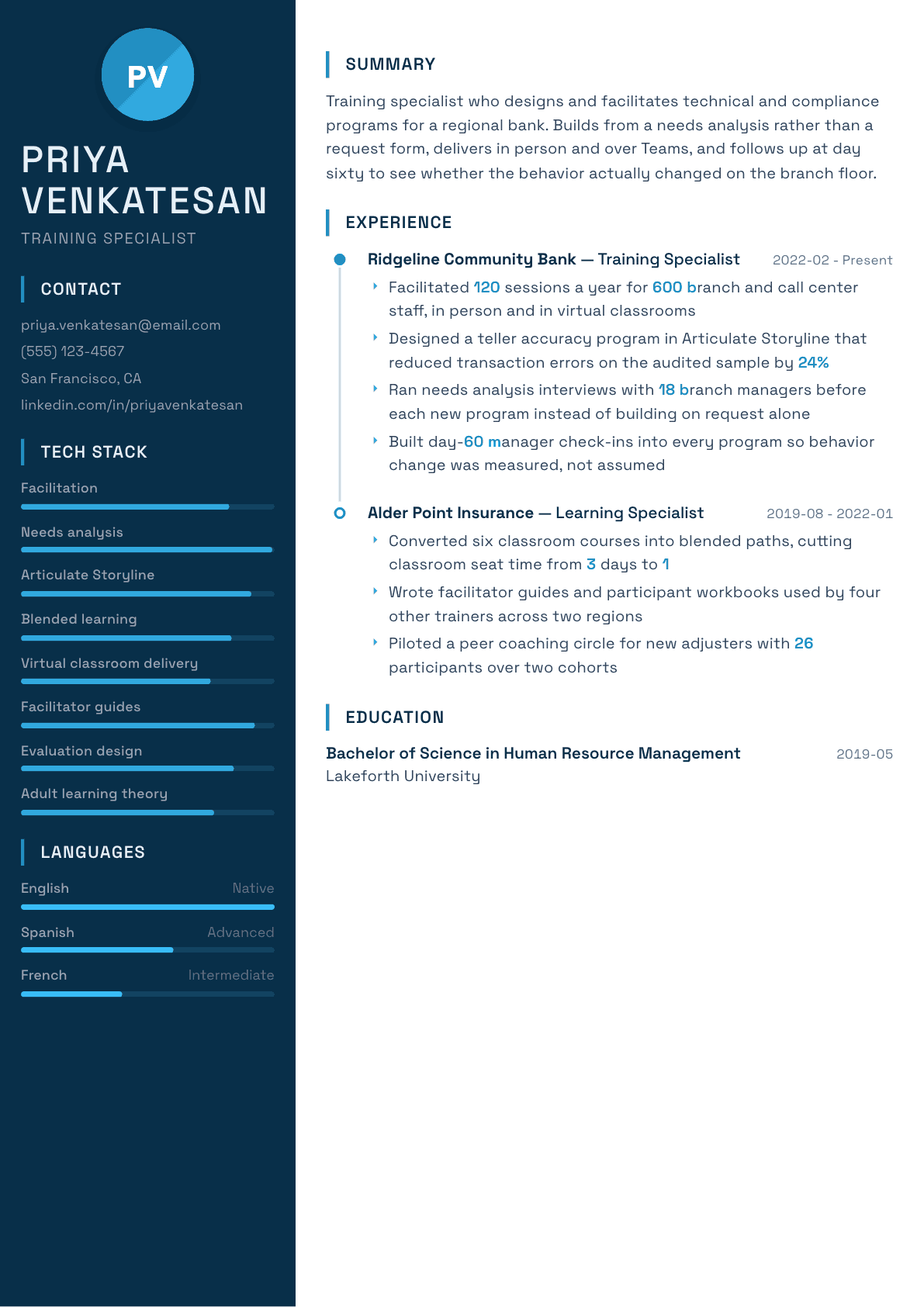
The same training specialist content laid out in three CVBooster templates, so you can see what the finished document looks like before you write a word.
Example Training Specialist summary
Training specialist with five years designing and delivering compliance and technical programs in banking and insurance. Facilitates well over a hundred sessions a year in classrooms and virtual rooms, builds courses in Articulate Storyline, and starts each program with manager interviews rather than a request form. Measures results with day sixty manager check-ins so behavior change is documented and not assumed.
Skills to list on a Training Specialist resume
- Facilitation
- Instructional design
- Training needs analysis
- Articulate Storyline
- Articulate Rise
- Adobe Captivate
- Virtual classroom delivery
- Blended learning
- Adult learning theory
- Facilitator guide writing
- Assessment writing
- Evaluation and follow-up
- Compliance training
- Job aid design
What actually gets this resume read
- Split delivery from design in your bullets, because most postings want both and score them separately.
- Give facilitation volume with audience type: sessions per year, learners per cohort and whether delivery was virtual.
- Name the authoring tools by product, such as Articulate Storyline, Rise, Captivate or Camtasia, not authoring software.
- Show the needs analysis step, since specialists who build straight from a request form look like order takers.
- Report at least one behavior or business result, not only completion counts and satisfaction scores.
- Mention the facilitator guides and workbooks you wrote, because reusable materials prove design quality to a reviewer.
How to write a training specialist resume
Training specialist postings almost always ask for two jobs in one advertisement: build the program and stand in front of the room to deliver it. Reviewers score those halves separately, so a resume that merges them into vague sentences about learning solutions loses on both counts.
The second thing a reviewer looks for is whether you start from a diagnosis or from a request form. A specialist who accepts every request and builds a course is a production resource. One who interviews managers, watches the work, and sometimes concludes that the fix is a job aid rather than a class is a professional, and the resume should make clear which you are.
This guide covers separating delivery from design, quantifying facilitation without exaggeration, naming authoring tools the way a reviewer expects, proving that behavior changed after the session, and the questions specialists ask when moving between industries or into design-only roles.
Split delivery and design in every job
Within each position, give delivery its own bullets and design its own. Delivery bullets carry session counts, audience type, cohort size and modality. Design bullets carry the course, the tool it was built in, the length and the assessment approach. When a reviewer is filling a delivery-heavy seat, they should be able to find your delivery evidence without hunting.
If your split has shifted over time, say so plainly in the summary. A specialist who now spends most of the week designing reads very differently from one still facilitating four days a week, and both are hireable for different postings.
- Delivery: sessions per year, learners per cohort, classroom versus virtual, travel required.
- Design: courses built, tool used, seat time, assessment type, revision cycles.
- Note any train-the-trainer work, since it multiplies your delivery reach.
Needs analysis: the step that separates professionals
Describe how a program starts. Manager interviews, observation of the work, review of quality or error data, focus groups with the target audience, or a task analysis of the process being taught. Naming the input is the single fastest way to signal that you design toward a gap rather than toward a topic.
Include one example where the analysis changed the answer: a request for a customer service course that turned into a scripting job aid, or a compliance refresh that became a checklist redesign. Reviewers remember that example longer than any list of courses.
Tools and modalities, named by product
Write Articulate Storyline, Articulate Rise, Adobe Captivate, Camtasia, Vyond, Miro, and the virtual classroom platform you facilitate in. Generic phrases like authoring tools and virtual platforms match nothing when a recruiter searches, and they suggest surface familiarity to a human reader.
Say what you can do in each. Building branching scenarios and variable-driven interactions in one tool is a different claim from assembling a linear course in another, and specialists who make that distinction on paper are trusted more in the interview.
Prove transfer, not attendance
Completion counts and satisfaction ratings describe an event. What a manager wants is evidence that people did the thing differently afterward. Build follow-up into your programs and put it on the resume: a manager check-in at a fixed interval, an observation checklist, a quality sample reviewed before and after, or a scored skills demonstration at the end of the cohort.
When you have an outcome, give the population and the window so the claim is checkable. When you do not, report the follow-up mechanism you built anyway. Designing measurement into a program is itself a differentiator in a field where most programs stop at the exit survey.
Materials that outlive the session
Facilitator guides, participant workbooks, job aids, quick reference cards and assessment banks all prove design quality in a way that a course title cannot. If other trainers deliver from materials you wrote, say how many and across which regions. That is evidence your design is clear enough to hand over.
Keep a portfolio ready even though this role asks for one less often than pure design roles do. A single sample facilitator guide and one short course walkthrough are usually enough to close an interview that a resume alone opened.
Training Specialist resume summary examples
First specialist role
Former branch supervisor moving into learning, with two years delivering onboarding and product refreshers to teller teams. Has written job aids adopted across four branches, completed an authoring tool course, and facilitates comfortably to groups of twenty. Seeking a training specialist position in financial services.
Five years in
Training specialist delivering roughly 120 sessions a year to 600 branch and call center staff, in classrooms and virtual rooms. Designs in Articulate Storyline, runs manager interviews before every build, and measures transfer with day sixty check-ins rather than satisfaction scores alone.
Senior specialist
Senior training specialist owning the technical curriculum for a regional insurer, from task analysis through assessment design. Writes facilitator guides delivered by four other trainers across two regions, runs train-the-trainer certification, and partners with quality assurance on the error data that drives the roadmap.
Work experience bullets: before and after
Before: Delivered training to employees.
After: Facilitated 120 sessions a year for 600 branch and call center staff, alternating half-day classroom workshops with 90-minute virtual clinics.
Volume, audience and modality let a reviewer match your delivery pattern to their own schedule.
Before: Created e-learning courses.
After: Built a teller accuracy course in Articulate Storyline using branching transaction scenarios and a scored practice module before the final assessment.
Naming the tool and the interaction design shows craft rather than assembling slides into a course shell.
Before: Assessed training needs.
After: Interviewed 18 branch managers and reviewed three months of transaction error data before scoping each program, which redirected one request from a course to a redesigned checklist.
The inputs and the redirect prove diagnosis rather than order taking, which is the core professional distinction.
Before: Followed up after training.
After: Built day sixty manager check-ins into every program, with a five-item observation form returned to the learning team for tracking.
A concrete follow-up instrument shows transfer was measured instead of assumed after the session ended.
Before: Wrote training materials.
After: Wrote facilitator guides and participant workbooks used by four other trainers across two regions, with timing cues and common objection responses in the margins.
Reuse by other facilitators and the specific guide features prove the materials are usable by someone else.
Hard skills
- Facilitation
- Training needs analysis
- Instructional design
- Articulate Storyline
- Articulate Rise
- Adobe Captivate
- Virtual classroom delivery
- Facilitator guide writing
- Assessment and question writing
- Job aid design
- Train-the-trainer certification
- Blended learning design
- Adult learning theory
Soft skills
- Reading a room and adjusting pace
- Handling a skeptical participant
- Interviewing managers about real gaps
- Giving feedback during skill practice
- Explaining technical steps plainly
- Recovering when technology fails mid-session
Certifications worth listing
- Certified Professional in Talent Development (CPTD) (Association for Talent Development)
- Associate Professional in Talent Development (APTD) (Association for Talent Development)
- Certified Technical Trainer (CTT+) (CompTIA)
Mistakes that cost training specialist candidates the interview
- Blending delivery and design into one set of bullets, so neither half of the job can be scored.
- Writing authoring tools instead of the product names a recruiter is searching the resume for.
- Reporting only attendance and satisfaction, which describes the event and not the result.
- Skipping the needs analysis step entirely, which makes you read as a production resource.
- Leaving out facilitator guides and workbooks, the artifacts that prove design quality to a reviewer.
- Listing every course ever built rather than the six closest to the posting in audience and subject.
Training Specialist resume questions
How many sessions should a training specialist list per year?
Report your real number and describe the mix. Twenty full-day workshops is a heavier load than a hundred short virtual clinics, so give session length and cohort size alongside the count rather than a bare annual total.
Do I need a portfolio as a training specialist?
You are asked for one less often than pure design roles, but having one wins interviews. A short course walkthrough and one facilitator guide sample are enough, and they answer quality questions that a resume bullet can only assert.
How do I switch industries as a training specialist?
Lead with the method rather than the content: analysis approach, design process, facilitation volume and evaluation practice all transfer. Then learn the target industry vocabulary and rewrite one program description in it so the reader sees you have done the translation.
Is instructional design experience required for this role?
Most postings expect at least working design skill, since specialists are usually asked to build what they deliver. If your background is delivery only, add an authoring tool course and one built program before applying to blended postings.
What should I do if my programs were never evaluated beyond a survey?
Say what you built into the design anyway: knowledge checks, skill demonstrations, observation forms or manager follow-ups. Reviewers understand that measurement often depends on the employer, and evidence that you designed for it still counts strongly.