Geneticist Resume Examples: free ATS score and gap list
Craft a Geneticist Resume Coded for Success
By Mustafa Tarabya, founder of CVBooster · Published · Updated
Build a compelling geneticist resume showcasing genomic analysis, genetic counseling, and bioinformatics expertise with templates tailored for clinical and research genetics.
Sample resumes for a geneticist
The same geneticist content laid out in three CVBooster templates, so you can see what the finished document looks like before you write a word.
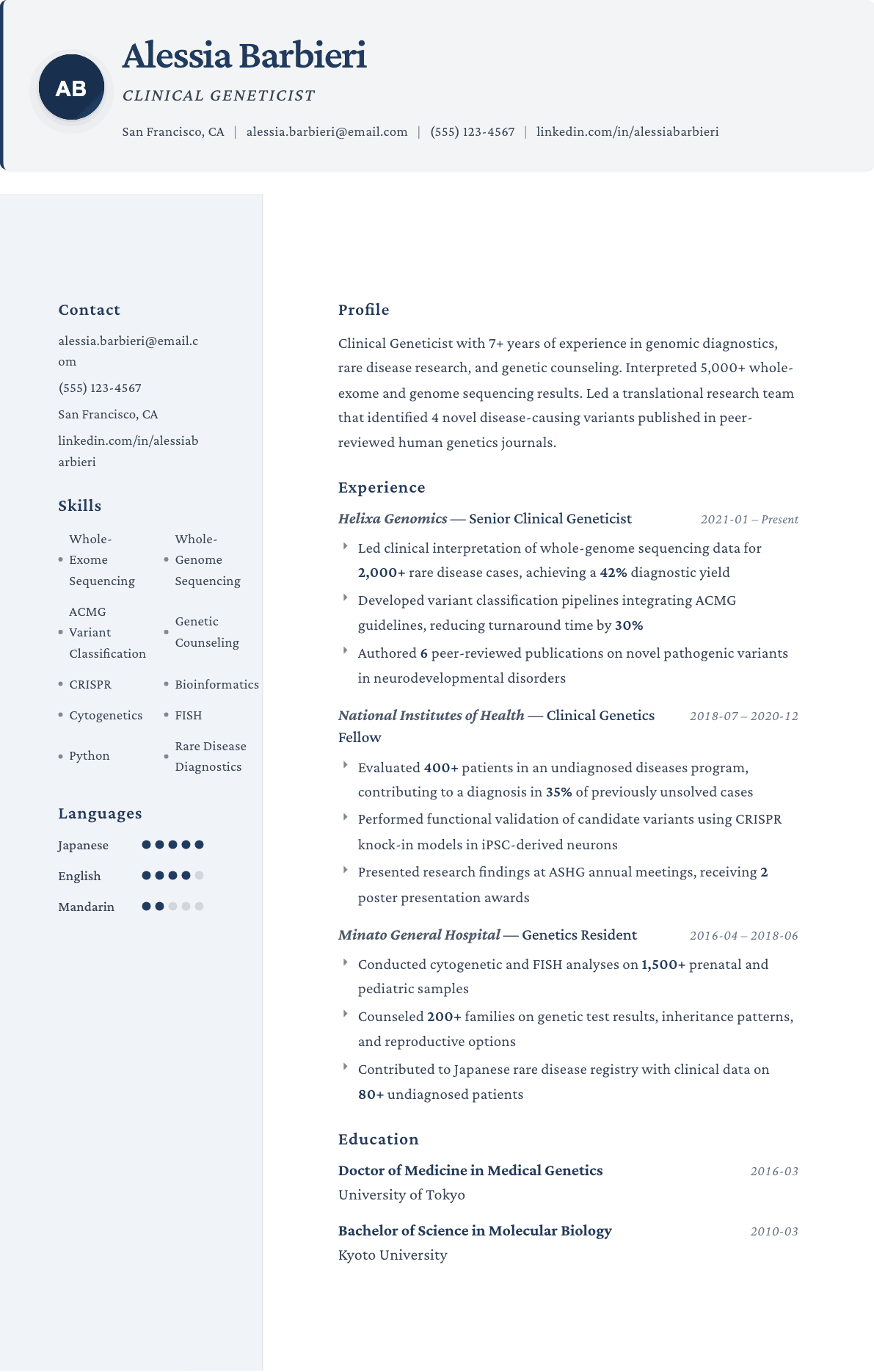
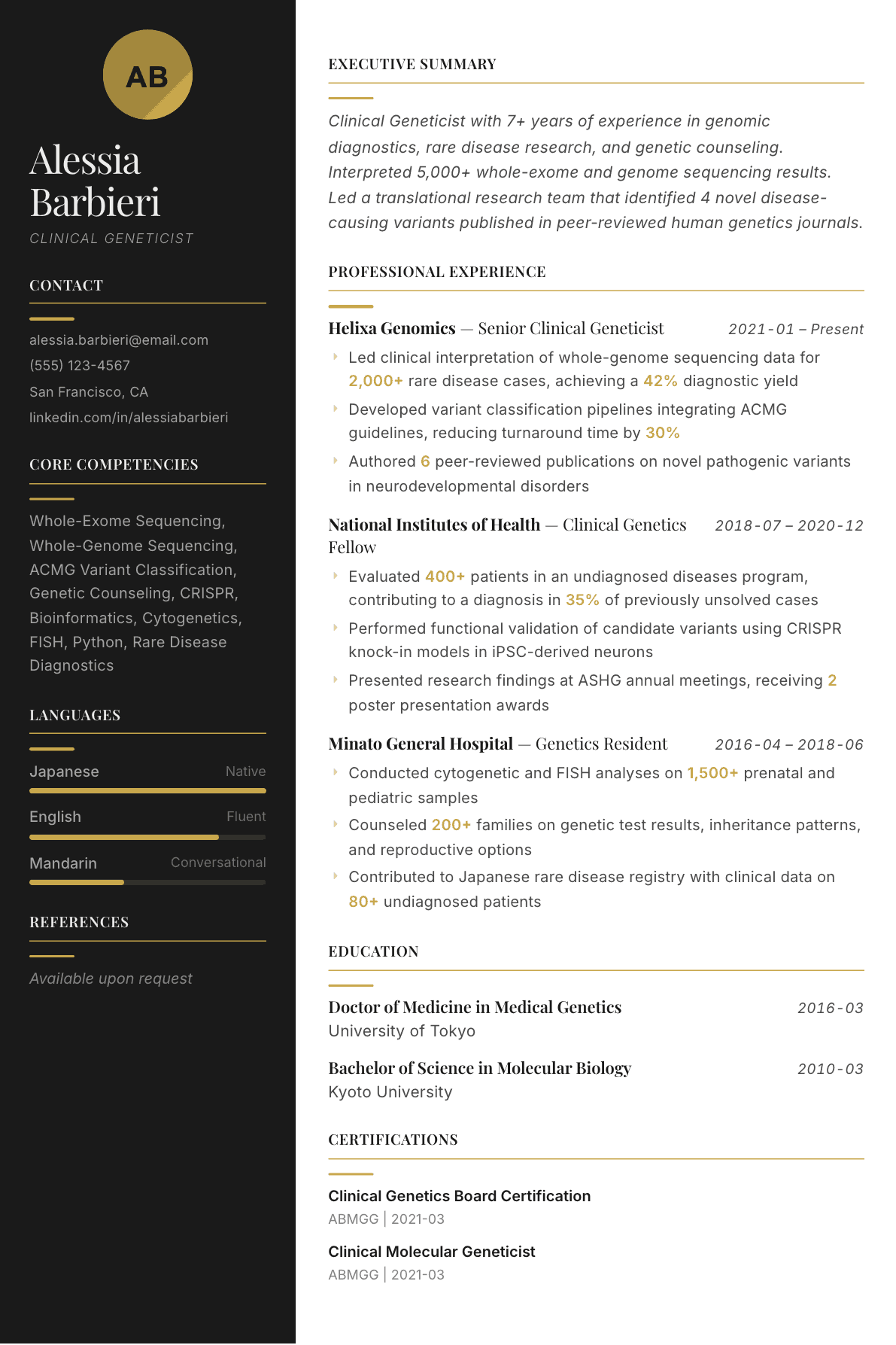
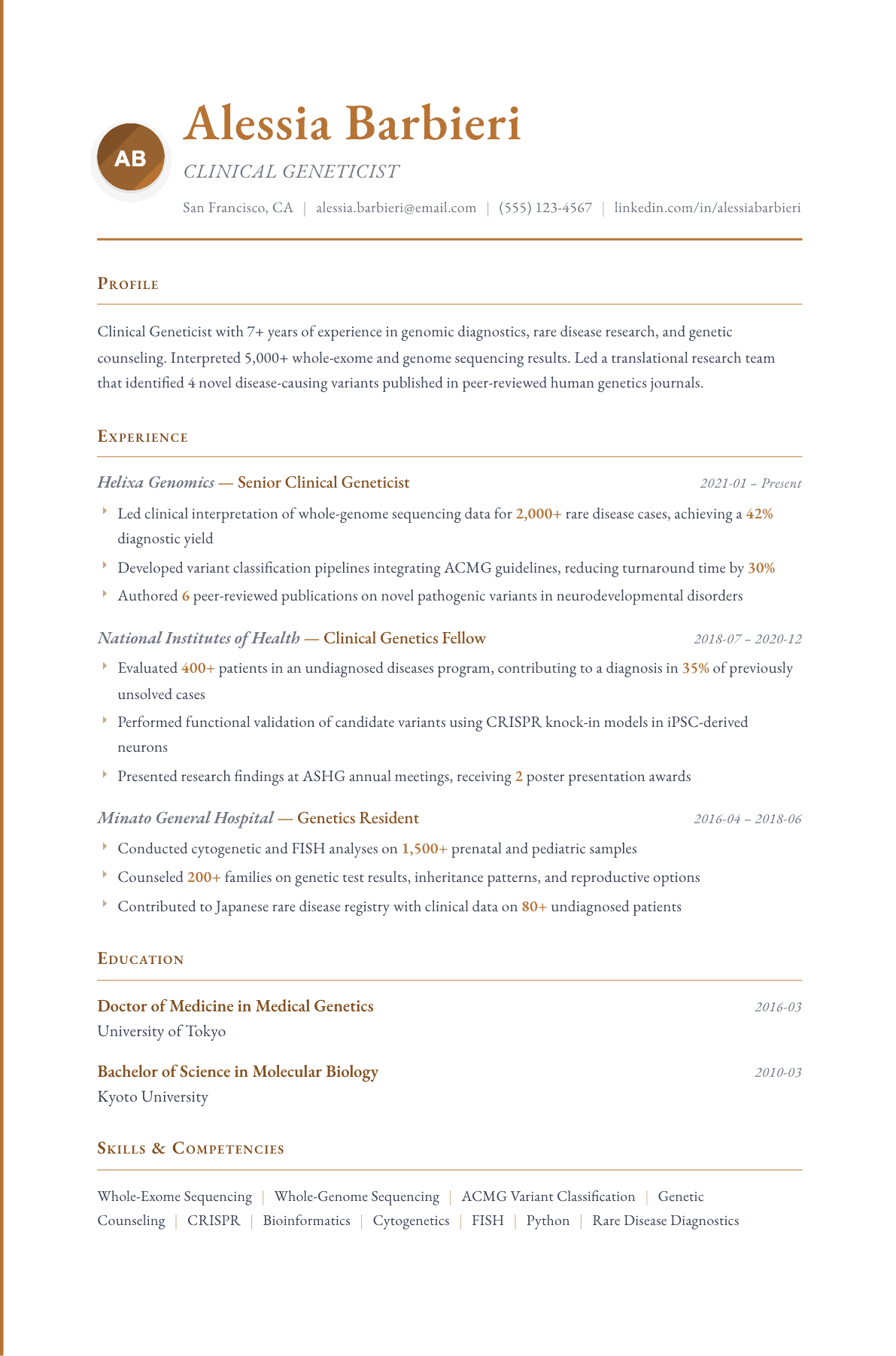
Example Geneticist summary
Board-certified Clinical Geneticist with 7+ years of experience in genomic diagnostics and rare disease research. Interpreted 5,000+ WES/WGS results with a 42% diagnostic yield. Published 10 peer-reviewed papers on novel pathogenic variants. Expert in ACMG classification, bioinformatics pipelines, and translational genetics.
Skills to list on a Geneticist resume
- Whole-Exome Sequencing
- Whole-Genome Sequencing
- ACMG/AMP Guidelines
- Bioinformatics
- CRISPR
- Cytogenetics
- FISH
- Genetic Counseling
- Python / R
- Clinical Genomics
- Rare Disease Diagnostics
- Pharmacogenomics
What actually gets this resume read
- Emphasize sequencing platforms and bioinformatics tools: Illumina, PacBio, BWA, GATK, VEP.
- Quantify diagnostic yield, number of cases reviewed, and variants classified.
- Highlight ACMG/AMP variant interpretation guidelines compliance.
- Include publications, grants, and conference presentations prominently.
- Mention genetic counseling and patient-facing experience if applicable.
How to write a geneticist resume
Geneticist covers two career tracks that share very little day to day. The clinical track works in a certified diagnostic laboratory, classifies variants against published guidelines, signs out reports and answers ordering clinicians. The research track designs experiments, builds models, wins funding and publishes. A laboratory director hiring for one will not be persuaded by a resume written for the other.
For clinical roles the screening reader is checking regulatory reality: has this person worked in a certified and accredited laboratory, do they know the variant classification framework, have they signed out or drafted reports, and how many cases have they interpreted. For research roles the reader is checking the model system, the technology and the publication record.
This guide covers how to structure a geneticist resume for each track, three summaries covering a variant scientist through a laboratory director, before and after bullets built from interpretation and research work, and the questions that come up when scientists cross from research into clinical genomics.
Format: declare the track in the first two lines
Clinical roles want a two page resume. Research faculty roles want a full curriculum vitae. Under your name, state the track and the subspecialty: clinical molecular genetics, clinical cytogenetics, biochemical genetics, cancer genomics, population genetics, functional genomics or statistical genetics. Add board certification or eligibility, since that is a hard requirement for signing out clinical cases.
Put the assay and platform vocabulary in the top third. Exome and genome sequencing, targeted panels, chromosomal microarray, karyotype and fluorescence in situ hybridization, RNA sequencing, methylation arrays and long read sequencing are the terms a hiring laboratory searches for, and burying them costs you the screen.
- Header: name, degree, board certification or eligibility, subspecialty, location, phone, email.
- Clinical order: summary, certification, laboratory experience, case volume and interpretation, assay development and validation, education, publications.
- Research order: education, appointments, funding, publications, technologies, teaching and mentoring.
Summary: assay, case volume, and the framework you classify by
For clinical work, three lines carrying the assay types, the indications you cover, the annual interpretation volume and the classification framework you apply. Naming the sequence variant interpretation guidelines and, for copy number, the technical standards used for their interpretation, tells a director you were trained inside the standard rather than around it.
For research, state the biological question, the model system and the technology in the same three lines. A geneticist working in mouse models of neurodevelopmental disease and one doing population scale association analysis both call themselves geneticists, and only the specifics distinguish them.
Clinical experience: cases interpreted, reports signed, decisions defended
Give volume and complexity together. Cases interpreted per year, the indication mix such as rare disease, hereditary cancer, prenatal, carrier screening or somatic tumor profiling, the proportion requiring family studies or reanalysis, and the diagnostic outcomes you can report without overclaiming.
Then show the interpretation work itself: evidence gathering from population and disease databases, segregation and phenotype correlation, functional evidence weighting, classification and reclassification decisions, variant of uncertain significance policies, orthogonal confirmation by an independent method, and the report language you wrote for the ordering clinician.
Add the laboratory operations side. Assay validation with the performance characteristics measured, pipeline versioning and bioinformatics quality metrics, proficiency testing, inspection preparation, competency assessment and standard operating procedure authorship. Directors hire for the ability to keep a laboratory compliant as much as for interpretation skill.
Research experience: system, technology, and what you actually showed
Structure each position around findings, not techniques. Say the question, the approach and the result: a gene implicated in a phenotype, a regulatory element characterized, a variant shown to alter splicing, a genome wide analysis that identified loci later replicated. Techniques are supporting detail.
Then name the technology stack precisely, because that is what determines whether you can be productive in a new laboratory quickly. Genome editing approaches and delivery methods, single cell and spatial assays, chromatin and expression profiling, model organism work, cell line and organoid systems, and the computational side including read alignment, variant calling, annotation and statistical analysis in R or Python.
Funding and mentoring belong here for anyone aiming at an independent position. Grants held with your role, fellowships awarded, students and technicians trained, and collaborations you led are the evidence a search committee weighs before the publication list.
Bioinformatics and data skills, stated at the right level
Be honest about the depth. Running an established pipeline, writing analysis scripts, and building and validating a pipeline are three different claims, and interviewers separate them in the first ten minutes. Name the tools you use directly for alignment, variant calling, annotation and filtering, the reference builds you work with, and the interpretation platforms and databases you query daily.
Add data governance for clinical roles: consent and reporting of secondary findings, patient privacy handling, variant data sharing into public databases, and the internal knowledge base you maintain. These are the practices that separate laboratory ready candidates from strong analysts.
Geneticist resume summary examples
Variant scientist
Genetics PhD with 2 years as a variant scientist in a clinical laboratory. Curated and classified 1,200 sequence variants under the sequence variant interpretation guidelines, drafted reports for rare disease exome cases, and maintained the internal variant knowledge base with evidence summaries.
Clinical genomic scientist, six years
Board certified clinical molecular geneticist with 6 years interpreting exome and panel testing. Signs out about 700 cases a year across rare disease and hereditary cancer, led validation of a 320 gene panel, and runs the quarterly reanalysis program that resolved 40 previously negative cases.
Laboratory director
Clinical laboratory director with 14 years in genomic diagnostics, overseeing exome, genome and cytogenomic testing for a hospital system. Directs 12 scientists, owns assay validation and inspection readiness, chairs the variant review committee, and has authored 30 peer reviewed papers on variant interpretation.
Work experience bullets: before and after
Before: Interpreted genetic test results.
After: Interpreted about 700 exome and panel cases a year in rare disease and hereditary cancer, applying the sequence variant interpretation guidelines with phenotype correlation, segregation data and orthogonal confirmation before sign out.
Volume, indications and the evidence steps show interpretation performed to a defined standard.
Before: Helped validate a new sequencing assay.
After: Led validation of a 320 gene hereditary cancer panel: measured analytical sensitivity and specificity across variant classes, established coverage thresholds and copy number calling limits, and wrote the validation report and standard operating procedure.
Naming the performance characteristics and the documents produced proves ownership of the validation.
Before: Worked with bioinformatics pipelines.
After: Built and version controlled a secondary analysis pipeline for alignment, variant calling and annotation, added per sample quality metrics with defined failure thresholds, and revalidated the pipeline after each reference and caller update.
Version control, quality thresholds and revalidation are the differences between using a pipeline and owning one.
Before: Reclassified variants when new evidence appeared.
After: Established a quarterly reanalysis program covering previously negative cases, reclassified 90 variants against new population and functional evidence, and issued amended reports that resolved 40 diagnoses.
A recurring program with reclassification counts and resolved cases shows a system, not an occasional review.
Before: Did research on gene function using CRISPR.
After: Used genome editing in patient derived cell lines to test 14 candidate variants for splicing effects, confirmed 5 as loss of function by RNA analysis, and provided the functional evidence that upgraded 3 variants of uncertain significance.
Linking functional work to a classification outcome makes research directly relevant to a clinical laboratory.
Hard skills
- Exome and genome sequencing interpretation
- Targeted panel design and analysis
- Sequence variant classification guidelines
- Copy number and structural variant interpretation
- Chromosomal microarray and cytogenetics
- Fluorescence in situ hybridization and karyotype analysis
- Assay validation in a certified laboratory
- Bioinformatics pipeline development
- Population and disease variant databases
- Genome editing techniques
- RNA sequencing and functional assays
- Statistical analysis in R and Python
- Report writing for ordering clinicians
Soft skills
- Communicating uncertainty to clinicians
- Chairing variant review discussions
- Mentoring scientists and trainees
- Working to turnaround commitments
- Collaborating with genetic counselors
Certifications worth listing
- Board certification in Clinical Molecular Genetics and Genomics (American Board of Medical Genetics and Genomics)
- Board certification in Laboratory Genetics and Genomics (American Board of Medical Genetics and Genomics)
- Certified Genetic Counselor (American Board of Genetic Counseling)
- Technologist in Molecular Biology, MB(ASCP) (American Society for Clinical Pathology)
Mistakes that cost geneticist candidates the interview
- Sending a research curriculum vitae to a clinical laboratory, where certification, case volume and regulatory experience decide the hire.
- Naming sequencing technologies without ever naming the classification framework you interpret against.
- Reporting a diagnostic yield without stating the cohort and indication it came from, which makes the number unusable.
- Overstating bioinformatics depth, since the difference between running and building a pipeline surfaces immediately in interview.
- Leaving out validation, proficiency testing and inspection work, the operations a director must trust you with.
- Listing publications ahead of laboratory experience when applying to a diagnostic laboratory that measures work in cases signed out.
Geneticist resume questions
Do I need board certification to work in a clinical genetics laboratory?
Certification is required to direct a laboratory and to sign out cases in most settings, but variant scientist and analyst positions are open to doctoral scientists without it. If you are certification eligible, say so explicitly with the pathway you are on.
How do I move from research genetics into clinical genomics?
Lead with variant level work: interpretation, evidence weighting, database curation and any functional assay that supports classification. Learn the classification guidelines properly, then apply to variant scientist and curation roles, which are the standard entry point into diagnostic laboratories.
What case volume should I report?
Report annual cases interpreted and, if it differs, cases signed out independently. Add the indication mix and the assay types, because a thousand carrier screening cases and a hundred complex exomes represent very different interpretive workloads.
How much bioinformatics should a clinical geneticist show?
Enough to be credible about how variants reach your worklist: filtering strategy, coverage and quality metrics, annotation sources and their limits. Deep pipeline engineering is a separate role, so claim it only if you have built and validated one.
Should I include my publication list on a clinical resume?
Yes, but keep it to a short selected list weighted toward variant interpretation, assay development and the disease areas the laboratory tests. The full bibliography belongs on a curriculum vitae you can supply if asked.