Head of Product Resume Examples: the lines they read
Write a Head of Product Resume That Reads as Leadership
By Mustafa Tarabya, founder of CVBooster · Published · Updated
A head of product resume example showing strategy, team leadership and business outcomes, with keywords and a guide for senior product hiring.
Sample resumes for a head of product
The same head of product content laid out in three CVBooster templates, so you can see what the finished document looks like before you write a word.
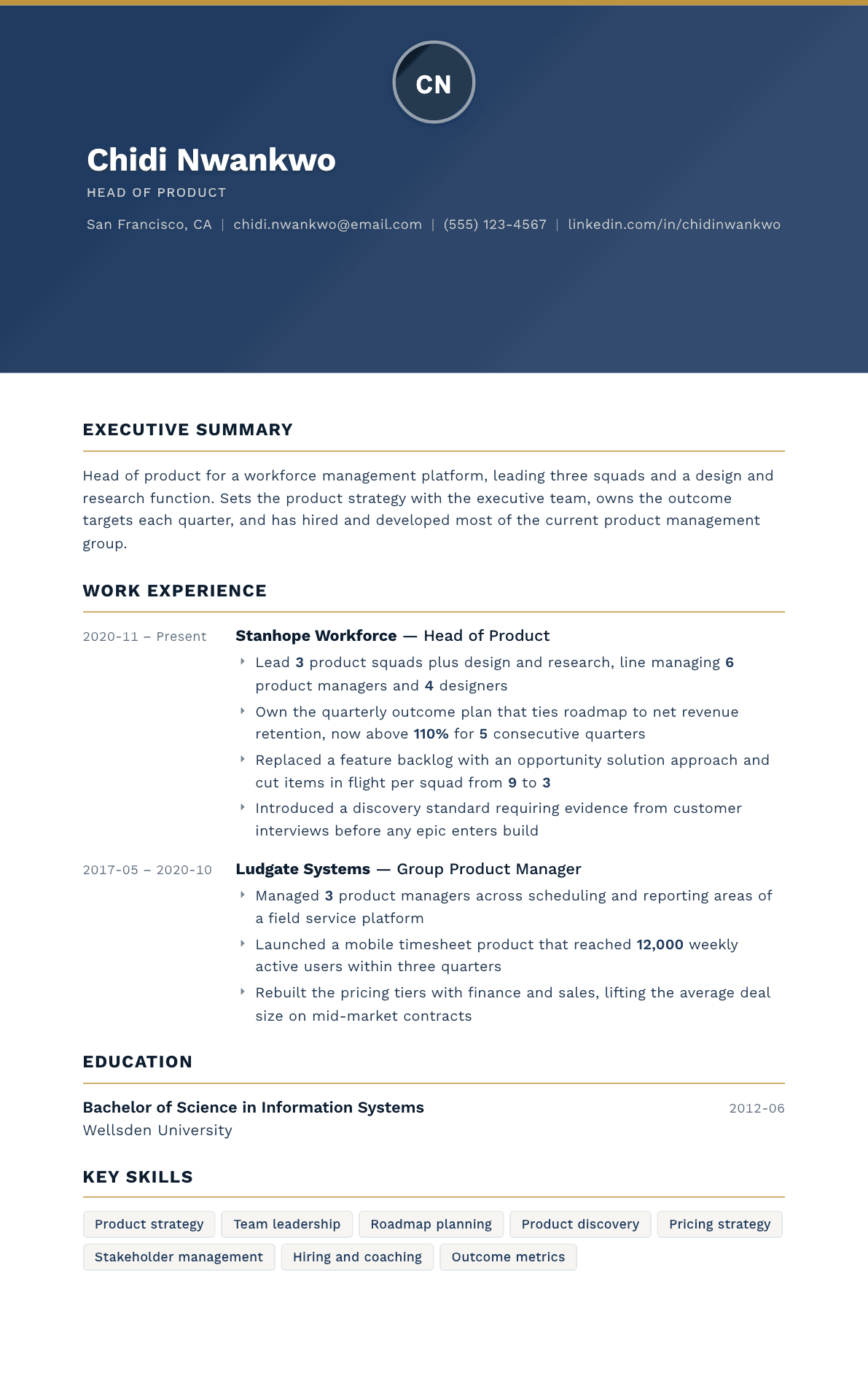
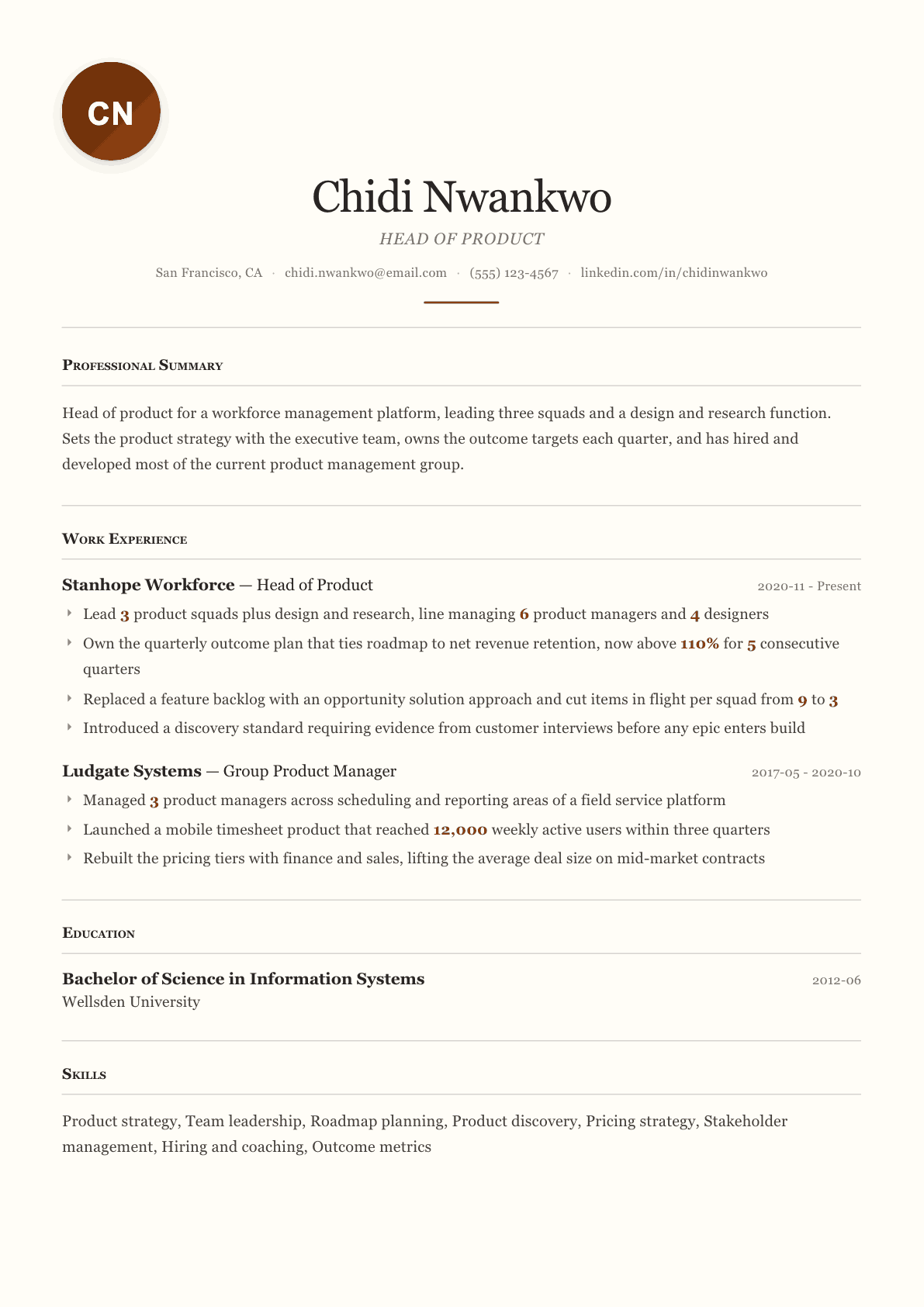
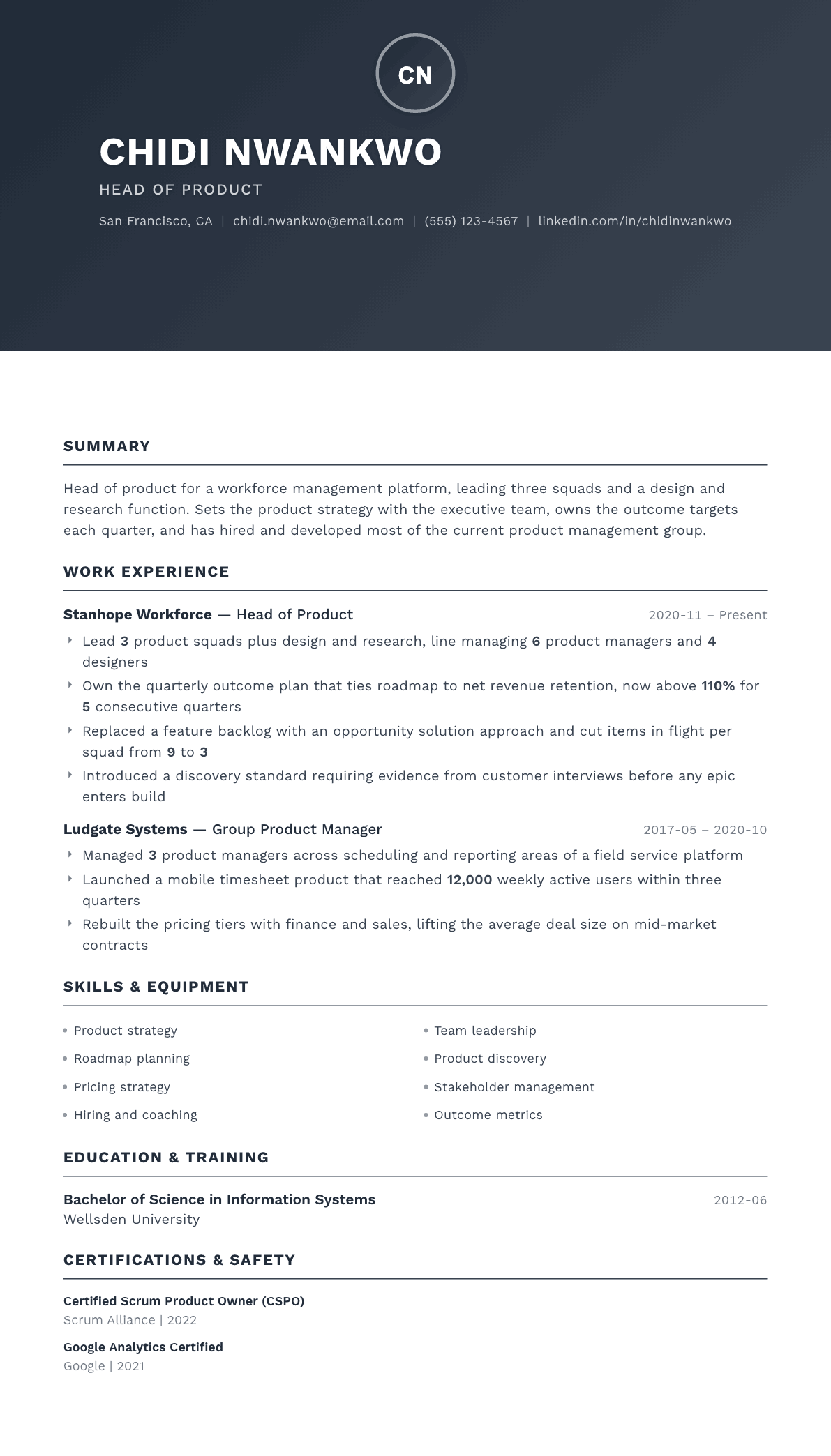
Example Head of Product summary
Head of product leading three squads plus design and research for a workforce management platform, with six product managers reporting in. Replaced a feature backlog with outcome based planning, cut work in flight per squad by two thirds, and held net revenue retention above a hundred and ten points for five quarters. Nine years in product before that. Seeking a chief product officer role in a scaling B2B business.
Skills to list on a Head of Product resume
- Product strategy
- Product leadership
- Roadmap and outcome planning
- Product discovery
- Team building and coaching
- Pricing strategy
- Portfolio prioritization
- Net revenue retention
- Executive stakeholder management
- Product operations
- Customer research programs
- Cross functional leadership
- Business case development
- Product analytics
What actually gets this resume read
- Open with the scope you lead: squads, direct reports, product surface area and the revenue those products carry.
- Show the operating system you installed, such as discovery standards, outcome planning or a quarterly review cadence.
- Report business results rather than launches, because a product leader is judged on retention, revenue and adoption.
- Describe your hiring record, including managers you promoted, since building the team is half of a head of product role.
- Explain how you work with the executive group and the board, particularly around strategy reviews and investment cases.
- Keep one earlier hands on role visible so the reader sees the individual contributor foundation under the leadership.
How to write a head of product resume
At head of product level the resume stops being a record of what you built and becomes evidence of what you can be trusted with. The reader is usually a chief executive, a chief product officer or a board member, and they are weighing three things: the scope you have already carried, the business results your products produced, and whether the product organization you ran got better while you led it.
The most common problem in this pile is a senior resume written in individual contributor language. It lists features launched and roadmaps delivered, and it reads like a strong product manager who kept getting promoted. A product leader is hired to set direction, allocate people and money across bets, install a way of working, and build the team that outlasts them. Those four themes should be visible before the second page.
This guide covers how to state scope in one line, which business metrics belong on a product leadership resume, how to write about the operating model you installed, how to present hiring and team building, and the questions that come up when a group product manager steps up or a head of product moves to a larger company.
Format: scope line, then results, then the operating story
Two pages. Under each leadership title, write one scope line covering squads, direct reports, the product surface, the customer segment and the revenue those products carry. A reader cannot calibrate a product leadership role from the title alone, because head of product means eight people in one company and eighty in another.
Follow the scope line with three or four result bullets, then two or three bullets on how you ran the organization. Keep individual contributor detail out of the leadership roles and let your earlier product manager positions carry it, compressed to a few lines each.
- Scope: squads, direct reports, product lines, segment, revenue carried.
- Results: retention, revenue, adoption, margin, market entry.
- Operating: planning model, discovery standard, review cadence, hiring.
Business results: the metrics a board actually asks about
Feature launches do not travel upward. Retention, expansion, gross margin, activation of new accounts, market entry and the revenue mix across product lines do. Choose the two or three that your company genuinely measured and show a direction over a period, since a single quarter number reads as a coincidence to anyone who has run a business.
Where a metric is commercially sensitive, use direction and relative change rather than absolute values. Net revenue retention held above a threshold for several quarters, or a new product line growing from nothing to a meaningful share of bookings, communicates the result without publishing internal figures.
Be careful with attribution. Product leaders share results with sales, marketing and engineering, and a claim that sounds solely yours invites a hostile question. Writing that the product organization delivered a result under your direction is both accurate and strong.
The operating model: what you installed and what changed
This is the section that separates a leader from a senior manager. Describe the way of working you put in place: how strategy turns into quarterly outcomes, how discovery evidence is required before build, how many bets a squad runs at once, how roadmaps are reviewed with sales and support, and how you decide what to stop.
Give the before and after. Moving from a feature backlog to outcome planning, cutting work in flight per squad, introducing a discovery standard, or replacing a monthly status meeting with a quarterly business review all have a visible before state, and that contrast is what proves the change was yours.
Include the interfaces you own outside product. Executive team, board reporting, sales leadership, customer advisory boards and partner relationships are part of the job, and their absence from a resume makes a candidate look internally focused.
- Planning: strategy to quarterly outcomes, prioritization criteria, funding of bets.
- Discovery: the evidence standard before an epic enters build.
- Governance: roadmap reviews, board reporting, advisory boards.
Team building: hiring, structure and the people who grew
Half of a product leadership job is the team. Say how many product managers, designers and researchers you hired, how you restructured squads around customer problems rather than around technology components, and what your progression framework looks like. Promotions are the strongest single signal, so name how many people you promoted and into what.
Do not skip the harder parts. Managing out a mis-hire, merging two teams after an acquisition, or reducing a product group during a downturn are all real leadership experience, and stating them briefly reads as maturity rather than as a problem.
- Hires made, levels covered, and the interview process you designed.
- Squad structure and the reason for the current shape.
- Progression framework, promotions, and coaching cadence.
Earlier career: keep the craft visible, keep it short
A product leader who cannot talk about discovery, pricing or a hard technical tradeoff loses the team quickly, so keep one or two hands on roles on the page with a couple of bullets each. Choose the ones that show range: a zero to one product, a rescue of something failing, or a platform migration.
Anything more than about a decade back can be reduced to a single line with the title, company and dates. The reader wants the shape of the career, not the detail of your first release.
Head of Product resume summary examples
Group product manager stepping up
Group product manager leading three product managers across scheduling and reporting for a field service platform. Launched a mobile timesheet product that reached 12K weekly active users within three quarters and rebuilt pricing tiers with finance and sales. Ready to take a head of product role with function level ownership.
Head of product, scaling company
Head of product leading three squads plus design and research for a workforce management platform, with six product managers reporting in. Replaced a feature backlog with outcome based planning and cut work in flight per squad from nine items to three, while net revenue retention stayed above 110% for five quarters.
Product leader, multi line business
Product leader accountable for four product lines and a group of eighteen across product, design and research. Set the strategy that opened a second customer segment now carrying a quarter of bookings, installed a quarterly business review with sales and support, and promoted three product managers into leadership roles.
Work experience bullets: before and after
Before: Led the product team.
After: Led three product squads plus the design and research functions, line managing six product managers and four designers across a platform serving mid-market and enterprise customers.
The rewrite converts a title claim into the scope numbers a reader needs to calibrate the role.
Before: Improved the product development process.
After: Replaced a feature request backlog with quarterly outcome planning tied to retention and expansion targets, reducing items in flight per squad from nine to three and giving each squad one primary metric.
It shows the before state, the mechanism and the measurable change in how the teams worked.
Before: Responsible for the product roadmap.
After: Owned the roadmap across four product lines, running a quarterly review with sales, support and finance where each bet carried a stated hypothesis, a cost and the metric it was expected to move.
A roadmap becomes leadership evidence when the review process and the funding logic are visible.
Before: Hired product managers.
After: Hired six product managers across two levels, redesigned the interview loop around a discovery exercise and a written strategy review, and promoted two of them into senior roles within two years.
Hiring reads as team building when the process you designed and the promotions that followed are included.
Before: Worked with the executive team on strategy.
After: Presented the product strategy and investment case to the executive team each quarter and to the board twice a year, securing funding for a new product line that reached a fifth of new bookings in its first year.
The strong version names the audience, the cadence and the outcome of the strategy work.
Hard skills
- Product strategy
- Outcome based planning
- Portfolio prioritization and investment cases
- Product discovery standards
- Pricing and packaging
- Net revenue retention and expansion
- Roadmap governance
- Product operations
- Customer research programs
- Product analytics
- Board and executive reporting
- Team structure design
Soft skills
- Setting direction under uncertainty
- Coaching and developing managers
- Executive communication
- Negotiating across functions
- Saying no with reasons
Certifications worth listing
- Pragmatic Institute Foundations and Focus (Pragmatic Institute)
- Certified Scrum Product Owner (Scrum Alliance)
Mistakes that cost head of product candidates the interview
- Writing a leadership role in individual contributor language, so it reads as a senior product manager resume.
- Leaving scope unstated, which makes a title impossible to calibrate across companies of different sizes.
- Listing launches instead of the business results the product organization produced.
- Claiming shared results as solely yours, which invites a question you will lose in the interview.
- Omitting hiring, promotions and team structure, which is half of what the role is actually for.
- Skipping the operating model, so nobody can tell what would change if you joined.
Head of Product resume questions
How long should a head of product resume be?
Two pages. You need room for a scope line under each leadership role, the business results, the operating changes you made and the team you built, with earlier product manager roles compressed to a few lines each.
What metrics belong on a product leadership resume?
Retention and expansion, activation of new accounts, revenue mix across product lines, margin, and adoption of major bets. Choose the ones your company genuinely tracked, and show direction over several quarters rather than one good period.
How do I show leadership if my company never gave me direct reports?
Describe the scope you influenced instead: squads coordinated, product managers mentored, the planning process you introduced, and the executive conversations you carried. Many product leaders take the first formal management role after doing the work informally.
Should I include the products I killed?
Yes, if the reasoning was sound. Stopping a product line after evidence showed a weak market is a decision most executives respect, and it demonstrates the judgment they are hiring for more clearly than another launch does.
How do I move from head of product at a small company to a larger one?
Emphasize the parts of the job that scale: strategy, prioritization across bets, hiring and coaching, executive alignment. Then be specific about the size you have run, since honesty about scope makes you a credible candidate for the next step up.
Related resume examples
- Product Manager Resume example
- Product Marketing Manager Resume example
- Product Designer Resume example
- General Manager Resume example
- Vice President Resume example
- Executive Resume example