Product Designer Resume Examples: the lines they read
Craft a Product Designer Resume That Backs Up Your Portfolio
By Mustafa Tarabya, founder of CVBooster · Published · Updated
A product designer resume example with process, research and design system keywords, sample bullets, and a guide to pairing resume with portfolio.
Sample resumes for a product designer
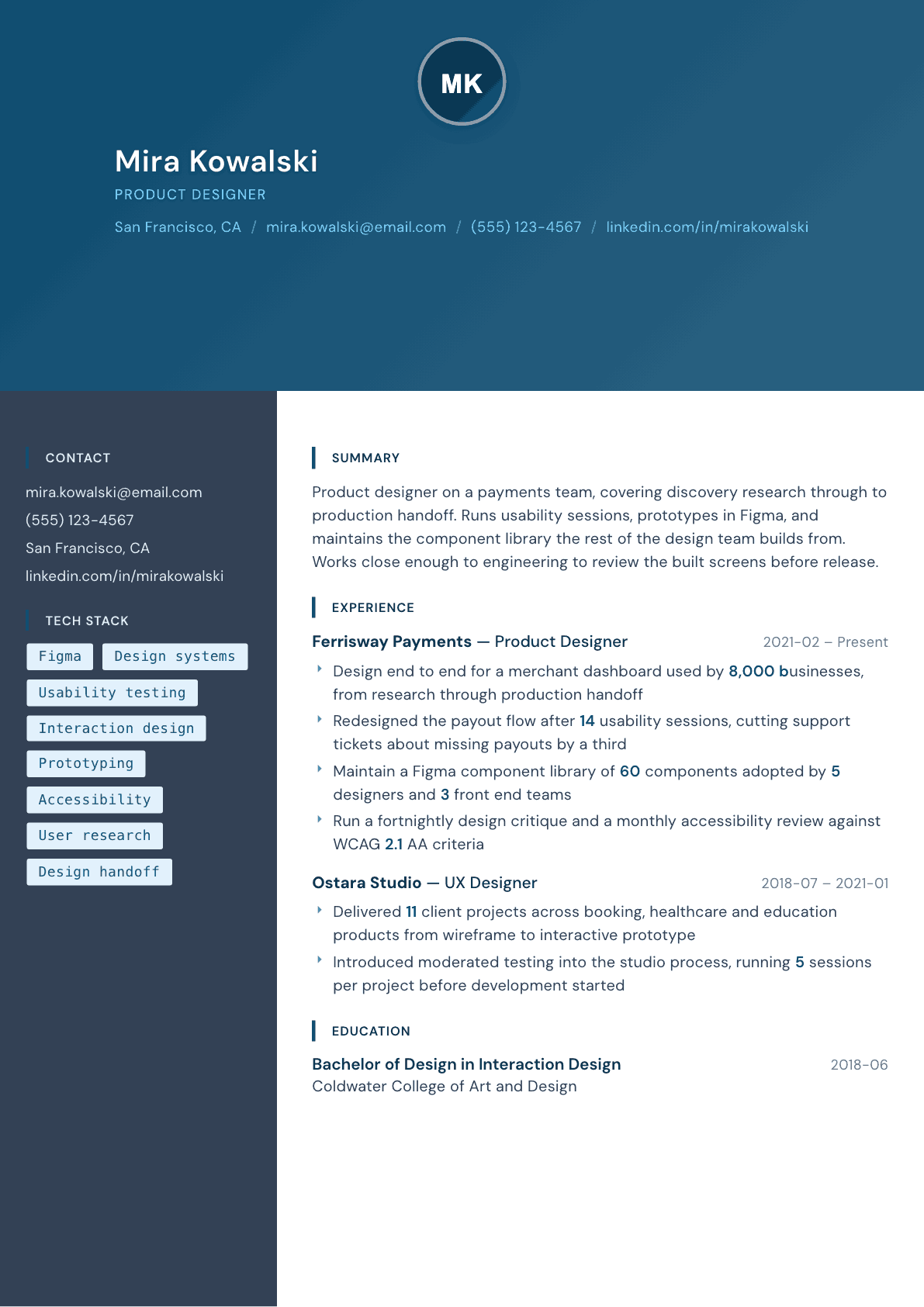
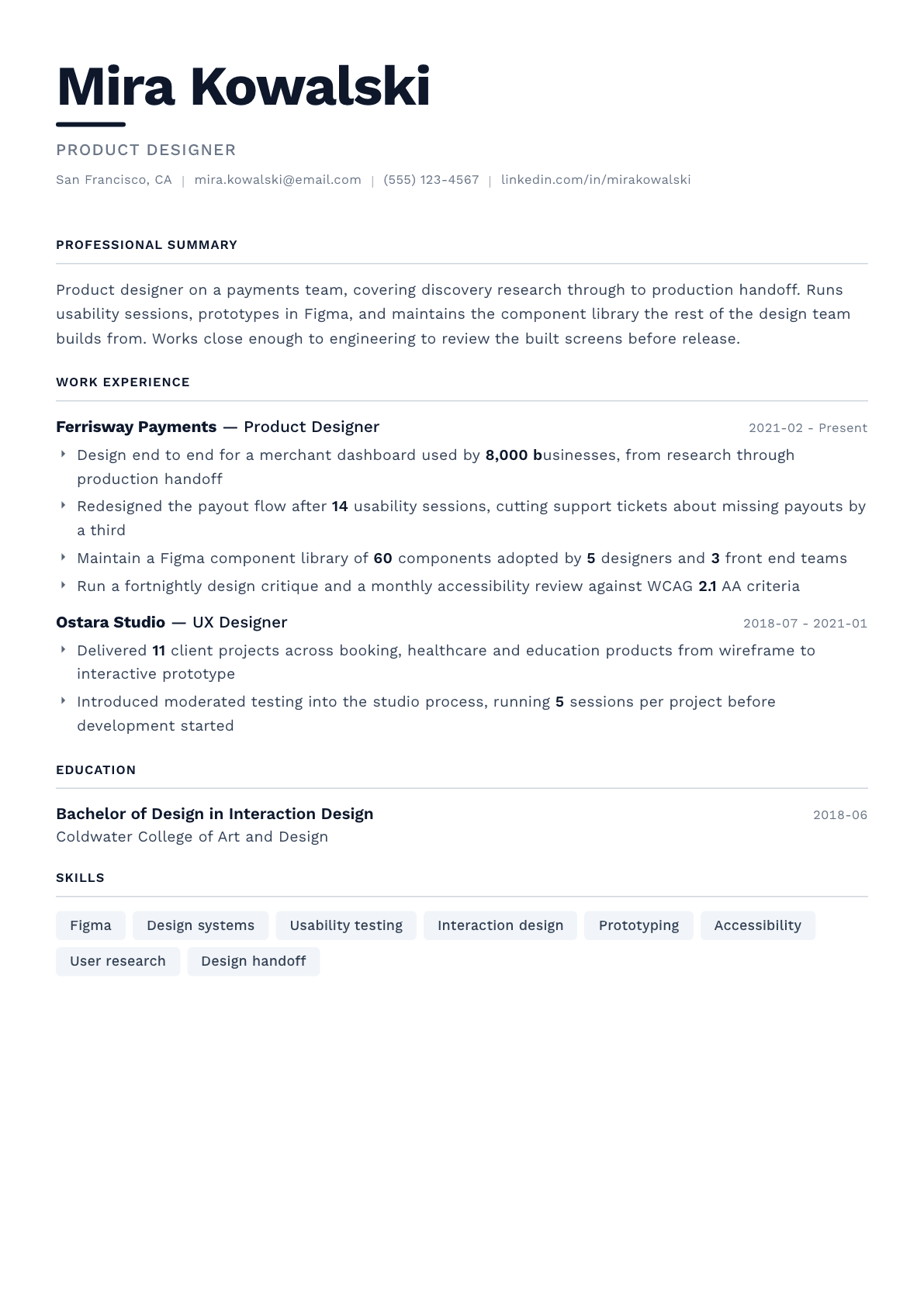
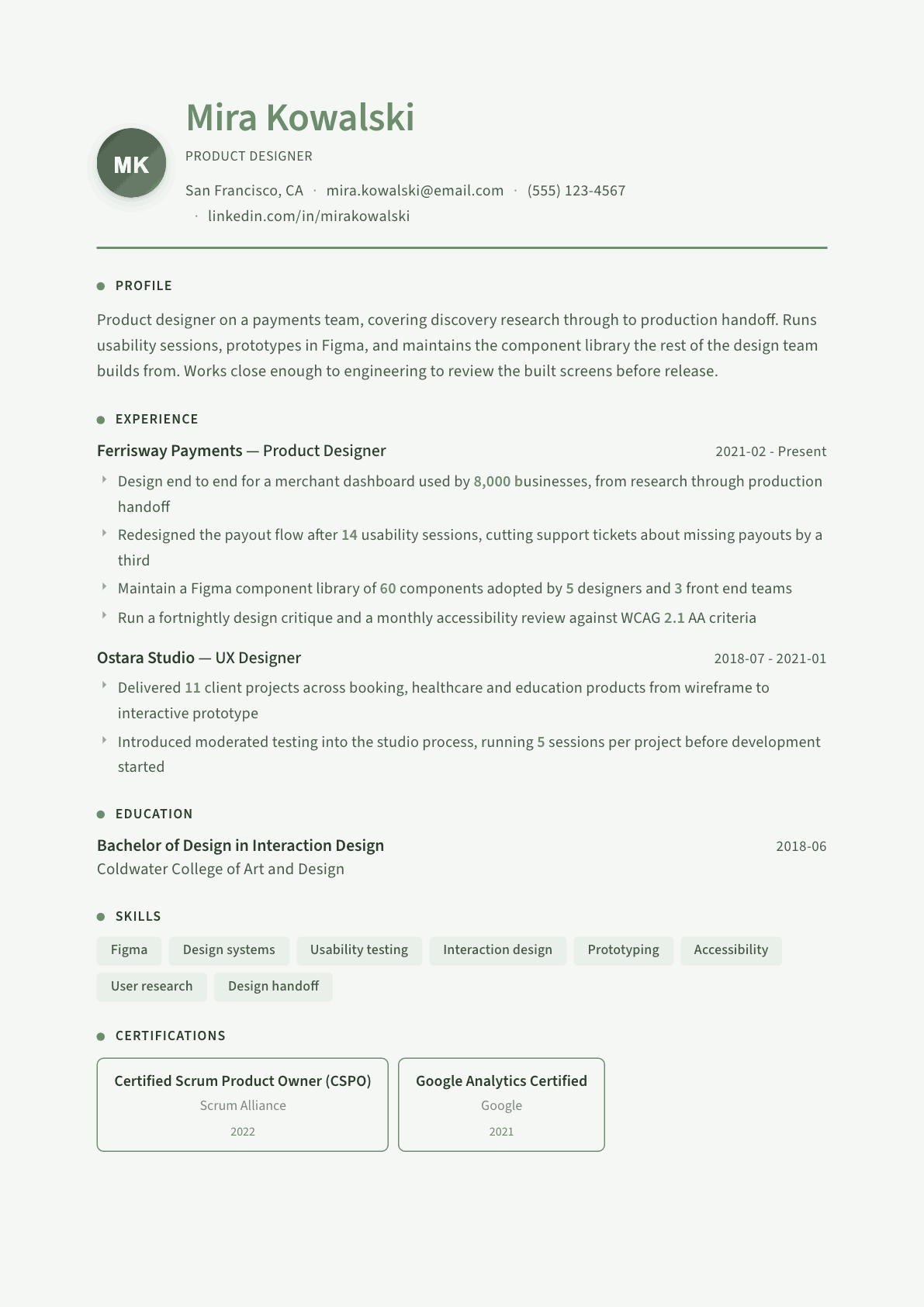
The same product designer content laid out in three CVBooster templates, so you can see what the finished document looks like before you write a word.
Example Product Designer summary
Product designer with six years across agency and in house teams, currently owning a merchant payments dashboard end to end. Redesigned a payout flow after fourteen usability sessions and cut related support tickets by a third, and maintains the component library five designers build from. Comfortable running research, critique and accessibility reviews. Seeking a senior product design role on a complex data heavy product.
Skills to list on a Product Designer resume
- Product design
- Interaction design
- User research
- Usability testing
- Wireframing
- Prototyping
- Design systems
- Figma
- Accessibility and WCAG
- Information architecture
- Design critique facilitation
- Developer handoff
- Journey mapping
- Visual design
- Design QA
What actually gets this resume read
- Put the portfolio link in the header next to your email, because no product design resume is read without it.
- Describe the product and its users in each role so a reviewer knows whether the work was consumer, enterprise or internal.
- Show where your involvement started and stopped, from discovery research to handoff and post release review.
- Cite the outcome of a design change in support tickets, task completion or conversion instead of describing the visuals.
- Name your design system contribution, since maintaining a component library is a different job from consuming one.
- Include accessibility standards you design against, as many teams now screen for WCAG knowledge explicitly.
How to write a product designer resume
A product design resume is never read alone. It is opened beside a portfolio, and its job is to answer the questions the portfolio cannot: how big were the teams, how long were the projects, what part of the work was yours, and what happened to the product after the redesign went live. A case study demonstrates craft, and the resume supplies the context around it.
Hiring managers filter for a specific shape of designer. Some want a systems person who can hold a component library together across several teams. Some want an end to end designer comfortable running research and defining the problem. Some want a specialist in complex data heavy interfaces. Your page should make it obvious within the first few lines which of those you are, because a generic design resume gets sorted into none of the piles.
This guide covers the layout that works when a portfolio does the visual work, how to describe your involvement honestly on team projects, which outcomes designers can legitimately claim, and the questions designers ask when they move between agency and product work.
Format: clean, single column, portfolio link in the header
Resist the urge to make the resume a design piece. Recruiters read it quickly, often through an applicant tracking system, and elaborate columns or graphic skill meters cost you more than they gain. Restraint on this page also reads as good judgment, since knowing where craft belongs is part of the job.
The portfolio link goes in the header beside your email, with the password inline if the case studies are protected. A designer who makes a reviewer request access has already lost half of the reviews. Under each role, add a product line: what the product does, who uses it, and the platform, whether web app, native mobile or an internal tool.
- Header: name, title, city, email, portfolio link with password if needed.
- Product line per role: product, users, platform, team structure.
- Section order: summary, experience, skills and tools, education, awards if any.
Scope: say where your involvement started and stopped
End to end is the most overused phrase in design resumes, and it means nothing without the stages. Name them: discovery interviews, problem definition, information architecture, wireframes, interaction design, visual design, prototyping, usability testing, handoff, and design quality review after build. Claim the ones you actually did and leave the rest out.
Team context matters just as much. Say how many designers, engineers and product managers you worked alongside, and whether you were the only designer on the product. A sole designer on a small team and one of eight designers in a platform group are hired for different reasons, and both are respectable.
- Stages you owned, in the order the work happened.
- Team shape: designers, engineers, product managers, researchers.
- Cadence: how work moved from discovery to build in that team.
Outcomes: what changed for users after the design landed
Designers often avoid numbers because the product manager owns the metric. You can still write the outcome without claiming sole credit. Support tickets on a confusing flow, task completion in usability sessions, error rates on a form, time to complete a core task, and adoption of a redesigned feature are all things a designer legitimately influences.
Qualitative evidence counts when it is specific. Fourteen usability sessions where participants failed the same step, and the redesign that removed it, is a real story. Vague statements about improving the user experience are the sentences a hiring manager skims past.
If you cannot get metrics, use the decision instead. A prototype tested with users that stopped an expensive build is a strong bullet, and it is available to almost every designer.
Design systems, accessibility and handoff
Say clearly whether you consumed a design system or maintained one. Maintaining means owning components, documenting usage, running contribution reviews and versioning the library, and it is a separate craft that many postings ask for directly. Give the component count and the number of designers and front end teams who built from it.
Accessibility is now a hiring filter in many companies. Name the standard you design against, the checks you run on contrast and focus order, and whether you test with a screen reader. That is a short section and it moves you ahead of most of the pile.
Handoff and design quality review close the loop. Describe how you spec interaction states, how you work with engineers during build, and whether you review the built screens before release. Designers who check the shipped result are rare enough to be worth a bullet.
- Design system: consumer or maintainer, component count, adopting teams.
- Accessibility: standard, contrast and focus checks, assistive technology testing.
- Handoff: specs, engineering collaboration, post build design review.
Product Designer resume summary examples
Junior designer
Product designer with two years on a booking product, working from wireframes to production screens alongside one senior designer and four engineers. Ran the first moderated usability sessions the team had done and reworked a date selection step that participants failed repeatedly. Building depth in research led interface work.
Owning a product area
Product designer covering discovery through handoff for a merchant payments dashboard used by 8,000 businesses. Redesigned the payout flow after fourteen usability sessions and cut support tickets about missing payouts by a third, while maintaining a Figma library of 60 components used by five designers.
Senior, systems focus
Senior product designer working across three squads on an enterprise analytics platform, leading the design system and the accessibility standard. Rebuilt the component library and documentation so three front end teams shared one implementation, and introduced a quarterly audit against WCAG 2.1 AA criteria.
Work experience bullets: before and after
Before: Redesigned the onboarding flow.
After: Redesigned the merchant onboarding flow after eight interviews and a diary study, reducing it from eleven screens to six and cutting drop off at the identity verification step in the following release.
The rewrite shows the research behind the change, the structural difference and where the drop off moved.
Before: Worked closely with engineers.
After: Specified interaction states and edge cases in Figma for every component handed to engineering, then reviewed the built screens each sprint and logged design defects alongside functional bugs.
Collaboration becomes evidence when the artifacts and the review ritual are named.
Before: Maintained the design system.
After: Maintained a Figma component library of 60 components with usage documentation, ran a contribution review every two weeks, and supported adoption by five designers and three front end teams.
It distinguishes maintaining a system from using one, which many postings screen for directly.
Before: Conducted user research.
After: Ran fourteen moderated usability sessions on the payout flow, coded the failures into three themes, and presented the findings to product and engineering with a prioritized list of fixes.
Session count, analysis method and where the findings landed make the research verifiable.
Before: Made the product more accessible.
After: Introduced a monthly accessibility review against WCAG 2.1 AA criteria, fixing contrast and focus order issues across 30 screens and adding keyboard navigation to the main table component.
The strong version names the standard, the cadence and the specific defects that were fixed.
Hard skills
- Interaction design
- Information architecture
- Wireframing and prototyping
- Figma
- Design systems and component libraries
- Usability testing
- User research and interviewing
- Accessibility and WCAG criteria
- Journey and service mapping
- Visual and typographic design
- Design specification and handoff
- Design quality review
Soft skills
- Giving and taking critique
- Storytelling in design reviews
- Collaboration with engineers
- Comfort with ambiguity
- Advocating for users without blocking delivery
Certifications worth listing
- NN/g UX Certification (Nielsen Norman Group)
- Certified Professional in Accessibility Core Competencies (International Association of Accessibility Professionals)
Mistakes that cost product designer candidates the interview
- Designing the resume itself into columns and graphics that parsers scramble and recruiters skim.
- Linking a portfolio that needs an access request, which quietly ends most reviews.
- Writing end to end without naming the stages you actually performed.
- Describing visual changes instead of what became easier for the user.
- Hiding team size, so a reviewer cannot tell whether you were the only designer or one of eight.
- Ignoring accessibility, which now appears as a stated requirement in many product design postings.
Product Designer resume questions
Do I still need a resume if my portfolio is strong?
Yes. The portfolio shows craft and process on a few projects, while the resume shows career shape: team sizes, product types, tenure, tools and scope. Recruiters screen on the resume before a hiring manager ever opens your case studies.
How do I show impact when the product manager owns the metrics?
Use the outcomes design plausibly influences, such as support tickets, task completion in testing, error rates and adoption, and phrase them as team results. Claiming a revenue number alone invites a question you cannot answer well.
Should a product designer resume be one page?
One page up to around eight years of experience, two after that if you have led systems work or managed designers. Depth belongs in the portfolio, so the resume can stay tight without losing anything important.
How do I move from agency work to a product company?
Emphasize the projects where you stayed past launch, any research you ran yourself, and any product you iterated on more than once. Product teams worry that agency designers hand off and leave, so evidence of iteration answers the real concern.
What tools should a product designer list?
Figma is expected. Add prototyping and research tools you genuinely use, such as a testing platform or a handoff tool, and skip long lists of software you touched once. Depth in two tools reads better than breadth in ten.
Related resume examples
- UX Designer Resume example
- UI Designer Resume example
- Product Manager Resume example
- Head of Product Resume example
- Innovation Director Resume example
- Lean Six Sigma Black Belt Resume example