Health Educator Resume Examples: the lines they read
Create a Health Educator Resume That Proves Program Reach
By Mustafa Tarabya, founder of CVBooster · Published · Updated
Health educator resume example with curriculum work, program reach numbers, CHES keywords and a guide to writing every section clearly.
Sample resumes for a health educator
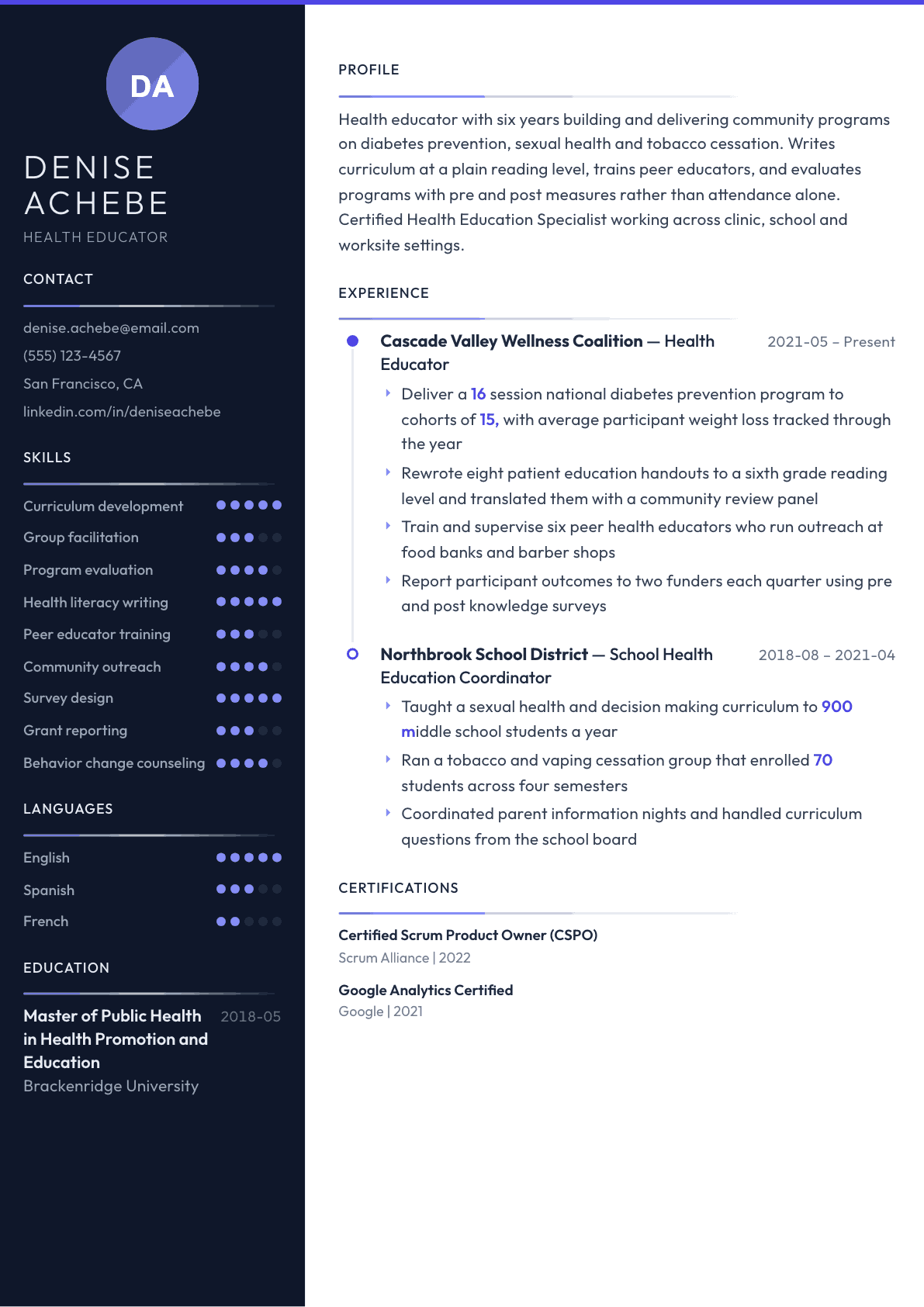
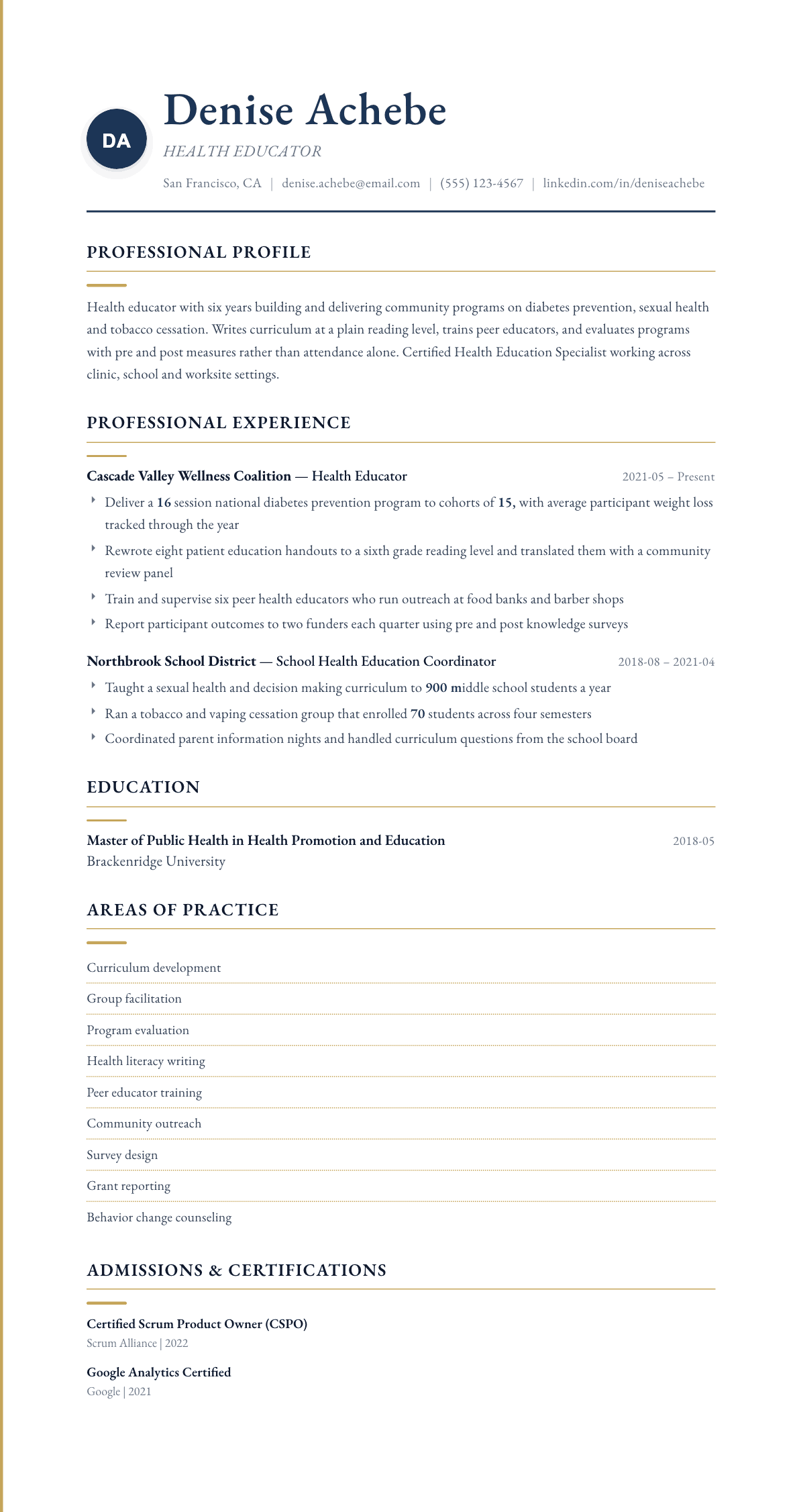
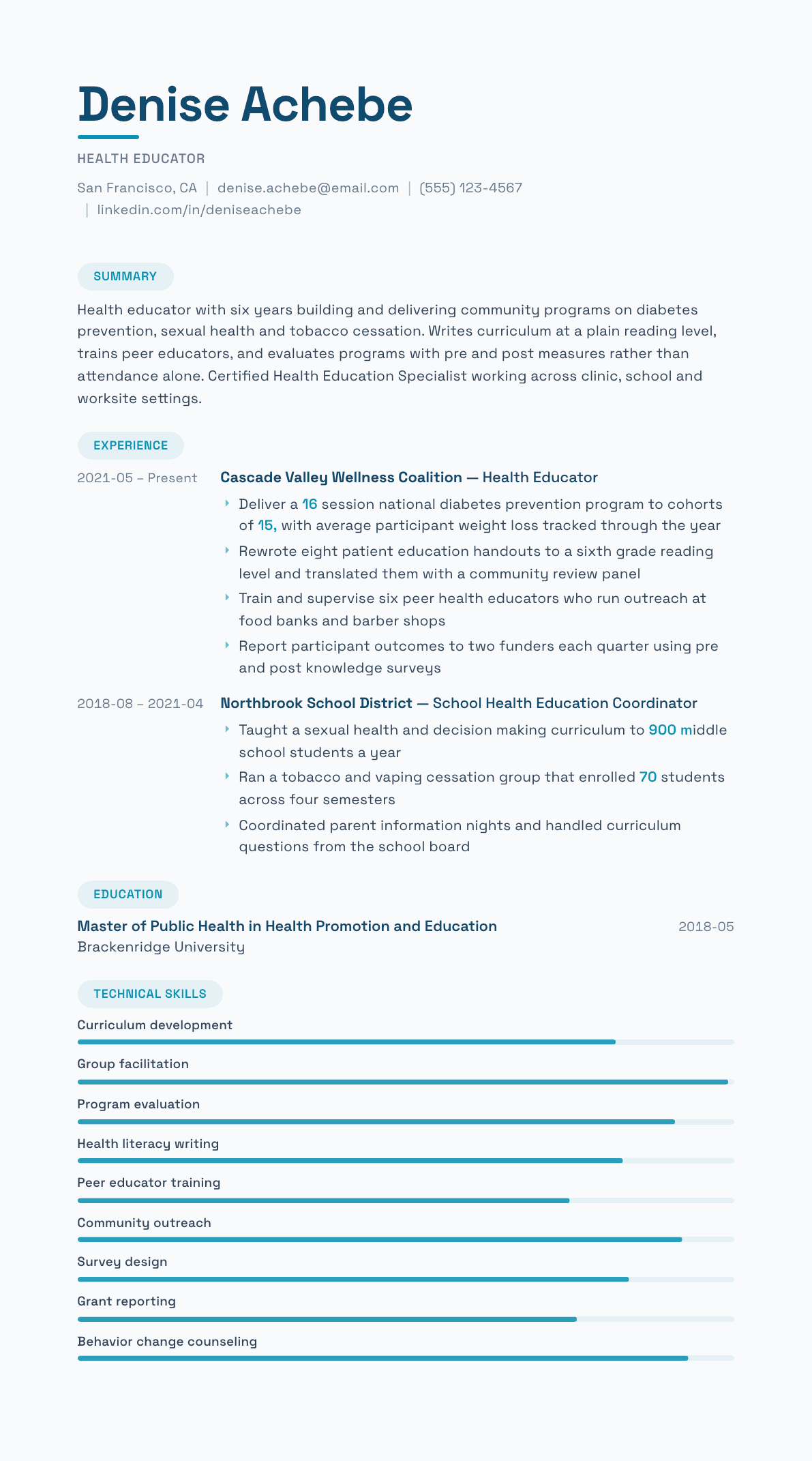
The same health educator content laid out in three CVBooster templates, so you can see what the finished document looks like before you write a word.
Example Health Educator summary
Certified Health Education Specialist with six years designing and delivering community health programs on diabetes prevention, sexual health and tobacco cessation. Reaches hundreds of participants a year through clinics, schools and worksites, and evaluates every program with pre and post measures. Skilled at rewriting clinical material into plain language and training peer educators who carry the work into their own neighborhoods.
Skills to list on a Health Educator resume
- Health education curriculum design
- Evidence based program delivery
- Group facilitation
- Behavior change counseling
- Program evaluation
- Pre and post survey design
- Health literacy and plain language writing
- Peer educator training
- Community needs assessment
- Coalition and partner engagement
- Grant writing and reporting
- Social media and campaign outreach
- Cultural adaptation of materials
- Data reporting and dashboards
What actually gets this resume read
- Lead with the programs you delivered and the number of people reached, because funders judge health education on reach.
- Name the evidence based curricula you are trained to deliver and who certified you to deliver them.
- Show evaluation work with pre and post measures, retention numbers and how you reported results to a funder.
- Mention health literacy skills such as plain language rewriting, translation review and material testing with readers.
- Include the settings you have worked in, since clinic, school, worksite and faith based programs need different approaches.
- Put CHES or MCHES certification near the top when you hold it, because many postings list it as preferred or required.
How to write a health educator resume
Health education jobs are almost always funded by someone: a grant, a contract, a hospital community benefit line or a state allocation. Whoever hires you has to report back to that funder. So the person reading your resume is silently checking one thing above all others, which is whether you produce results that can be written into a report.
That is why a health educator resume built on lists of workshops delivered rarely competes. Sessions delivered is an activity measure. Participants enrolled, participants retained through the full curriculum, knowledge change between pre and post survey, referrals completed and partner sites recruited are outcome measures, and outcome measures are what a program director needs on the next quarterly submission.
This guide covers how to build the file around programs and outcomes, with example summaries at three career stages, before and after bullets from clinic, school and worksite settings, and answers to the questions health educators ask when they move between funders or step up into coordination.
Format: program based, with reach visible on page one
One page early on, two once you have run several programs. Reverse chronological, plain headings. Directly under your summary, add a short programs line naming the curricula you are trained to deliver and the settings you work in. That single line does more matching work than the rest of the page.
If you hold Certified Health Education Specialist or the master level credential, put it after your name and again in a credentials block. Many postings list it as preferred or required, and a screener working from a checklist may not read far enough to find it under education.
- Header: name with credential, city and state, phone, email.
- Sections: summary, credentials, curricula delivered, program experience, evaluation and reporting, skills, languages.
- Entry level candidates lead with practicum, internship or campus peer education work, described as programs with numbers.
Summary: topics, settings, populations, evidence
Four lines. Name your years, the health topics you work in, the settings, the populations you reach and the fact that you evaluate. Topic areas are how this field is organized: diabetes prevention, sexual and reproductive health, tobacco and vaping cessation, nutrition, maternal health, substance use, cancer screening, chronic disease self management.
Say who you reach as precisely as you can. A health educator experienced with adolescents in schools, with older adults in senior centers, or with clients in a federally qualified health center are three different hires. Vagueness here costs you the match.
Experience: curriculum, delivery, retention, evaluation
Give each role the organization, the funding context if it shaped the work, and the scale. Then write bullets across the four things a program director tracks.
Curriculum: whether you delivered an established evidence based program under fidelity requirements or built your own material, and if you built it, what reading level you wrote to and how you tested it with readers. Delivery: cohort sizes, session counts, number of participants reached in a year, and the settings. Retention: how many participants completed the full series, because completion is where most programs fail and where a good educator proves value. Evaluation: pre and post measures, the instrument used, follow up intervals and how results were reported to the funder.
Add partnership work. Recruiting a barber shop, a food bank, a faith congregation or an employer as a delivery site is difficult, durable work that program directors value highly and that most applicants never write down.
Health literacy, adaptation and language access
Materials work is a distinct skill and it belongs in its own section if you have done much of it. Rewriting clinical content to a plain reading level, running a community review panel, adapting a curriculum for a cultural context, testing a handout with actual readers and working with translators are all concrete and all rare enough to notice.
Name the languages you deliver in, and say plainly whether you deliver directly in that language or work with an interpreter. Both are useful. Overstating fluency is discovered in the first community session and cannot be recovered from.
Skills, data and the keywords that get matched
Postings reuse a predictable vocabulary: health promotion, community needs assessment, evidence based curriculum, program planning, implementation, evaluation, behavior change theory, coalition building, outreach, and health literacy. Mirror these once in the skills list and once inside a bullet where the work is demonstrated.
Include the practical tools too: survey platforms, the participant tracking database, spreadsheet reporting, presentation software and the social media channels you have run campaigns on. Program directors are usually short on someone who can both facilitate a room and produce a clean data table afterward.
Health Educator resume summary examples
Recent graduate
Health educator with a public health degree, a 400 hour practicum delivering nutrition workshops in a community clinic, and two years as a campus peer education coordinator reaching 600 students a year. Trained in behavior change theory and survey design, and preparing for the health education specialist examination.
Five years in community programs
Certified Health Education Specialist with five years delivering diabetes prevention and tobacco cessation programs in clinics and worksites. Runs cohorts of fifteen through a 16 session curriculum, keeps completion above three quarters of enrollment, and reports pre and post knowledge change to two funders each quarter.
Program coordinator
Senior health educator coordinating a coalition portfolio across nutrition, sexual health and chronic disease self management. Supervises three educators and six peer facilitators, recruits and trains community delivery sites, writes grant narratives and evaluation sections, and adapts curricula for two language communities.
Work experience bullets: before and after
Before: Ran health education workshops.
After: Delivered a 16 session evidence based diabetes prevention curriculum to four cohorts of fifteen a year under fidelity requirements, with weekly weight and activity tracking recorded for each participant.
Session count, cohort size, fidelity and the tracked measures move the bullet from activity to program delivery.
Before: Made educational materials for patients.
After: Rewrote eight patient education handouts to a sixth grade reading level, tested them with a community review panel of ten readers, and had them translated and back checked before clinic release.
Reading level, reader testing and the translation check demonstrate real health literacy skill rather than design work.
Before: Evaluated program results.
After: Measured knowledge and confidence change with matched pre and post surveys at the first and final sessions, followed participants at three months, and built the outcome tables submitted to the funder each quarter.
Naming the instrument, the intervals and the deliverable proves you can produce what a grant report needs.
Before: Worked with community partners.
After: Recruited a food bank, two barber shops and a faith congregation as outreach sites, trained a peer educator at each one, and kept all four sites active across two full program years.
Named sites, the training model and the retention period show durable partnership building rather than contact making.
Before: Taught students about health topics.
After: Taught a sexual health and decision making curriculum to about 900 middle school students a year, ran parent information evenings, and answered curriculum questions at two school board meetings.
Volume plus the parent and board work shows you can hold a program that draws community scrutiny.
Hard skills
- Evidence based curriculum delivery
- Health education program planning
- Group facilitation
- Community needs assessment
- Pre and post survey design
- Program evaluation and reporting
- Health literacy and plain language writing
- Cultural adaptation of materials
- Peer educator recruitment and training
- Coalition and partner site development
- Grant narrative writing
- Behavior change theory application
Soft skills
- Reading a room and adjusting pace
- Nonjudgmental facilitation on sensitive topics
- Persuading partners to host a program
- Handling hostile questions in public settings
- Following through on participant follow up
- Collaboration with clinical staff
Certifications worth listing
- Certified Health Education Specialist (CHES) (National Commission for Health Education Credentialing)
- Master Certified Health Education Specialist (MCHES) (National Commission for Health Education Credentialing)
- Certified in Public Health (CPH) (National Board of Public Health Examiners)
- Certified Lifestyle Coach for the National Diabetes Prevention Program (Centers for Disease Control and Prevention recognized training entity)
- Certified Diabetes Care and Education Specialist (CDCES) (Certification Board for Diabetes Care and Education)
Mistakes that cost health educator candidates the interview
- Listing workshops delivered as the main achievement, when funders are asking about enrollment, completion and change.
- Leaving the health education credential out of the header, where a checklist screener is looking for it.
- Failing to name the evidence based curricula you are trained in and who trained you to deliver them.
- Describing audiences vaguely, so a director cannot tell whether you can hold a room of teenagers or a room of retirees.
- Ignoring evaluation entirely, which makes you look like a presenter rather than a program person.
- Claiming language fluency you cannot sustain through a full session on a sensitive health topic.
Health Educator resume questions
Is the CHES credential worth listing if the job does not require it?
Yes. Many postings list it as preferred, and it signals formal training in program planning and evaluation rather than only in teaching. Put it after your name and in a credentials block so a screener finds it immediately.
How do I show results when my program is about prevention?
Use the measures the program itself collects: enrollment, session attendance, completion of the full series, knowledge or confidence change on matched surveys, and completed referrals. Long term disease outcomes are rarely attributable to one program, and claiming them weakens your credibility.
What is the difference between a health educator and a community health worker?
A health educator plans, delivers and evaluates structured programs, usually with formal training in health promotion. A community health worker connects people to services and offers navigation and support drawn largely from shared community experience. Many teams employ both.
Should I list every curriculum I have been trained to deliver?
List the recognized ones with the training body, and group anything internal under a single line. A director scanning for a specific evidence based program wants to see its exact name, so precision matters more than length here.
How do I write a resume for a health educator role in a hospital?
Emphasize patient education, discharge teaching support, community benefit reporting and work alongside clinical teams. Hospitals also value materials work at plain reading levels and any experience aligning programs with community needs assessment findings.