Mental Health Counselor Resume Examples: free ATS score
Create a Mental Health Counselor Resume That Connects
By Mustafa Tarabya, founder of CVBooster · Published · Updated
Build a professional mental health counselor resume with therapy-focused templates, clinical examples, and tips for LPC and LMHC positions.
Sample resumes for a mental health counselor
The same mental health counselor content laid out in three CVBooster templates, so you can see what the finished document looks like before you write a word.
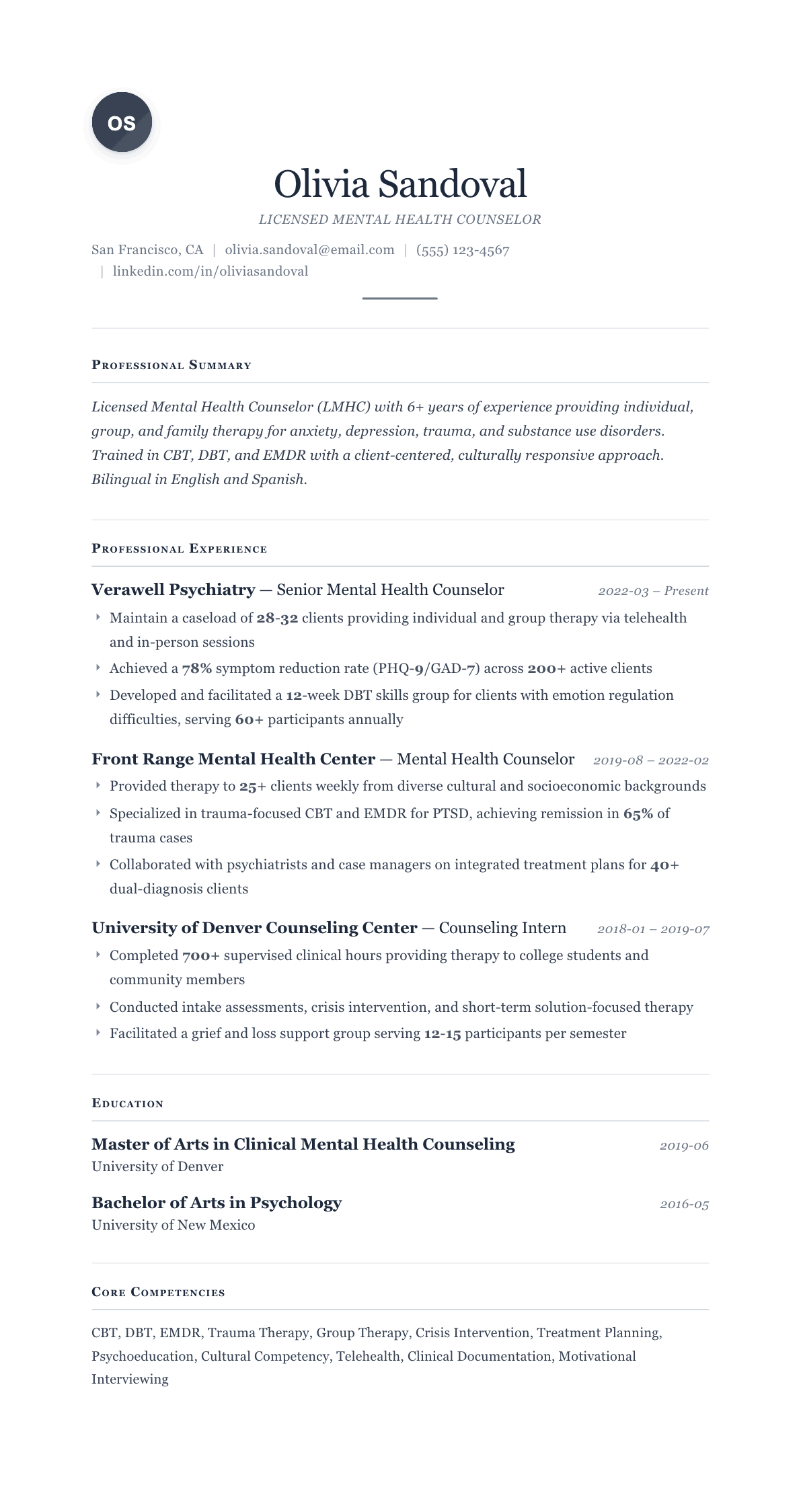
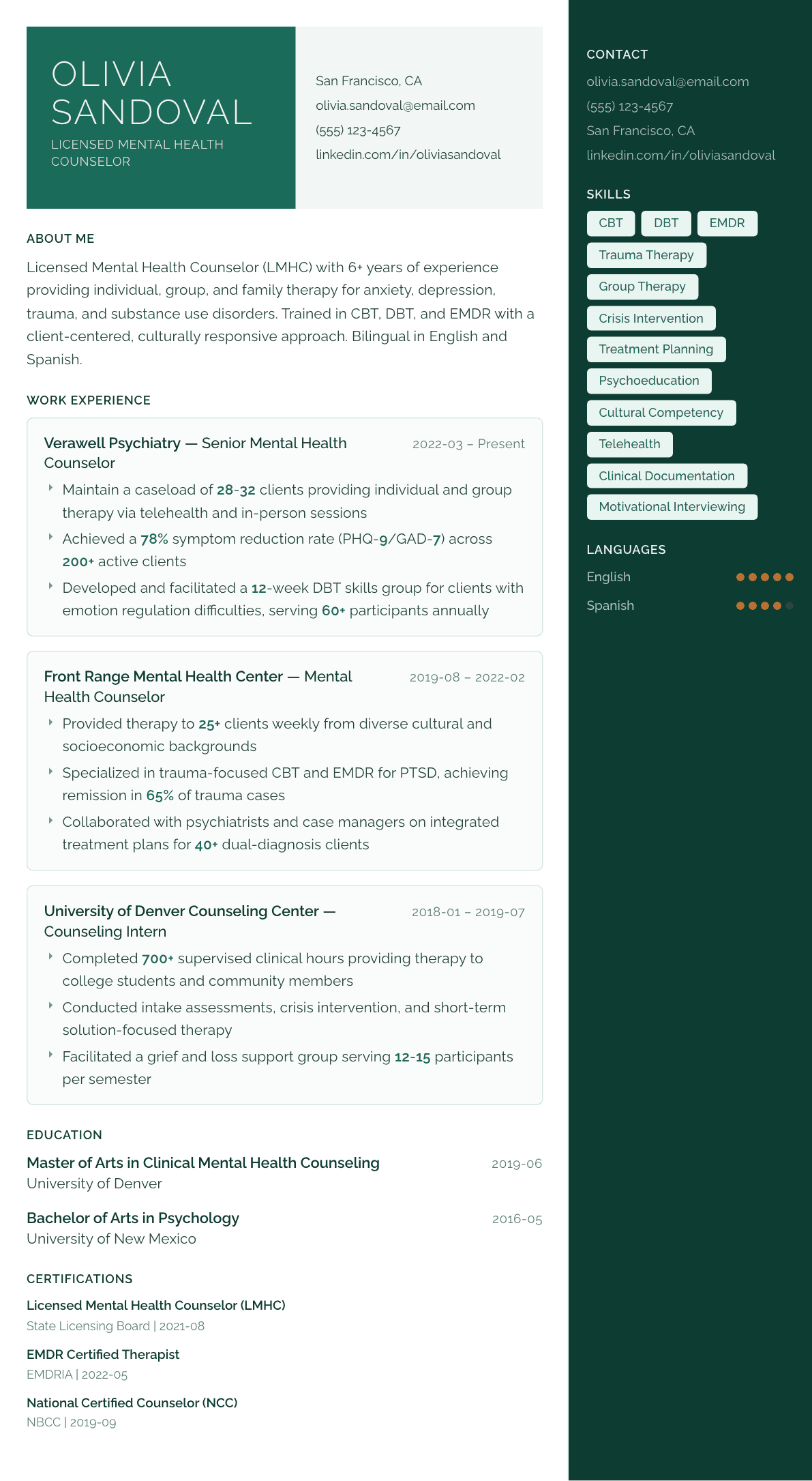
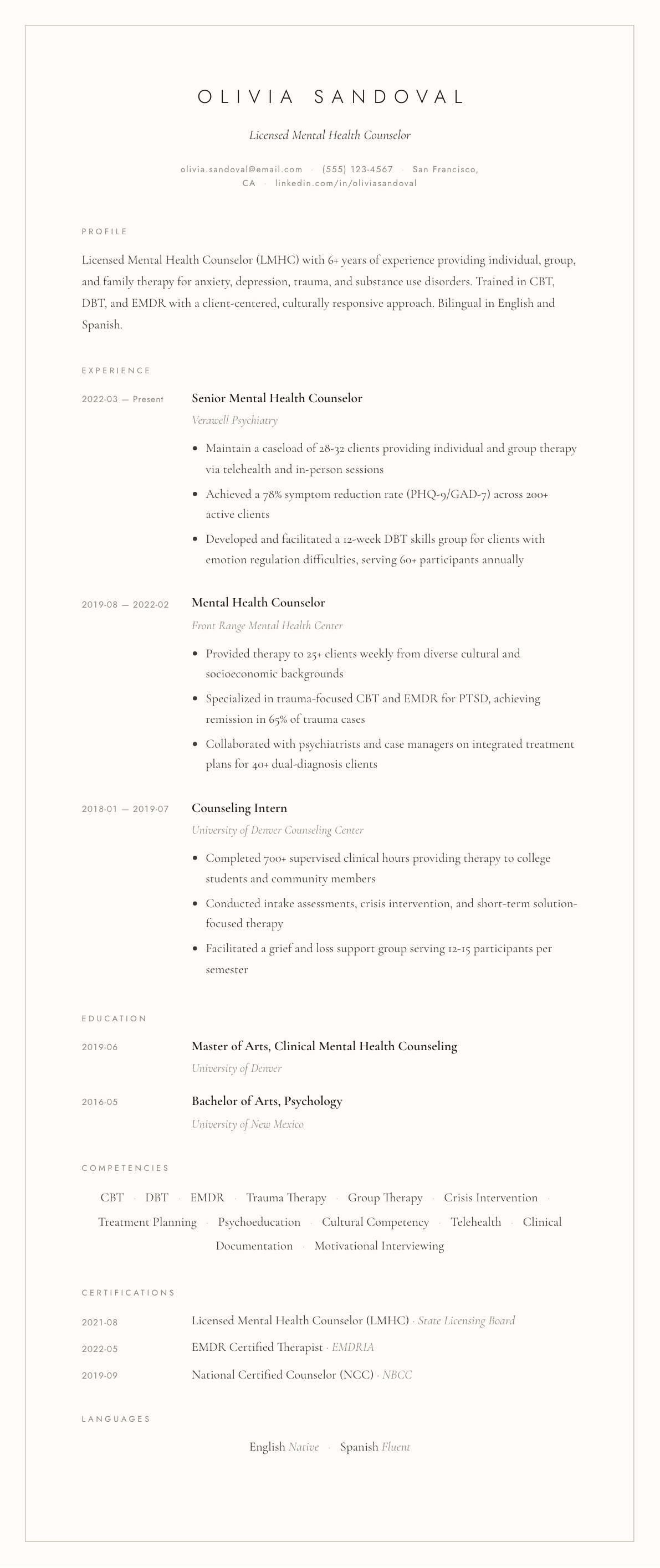
Example Mental Health Counselor summary
Licensed Mental Health Counselor (LMHC) with 6 years of experience in individual and group therapy for anxiety, depression, and trauma. CBT, DBT, and EMDR trained with a 78% symptom reduction rate. Bilingual in English and Spanish. Seeking a clinical position at a community mental health center.
Skills to list on a Mental Health Counselor resume
- CBT
- DBT
- EMDR
- Trauma Therapy
- Group Therapy
- Family Therapy
- Crisis Intervention
- Treatment Planning
- Motivational Interviewing
- Psychoeducation
- Substance Use Treatment
- Cultural Competency
- Telehealth
- Clinical Documentation
- Supervision
What actually gets this resume read
- Display your license type (LPC, LMHC, LCPC) and NCC credential prominently.
- Quantify caseload sizes, client outcomes, and symptom reduction rates.
- List specific therapeutic modalities you are trained in (CBT, DBT, EMDR, etc.).
- Specify the populations and diagnoses you specialize in.
- Highlight bilingual abilities and cultural competency training.
- Include group therapy facilitation and program development experience.
How to write a mental health counselor resume
A mental health counselor resume is screened by a clinical director or a group practice owner who is looking for three things before anything else: the license and its state, the modalities you were trained in and actually use, and the populations and presentations you are competent to treat. After that comes the practical question of whether you can hold a caseload at the volume the agency needs.
Counselors tend to write warmly and vaguely, and warmth does not survive a screen. "Passionate about helping clients reach their potential" appears on nearly every application in the pile. What separates a file is naming the therapy models, the diagnostic categories, the assessment instruments, the setting and the caseload, then showing clinical judgment in the way you describe cases.
This guide covers the layout agencies and group practices expect, how to present licensure at every stage from associate to independent, how to write caseload and outcomes without overstating them, and the questions counselors ask when moving between community mental health, private practice, telehealth and integrated care.
Format: license in the header, one page until you supervise
Reverse chronological, one page for the first several years, two pages once you supervise, teach or hold multiple state licenses. Put the license after your name in the exact abbreviation your state uses, since the title varies by state and a hiring director in another state will read it carefully.
Give licensure its own section directly under the summary: license type, state, number, expiration, and any additional state where you are licensed or hold a telehealth authority. Multi-state licensure is a hiring advantage for any practice running virtual sessions and it belongs where it cannot be missed.
- Header: name with credential, city and state, phone, email, and the states you are licensed to practice in.
- Sections in this order: summary, licensure, clinical experience, modalities and training, education and practicum, certifications.
- Prelicensed candidates add supervised hours accrued, the supervisor credential and the expected exam date.
Summary: license, population, modalities, setting
Three or four lines. Name the license, the years of post-graduate practice, the presentations you treat most, the modalities you were formally trained in, and the setting. "Licensed counselor with six years treating anxiety, depression, trauma and co-occurring substance use, trained in cognitive behavioral therapy, dialectical behavior therapy and eye movement desensitization and reprocessing" gives a director everything needed to place you.
If you speak a second language at clinical level, put it in the summary. Bilingual clinicians are a scarce resource in community mental health and the summary is where that gets noticed rather than at the bottom of the page.
Experience: caseload, modality, and clinical decision making
Open each role with the setting and the caseload: a community mental health center, a partial hospitalization program, a substance use treatment center, a school based clinic, an integrated primary care team, a college counseling center or a group private practice. Then give the weekly session count or active client count, the age range and the acuity.
Write bullets that show the clinical work. Intake and diagnostic assessment against the current diagnostic manual, treatment planning with measurable goals, the modality applied to which presentation, group facilitation with the curriculum and length, risk assessment and safety planning, coordination with prescribers, and case consultation. A director is reading for whether you can hold a high risk client without panicking.
Outcomes can appear if you actually collected them. Symptom measures such as the depression and anxiety screening instruments many agencies administer at intake and review are legitimate to cite when your agency tracked them. Retention and attendance rates are also fair. Do not invent a remission figure.
Modalities and training: specific, and honestly leveled
List the models you were trained in and mark the level of training rather than blurring it. There is a difference between a weekend introduction, a full certification course, and years of supervised application. Directors ask about this in interviews and an inflated claim is easy to catch.
Common models worth naming when they are real: cognitive behavioral therapy, dialectical behavior therapy including skills group facilitation, acceptance and commitment therapy, motivational interviewing, trauma focused cognitive behavioral therapy, eye movement desensitization and reprocessing, solution focused brief therapy, internal family systems, and structural or emotionally focused approaches for couples and families.
Add the assessment and screening instruments you administer, the documentation platform you chart in such as SimplePractice, TherapyNotes, Valant or an Epic behavioral health module, and any experience with insurance panels, utilization review or authorization requests, because a group practice cares whether you can carry billable hours cleanly.
Risk, ethics and the language postings use
Every posting in this field carries the same vocabulary: intake assessment, treatment planning, evidence based practice, suicide risk assessment, safety planning, crisis intervention, duty to warn, mandated reporting, confidentiality and HIPAA, cultural responsiveness, and clinical documentation. Mirror the phrasing once in a skills block and once inside a bullet that demonstrates it.
Give risk work its own bullet. Naming a suicide risk assessment framework you use, describing how you build a safety plan with a client, and saying how you handle a hospitalization decision and the handoff afterward is the clearest signal of clinical maturity you can put on a page.
Mental Health Counselor resume summary examples
Prelicensed associate
Master level counselor working toward independent licensure with more than 800 supervised clinical hours across a university counseling center and a community agency. Trained in cognitive behavioral therapy and motivational interviewing, experienced with intake assessment, crisis response and short term treatment for young adults.
Six years licensed
Independently licensed counselor carrying a caseload near thirty clients weekly in a group practice, treating anxiety, depression, post-traumatic stress and co-occurring substance use. Trained in dialectical behavior therapy and eye movement desensitization and reprocessing, and facilitates a twelve week skills group each term.
Clinical supervisor
Clinical supervisor and licensed counselor with eleven years in community mental health and integrated primary care, supervising six associates toward licensure. Built the agency risk assessment protocol, runs the trauma treatment track, and consults on the highest acuity cases across three programs.
Work experience bullets: before and after
Before: Provided therapy to clients with mental health issues.
After: Carried a weekly caseload of about thirty adult clients treating generalized anxiety, major depression, post-traumatic stress and co-occurring alcohol use in a community mental health center.
Caseload, presentations and setting let a director judge fit instead of guessing at it.
Before: Used evidence-based treatment approaches.
After: Applied trauma focused cognitive behavioral therapy across a twelve to sixteen session course for clients with post-traumatic stress, tracking symptom measures at intake, midpoint and discharge.
A named model, a course length and a measurement rhythm show real protocol adherence.
Before: Ran group therapy sessions.
After: Developed and facilitated a twelve week dialectical behavior therapy skills group covering distress tolerance and emotion regulation, running two cohorts a year with a stable attendance rate.
Curriculum, length and cadence turn a group mention into evidence you can build a program.
Before: Handled clients in crisis.
After: Conducted suicide risk assessments and built collaborative safety plans with clients and families, coordinating voluntary admissions with the local crisis team and completing the return to care handoff.
Risk work is only credible when the process and the handoff are described, not just claimed.
Before: Worked with the treatment team.
After: Coordinated integrated care with prescribers and case managers for clients on complex medication regimens, presenting cases at weekly consultation and updating shared treatment plans in the chart.
It shows the mechanics of collaboration rather than asserting that a team existed.
Hard skills
- Diagnostic assessment and intake
- Treatment planning with measurable goals
- Cognitive behavioral therapy
- Dialectical behavior therapy skills groups
- Motivational interviewing
- Trauma focused therapy
- Suicide risk assessment and safety planning
- Substance use screening and co-occurring care
- Group facilitation
- Symptom measure administration
- Clinical documentation and treatment notes
- Telehealth practice
Soft skills
- Therapeutic alliance building
- Nonjudgmental listening
- Boundary maintenance
- Cultural responsiveness
- Tolerance for clinical uncertainty
- Self-care and burnout management
Certifications worth listing
- Licensed Professional Counselor (LPC) (State professional counselor licensing board)
- Licensed Mental Health Counselor (LMHC) (State licensing authority)
- National Certified Counselor (NCC) (National Board for Certified Counselors)
- Certified Clinical Mental Health Counselor (CCMHC) (National Board for Certified Counselors credentialing arm)
- Master Addiction Counselor (MAC) (NBCC certification program)
- EMDR Basic Training completion (EMDR International Association approved provider)
Mistakes that cost mental health counselor candidates the interview
- Opening with warmth and passion instead of the license, the setting and the presentations you treat.
- Leaving the license state and number off the page, which forces a verification email before anyone reads the experience.
- Listing every therapy model ever encountered without saying which ones you were formally trained in and use weekly.
- Omitting the caseload, so a director cannot tell whether you have carried the volume her program requires.
- Avoiding risk and crisis work on the page when that is exactly the competence agencies are most anxious about.
- Reporting an outcome rate no one at the agency ever measured, which collapses under a single interview question.
- Burying a second clinical language at the bottom of the page instead of in the first three lines.
Mental Health Counselor resume questions
How do I write a counseling resume while I am still prelicensed?
Lead with the degree, the supervised hours accrued, your supervisor credential and the expected exam date. Then write your practicum and associate work as real clinical experience with populations, caseload and modalities, because that is what a director evaluates.
Should I list every therapy modality I have training in?
List the ones you use regularly and mark the depth of training honestly. A short list of models you can discuss in supervision reads far stronger than a long list where an interviewer finds the second and third item are single workshops.
Can I put client outcomes on a mental health counselor resume?
Only outcomes your agency actually collected, such as symptom measure changes, attendance and retention, or completion of a structured group. Describe the measurement rhythm alongside the result so the reader can see where the number came from.
How do I present private practice experience to an agency employer?
Give the caseload, the presentations, the insurance panels you are credentialed with and the documentation platform you use. Agencies worry that private practice clinicians will resist productivity targets, so show volume and clean documentation directly.
Does telehealth experience belong on the resume?
Yes, and name the platform, the states you are authorized to practice in and how you handle risk assessment at a distance. Remote crisis protocols are a real skill and practices hiring for virtual work screen for them specifically.