Public Health Nurse Resume Examples: what gets the call
Write a Public Health Nurse Resume Built on Population Work
By Mustafa Tarabya, founder of CVBooster · Published · Updated
Public health nurse resume example with community program detail, case investigation keywords, grant wording and a guide to writing each section.
Sample resumes for a public health nurse
The same public health nurse content laid out in three CVBooster templates, so you can see what the finished document looks like before you write a word.
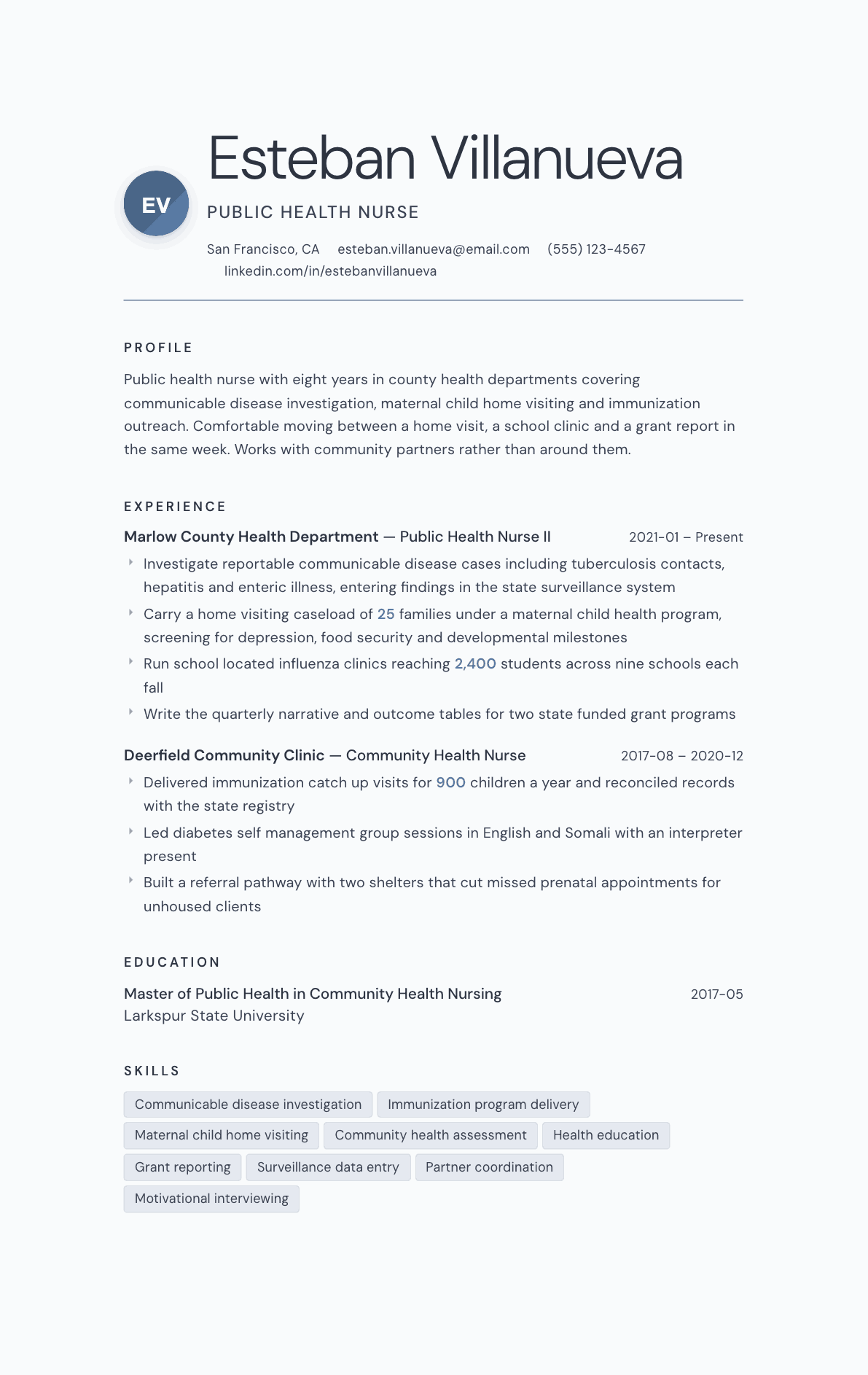
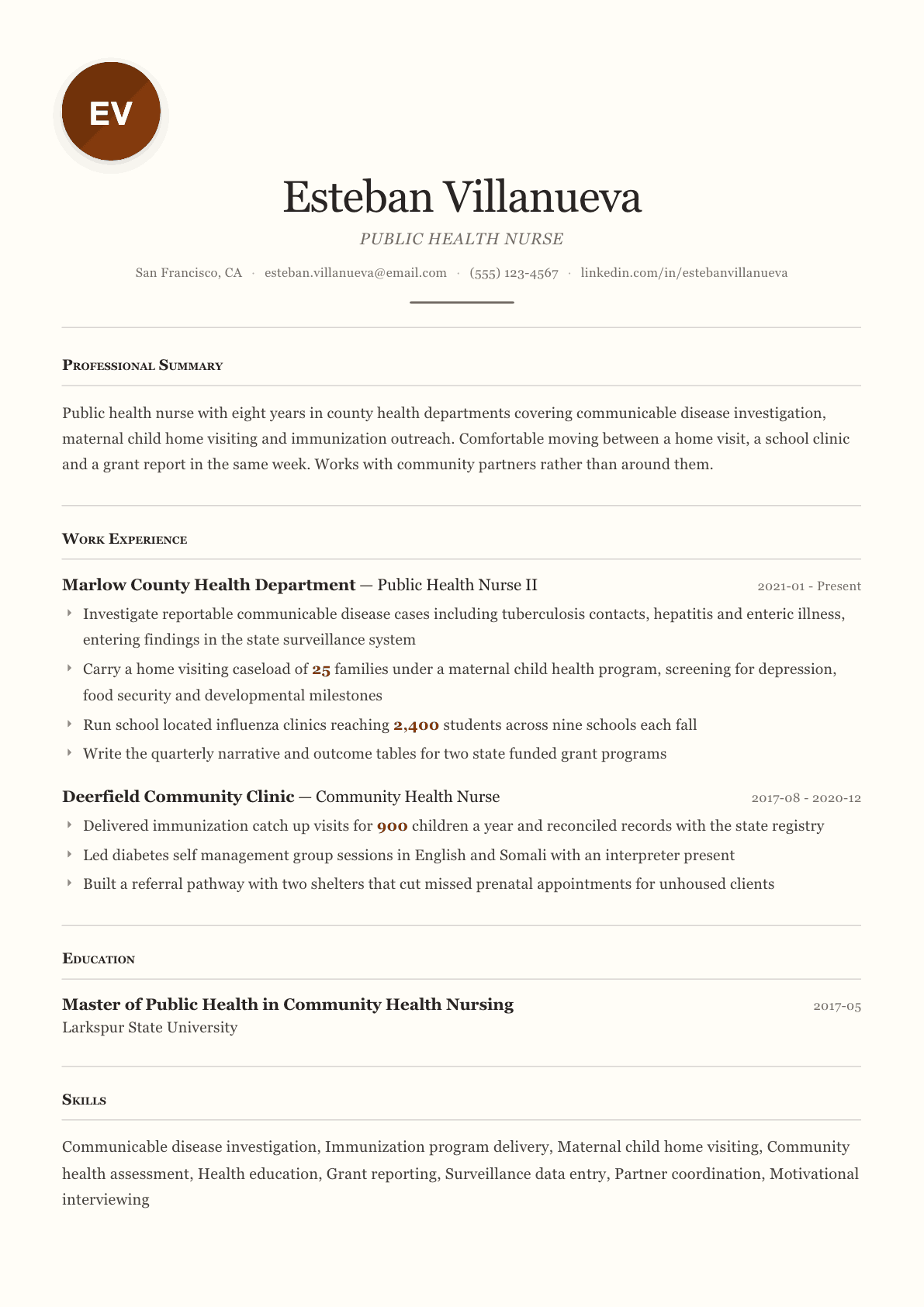
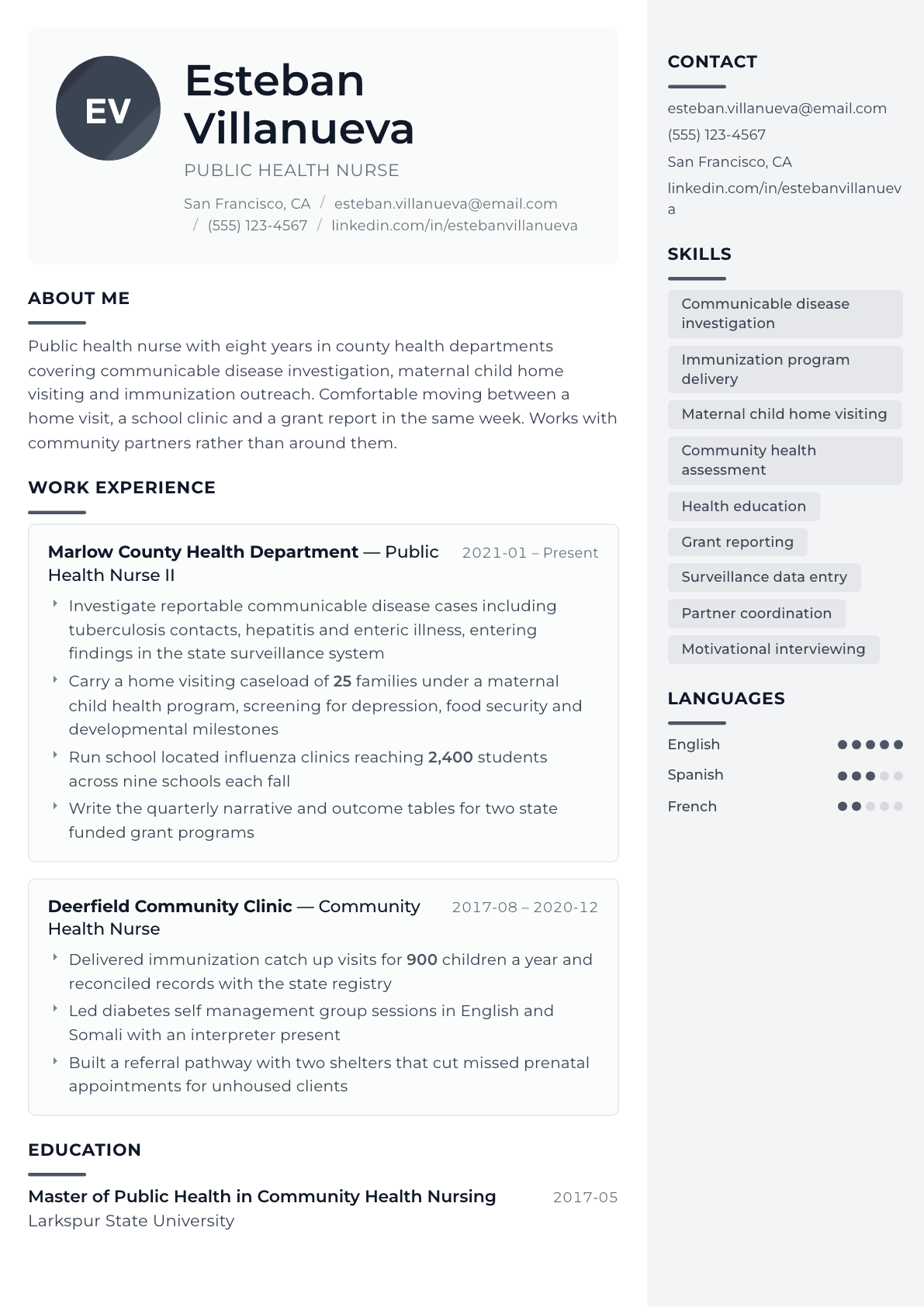
Example Public Health Nurse summary
Public health nurse with eight years in county health department programs spanning communicable disease investigation, maternal child home visiting and mass immunization clinics. Comfortable with state surveillance systems, grant narratives and outbreak response roles under incident command. Builds working relationships with schools, shelters and clinics so that programs reach the families who are hardest to enroll.
Skills to list on a Public Health Nurse resume
- Population health assessment
- Communicable disease investigation
- Contact tracing
- Immunization delivery and registry reconciliation
- Maternal and child home visiting
- Developmental and depression screening
- Health education and outreach
- Emergency preparedness response
- Grant reporting and program evaluation
- Community partnership building
- Motivational interviewing
- Case management
- Epidemiological surveillance systems
- Policy and protocol writing
What actually gets this resume read
- Frame your work at population level, naming the county, the caseload size and the program that funded the position.
- List the surveillance and registry systems you have used, because health departments hire on that familiarity.
- Show your role in outbreak or case investigation work, including contact tracing volume and isolation follow up.
- Include grant reporting, budget monitoring or program evaluation, since these separate a public health nurse from bedside nursing.
- Name the communities and languages you serve, as cultural reach is a stated requirement in many local postings.
- Keep your RN license, public health nurse certificate where required, and any state specific credential clearly visible.
How to write a public health nurse resume
A public health nurse resume goes to a government hiring process before it goes to a nurse. Human resources checks the license, the degree, the minimum qualifications and often a set of supplemental questions that are scored point by point. Only then does a program supervisor read it. Writing for the supervisor alone is how strong candidates get filtered out before anyone clinical sees the file.
Once it reaches the supervisor, the question changes completely. She is not looking for bedside skill. She wants to know whether you can hold a home visiting caseload, close a case investigation properly in the surveillance system, stand up a clinic in a school gymnasium, and write the part of the grant report that describes what the program did.
This guide walks through both audiences: the minimum qualification language that gets you past screening, and the program detail that gets you interviewed. It includes three example summaries, before and after bullets from county health department work, and answers to the questions nurses ask when they move from hospital work into public health.
Format: written for a scored application, not just a reader
Two pages is normal and often expected, because government screening rewards completeness rather than brevity. Reverse chronological, plain headings, no columns. Mirror the exact wording of the minimum qualifications in the posting, since a screener may be comparing your text against a checklist rather than interpreting it.
Keep a licensure block near the top with your registered nurse license and state, any public health nurse certificate required by your state, and your degrees. Some states restrict the job title itself to nurses holding a specific certificate, so make yours impossible to miss.
- Header: name with credentials, city and state, phone, email, license state and number status.
- Sections: summary, licensure and education, program experience, community and partner work, skills, systems, training.
- Government applications often want month and year for every position, plus hours per week. Include both.
Summary: level of practice, programs, population
Four lines. Name the years in public health, the jurisdiction type such as county, city or state, the programs you have carried, and the population you served. Public health nursing is organized around programs, so naming them is how you show scope: communicable disease, maternal child health, immunization, school health, refugee health, tuberculosis, correctional health or emergency preparedness.
If you are moving from acute care, say it directly and bridge it. Case management, patient education, discharge planning, infection prevention and triage all translate. What does not translate on its own is the population level thinking, so pair the bridge with any community project, screening event or outreach work you have done.
Experience: caseloads, investigations, clinics, partners
Each position needs the agency, the program, the funding source if it shaped the work, and the size of what you carried. Caseload numbers matter here the way patient ratios matter on a hospital unit. A home visiting caseload of twenty five families is a workload statement a supervisor understands instantly.
Then write bullets around the four types of work. Case investigation: the diseases you have investigated, contact tracing volume, isolation and quarantine follow up, and the surveillance system you entered findings into. Direct service: home visits, screening, immunization delivery, directly observed therapy, and the assessment tools you used. Clinic and event operations: how many people were served, how many sites, how you staffed and supplied them. Program and partner work: coalition membership, school and shelter agreements, referral pathways, and the community health assessment cycle.
Add grant work if you have touched it. Writing a narrative section, building the outcome table, monitoring a budget line or preparing a site visit are all things public health nurses do and rarely put on paper, and they distinguish you immediately from a purely clinical applicant.
Systems, tools and the frameworks the field uses
Name the systems by category since they vary by state: the disease surveillance system, the immunization information system, the home visiting data system and the electronic record used in your clinic. Familiarity with any of them shortens onboarding and supervisors know it.
Then name the frameworks you work within: the ten essential public health services, incident command structure during an emergency response, the community health assessment and improvement plan cycle, and accreditation standards if your agency pursued them. These are the vocabulary of the field, and using them accurately signals that you are already inside it.
Skills and the supplemental questions
Keep the skills list weighted toward population practice: assessment, investigation, contact tracing, screening, health education, case management, motivational interviewing, cultural responsiveness, interpreter use, and data entry and reporting. Clinical skills still belong there, but they should not crowd out the community work.
Finally, treat the supplemental questions as part of the resume. Answer each one with a concrete example that also appears in your experience section, so the screener finds the same fact in two places. Vague answers to scored questions are the most common reason a qualified nurse never reaches the interview list.
Public Health Nurse resume summary examples
New to public health
Registered nurse with three years in medical surgical care and a public health nurse certificate, now moving into community practice. Experience with discharge planning, patient education and infection prevention, plus volunteer work running blood pressure screening and immunization events at a neighborhood clinic. Bilingual in English and Spanish.
Five years in a county program
Public health nurse with five years in a county health department carrying a maternal child home visiting caseload of 25 families and covering communicable disease investigation on rotation. Runs school located immunization clinics each fall, enters findings into the state surveillance system, and screens for depression, food security and developmental milestones.
Program supervisor track
Senior public health nurse with eleven years across communicable disease, maternal child health and emergency preparedness. Supervises four nurses and two community health workers, writes quarterly grant narratives for two funded programs, and served as a section chief under incident command during a regional outbreak response.
Work experience bullets: before and after
Before: Investigated communicable disease cases.
After: Investigated reportable communicable disease cases including tuberculosis contacts, hepatitis and enteric illness, completing interviews, contact elicitation and isolation follow up, and entering every case in the state surveillance system within the reporting window.
The diseases, the investigation steps and the reporting window show the full case cycle rather than the word investigated.
Before: Made home visits to families.
After: Carried a home visiting caseload of 25 families under a maternal child health program, screening for perinatal depression, food security and developmental milestones, and referring to early intervention when a delay was identified.
Caseload size and named screening tools turn home visits into a measurable program responsibility.
Before: Helped run vaccination clinics.
After: Coordinated school located influenza clinics across nine schools each fall, handling consent collection, staffing, cold chain management and registry reconciliation for about 2,400 students.
Site count, logistics detail and volume show you can operate a clinic rather than staff one.
Before: Worked with community organizations.
After: Built a referral pathway with two shelters and a community clinic that moved unhoused pregnant clients into prenatal care directly, reducing missed first trimester appointments across the program year.
A named partnership with a mechanism and a result is real community work rather than attendance at meetings.
Before: Reported on program activities.
After: Wrote the quarterly narrative and outcome tables for two state funded grant programs, reconciling service counts against the data system before each submission to the state program officer.
Grant reporting is a distinguishing skill, so name the deliverable, the reconciliation and the recipient.
Hard skills
- Communicable disease case investigation
- Contact tracing and isolation follow up
- Disease surveillance system entry
- Immunization delivery and registry reconciliation
- Maternal and child home visiting
- Developmental and perinatal depression screening
- Community health assessment
- Directly observed therapy for tuberculosis
- Mass clinic operations and cold chain management
- Emergency preparedness under incident command
- Grant reporting and program evaluation
- Health education and outreach planning
Soft skills
- Building trust in distrustful communities
- Working through interpreters
- Coalition and partner facilitation
- Independent judgment in the field
- Persistence in follow up
- Writing clearly for non clinical readers
Certifications worth listing
- Registered Nurse License (State board of nursing)
- Public Health Nurse Certificate (State board of registered nursing)
- Certified in Public Health (CPH) (National Board of Public Health Examiners)
- Incident Command System IS-100 and IS-700 (Federal Emergency Management Agency)
- Basic Life Support (BLS) (American Heart Association)
Mistakes that cost public health nurse candidates the interview
- Writing for the nurse supervisor and ignoring the human resources screener who scores the application first.
- Describing hospital duties in hospital language when the posting asks for population level and community experience.
- Leaving out caseload sizes, clinic volumes and site counts, which are the only way a reader can size the work.
- Skipping the surveillance, registry and reporting systems you have used, which is a direct onboarding cost to the agency.
- Answering supplemental questions vaguely, so the scored part of the application drags down an otherwise strong file.
- Omitting emergency preparedness roles, since most health departments expect every nurse to deploy during a response.
Public Health Nurse resume questions
Do I need a public health nurse certificate to apply?
It depends on the state. Some states restrict the job title to registered nurses holding a specific public health certificate, while others accept any registered nurse license. Read the minimum qualifications carefully and state clearly which credential you hold.
How do I move from hospital nursing into public health?
Bridge the transferable work explicitly: case management, patient education, discharge coordination, infection prevention and triage. Then add anything population facing you have done, including screening events, community volunteering, outreach clinics or a public health course.
How long should a public health nurse resume be?
Two pages is standard because government screening rewards complete documentation of duties, dates and hours. Keep it dense with real detail rather than padded, and include month and year for every position since many applications require it.
Should I include contact tracing work from an outbreak response?
Yes, and give it structure. Say how many cases and contacts you handled, the interview and follow up protocol you worked from, the system you documented in, and any team lead or training role you took during the response.
How do I show grant experience if I did not write the application?
Describe the part you owned. Preparing outcome tables, writing narrative sections, tracking service counts, monitoring a budget line or getting a site visit ready are all genuine grant experience, and supervisors recognize them as such.