Nutritionist Resume Examples: free ATS score and gap list
Build a Nutritionist Resume That Names Your Credential and Population
By Mustafa Tarabya, founder of CVBooster · Published · Updated
A nutritionist resume example with counseling settings, assessment methods and credential placement, plus the keywords hiring managers screen for.
Sample resumes for a nutritionist
The same nutritionist content laid out in three CVBooster templates, so you can see what the finished document looks like before you write a word.
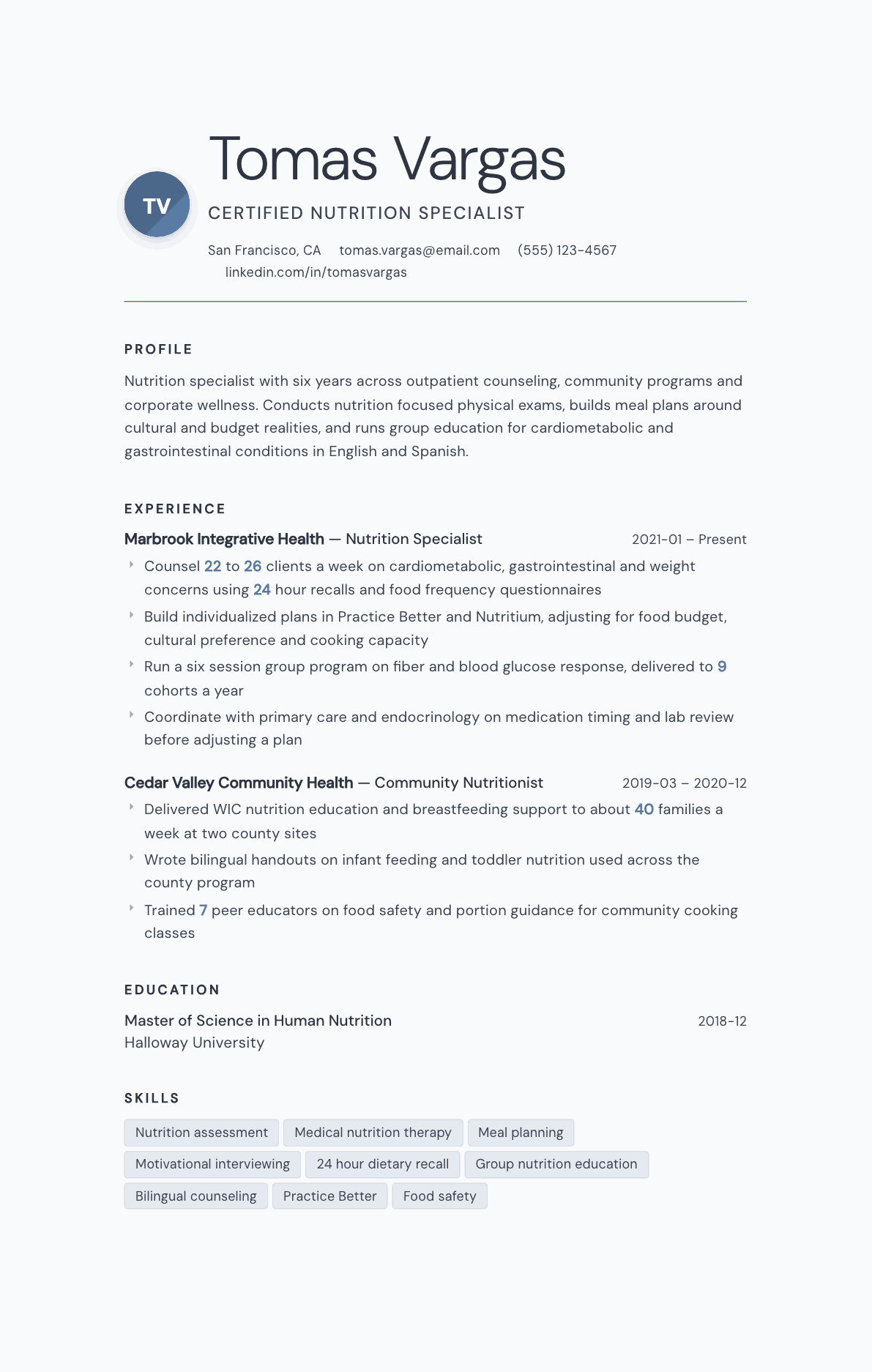
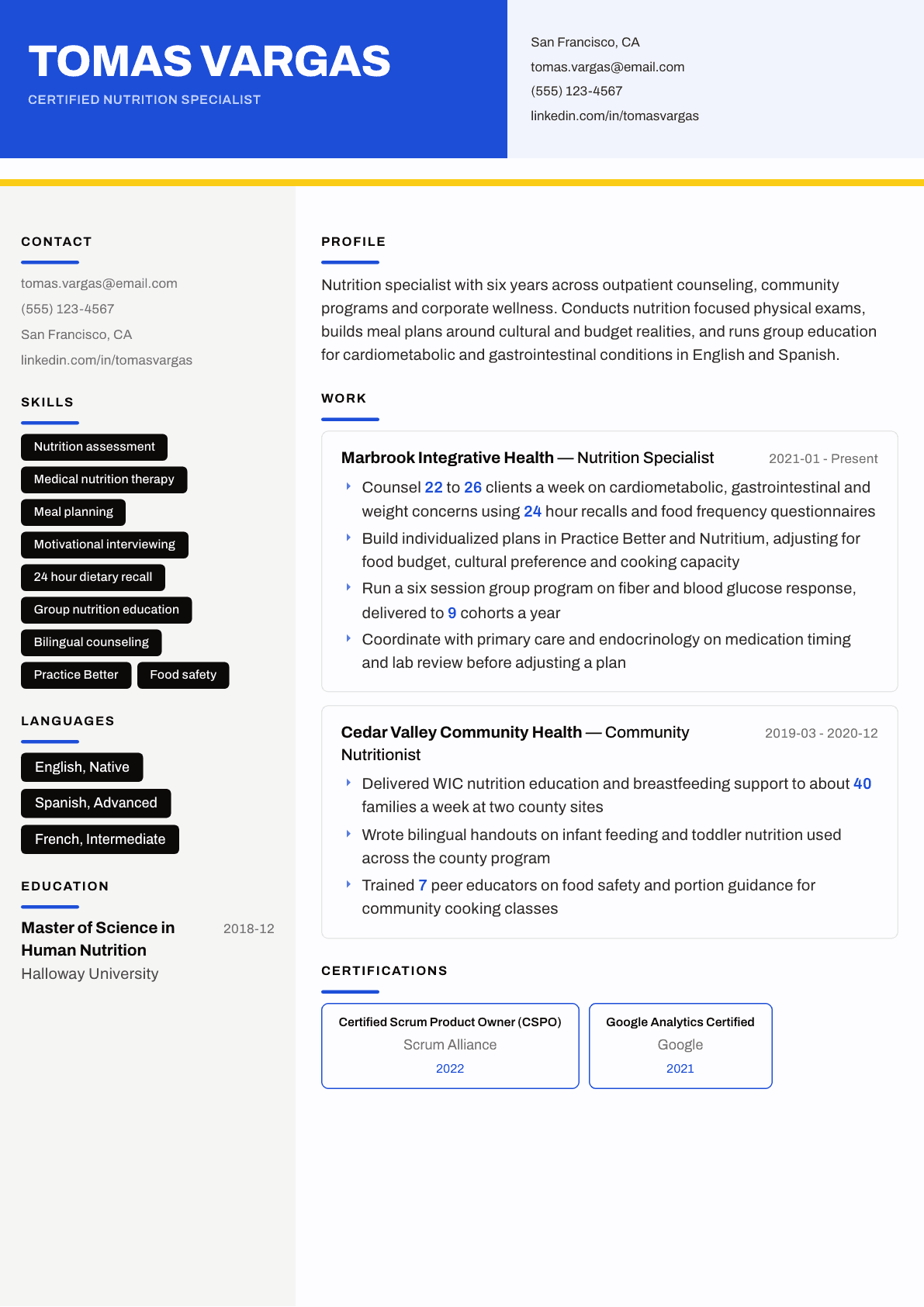
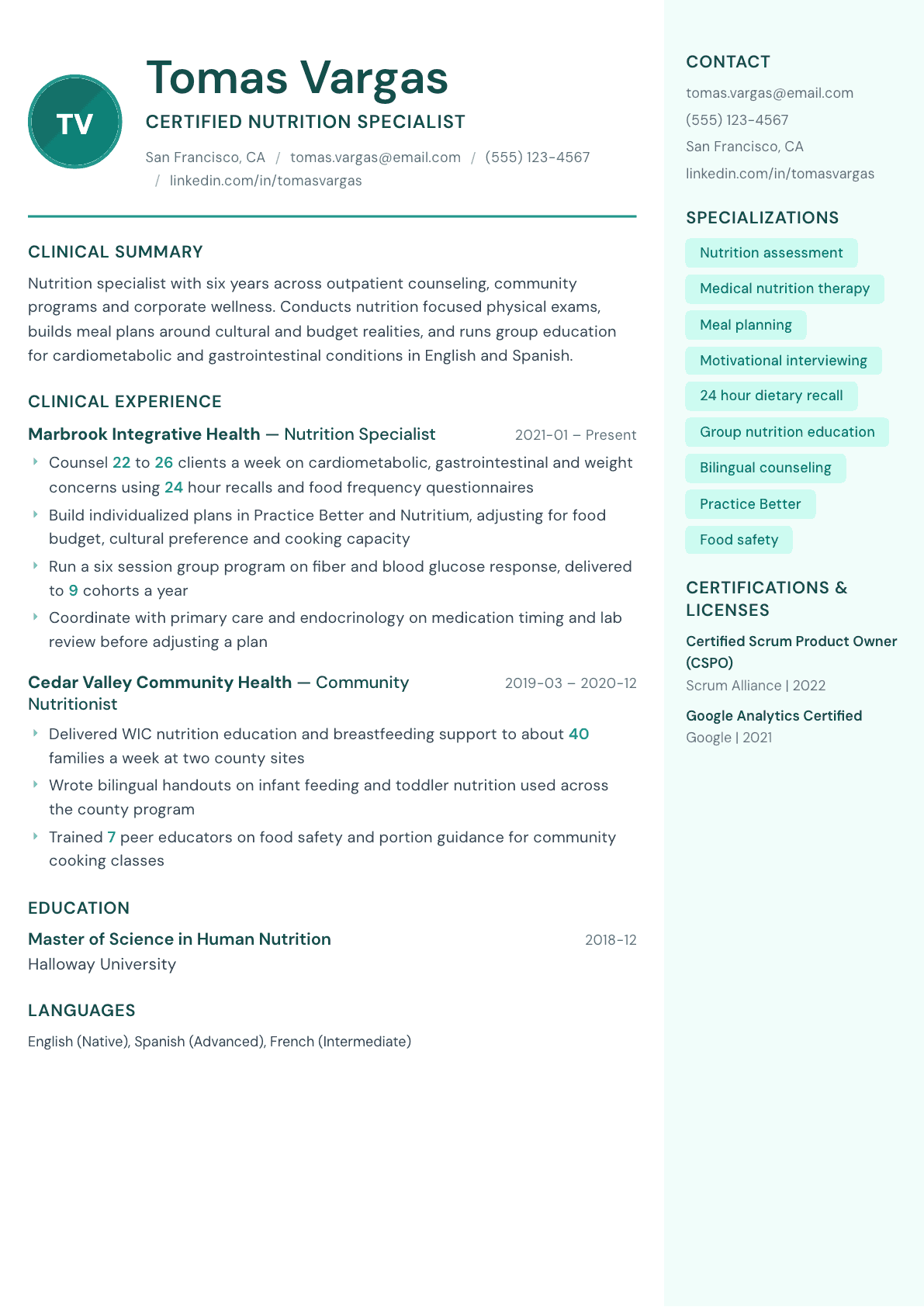
Example Nutritionist summary
Nutrition specialist with six years in outpatient counseling, community health and corporate wellness. Assesses intake with 24 hour recalls and food frequency questionnaires, then builds plans that fit a client budget, kitchen and culture. Counsels cardiometabolic, gastrointestinal and weight concerns in English and Spanish, and coordinates with primary care and endocrinology before adjusting plans around medication and lab results.
Skills to list on a Nutritionist resume
- Nutrition assessment
- Medical nutrition therapy
- Individualized meal planning
- Nutrition focused physical exam
- 24 hour dietary recall
- Food frequency questionnaires
- Diabetes nutrition counseling
- Gastrointestinal nutrition
- Sports and performance nutrition
- Group education delivery
- Motivational interviewing
- Food safety and sanitation
- Bilingual client counseling
- Practice Better
- Community program delivery
What actually gets this resume read
- Put your credential and its state license status in the header, because nutrition titles are regulated differently in each state.
- Distinguish medical nutrition therapy from general nutrition education, since only some settings can bill for the former.
- Name the assessment tools you use, such as 24 hour recall, food frequency questionnaires or nutrition focused physical exam.
- Give client volume per week and the setting, because outpatient, community and corporate caseloads look nothing alike.
- List the conditions you counsel most, from diabetes and dyslipidemia to celiac disease, reflux and food allergy.
- Add languages spoken, since bilingual counseling is a hiring driver in community and clinic nutrition roles.
How to write a nutritionist resume
Nutritionist is a title with different legal weight depending on where you practice. Some states restrict who may call themselves a nutritionist and who may provide medical nutrition therapy, and the person screening your resume knows exactly which rules apply in their state. That is why the credential line at the top of the page carries more weight in this field than in almost any other health role.
Beyond the credential, hiring managers read for three things: the settings you have counseled in, the assessment methods you actually use, and the conditions you are comfortable taking on. Outpatient clinic, community program, corporate wellness, long term care and private practice all look for different evidence, and a single generic resume satisfies none of them.
This guide covers the section order employers expect, summaries for a new graduate through a private practice owner, before and after bullets built from real counseling work, and the questions nutritionists ask when they are switching settings.
Format: credential and license status at the very top
Put your credential abbreviations after your name and add a licensure line beneath it naming the state and status. Where a state licenses nutritionists or restricts medical nutrition therapy, a hiring manager cannot move your file forward without knowing whether you are already licensed there or eligible.
Keep it to one page under five years of experience. Order the page so the credential, the settings and the conditions are all visible without scrolling, then let the job history carry the detail.
- Header: name, credential abbreviations, city and state, phone, email, and languages spoken.
- Order: summary, credentials and licensure, clinical focus areas, professional experience, education and supervised practice, skills.
- New graduates put the supervised practice or internship hours directly under education with the rotation settings named.
Summary: setting, population, and the conditions you counsel
Three sentences that answer where, who and what. The setting: outpatient clinic, community health, employer program, sports team, long term care or private practice. The population: pediatric, adult, geriatric, prenatal, athletic. The conditions: diabetes, dyslipidemia, chronic kidney disease, celiac disease, inflammatory bowel disease, food allergy, eating concerns, weight management.
End with something operational. Counseling volume per week, group program delivery or bilingual capacity all say more about your fit than an adjective. A nutritionist who counsels twenty five clients a week in two languages has said something no summary phrase can match.
Experience: assessment method, volume, and the plan you built
Lead each role with the setting and the caseload. Then show the assessment method by name: twenty four hour dietary recall, three day food record, food frequency questionnaire, nutrition focused physical exam, anthropometrics, and review of relevant labs where that is within your scope. Naming the method is what separates a nutrition professional from a general wellness advisor on paper.
Then show the plan. A meal plan built around a client food budget, kitchen equipment, work schedule and cultural food preferences is a real intervention, and describing those constraints proves you counsel actual people rather than textbook cases. Add follow up cadence, since adherence work happens between sessions.
Group and community work deserves its own bullets. Cohort counts, session series length, class sizes and the materials you wrote are all concrete, and community employers hire almost entirely on that evidence.
Scope, collaboration and documentation
Show where you coordinate with clinicians. Reviewing a plan against medication timing with a pharmacist, checking a renal diet with the nephrology team, or flagging a suspected eating disorder for behavioral health referral are all bullets that demonstrate judgment. A reader who supervises nutrition staff is scanning for exactly that.
Name your documentation. Charting in an electronic health record, using a practice management platform for plans and messaging, or completing standardized nutrition care process notes with problem, etiology and signs are all filterable, checkable details.
- Use the nutrition care process vocabulary where you have been trained in it: assessment, diagnosis, intervention, monitoring and evaluation.
- List analysis software and practice platforms by name, since employers ask about them during onboarding.
- State any billing exposure, including which visit types you documented for reimbursement.
Keywords and the tailoring pass
Postings repeat a short list: nutrition assessment, medical nutrition therapy, individualized meal planning, dietary counseling, patient education, group education, motivational interviewing and the condition names. Mirror the exact wording of the posting once in the focus areas block and once inside a bullet where it is true.
Then tailor. A sports nutrition posting wants body composition, fueling strategies and periodization language. A community posting wants supplemental nutrition program experience, bilingual delivery and outreach. Rewrite the summary and the first two bullets for each, and leave the rest.
Nutritionist resume summary examples
New graduate
Master of science graduate in human nutrition with supervised practice across an outpatient clinic, a county community program and a long term care kitchen. Trained in nutrition focused physical exam and 24 hour recall methods, with bilingual counseling in English and Spanish.
Five years in
Nutrition specialist counseling 22 to 26 clients a week on cardiometabolic, gastrointestinal and weight concerns in an integrative practice. Builds plans around food budget, cultural preference and cooking capacity, runs a six session fiber and glucose group program, and coordinates plan changes with primary care and endocrinology.
Private practice owner
Nutritionist with eleven years of clinical counseling and six years running a three clinician private practice. Built the intake and follow up protocol, contracted with two regional insurers, supervised two nutrition graduates through their practice hours, and delivers corporate group programs alongside individual caseload.
Work experience bullets: before and after
Before: Provided nutrition counseling to clients.
After: Counseled 22 to 26 clients a week on cardiometabolic, gastrointestinal and weight concerns, assessing intake with 24 hour recalls and food frequency questionnaires.
Weekly volume, condition mix and named assessment methods show the actual clinical work instead of the job description.
Before: Created meal plans for clients.
After: Built individualized plans that accounted for a client grocery budget, kitchen equipment, shift schedule and cultural food preferences, then adjusted them at each two week follow up.
Real constraints and a follow up cadence prove the plans were used, not printed.
Before: Ran nutrition classes in the community.
After: Delivered a six session group program on fiber intake and blood glucose response to 9 cohorts a year, writing the participant workbook and the facilitator guide.
Cohort count and authored materials turn a class into a program you can be trusted to build again.
Before: Worked with the medical team on patient care.
After: Reviewed medication timing with the clinical pharmacist and confirmed lab trends with the referring physician before adjusting carbohydrate distribution for insulin treated clients.
The specific coordination point shows scope awareness and clinical judgment in a single sentence.
Before: Helped families with nutrition education at a county program.
After: Delivered supplemental nutrition education and breastfeeding support to about 40 families a week across two county sites and wrote the bilingual infant feeding handouts used program wide.
Volume, sites and a durable product from your work are the three things a community program manager looks for.
Hard skills
- Nutrition assessment
- Medical nutrition therapy
- Nutrition focused physical exam
- 24 hour dietary recall
- Food frequency questionnaires
- Individualized meal planning
- Anthropometric measurement
- Diabetes and cardiometabolic counseling
- Gastrointestinal nutrition
- Sports and performance nutrition
- Group education delivery
- Nutrition care process documentation
- Food safety and sanitation
- Bilingual counseling
Soft skills
- Motivational interviewing
- Cultural food humility
- Setting realistic expectations
- Client follow through coaching
- Interdisciplinary communication
- Boundary awareness with disordered eating
Certifications worth listing
- Certified Nutrition Specialist (CNS) (Board for Certification of Nutrition Specialists)
- Registered Dietitian Nutritionist (RDN) (Commission on Dietetic Registration)
- Certified Diabetes Care and Education Specialist (CDCES) (Certification Board for Diabetes Care and Education)
- Certified Specialist in Sports Dietetics (CSSD) (Commission on Dietetic Registration)
- Certified Nutrition Support Clinician (CNSC) (National Board of Nutrition Support Certification)
Mistakes that cost nutritionist candidates the interview
- Omitting the state license or license eligibility, which stalls the file in states that regulate the title.
- Claiming medical nutrition therapy in a setting or state where your credential does not permit you to provide it.
- Listing meal planning without ever naming an assessment method, which reads as wellness advice rather than clinical work.
- Giving no counseling volume, so a manager cannot tell whether you have seen hundreds of clients or a handful.
- Filling the skills section with general wellness terms while leaving out the condition names the posting used.
- Sending the same resume to a sports team and a community health center when the two want opposite evidence.
Nutritionist resume questions
What is the difference between a nutritionist and a dietitian on a resume?
A registered dietitian nutritionist holds a specific national credential with accredited supervised practice behind it. Nutritionist is a broader title whose legal meaning varies by state. Write your exact credential and license status rather than relying on the title alone.
Do I need a license to work as a nutritionist?
It depends entirely on your state and on what services you provide. Several states license nutritionists or restrict medical nutrition therapy to licensed practitioners. Check your state board and state your status plainly on the resume so the employer does not have to ask.
How do I show results without inventing outcomes?
Report what you can defend: client volume, follow up attendance, group program cohorts, materials you authored, and referral coordination. If a program formally measured clinical improvement and attributed it to your service, name the program and the measure.
Should I include recipes or a portfolio with my application?
A short portfolio helps for community, media and corporate roles. Include client handouts, group curricula, workbooks or public education material you wrote. Do not include anything containing client identifiers, and never attach counseling notes.
How do I move from community nutrition into clinical counseling?
Rewrite the resume around assessment and individualized intervention rather than outreach volume. Lead with any one to one counseling you did, name the assessment methods, and add the condition specific continuing education that shows you prepared for the change.