Nurse Educator Resume Examples: the lines they read
Build a Nurse Educator Resume for Academic or Hospital Roles
By Mustafa Tarabya, founder of CVBooster · Published · Updated
Nurse educator resume examples covering curriculum design, simulation, competency validation and the keywords academic and hospital panels search.
Sample resumes for a nurse educator
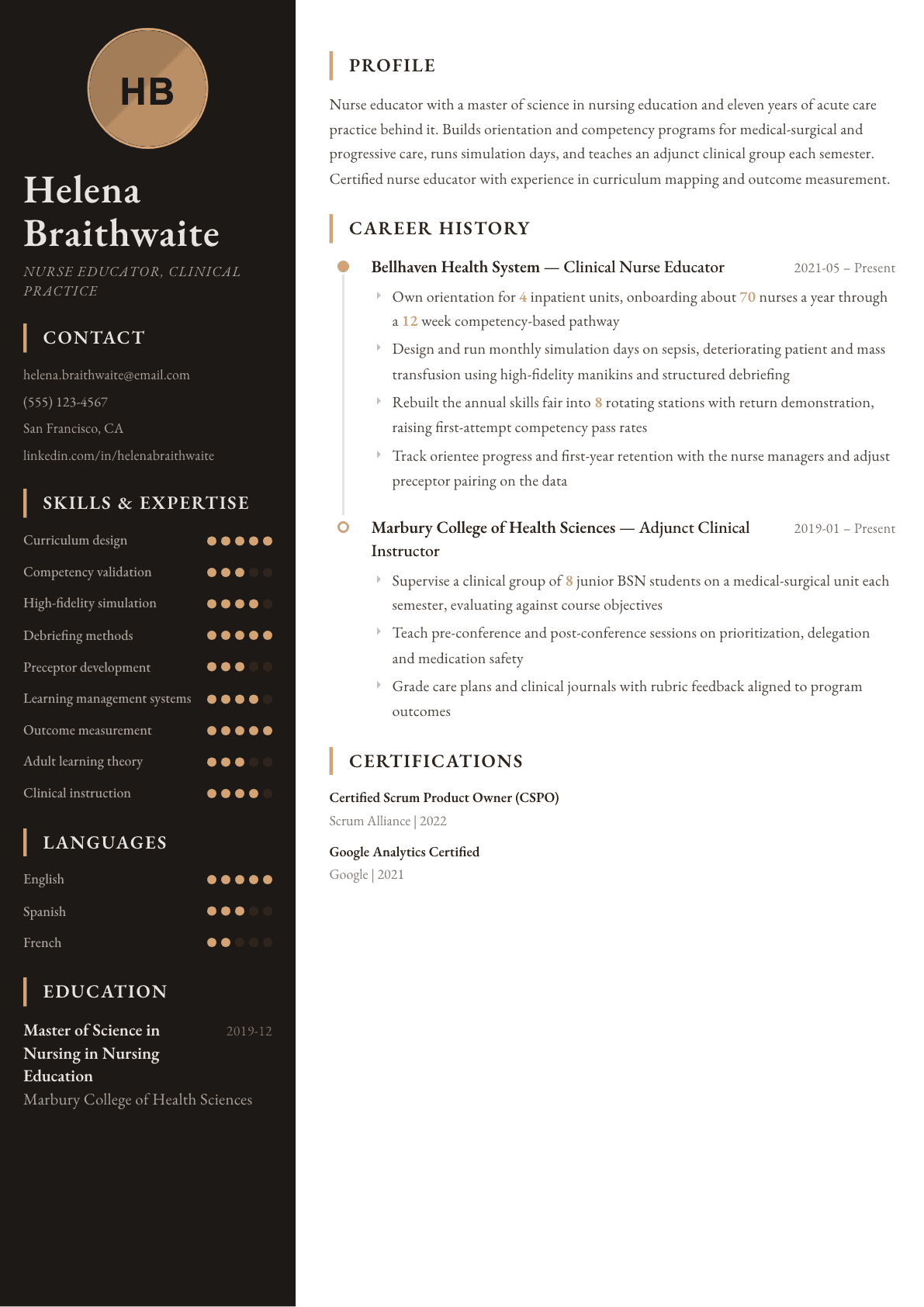
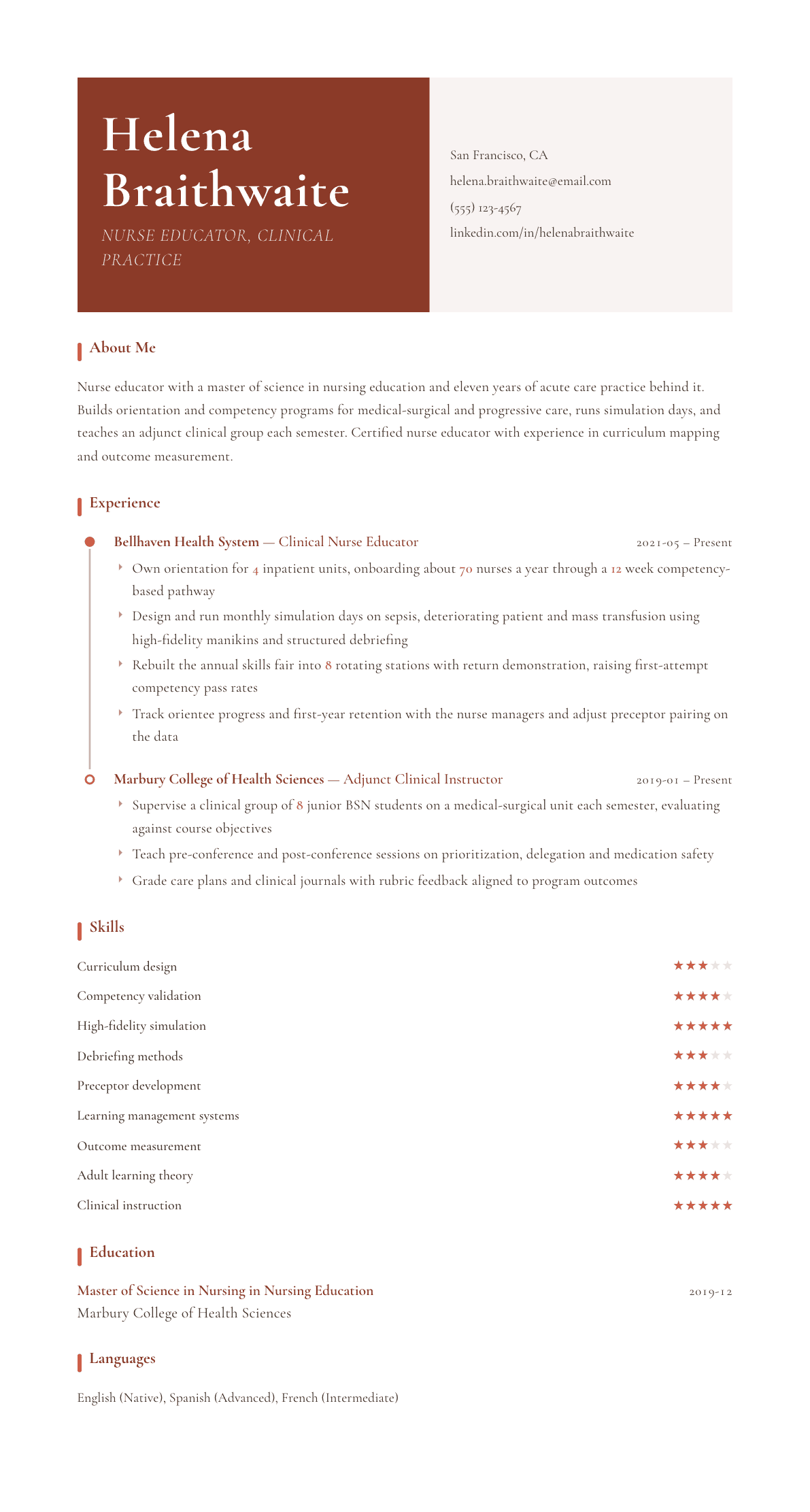
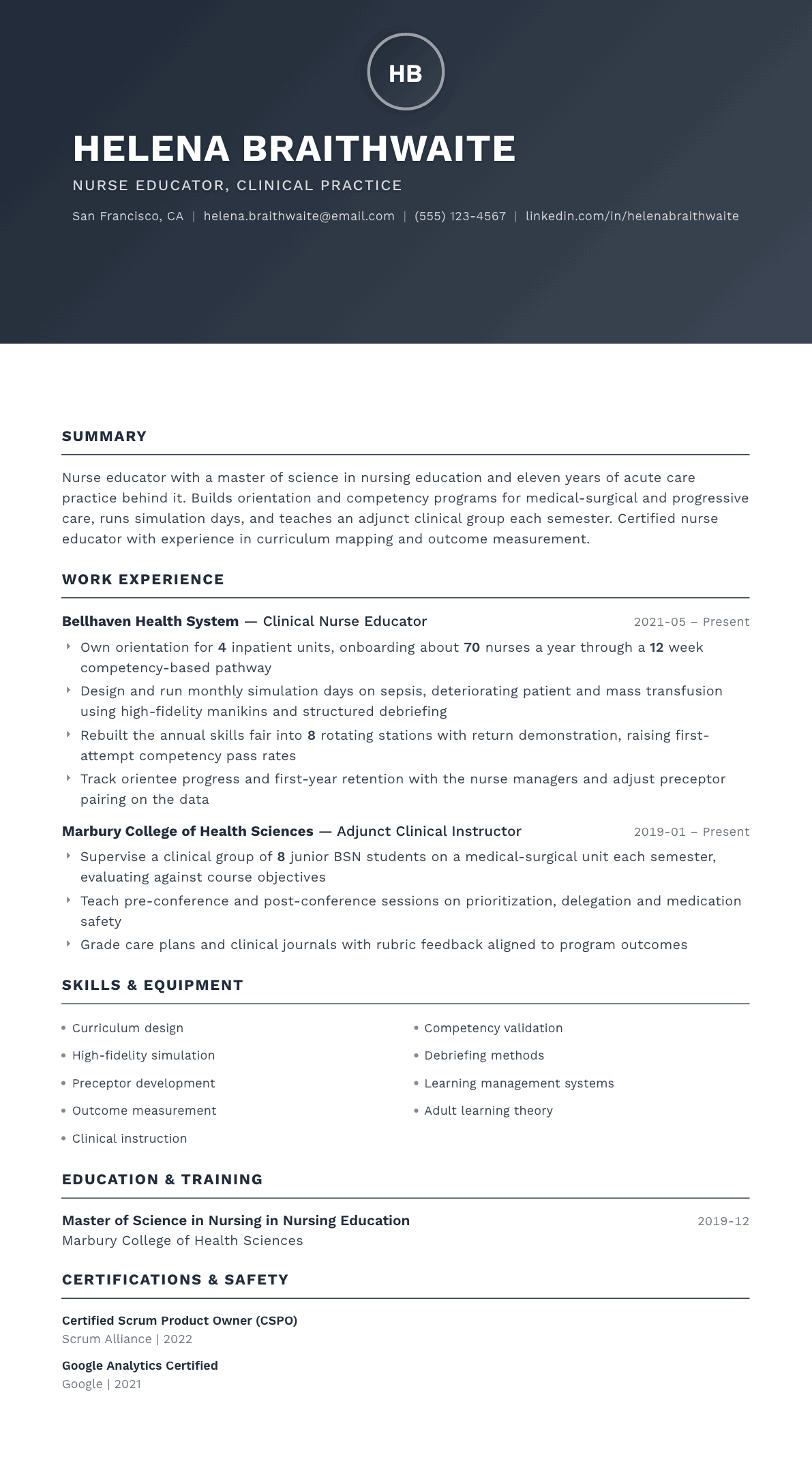
The same nurse educator content laid out in three CVBooster templates, so you can see what the finished document looks like before you write a word.
Example Nurse Educator summary
Nurse educator with a master of science in nursing education and eleven years of acute care practice. Owns competency-based orientation for four inpatient units and about 70 new nurses a year, runs high-fidelity simulation on sepsis and deterioration, and teaches an adjunct clinical group of eight BSN students each semester. Certified nurse educator focused on measurable competency outcomes and preceptor development.
Skills to list on a Nurse Educator resume
- Curriculum development
- Competency-based orientation
- High-fidelity simulation
- Structured debriefing
- Clinical instruction
- Preceptor training
- Adult learning principles
- Learning management systems
- Skills fair and return demonstration
- Program evaluation
- Evidence-based practice mentoring
- Nursing professional development
- Course and rubric design
- Accreditation documentation
What actually gets this resume read
- Decide early whether you are targeting academia or a hospital education department, because the section order differs.
- For academic roles put education, credentials and teaching first, then scholarship, service and clinical practice.
- For hospital roles lead with orientation ownership, competency programs, simulation and the units you support.
- Quantify the learner volume: nurses onboarded a year, students supervised per clinical group, classes taught per cycle.
- Name the frameworks and tools you use, such as Benner stages, structured debriefing models and your learning management system.
- Keep your active bedside practice visible, since both hiring panels distrust an educator who has left the unit entirely.
How to write a nurse educator resume
Nurse educator is two jobs wearing one title. In a hospital it means owning orientation, competency validation, simulation and annual skills days for a set of units. In academia it means teaching a course, supervising a clinical group, writing exam items that survive review, and contributing to accreditation evidence. A single resume sent to both loses both, because each hiring panel puts a different section first.
What the two share is a demand for proof that learning happened. Panels read for measurable outcomes: orientees onboarded and retained, first attempt competency pass rates, course pass rates, simulation debriefs run, curriculum revised against a standard. Statements about a passion for teaching carry no weight in a field whose entire subject is evidence.
This guide splits the academic and hospital versions, shows how to write curriculum, simulation and competency work concretely, gives summaries for three stages of an education career, and covers the questions bedside nurses ask when they move into a development role.
Format: decide academic or hospital, then reorder
For an academic post, the order is education and credentials, teaching experience, scholarship and presentations, service, then clinical practice. Faculty search committees check the degree first because accreditation depends on it, and a doctorate in progress belongs on the first page with the expected completion month.
For a hospital professional development post, the order is summary, certifications, education and development experience, clinical experience, then education. The manager wants to know which units you support, how many nurses you onboard, and what you own in the competency calendar.
- Header: name, credentials in the order degree, license, then certification such as CNE or NPD-BC.
- Academic version: add a scholarship block for posters, podium presentations and publications.
- Hospital version: add a program block for orientation, simulation, skills fairs and preceptor development.
Teaching and program experience: volume, method, outcome
Every teaching bullet needs a learner count, a method and a result. Number of nurses onboarded a year, students in a clinical group, sections taught per term, classes delivered per cycle. Method covers what you actually do: lecture, case unfolding, high fidelity simulation, return demonstration, skills stations, online modules.
Outcomes are the part most applicants leave out. First attempt competency pass rates, orientation length changes, first year retention on units you support, course pass rates, and remediation completed. Report only the numbers you can defend in an interview, and name the source: the manager dashboard, the course report, the orientation tracker.
Say who you teach. Onboarding new graduates is different from cross-training experienced nurses to a new unit, which is different again from teaching junior students their first assessment. Panels want a match to their learner population.
Curriculum and competency: name the frameworks you use
Show how you build learning rather than deliver it. Needs assessment from incident data or manager request, objectives written at the right cognitive level, curriculum mapping against course or unit outcomes, evaluation plan, and revision on the results. Reference the frameworks you genuinely use, such as Benner stages of skill acquisition, adult learning principles, structured debriefing models, or the professional development scope and standards.
Competency validation is the hospital core. Describe the annual competency calendar, the return demonstration stations, the high risk low volume skills you validate, and how you handle a nurse who does not pass. That last one is what a director wants to know and almost nobody writes.
Simulation, scholarship and accreditation evidence
Simulation earns its own block if you run it. Scenario authoring, manikin platform, prebrief structure, debriefing model, video review, interprofessional participants, and the frequency you run days. Named scenarios such as sepsis, deteriorating patient, mass transfusion and difficult airway tell a reader the acuity you can build.
For academic roles, scholarship is not optional. List posters and podium presentations with the conference name, any peer reviewed work, item writing and test blueprint work, and your part in accreditation self study evidence. Committee service and course coordination round out the file, and search committees read that section for whether you will carry departmental load.
Keywords both panels search on
The shared vocabulary is nursing professional development, curriculum development, competency validation, clinical instruction, preceptor development, high fidelity simulation, debriefing, adult learning, program evaluation, evidence-based practice and learning management system. Use the exact posting wording once in the skills block and once inside a bullet.
Name your systems by product where you can: the learning management system, the simulation platform, the electronic record you teach in. A hospital that runs the same tools sees an educator who can build content in week two rather than week ten.
Nurse Educator resume summary examples
Preceptor moving into education
Medical-surgical nurse with seven years at the bedside and three as the unit lead preceptor, onboarding twelve new graduates and rebuilding the orientation checklist with the manager. Teaches the quarterly skills station on drains and wound vacs. Completing a master of science in nursing education and seeking a clinical educator role.
Clinical nurse educator
Clinical nurse educator supporting four inpatient units, onboarding about 70 nurses a year through a competency-based pathway. Designs and debriefs monthly simulation on sepsis and patient deterioration, runs an eight station annual skills fair, and pairs orientees with preceptors using retention data. Certified in nursing professional development.
Faculty and program lead
Nursing faculty member teaching adult health lecture and clinical, coordinating a course of about eighty students each term. Writes and analyzes exam items, supervises clinical groups on a medical-surgical unit, and contributes evidence to program accreditation self study. Doctor of nursing practice with fourteen years of acute care experience.
Work experience bullets: before and after
Before: Provided education to nursing staff.
After: Owned orientation for four inpatient units, onboarding about 70 nurses a year through a twelve week competency-based pathway with weekly checkpoints against a written pathway.
Scope, learner volume and program structure show ownership rather than occasional teaching.
Before: Ran simulation sessions for nurses.
After: Authored and facilitated monthly high fidelity simulations on sepsis, patient deterioration and mass transfusion, using a structured prebrief and debrief with video review.
Scenario topics and the debrief method prove simulation design ability, not attendance at a session.
Before: Improved the annual skills fair.
After: Rebuilt the annual skills fair into eight rotating stations with return demonstration, which raised first attempt competency pass rates recorded in the education tracker.
The redesign, the format and the named measurement source make the improvement verifiable.
Before: Taught nursing students in clinical.
After: Supervised a clinical group of eight junior students on a medical-surgical unit each term, evaluating against course objectives and leading pre-conference on prioritization and delegation.
Group size, level and evaluation basis tell a search committee exactly what you can be assigned.
Before: Helped with preceptor training.
After: Redesigned preceptor development into a two day workshop on feedback, competency sign-off and generational learning differences, then paired orientees using retention data with the managers.
The content and the pairing decision show program design instead of assistance with someone else's course.
Hard skills
- Curriculum design and mapping
- Competency-based orientation
- Competency validation and return demonstration
- High fidelity simulation authoring
- Structured debriefing
- Clinical group instruction
- Preceptor development
- Exam item writing and analysis
- Learning management system administration
- Needs assessment and gap analysis
- Program evaluation and outcome measurement
- Accreditation and survey documentation
- Evidence-based practice mentoring
Soft skills
- Giving corrective feedback that lands
- Coaching anxious new graduates
- Negotiating release time with managers
- Public speaking to large groups
- Curiosity about why a learner failed
Certifications worth listing
- Certified Nurse Educator (CNE) (National League for Nursing)
- Certified Academic Clinical Nurse Educator (CNEcl) (National League for Nursing)
- Nursing Professional Development Certification (NPD-BC) (American Nurses Credentialing Center)
- Certified Healthcare Simulation Educator (CHSE) (Society for Simulation in Healthcare)
- Basic Life Support Instructor (American Heart Association)
Mistakes that cost nurse educator candidates the interview
- Sending one resume to both academic and hospital postings when the two panels want opposite section orders.
- Writing about a passion for teaching instead of learner counts, methods and measured outcomes.
- Omitting the degree status on an academic application, where accreditation makes it the first screen.
- Listing simulation as a skill with no scenarios, platform or debriefing model behind it.
- Dropping clinical practice entirely, which makes both panels doubt you can still teach at the bedside.
- Leaving out remediation and failure handling, the part of competency work a director most wants to hear about.
Nurse Educator resume questions
Do I need a master of science in nursing to become a nurse educator?
For academic faculty roles it is usually the minimum and a doctorate is often preferred or required for tenure track. Hospital clinical educator roles vary, and many hire experienced preceptors with a bachelor degree who are enrolled in a graduate program.
How do I move from bedside nursing into an educator role?
Build a paper trail first. Take the lead preceptor role, teach a skills station, rewrite an orientation checklist, run a unit in-service, join the practice council. Then write those bullets with learner counts and outcomes, and add a graduate program in progress.
What is the difference between an academic and a hospital educator resume?
The academic version leads with degrees, teaching assignments, scholarship and service, and reads like a short curriculum vitae. The hospital version leads with the units supported, orientation ownership, competency calendar and simulation program, and reads like a nursing resume.
Should I include presentations and posters?
Yes for academic applications, where scholarship is part of the appointment, and yes for hospital roles when the work is relevant. List the title, the venue and your role, and keep unpublished internal in-services in the experience bullets rather than the scholarship block.
How do I show teaching outcomes without inventing numbers?
Use figures you can trace to a real source such as an orientation tracker, a course report or a manager dashboard, and say where they came from. When no number exists, describe the redesign and the measurement you introduced, which is itself evidence of an educator mindset.