Operations Consultant Resume Examples: read this first
Build an Operations Consultant Resume That Proves Efficiency Gains
By Mustafa Tarabya, founder of CVBooster · Published · Updated
Create a results-driven operations consultant resume highlighting process optimization, supply chain improvement, and Lean Six Sigma expertise with clear ROI metrics.
Sample resumes for a operations consultant
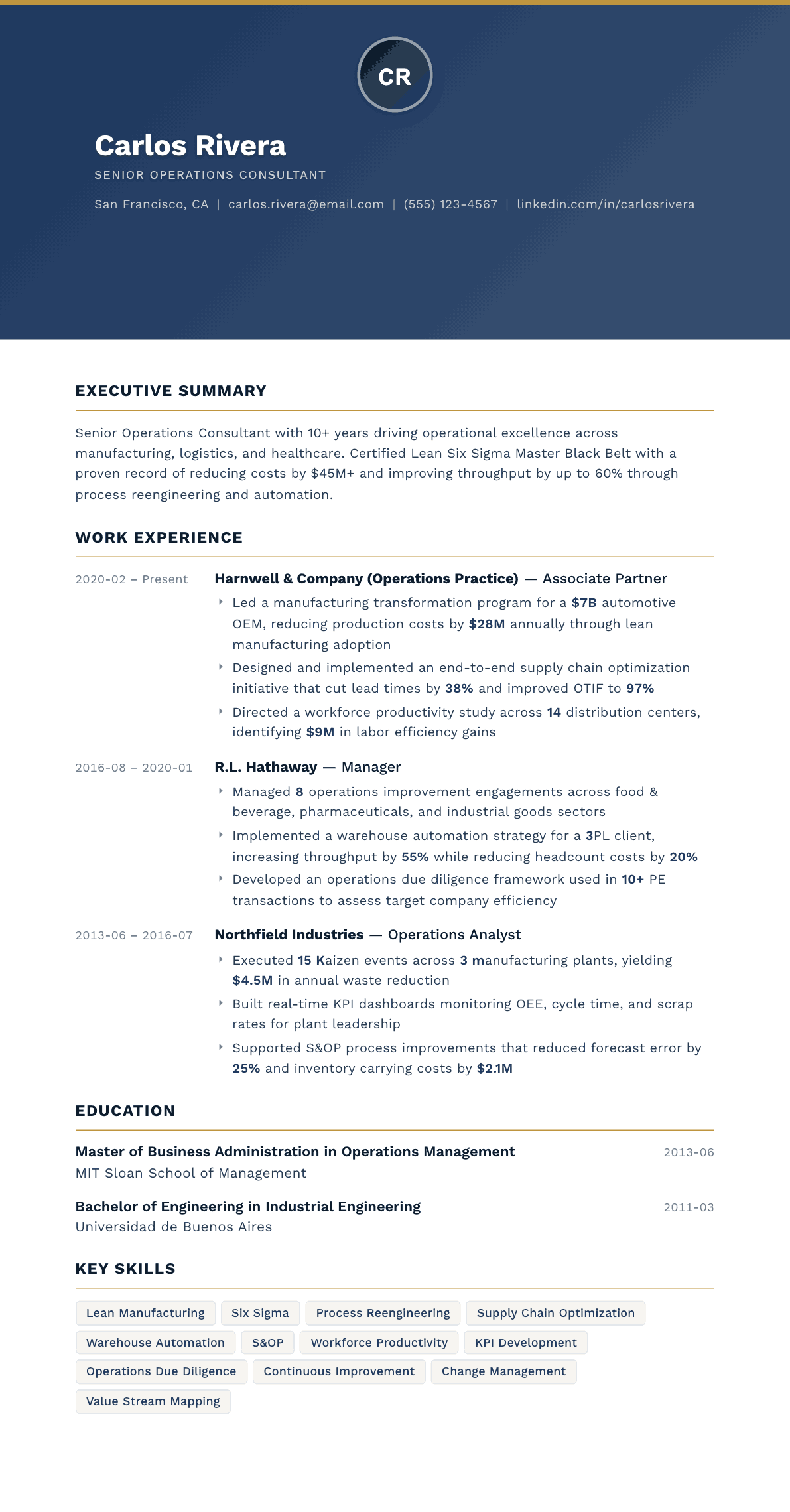
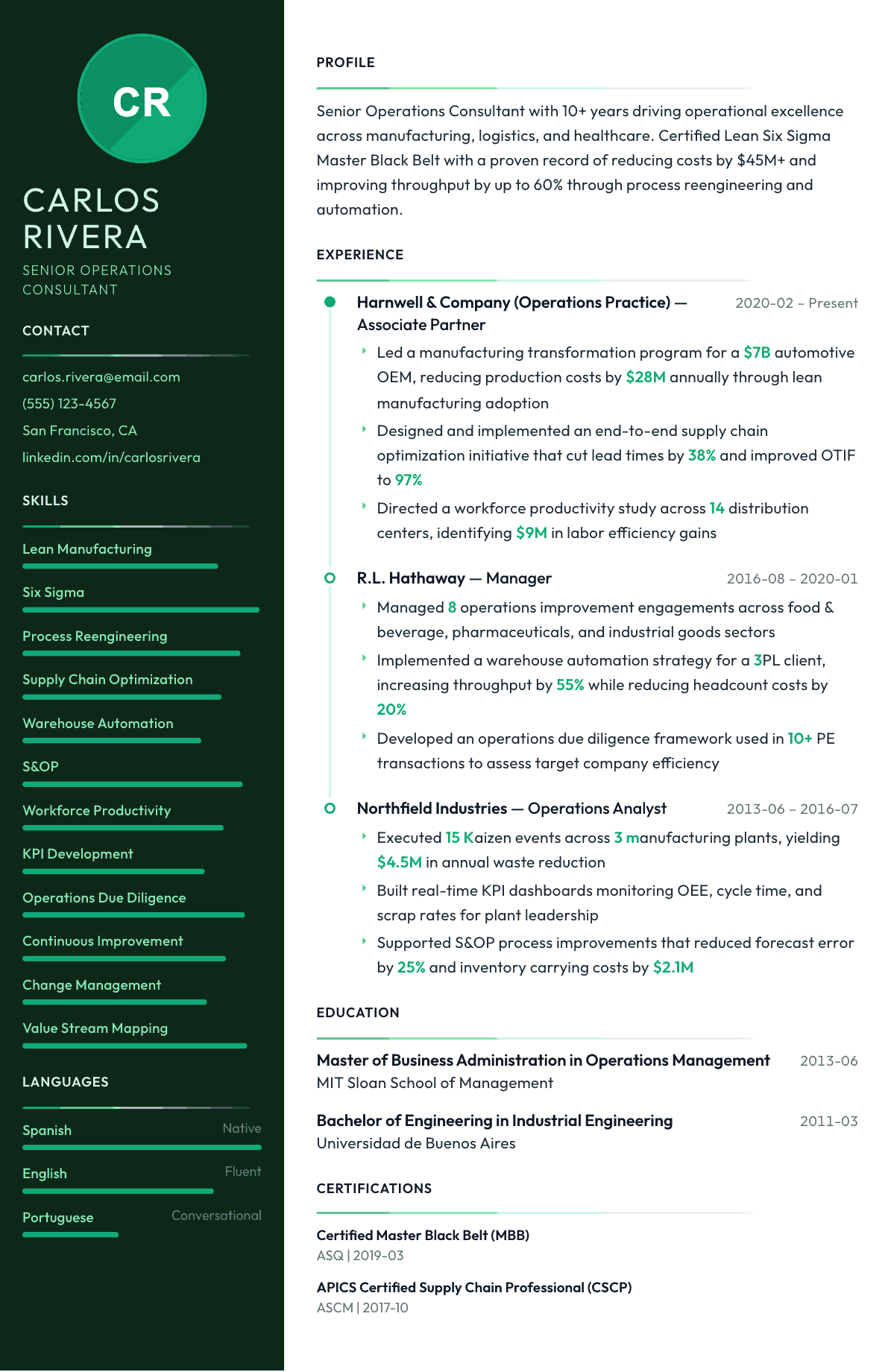
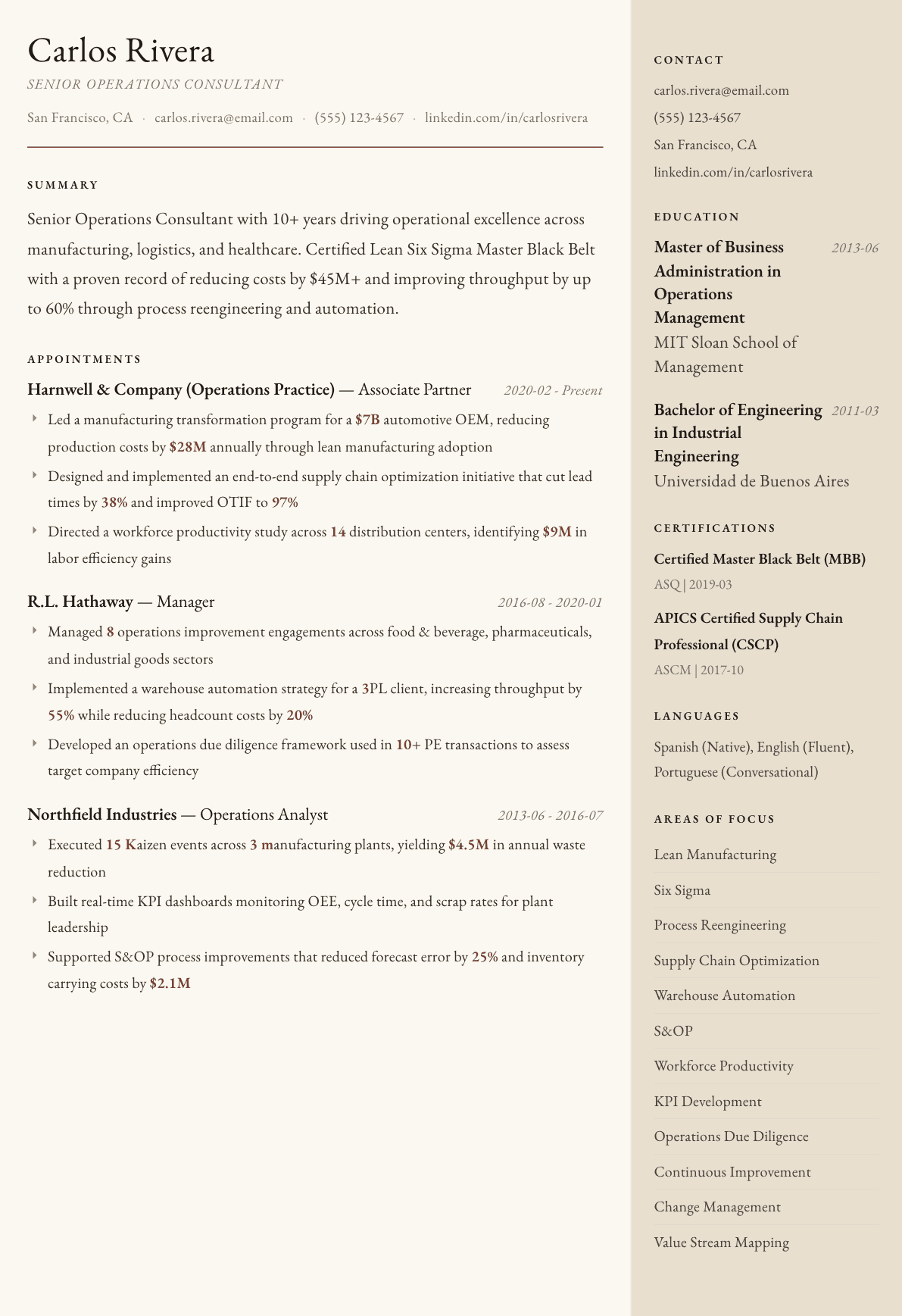
The same operations consultant content laid out in three CVBooster templates, so you can see what the finished document looks like before you write a word.
Example Operations Consultant summary
Senior Operations Consultant and Lean Six Sigma Master Black Belt with 10 years of experience driving $45M+ in cost reductions across manufacturing, logistics, and healthcare. Expert in process reengineering, supply chain optimization, and workforce productivity improvement.
Skills to list on a Operations Consultant resume
- Lean Manufacturing
- Six Sigma
- Process Optimization
- Supply Chain Management
- Warehouse Operations
- S&OP
- Workforce Planning
- KPI Dashboards
- Operations Due Diligence
- Continuous Improvement
- Value Stream Mapping
- Change Management
What actually gets this resume read
- Lead with hard numbers: cost reductions, throughput improvements, defect rate decreases, and ROI figures.
- Highlight Lean Six Sigma certification level and the number of projects or Kaizen events led.
- Showcase cross-industry versatility. Operations consulting spans manufacturing, healthcare, logistics, and retail.
- Include technology enablers: ERP systems, automation tools, and analytics platforms you have deployed.
- Structure bullets to show the problem, your intervention, and the quantified result.
How to write a operations consultant resume
Operations consulting is judged on whether the improvement stuck after the consultant left the site. The partner or principal reading your resume has watched plenty of engagements produce a beautiful current state map and no change in throughput, so they read your file looking for the opposite: a measured baseline, an intervention you personally ran on the floor, and a number that moved and stayed moved.
That changes what belongs on the page. A generalist strategy file leads with analysis. An operations consultant file leads with the physical system: the plant, the distribution center, the claims queue, the operating room block schedule. Name the setting, name the constraint you attacked, and name the metric the client already tracked before you arrived, because a metric you invented for the deck convinces nobody.
The sections below cover how to shape the file for a firm that sells implementation work, how to write about Kaizen events and rapid improvement weeks without sounding like a certification syllabus, summaries at three levels, and the questions people ask when moving between industry operations and consulting.
Format: put the settings and the belts where they are seen first
Use reverse chronological order on one page, moving to two only when you have more than a decade of engagements across several industries. Directly under the header, run a short line of the environments you have worked in: discrete manufacturing, cold chain distribution, hospital perioperative services, contact centers. Operations firms staff by setting, and a staffing partner scanning for someone who has stood in a food plant will find that line before they read a bullet.
Belts belong near the top too. A Black Belt from a recognized body is a screening filter for many operations practices, and burying it in a final line under interests costs you the filter. List the belt, the issuing body, and, if you have it, the number of certified projects behind it.
- Environment line: the industries and facility types you have physically worked in.
- Certification line: belt level, issuing body, and supply chain credentials.
- Experience: one scope line per engagement block, then bullets that pair a baseline with a result.
- Tools: the ERP, WMS, MES and analytics stack you have actually pulled data from.
Baselines are the whole argument
Every credible operations bullet has two numbers: what the process did before and what it did after. Without the before, a reader cannot tell whether an improvement in units per labor hour was a genuine gain or a recovery from an unusually bad quarter. State the baseline period and the measurement window so the claim can be interrogated.
Use the metric family the client lives in rather than a consulting abstraction. Manufacturing runs on overall equipment effectiveness, changeover time, scrap rate, first pass yield and schedule adherence. Distribution runs on lines per hour, dock to stock, order accuracy and cost per case. Service operations run on handle time, first contact resolution, backlog age and adherence. Using the right family tells the reader you were inside the operation, not adjacent to it.
Write the intervention, not the toolkit
Value stream mapping, five why analysis, standard work and A3 problem solving are table stakes in this field, and a resume that lists them without a client outcome reads like a training record. Write the intervention instead: you found the constraint at the packaging line changeover, you ran a four day rapid improvement event with operators and maintenance, you rewrote the changeover standard work, and the changeover fell from a documented baseline.
Name who was in the room. Operations change is carried by supervisors and frontline operators, so a bullet that shows you trained twenty two line leads on tiered daily management, or that the client kept running the daily board six months after handover, is stronger evidence than the same result with no adoption story.
Operational due diligence and private equity work
If you have done diligence for financial sponsors, give it its own block. It is a different rhythm from a transformation: two to four weeks, limited data room access, management interviews under time pressure, and a written view on whether the operational thesis is achievable. Sponsors and the firms that serve them screen hard for that experience because it cannot be learned on a slow engagement.
Say how many diligences you supported, the deal sizes by descriptor rather than by figure, the sectors, and whether your view was used post close. A consultant who wrote the hundred day operating plan and then went in to run it has a story most candidates cannot match.
Keywords the operations practices search on
Postings and internal staffing databases repeat a narrow vocabulary: lean transformation, continuous improvement, value stream mapping, sales and operations planning, network optimization, labor productivity, footprint rationalization, throughput, capacity modeling, and the belt levels. Use each once in a place where it is doing real work: the environment line, a scope line, or a bullet that proves it.
Add the systems by name. Client teams filter for consultants who can navigate their own stack, so naming the enterprise resource planning system, the warehouse management system, the manufacturing execution system and the analytics tool you extracted from separates you from a candidate who worked entirely off files someone else exported.
Operations Consultant resume summary examples
Analyst, first engagements
Operations analyst with two years supporting lean engagements in food manufacturing and third party logistics. Built the time study database for a packaging line assessment covering 340 observed cycles, and ran the daily tracking board during a six week implementation. Green Belt certified with an industrial engineering degree.
Consultant, six years in
Operations consultant with six years across discrete manufacturing and distribution, leading rapid improvement events on the client floor. Cut changeover time on a bottleneck packaging line by 41% against a four week baseline and held the gain through two quarters of post handover audits. Black Belt certified.
Engagement leader
Operations engagement leader with eleven years running lean transformations and operational due diligence for private equity sponsors. Led teams of six across multi site programs in automotive components and cold chain distribution, and wrote hundred day operating plans that two portfolio companies executed with our support.
Work experience bullets: before and after
Before: Conducted value stream mapping for a manufacturing client.
After: Mapped the current and future state value stream for a two line injection molding cell, isolating changeover and mold qualification as 63% of non value added time and sequencing them into a three wave improvement plan.
The map becomes evidence once the reader sees what it found and what the client did next.
Before: Ran Kaizen events to improve productivity.
After: Facilitated five rapid improvement events with operators, maintenance and quality over eight months, rewriting standard work for changeover and startup and lifting overall equipment effectiveness from a 58% baseline.
Naming the participants, the count and the baseline turns a workshop claim into a measured intervention.
Before: Improved warehouse efficiency.
After: Redesigned pick paths and slotting in a 45 dock door distribution center using twelve weeks of order line history, raising lines picked per labor hour by 27% without adding equipment.
The facility size, the data window and the no capital constraint let a reader judge how hard the win was.
Before: Supported due diligence for a private equity client.
After: Ran operations diligence on a three plant automotive components target in nineteen days, testing the capacity thesis against maintenance logs and shift records and flagging a labor constraint the sponsor priced into the offer.
The timeline, the sources you used and the effect on the deal show diligence judgment rather than attendance.
Before: Trained client staff on continuous improvement.
After: Trained 22 line supervisors on tiered daily management and problem escalation, and audited the boards at 30, 60 and 90 days, with all four lines still running the cadence at the final check.
Sustainment is the thing operations partners doubt most, so proving it is the strongest bullet you can write.
Hard skills
- Value stream mapping
- DMAIC and A3 problem solving
- Time and motion study
- Overall equipment effectiveness analysis
- Changeover and setup reduction
- Sales and operations planning
- Network and footprint modeling
- Warehouse slotting and pick path design
- Labor standards and capacity models
- Operational due diligence
- SAP and Oracle data extraction
- Warehouse management systems
- Power BI and Tableau
- Statistical process control
Soft skills
- Credibility with frontline operators
- Facilitating rooms with conflicting incentives
- Coaching supervisors
- Working plant shift patterns
- Delivering unwelcome findings to plant leadership
Certifications worth listing
- Certified Six Sigma Black Belt (CSSBB) (American Society for Quality)
- Certified Six Sigma Green Belt (CSSGB) (American Society for Quality)
- Certified Supply Chain Professional (CSCP) (Association for Supply Chain Management)
- Certified in Planning and Inventory Management (CPIM) (Association for Supply Chain Management)
- Certified in Logistics, Transportation and Distribution (CLTD) (Association for Supply Chain Management)
Mistakes that cost operations consultant candidates the interview
- Reporting an after number with no baseline, which leaves the reader unable to size the improvement.
- Listing lean tools as skills without a single engagement where one of them changed a client metric.
- Describing improvements in invented measures instead of the operational metrics the client already reported.
- Hiding the belt level and issuing body at the bottom when many operations practices screen on it first.
- Omitting the facility type and size, so a reader cannot tell a pilot cell from a multi site network.
- Claiming a result at go live with no evidence the client held it after the team demobilized.
Operations Consultant resume questions
How do I move from a plant operations job into operations consulting?
Rewrite your plant roles as engagements. Each becomes a problem, an intervention you led, a baseline and a result, with the cross functional groups you had to persuade named. Firms value candidates who have carried operational accountability, so make the accountability and the settings explicit.
Is a Black Belt necessary for an operations consultant resume?
It is not mandatory at every firm, but it clears a filter at many and it signals a shared vocabulary with clients running their own programs. If you hold a Green Belt, list it with the projects behind it, and say if a Black Belt is in progress with the issuing body named.
Should I include engagements where the client never implemented the recommendation?
Include them when the analysis itself was the deliverable, such as a diligence or a feasibility study, and describe the decision it informed. Avoid presenting an unimplemented transformation as a result, because a partner who asks one follow up question will find the gap immediately.
How much detail about tools and systems should the resume carry?
Enough to prove you extracted your own data. Name the enterprise system, the warehouse or manufacturing execution system, and the analytics tool, and keep them to systems you could open and query today. A list of everything you have seen a client use is easy to test and easy to fail.
How do operations consulting resumes differ from strategy consulting resumes?
Operations files carry physical detail: the line, the shift pattern, the facility size, the constraint, the sustainment audit. Strategy files carry market and financial reasoning. If you are applying to an operations practice, every leading bullet should smell of the floor rather than of the boardroom.
Related resume examples
- Supply Chain Manager Resume example
- Management Consultant Resume example
- Industrial Engineer Resume example
- VP Operations Resume example
- Healthcare Consultant Resume example
- Continuous Improvement Manager Resume example