Hospital Administrator Resume Examples: read this first
Lead Healthcare Organizations with a Hospital Administrator Resume
By Mustafa Tarabya, founder of CVBooster · Published · Updated
Create a hospital administrator resume demonstrating your expertise in healthcare operations, financial management, regulatory compliance, and quality improvement.
Sample resumes for a hospital administrator
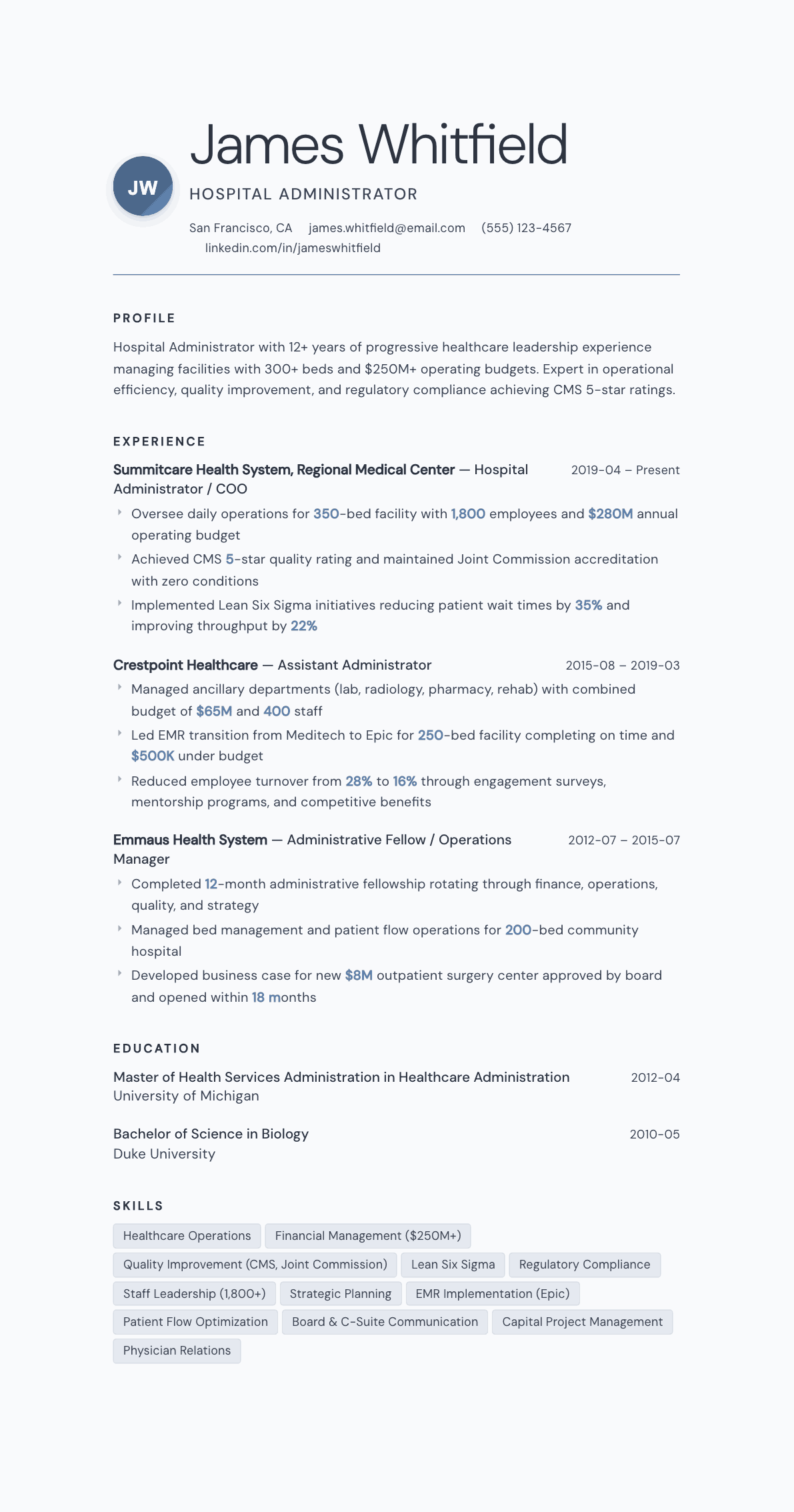
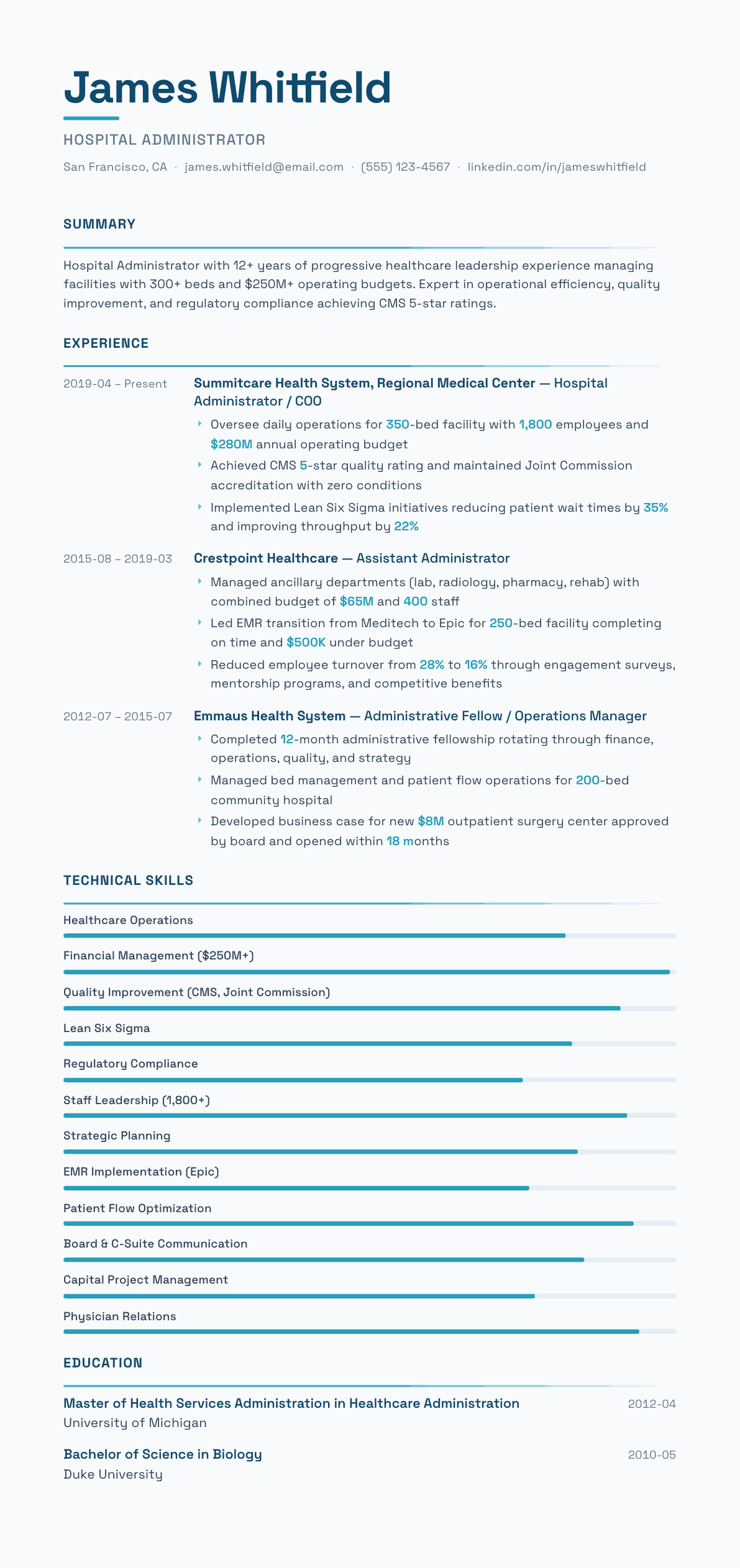
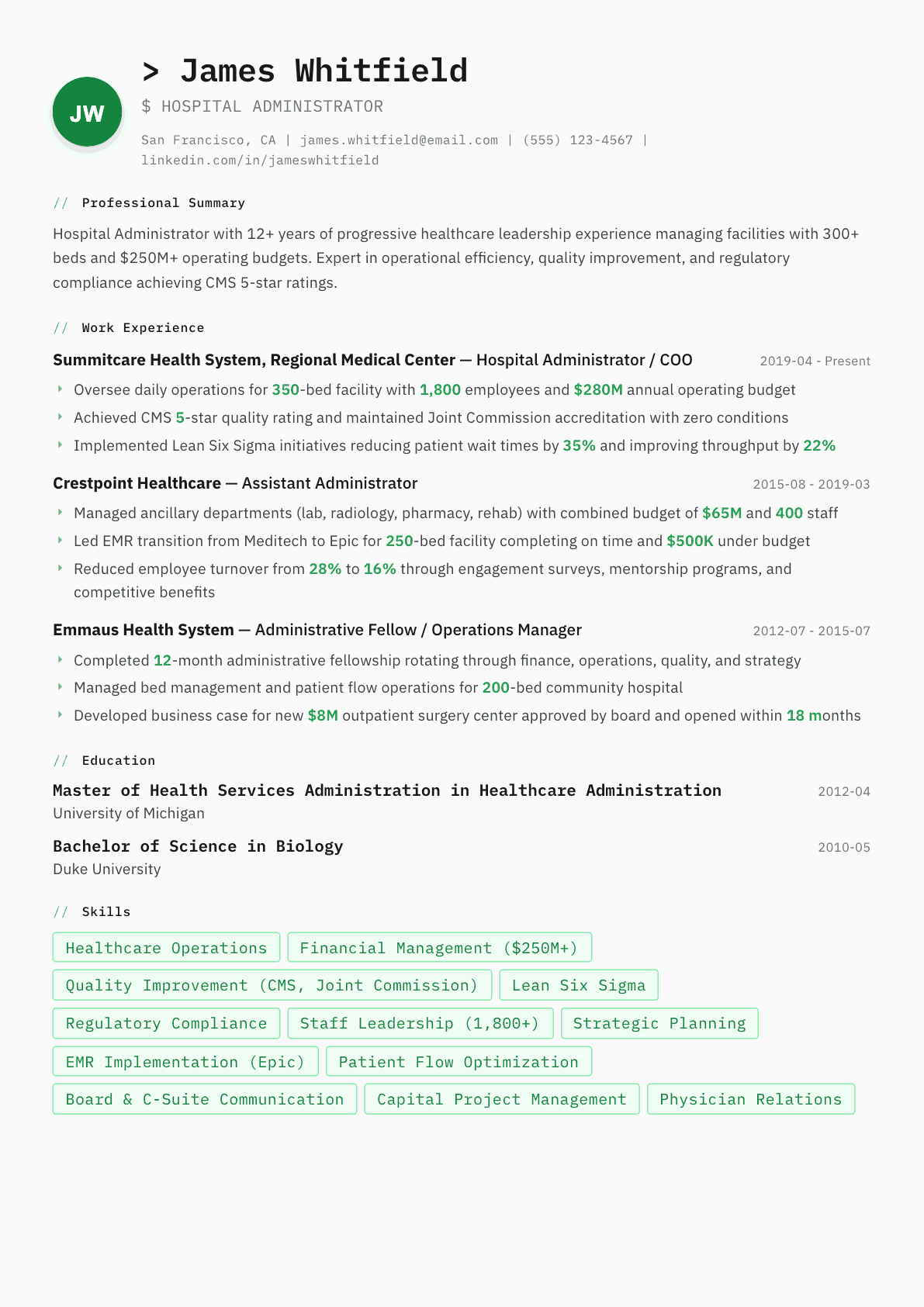
The same hospital administrator content laid out in three CVBooster templates, so you can see what the finished document looks like before you write a word.
Example Hospital Administrator summary
Hospital Administrator with 12 years of healthcare leadership managing 350-bed facilities with $280M budgets and 1,800 employees. Achieved CMS 5-star rating, Joint Commission accreditation, and 35% wait time reduction through Lean Six Sigma.
Skills to list on a Hospital Administrator resume
- Healthcare Operations
- Financial Management
- Quality Improvement
- Regulatory Compliance
- Lean Six Sigma
- Strategic Planning
- Staff Leadership
- EMR Systems (Epic)
- Patient Experience
- Capital Planning
- Board Governance
- Physician Relations
What actually gets this resume read
- Lead with facility size: bed count, employee count, and operating budget to establish scope.
- Highlight quality ratings and accreditation achievements: CMS stars, Joint Commission, Leapfrog.
- Include financial results: budget management, cost reductions, revenue growth, capital projects.
- Showcase operational improvements: wait times, throughput, readmission rates, patient satisfaction.
- Mention FACHE credential and MHA/MBA education as they carry significant weight in hospital leadership.
How to write a hospital administrator resume
A hospital administrator resume is read by a search committee, a system chief operating officer or an executive recruiter, and it is read against a facility. Bed count, case mix, service lines, teaching status, ownership model and the market the hospital sits in all shape what the job requires. Your file has to let them place you against their own facility inside the first few lines or it goes into the maybe pile and stays there.
What separates a strong file is the ability to show you have run a hospital through a real test. A survey with a condition level finding, a labor action, a record conversion, a service line closure, a merger, a capacity crisis, an unfavorable payer negotiation. Executives are not hired for steady state, they are hired for the ability to hold an organization together while it changes, and that has to be visible.
This guide covers how to size the facilities you have led, which financial and quality measures belong on an executive file, three summaries covering an assistant administrator through to a chief executive, and rewrites of the vague leadership bullets that fill most hospital administration resumes.
Format: an executive resume, not a curriculum vitae
Two to three pages. Reverse chronological. Open with a short profile, then a career progression that shows increasing scope, because search committees read a hospital administrator resume as a trajectory rather than a list of jobs. Board service, professional fellowship and community leadership go near the end but must be present, since hospital boards weigh them.
Immediately under each title write a facility line: licensed beds, staffed beds, employees, medical staff size, service lines, teaching affiliation, and ownership type such as nonprofit, investor owned, public district, critical access or academic. That line is what lets a committee compare the job you held to the job they are filling.
- Header: name with degree and fellowship designation, city and state, phone, email.
- Order: executive profile, career progression with facility lines, selected accomplishments, education, credentials, board and community service.
- Include a short line on the reporting relationship, since reporting to a system chief operating officer differs from reporting to a local board.
Executive profile: facility scale, reporting line, and your record
Three or four sentences. Name the size and type of facilities you have led, the functions in your remit, who you reported to, and the two or three things you have consistently delivered: quality performance, margin improvement, capacity and throughput, physician alignment, or growth through service line development.
Then say what test you have taken the organization through. A committee reads that a candidate has led a hospital through a full accreditation survey with a condition level finding and closed it, and immediately knows something about the person that no adjective conveys.
Operations and quality: the measures a board reviews
Hospital boards look at a consistent dashboard, so use its language. Length of stay against expected, observed to expected mortality, readmission rates, hospital acquired condition and infection rates, emergency department left without being seen and boarding hours, operating room first case on time starts and block utilization, discharge before noon, and patient experience results by domain.
For each measure you improved, give the intervention. Capacity command center, care progression rounds, a discharge lounge, a hospitalist restructuring, a nursing shared governance change, or an infection prevention bundle. A number without a mechanism reads as inherited performance rather than leadership.
Regulatory work must be explicit. Name the accrediting body and survey type, your role in preparation, findings received, plans of correction written and the resurvey outcome. Add licensure, certification of participation and any state specific survey history relevant to the setting.
Financial performance without publishing the numbers
Describe financial scope by facility size, employee count, medical staff size and service volume rather than by budget currency, then describe direction and mechanism: margin improvement through labor productivity targets, supply and purchased services renegotiation, length of stay reduction, denial and payer performance improvement, or service line rationalization.
Capital projects are worth their own bullets with scope described in beds, rooms, operating suites or square footage rather than cost. Say what you delivered, over what period, and whether it opened on schedule. A committee cares that you can carry a project through construction, licensure and staffing more than it cares about the invoice total.
Labor is the largest cost in any hospital, so name what you did there: contract labor reduction, nursing turnover and vacancy movement, a residency or transition to practice program, a float pool redesign, or a collective bargaining relationship you managed.
Physician alignment, growth and governance
Physician relationships decide whether a hospital administrator succeeds. Describe medical staff leadership work concretely: joint operating committees, co management agreements, recruitment and onboarding of specialists, call coverage arrangements, and how you handled a disruptive behavior or quality concern through the medical executive committee.
Growth belongs on the file as service line work: opening a cardiac catheterization laboratory, a behavioral health unit, an observation unit, a cancer center, or a rural outreach clinic network. Give the volume the service line reached and the referral pattern it changed. Close with board governance experience, since hospital administrators are expected to prepare and present to a board and its committees.
Hospital Administrator resume summary examples
Assistant administrator
Assistant administrator for a 190 bed community hospital, responsible for laboratory, imaging, pharmacy, rehabilitation and environmental services with 260 employees. Led the accreditation readiness program and cut emergency department boarding hours by a third through a capacity huddle and discharge lounge.
Chief operating officer
Chief operating officer of a 340 bed nonprofit hospital with 1,700 employees and a 420 member medical staff, reporting to the chief executive. Owns nursing, surgical services, emergency and ancillary operations, and reduced contract labor use by half over three years while improving nurse retention.
Hospital chief executive
Hospital chief executive with nineteen years of acute care leadership, currently running a 460 bed teaching facility within a nine hospital system. Led the organization through a full accreditation survey, a record conversion and the integration of an acquired 90 bed community hospital.
Work experience bullets: before and after
Before: Responsible for the overall operations of the hospital.
After: Ran daily operations of a 340 bed nonprofit hospital with 1,700 employees and a 420 member medical staff, holding nursing, surgical services, emergency and all ancillary departments.
Beds, headcount, medical staff size and the named departments define an executive scope that overall operations leaves blank.
Before: Improved quality and patient safety outcomes.
After: Introduced daily care progression rounds and an infection prevention bundle audit, moving observed to expected length of stay below one and cutting catheter associated infections for six consecutive quarters.
The intervention plus board level measures show leadership of the result rather than presence during it.
Before: Managed the hospital budget and reduced expenses.
After: Set unit level labor productivity targets, renegotiated three purchased service contracts and rationalized a low volume service line, delivering margin improvement in each of three years.
Naming the levers makes the financial claim testable, which is what a search committee probes in interview.
Before: Worked closely with physicians and medical staff.
After: Built a joint operating committee with the orthopedic group, established a co management agreement for the surgical service line, and recruited six specialists into an underserved call schedule.
Specific structures and recruitment outcomes describe physician alignment, which vague closeness does not.
Before: Oversaw a construction project at the facility.
After: Delivered a 24 room emergency department expansion and a six suite operating room build through design, construction, state licensure and staffing, opening on the planned date.
Project scope in rooms and suites plus the licensure and staffing steps show the full delivery, not just the ribbon cutting.
Hard skills
- Acute care operations leadership
- Accreditation and regulatory survey readiness
- Capacity and patient throughput management
- Labor productivity and workforce planning
- Service line development
- Capital project delivery
- Medical staff and physician alignment
- Board and committee governance
- Quality and patient safety programs
- Payer and vendor contract negotiation
- Emergency preparedness and incident command
- Merger and acquisition integration
Soft skills
- Executive presence with a board
- Crisis decision making
- Negotiation with physician leaders
- Succession and leadership development
- Community and stakeholder engagement
Certifications worth listing
- Fellow of the American College of Healthcare Executives (FACHE) (American College of Healthcare Executives)
- Certified Professional in Healthcare Quality (CPHQ) (National Association for Healthcare Quality)
- Fellow of the Healthcare Financial Management Association (FHFMA) (Healthcare Financial Management Association)
- Certified Six Sigma Black Belt (CSSBB) (American Society for Quality)
- Licensed Nursing Home Administrator (LNHA) (State board of long term care administrators)
Mistakes that cost hospital administrator candidates the interview
- Listing titles with no facility line, so a search committee cannot tell whether you ran a critical access hospital or an academic medical center.
- Writing responsible for operations without naming the departments, the headcount or the medical staff size in your remit.
- Quoting quality improvements with no intervention behind them, which reads as performance you inherited.
- Leaving out accreditation survey history, the single experience a hospital board most wants confirmed before an offer.
- Ignoring physician alignment work, when medical staff relationships determine whether an administrator survives the first year.
- Presenting a curriculum vitae style publication list instead of an executive resume built around scope and results.
- Omitting board and community service, which hospital trustees treat as part of the executive profile rather than an extra.
Hospital Administrator resume questions
How long should a hospital administrator resume be?
Two to three pages. Executive search committees expect enough room for facility scope, career progression and selected accomplishments, but they will not read ten pages. Keep publications and speaking engagements to a short selected list unless you are applying to an academic medical center.
How do I describe the size of the hospitals I have led?
Give licensed and staffed beds, employee count, medical staff size, service lines, teaching status and ownership model under each title. Add annual discharges or emergency visits if they distinguish the facility. That profile lets a committee compare your experience directly to their own hospital.
Should an administrator include financial results on the resume?
Include direction and mechanism rather than currency figures. Describe margin improvement, contract labor reduction, denial performance or supply standardization and say what you changed to produce it. Committees probe the mechanism in interview and a bare figure invites doubt about attribution.
What is the value of the FACHE credential on a resume?
It is widely recognized among hospital boards and health system executives and appears in many executive postings as preferred. Board certification through that fellowship signals sustained professional commitment, so place it in the credentials block and after your name in the header.
How do I position a move from a system role to a single hospital?
Say it directly in the profile and show operating depth rather than corporate breadth. Emphasize any time you held direct facility responsibility, medical staff relationships, survey leadership and capacity work, since a board will otherwise assume a system executive has never run a building.