Heavy Equipment Operator Resume Examples: free ATS score
A Heavy Machine Operator Resume That Names Every Machine
By Mustafa Tarabya, founder of CVBooster · Published · Updated
Heavy equipment, construction equipment and heavy machine operator resume samples with machine lists, grade and quarry bullets, safety credentials and a writing guide.
Sample resumes for a heavy equipment operator
The same heavy equipment operator content laid out in three CVBooster templates, so you can see what the finished document looks like before you write a word.
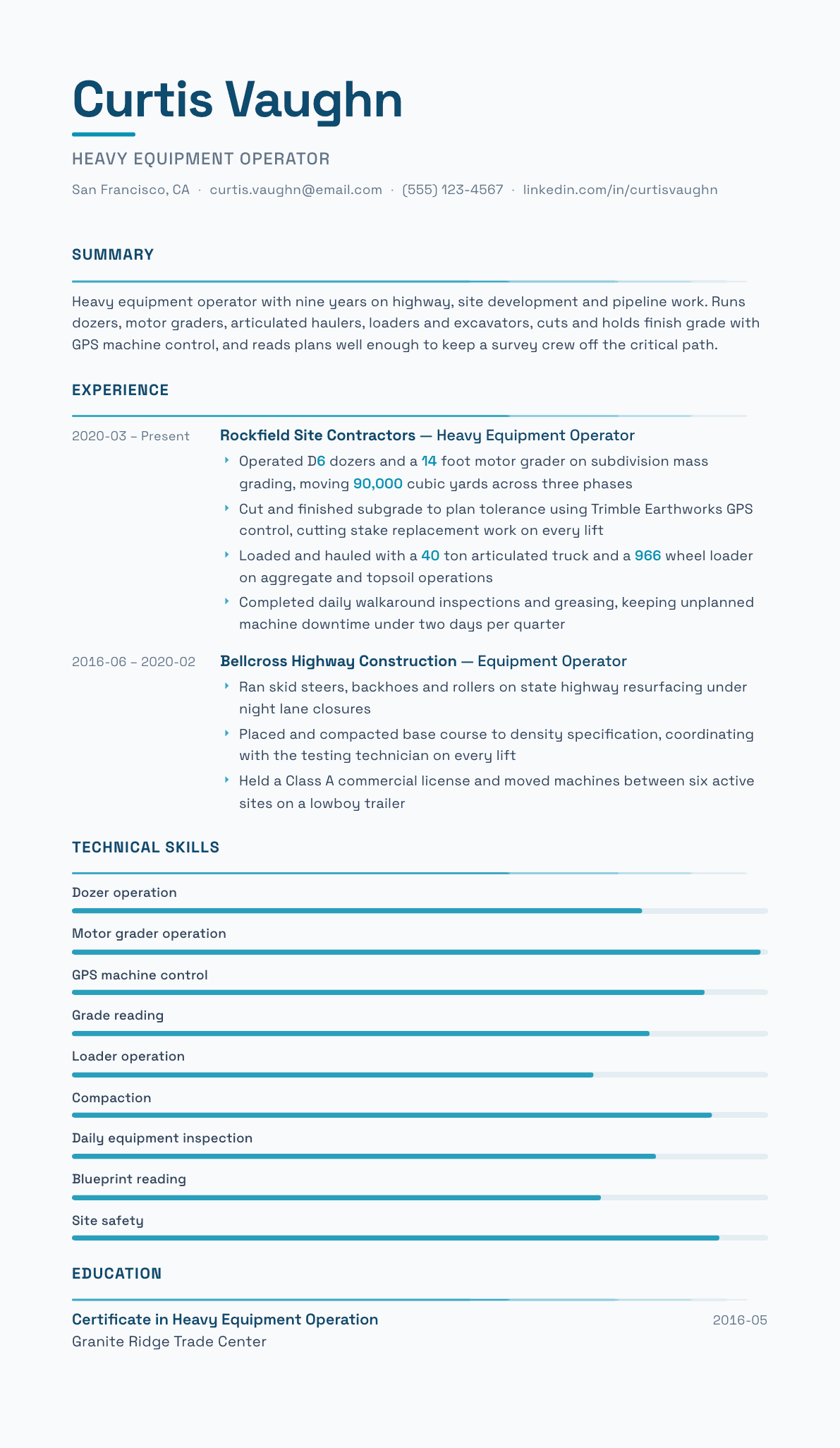


Example Heavy Equipment Operator summary
Heavy equipment operator with nine years on site development, highway and pipeline crews. Runs dozers, motor graders, excavators, loaders and articulated haulers, and holds finish grade with GPS machine control or by stake. Reads civil plans, coordinates with survey and density testing, and services his own machine daily. Holds a Class A commercial license and moves equipment between sites. Looking for a grading crew lead position.
Skills to list on a Heavy Equipment Operator resume
- Dozer operation
- Excavator operation
- Motor grader operation
- Wheel loader operation
- Skid steer operation
- Backhoe operation
- GPS machine control
- Laser grade control
- Compaction and rolling
- Blueprint and grade stake reading
- Preventive maintenance
- Load securement
- Trench safety
- Site cleanup
What actually gets this resume read
- List every machine class and model line you can run, because dispatchers staff crews by the iron they need that week.
- Say whether you can hold finish grade by eye, by laser, or with GPS machine control, and name the control brand.
- Give the work type: mass grading, road building, pipeline, quarry, demolition and utility work all hire separately.
- Include your commercial license class and endorsements, since operators who can move their own iron get called first.
- Show volumes moved and tolerances held so a superintendent can judge your production against his schedule.
- Put safety cards and training in a section of their own: fall protection, trenching awareness and site orientation cards.
How to write a heavy equipment operator resume
A heavy equipment operator resume is read by a superintendent or a dispatcher who already knows what iron is sitting idle next week. He is not looking for a career narrative. He is looking for a machine list, a work type, and some sign that you can hold grade without a survey crew babysitting you.
That makes this one of the few resumes where a plain list beats good prose. The machine section should be findable in two seconds, and the experience should tell him whether you came up on dirt work, road building, pipeline, quarry or demolition, because those crews do not swap easily.
This guide covers the layout that trade employers expect, how to write a summary that names iron and tolerance, how to describe production without exaggerating it, which cards and licenses belong on the page, and the questions operators ask when they move between contractors.
Format: one page, machine list high on the page
Single column, one page, no graphics. Contractors often collect resumes through a simple online form or an email to the office manager, so a clean text file survives better than a designed one.
Put an equipment section directly under the summary rather than at the bottom. It is the section that gets read, and burying it under a chronology costs you calls when a crew needs a grader hand this week.
- Header: name, city and state, phone, email, driver license class and endorsements.
- Section order: summary, equipment operated, certifications and safety cards, experience, training.
- A newer operator lists training school hours, seat time by machine, and any laborer or truck driving history.
Summary: work type, years, iron, and how you hold grade
Three lines that answer the dispatcher question. Say the sectors you have run in, the years, the primary machines, and how you work to grade: by eye, off stakes, with a laser receiver, or with full three dimensional machine control. Name the control brand, since a contractor running one system does not want to retrain you on it.
If you can move your own equipment, say so in the summary. An operator with a commercial license who can pull a lowboy or a tag trailer between sites is worth more to a small contractor than one who needs a hauler booked every time.
Experience: production, tolerance and the crew around you
Write each job with the contractor, the work type, and what you personally ran. Then use bullets that carry a number a superintendent recognizes: cubic yards moved on a phase, feet of trench per shift, loads per hour into trucks, lifts of base placed and compacted, or acres stripped.
Tolerance is the other half. Finishing subgrade to plan, holding a crown and cross slope on a road, cutting a ditch to line and grade, or trimming a pad flat enough that the concrete crew does not complain, are all worth stating directly.
Add the coordination bullets. Working with survey, with the density testing technician, with pipe crews in an open trench, and with truck drivers on a haul road are the parts that keep a job moving. An operator who understands the whole sequence gets promoted to lead.
Maintenance belongs on the page too. Daily walkaround inspections, greasing, fluid checks, track and undercarriage watching, and catching a wear item before it strands a machine on a Friday all save a contractor real money.
- Machines by class and size, not just the word equipment.
- Production per shift or per phase, with the material type.
- Grade method and tolerance held, plus the control system used.
Licenses, safety training and the keywords contractors filter on
Give your driver license class and endorsements, any mine safety training if you have worked in aggregates, site orientation cards, first aid, and construction safety course hours. Contractors on larger projects have to prove crew training to the owner, so a candidate who arrives with valid cards removes paperwork.
Union membership and local number belong here when they apply, along with apprenticeship completion or the operator school you trained through with its total seat hours.
Postings repeat machine names and work types: dozer, motor grader, excavator, wheel loader, skid steer, roller, articulated truck, mass grading, site development, road construction, utilities, machine control and finish grade. Use the exact machine words rather than generic phrasing.
Staffing agencies searching a resume database will also match on license class, safety card names and years of seat time, so spell those out instead of assuming the reader will infer them.
Construction equipment operator resume sample, start to finish
A construction equipment operator resume uses the same order whether the posting says heavy equipment operator, construction equipment operator, construction operator or utility equipment operator. On a contractor's posting, construction operator means the person in the seat of the excavator, dozer or loader, not a plant or machine shop operator, so the machine list and the work type do the same job here as on any heavy equipment resume. The sample below is for an operator with seven years on site work and utility jobs, and the person and contractors are invented. The machine list sits high because a superintendent scans it before anything else.
- Header: Travis Bell, Equipment Operator. City, phone, email, Class A commercial driver license.
- Summary: Equipment operator with seven years on site development and underground utility work. Runs excavators, dozers, loaders and backhoes, and holds grade from stakes, lasers and GPS machine control. Clean safety record and comfortable working close to pipe crews and live utilities.
- Equipment: excavators from mini to large class, dozers, wheel loaders, backhoes, skid steers, motor grader, smooth drum roller, off road haul trucks.
- Current role, Equipment Operator, a site and utility contractor, four years: digs and backfills trench for water, sewer and storm lines, working beside the pipe crew; cuts and fills pads and roads to finish grade with GPS machine control; loads trucks and stockpiles material on commercial sites.
- Previous role, Laborer to Operator, a road contractor, three years: started on grade checking and traffic control, then moved to the roller and loader, then to the excavator on paving projects.
- Licenses and training: Class A commercial driver license, OSHA construction safety card, trench and excavation safety training, first aid.
Heavy machine operator resume: a quarry and plant sample
People search for a heavy machine operator resume and a heavy machinery operator resume as often as for the equipment operator title, and contractors, quarries and mines use all three in their postings. The resume is the same document. Use the exact words from the posting in your title line and summary, and keep the machine list high on the page.
The sample below is for an operator in aggregates rather than site work, because that is where the machinery wording is most common. The person and employers are invented. Notice that production is described in loads and tons where the operator knows the figure, and the safety training is specific to the site type.
- Header: Luis Ortega, Heavy Machinery Operator. City, phone, email, Class B commercial driver license.
- Summary: Heavy machinery operator with nine years in sand, gravel and crushed stone. Runs wheel loaders, off road haul trucks, excavators and a dozer on the face, and loads highway trucks at the scale house. Clean safety record and trained in pre shift inspections and lockout procedures.
- Machinery: large wheel loaders, articulated and rigid frame haul trucks, hydraulic excavators, dozer, water truck, skid steer.
- Current role, Loader and Haul Truck Operator, a regional aggregates producer, six years: loads customer trucks to the scale ticket weight, feeds the primary crusher, builds and maintains stockpiles by product, and runs the haul truck between the face and the plant.
- Previous role, Plant Laborer to Operator, a sand and gravel pit, three years: cleaned conveyors and screens, then moved to the water truck and the loader.
- Training: MSHA new miner and annual refresher training, first aid, pre shift equipment inspection, lockout and tagout.
Heavy Equipment Operator resume summary examples
Out of operator school
Equipment operator with 320 hours of school seat time on dozer, excavator, loader and backhoe, plus two seasons as a construction laborer on grading crews. Reads plans and grade stakes, performs daily machine inspections, and holds a Class A commercial license for equipment moves.
Five years on dirt
Heavy equipment operator with five years on site development and subdivision grading. Runs dozers, loaders and rollers, cuts subgrade to plan tolerance with a laser receiver, and places and compacts base course with the density technician. Services his own machine and keeps downtime low.
Grade hand and crew lead
Finish grade operator with twelve years across highway, pipeline and commercial site work. Runs motor graders and dozers under three dimensional machine control, trims pads and holds crown and cross slope on roadway, and leads a five machine grading crew through phased earthwork schedules.
Work experience bullets: before and after
Before: Operated heavy equipment on construction sites.
After: Ran D6 dozers and a 14 foot motor grader on subdivision mass grading, moving roughly ninety thousand cubic yards across three phases in a single season.
Naming the machines and the volume gives a superintendent a production number he can compare to his own.
Before: Graded to the correct level.
After: Cut and finished subgrade to plan tolerance using Trimble machine control, which removed most stake replacement work and kept the paving crew on their scheduled start.
The control system and the schedule consequence prove you save the job time, not just move dirt.
Before: Loaded trucks with material.
After: Loaded and hauled aggregate and topsoil with a 40 ton articulated truck and a wheel loader, keeping a six truck haul cycle moving without stacking at the pit.
Cycle management is the real skill in loading, and the bullet now shows it rather than the act of scooping.
Before: Did maintenance on the machines.
After: Completed daily walkaround inspections, greased pins and checked undercarriage wear each morning, reporting three failing components before they caused an unplanned shutdown.
Catching failures early is a cost saving a contractor can price, unlike a generic maintenance claim.
Before: Followed all safety rules on site.
After: Worked under night lane closures on state highway resurfacing, setting spotters, respecting the swing radius and coordinating machine movement with flagging crews.
A concrete safety situation shows judgment where a rules statement shows nothing at all.
Hard skills
- Dozer operation
- Motor grader operation
- Excavator operation
- Wheel loader and skid steer operation
- Backhoe operation
- Roller and compaction work
- GPS and laser grade control
- Grade stake and plan reading
- Articulated hauler operation
- Preventive maintenance and inspection
- Load securement and equipment moves
- Haul road and stockpile management
Soft skills
- Situational awareness around crews
- Radio communication
- Working to a phased schedule
- Reliability on early starts
- Coaching newer operators
Certifications worth listing
- NCCER Heavy Equipment Operations Credential (National Center for Construction Education and Research)
- OSHA 30-Hour Construction Outreach Training (Occupational Safety and Health Administration)
- Part 46 New Miner Training (Mine Safety and Health Administration)
- Commercial Driver License Class A (State department of motor vehicles)
Mistakes that cost heavy equipment operator candidates the interview
- Writing operated heavy equipment without naming a single machine class, which fails every keyword search.
- Leaving grade method out, so a contractor cannot tell a rough cut operator from a finish hand.
- Claiming seat time on a machine you have run twice, since a work test on the first morning will expose it.
- Omitting the driver license class when half the small contractors need someone who can move iron.
- Listing safety cards that have expired without noting renewal, which creates a paperwork problem on day one.
- Sending a two page chronology when the machine list is what the reader wanted in the first ten seconds.
Heavy Equipment Operator resume questions
Is a construction equipment operator resume the same as a heavy equipment operator resume?
Yes. Construction equipment operator, construction operator, heavy machine operator, heavy equipment operator and equipment operator are the same job described in different words, and the resume follows the same order: summary, machine list, experience with work type and results, then licenses and safety training. Copy the title the posting uses and lead with the machines it names.
How much detail should I give about machines I have run?
Name the class and a representative size, such as a mid size dozer or a 35 ton excavator. Model numbers help when a contractor runs the same fleet, but the class and size tell a dispatcher most of what he needs.
Does machine control experience really matter?
It matters more each year on larger sites. If you have run three dimensional control, name the brand and say whether you can load models and check calibration, not just follow the screen the grade checker set up.
How do I explain layoffs and seasonal gaps?
Label them plainly as seasonal layoff or project completion. Construction employers expect this, and an honest one line note reads far better than dates that seem to hide something the reference call will uncover.
Do I need a commercial driver license to get hired?
Not always, but it is a strong advantage. Smaller contractors want operators who can move their own machines and run a water truck or a haul truck when the grading crew is waiting on material.
Related resume examples
- Crane Operator Resume example
- Excavator Operator Resume example
- Construction Manager Resume example
- Demolition Worker Resume example
- Diesel Mechanic Resume example
- Road Construction Worker Resume example