Diesel Mechanic Resume Examples: the lines they read
Power Up Your Career with a Diesel Mechanic Resume
By Mustafa Tarabya, founder of CVBooster · Published · Updated
Build a diesel mechanic resume showcasing your heavy equipment expertise, diagnostic skills, and fleet maintenance experience.
Sample resumes for a diesel mechanic
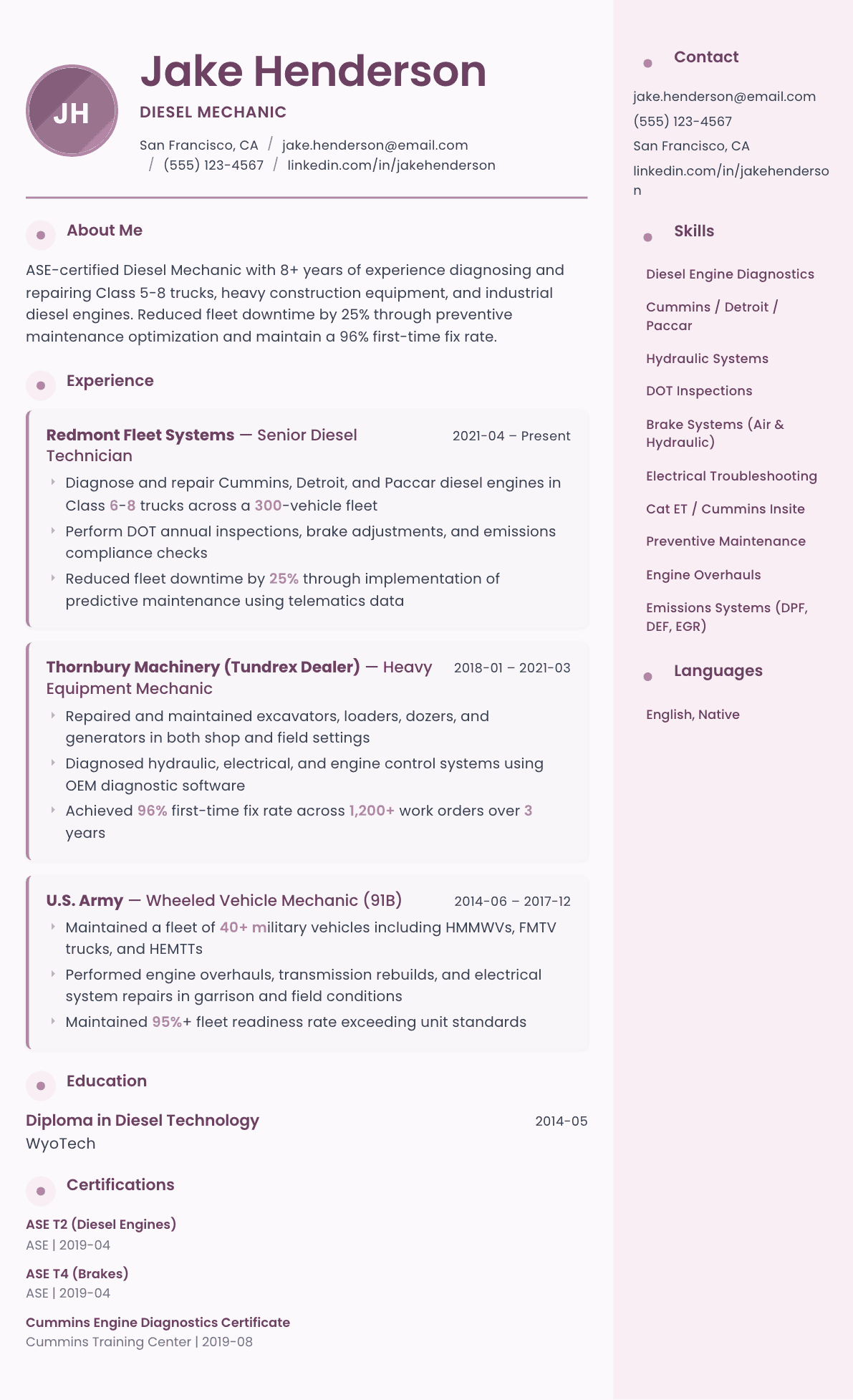
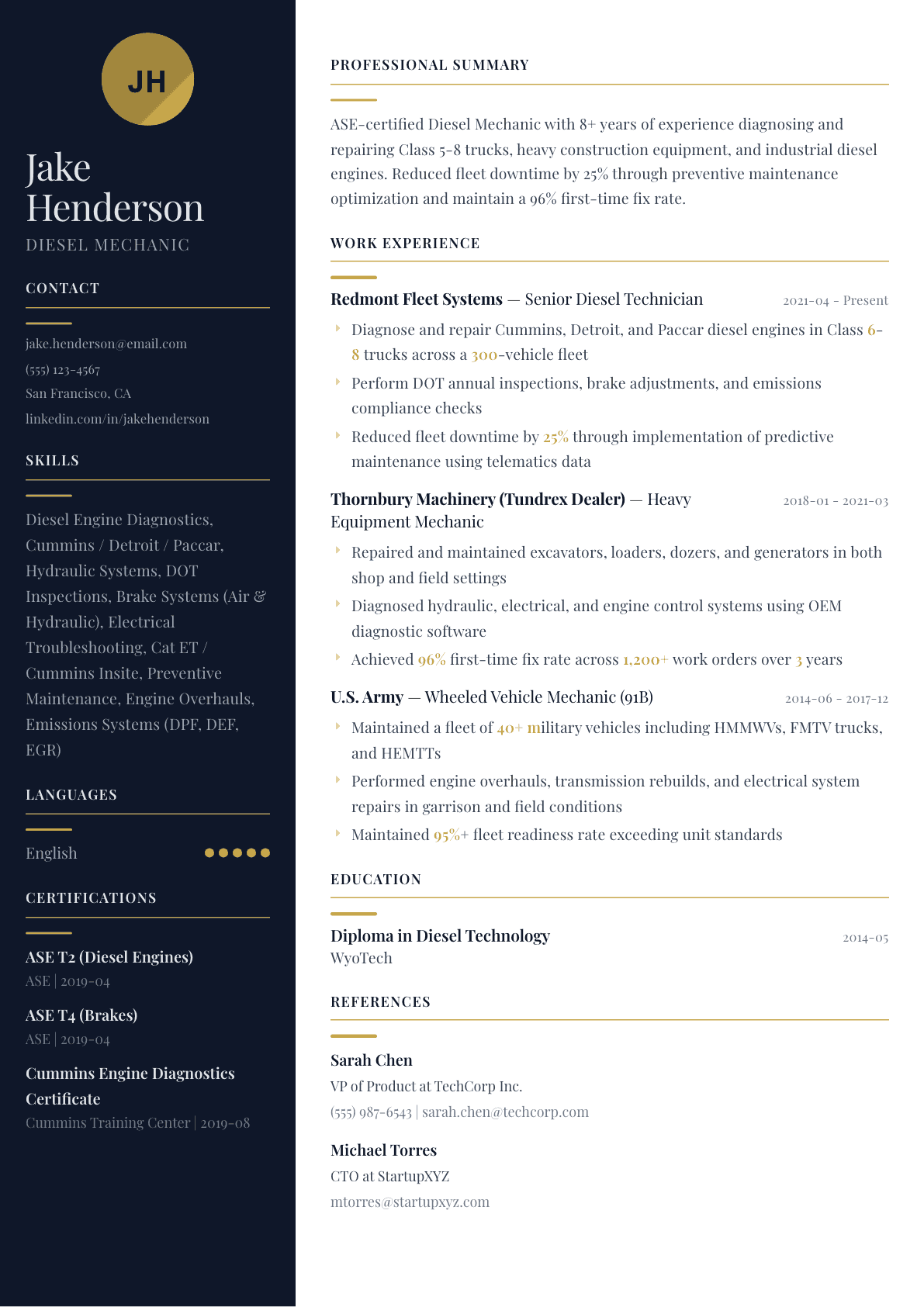
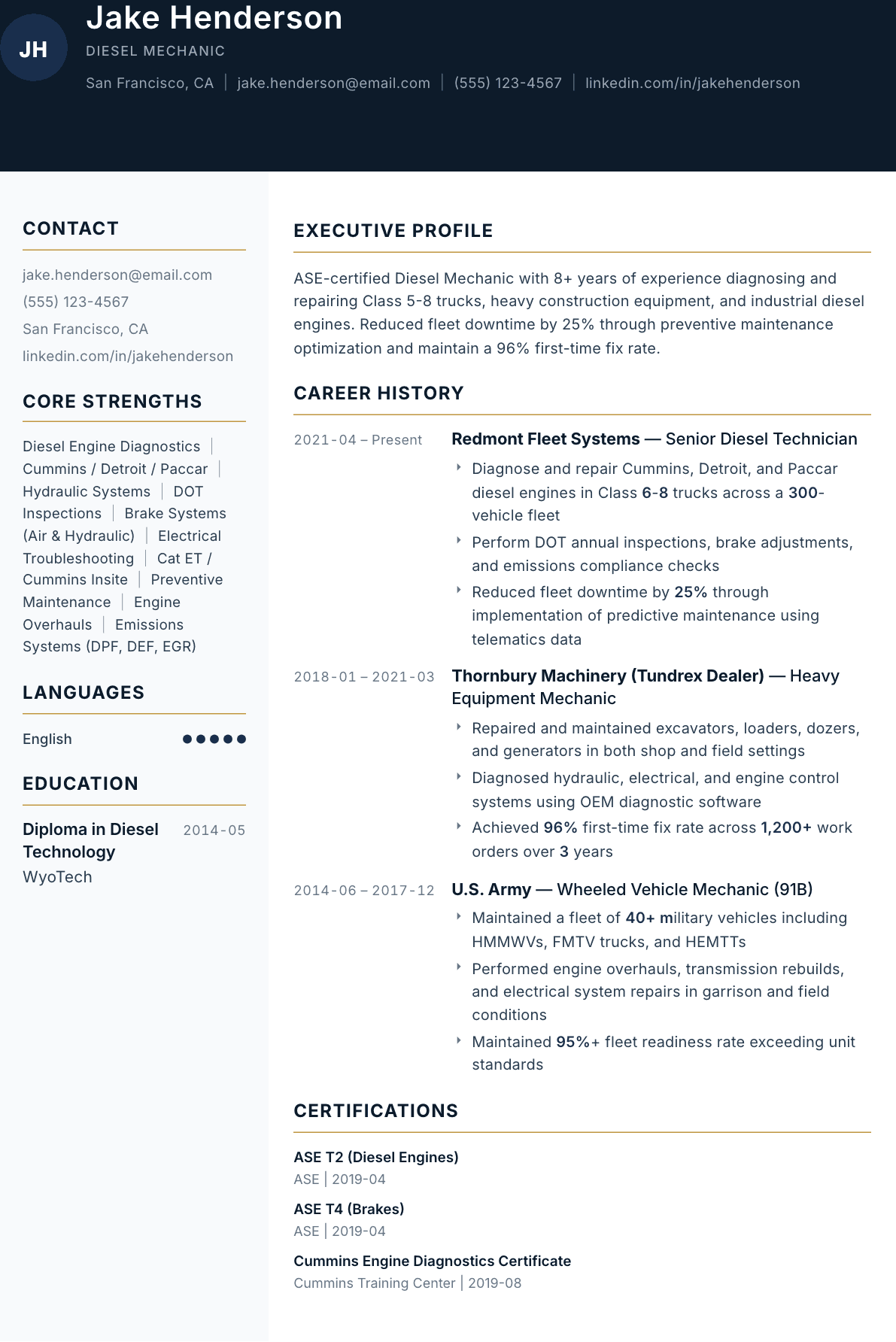
The same diesel mechanic content laid out in three CVBooster templates, so you can see what the finished document looks like before you write a word.
Example Diesel Mechanic summary
ASE-certified Diesel Mechanic with 8 years of experience maintaining Class 5-8 trucks and heavy equipment. Reduced fleet downtime by 25% with a 96% first-time fix rate on Cummins, Detroit, and CAT diesel engines. Seeking a shop foreman or fleet maintenance manager role.
Skills to list on a Diesel Mechanic resume
- Diesel Engine Repair
- Cummins / Detroit / Paccar / CAT
- Hydraulic Systems
- Air Brake Systems
- DOT Inspections
- Electrical Diagnostics
- Diagnostic Software
- Preventive Maintenance
- Engine Overhauls
- Transmission Repair
- Emissions Systems (DPF/DEF/EGR)
- Welding
- Fleet Management
- Heavy Equipment
What actually gets this resume read
- List ASE T-series certifications (T1-T8) and manufacturer-specific training (Cummins, Detroit, CAT).
- Quantify your fleet: number of vehicles maintained, downtime reduction, first-time fix rate.
- Include DOT inspection qualifications and FMCSA compliance experience.
- Specify diesel engine brands: Cummins, Detroit, Paccar, CAT, Volvo, Mack.
- Highlight diagnostic software proficiency: Cat ET, Cummins Insite, Detroit Diesel Diagnostic Link.
- Mention military vehicle maintenance experience as it translates well to civilian diesel roles.
How to write a diesel mechanic resume
A fleet maintenance manager hiring a diesel mechanic is protecting uptime. Every truck sitting in the shop is a load not moving and a driver not earning, so the resume is read as a downtime risk assessment. Can this person diagnose an aftertreatment fault without throwing a doser at it, sign a federal annual inspection, and turn a road call around before the dispatcher reschedules the customer.
Diesel work has split into two skill sets that hiring managers treat separately. There is mechanical depth, meaning engines, transmissions, drivelines, brakes, hydraulics and steering. Then there is electronic depth, meaning engine control diagnostics, emissions aftertreatment, multiplexed chassis wiring and telematics fault codes. The strongest resumes prove both and say which one they lead with.
This guide covers the layout fleets and dealers expect, how to write about engine families and equipment classes, three summaries from apprentice to lead technician, before and after bullets, and the credentials that decide whether your file goes in the interview pile.
Format: one page, engine families named, inspector status visible
Reverse chronological, one page for under ten years. Fleet shops receive resumes through simple applicant systems, so plain headings and no columns. Put a credentials line directly under the header covering ASE medium and heavy truck certifications, your federal inspector qualification, your commercial driver license class, and any endorsements.
A short equipment block near the top pays for itself: the engine families you have worked on, the transmission types, and the equipment classes. A shop running Cummins and Detroit engines with automated manual transmissions will look for those exact words before reading a single bullet.
- Header: name, city and state, phone, email, CDL class and endorsements, inspector qualification.
- Order: summary, certifications and licenses, equipment and engines, experience, education and factory training.
- Say whether each shop was over the road fleet, vocational, transit, construction equipment or dealer service.
Summary: engines, classes, and the kind of failures you close
Two or three lines that name the engine manufacturers, the vehicle or equipment classes, and the diagnostic work you are trusted with. A diesel mechanic who can chase a regeneration failure through the sensors, the doser and the harness rather than replacing the filter is a different hire than one who does preventive maintenance well.
Say where you work. Shop bay, mobile road service, or in the field on machines that cannot be moved are three very different jobs, and a manager building a mobile route reads for that immediately.
Experience: fleet size, cycle compliance, and downtime
Open each entry with the operation: how many power units and trailers, what they hauled or dug, and whether maintenance ran on mileage, hours or calendar intervals. A hundred and fifty tractor fleet on a scheduled preventive cycle is not the same job as a rental yard of excavators and generators.
Then the bullets. Lead with diagnosis and rebuilds: injector cup replacement, head gasket and in-frame overhauls, turbocharger and exhaust gas recirculation service, aftertreatment cleaning and forced regeneration, air brake overhaul, hydraulic pump and cylinder rebuild, differential and clutch work. Name the diagnostic software by manufacturer, since that is a hard filter in many postings.
Quantify the way a maintenance manager does: preventive services completed on schedule, first-time-fix rate, mean time between failures, road calls per truck, or downtime hours per unit. If you helped move a fleet from breakdown response to a scheduled program, that is the strongest bullet on the page.
Compliance and safety: the parts a manager cannot compromise on
Federal annual inspections, brake adjustment qualification and out of service criteria are the compliance spine of a truck shop. State that you are qualified to perform and sign inspections, and that you understand what puts a unit out of service at a roadside stop. A shop that fails a compliance audit remembers whose signature was on the sheet.
Add the hazard side of the work: high pressure fuel systems, lockout on hydraulics and stored energy, wheel and tire safety, welding and torch work, and used oil and coolant disposal. Field mechanics should mention working alone safely on a shoulder or a job site.
Skills and the keywords fleet postings repeat
The vocabulary is consistent across postings: preventive maintenance, diagnostics, aftertreatment, air brakes, hydraulics, electrical troubleshooting, engine overhaul, DOT inspection, and increasingly telematics and fault code triage. Use those exact terms once in the skills block and once where you show the work.
Name the software and the systems. Manufacturer engine diagnostic suites, the maintenance management platform the shop ran, telematics dashboards, parts systems, and any warranty claim work you did. Warranty literate mechanics are rarer than fleets would like.
Diesel Mechanic resume summary examples
Diesel program graduate
Diesel technology graduate with 1 year in a truck shop performing preventive services, brake jobs, tire and wheel work and fluid analysis sampling. Holds a Class A commercial driver license and is qualified to perform brake inspections, seeking a fleet shop with structured mentoring toward engine diagnostics.
Six years in fleet maintenance
Diesel mechanic with 6 years maintaining a 200-unit Class 8 fleet, covering Cummins and Detroit engines, aftertreatment diagnostics, air brake overhaul and driveline work. Qualified federal annual inspector, and holds first-time-fix above 90% across roughly 400 repair orders a year.
Lead technician
Lead diesel technician with 12 years across over the road fleet and heavy construction equipment, running in-frame overhauls, hydraulic rebuilds and electrical diagnostics on multiplexed chassis. Sets the preventive maintenance cycle, reviews telematics fault trends weekly, and trains three technicians toward their inspector qualification.
Work experience bullets: before and after
Before: Repaired trucks and did preventive maintenance.
After: Maintained a 200-unit Class 8 tractor fleet on a mileage-based preventive cycle, performing full services, air brake adjustment, driveline lubrication and federal annual inspections in a six-bay shop.
Fleet size, cycle basis and inspection authority describe the operation a manager is trying to staff.
Before: Fixed emissions problems on diesel engines.
After: Diagnosed repeat regeneration failures by testing differential pressure sensors, doser injectors and nitrogen oxide sensors before condemning a filter, cutting aftertreatment parts spend on the fleet.
The diagnostic sequence separates a real emissions technician from someone who replaces expensive parts in order.
Before: Rebuilt engines.
After: Completed in-frame overhauls on heavy duty engines including liners, pistons, bearings, injector cups and head service, returning each unit to service inside a five-day shop target.
The scope of the rebuild and the turnaround target prove depth and speed at the same time.
Before: Reduced downtime for the company.
After: Reviewed telematics fault codes weekly and pulled units in before a derate, cutting unscheduled road calls per truck by roughly a third over two seasons.
A named method behind the downtime claim makes the improvement believable and repeatable.
Before: Worked on hydraulic systems for heavy equipment.
After: Rebuilt hydraulic pumps, cylinders and control valves on excavators and loaders in the field, flushing systems and setting relief pressures to manufacturer specification before release.
Field context and the pressure setting detail show competence rather than familiarity.
Hard skills
- Heavy duty engine overhaul
- Engine control diagnostics
- Aftertreatment and emissions systems
- Air brake service and adjustment
- Hydraulic system repair
- Electrical and multiplexed chassis wiring
- Automated and manual transmissions
- Differential and driveline service
- Federal annual inspection
- Welding and fabrication
- Telematics fault triage
- Preventive maintenance scheduling
Soft skills
- Working alone on road calls
- Driver debrief and complaint verification
- Prioritizing units by dispatch urgency
- Accurate repair documentation
- Parts room coordination
- Training junior technicians
Certifications worth listing
- ASE Master Medium/Heavy Truck Technician (T2 to T8) (National Institute for Automotive Service Excellence)
- ASE T8 Preventive Maintenance Inspection (ASE)
- ASE L2 Electronic Diesel Engine Diagnosis Specialist (National Institute for Automotive Service Excellence (ASE))
- Commercial Driver License, Class A (State department of motor vehicles)
- Certified Welder (American Welding Society)
Mistakes that cost diesel mechanic candidates the interview
- Not saying whether you are qualified to perform and sign federal annual inspections, which many fleet postings treat as a hard requirement.
- Leaving the engine families off the page, so a shop that runs one manufacturer cannot tell whether you fit.
- Describing preventive services in detail while never showing a single diagnostic story.
- Mixing light automotive work into a heavy truck resume without separating the two, which makes the depth look thinner than it is.
- Omitting the commercial driver license class, which decides whether you can road test the units you repair.
- Writing bullets that never mention downtime, cycle compliance or road calls, the three things the manager is judged on.
Diesel Mechanic resume questions
Do I need a CDL to be hired as a diesel mechanic?
Many shops require at least a Class B so you can move and road test units, and over the road fleets often prefer Class A. Put the class and endorsements in the header, since recruiters filter on it before reading anything else.
How do I move from light automotive work into diesel?
Lead with the transferable diagnostics: electrical troubleshooting, hydraulics if you have it, and any heavy duty brake work. Then name the diesel training you have completed and be honest that you are early on engine overhauls, because fleets will test that in the interview anyway.
Should I list every piece of equipment I have worked on?
Group it instead. Engine manufacturers, transmission types, and equipment classes such as Class 8 tractors, refuse trucks, transit buses or earthmoving machines. A grouped block reads faster and still contains the keywords a fleet posting is scanning for.
What numbers matter most on a diesel mechanic resume?
Fleet size, preventive services completed on schedule, first-time-fix rate, and road calls or downtime hours per unit. Those are the metrics a maintenance manager reports upward, so a resume that speaks in them sounds like it came from inside the shop.
Is mobile or field service experience worth calling out?
Yes, and it should be explicit. Field work means diagnosing without a lift, carrying the right inventory on the truck, and deciding on the spot whether to repair or tow. Shops building a mobile route search for exactly that experience.
Related resume examples
- Automotive Technician Resume example
- Mechanic Resume example
- Maintenance Technician Resume example
- Fleet Mechanic Resume example
- Heavy Equipment Mechanic Resume example
- Diesel Technician Resume example