Crane Operator Resume Examples: the lines they read
Lift Your Career with a Professional Crane Operator Resume
By Mustafa Tarabya, founder of CVBooster · Published · Updated
Create a crane operator resume that highlights your certifications, equipment expertise, and safety record for construction and industrial roles.
Sample resumes for a crane operator
The same crane operator content laid out in three CVBooster templates, so you can see what the finished document looks like before you write a word.
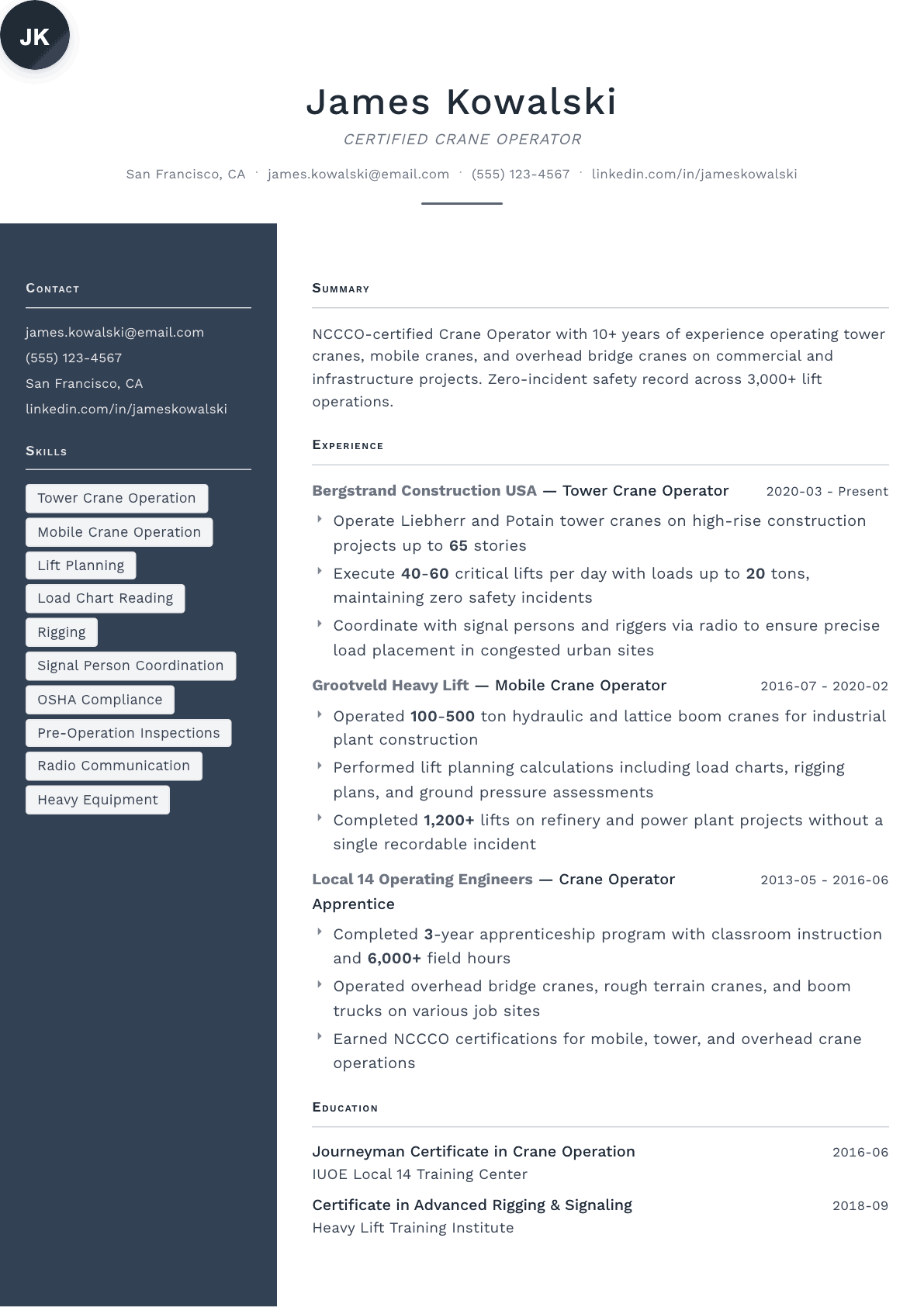
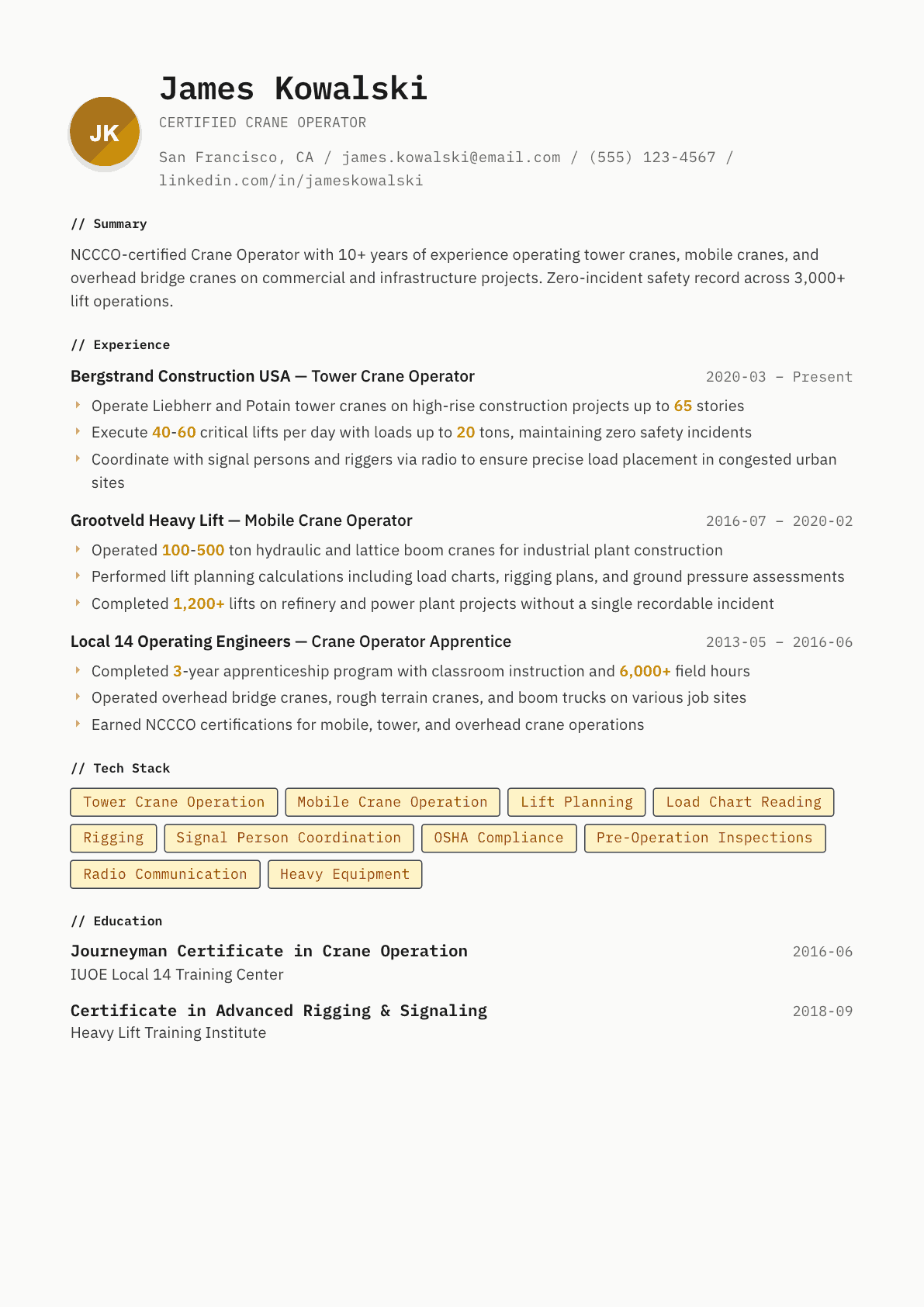
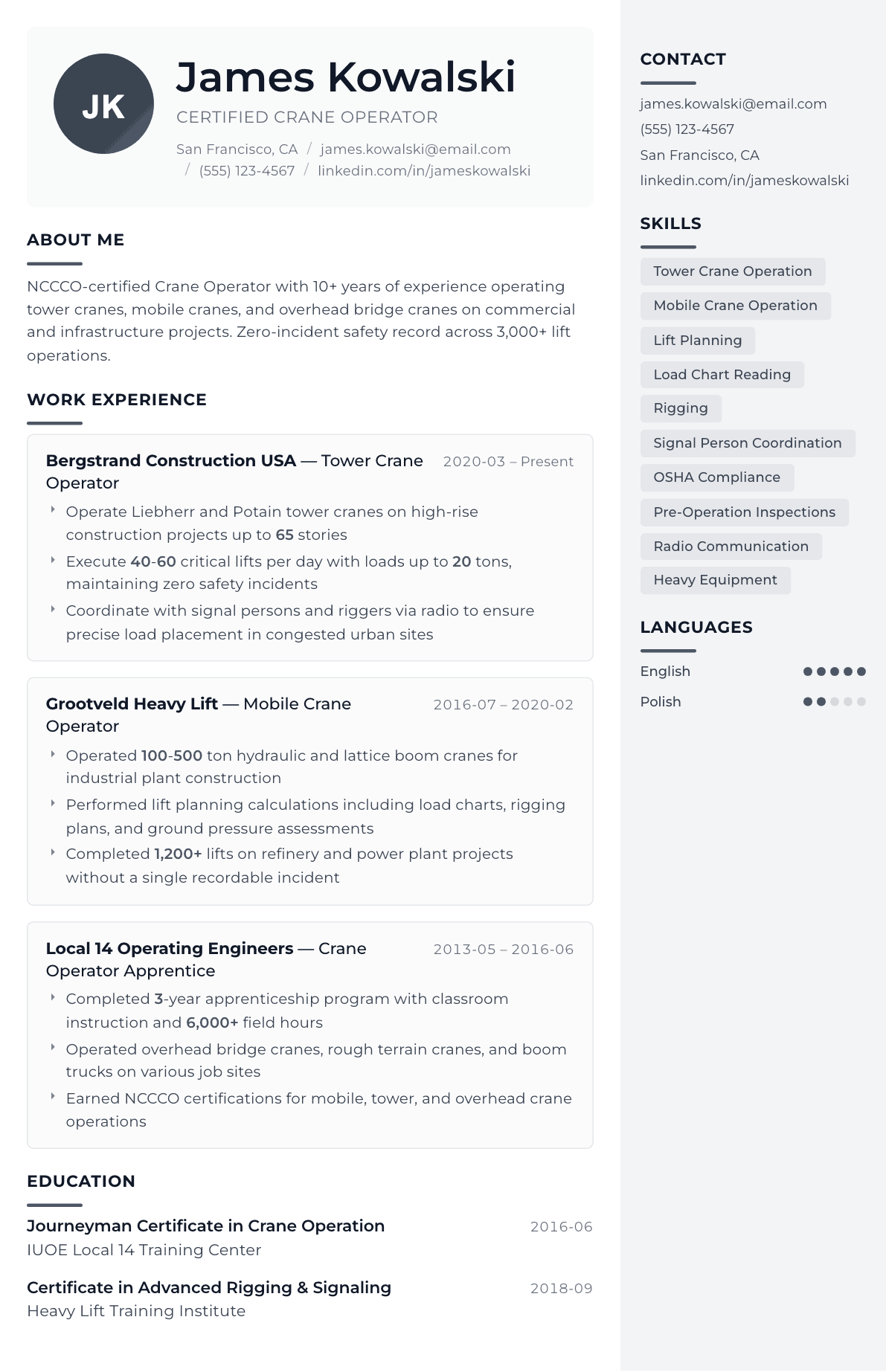
Example Crane Operator summary
NCCCO-certified Crane Operator with 10 years of experience operating tower, mobile, and overhead cranes on commercial and industrial projects. Completed 3,000+ lifts with a perfect safety record. Seeking a tower crane operator position on large-scale urban construction projects.
Skills to list on a Crane Operator resume
- Tower Crane Operation
- Mobile Crane Operation
- Overhead Crane Operation
- Lift Planning
- Load Chart Analysis
- Rigging & Signaling
- Pre-Operation Inspection
- OSHA Compliance
- Radio Communication
- Heavy Equipment Operation
- Lattice Boom Cranes
- Hydraulic Cranes
- Safety Protocols
- Rough Terrain Cranes
What actually gets this resume read
- List all NCCCO certifications by type (mobile, tower, overhead) as these are mandatory for most employers.
- Emphasize your safety record: number of lifts completed without incident, years without recordable injuries.
- Specify crane types and capacities you have operated (Liebherr LTM 1300, Potain MDT 389, 500-ton lattice boom).
- Include lift planning skills such as load chart calculations, rigging plans, and ground bearing assessments.
- Mention union membership and journeyman status if applicable.
How to write a crane operator resume
A crane operator resume is a safety document before it is a career document. The person reading it is a superintendent or a lift director who has to justify putting you in a seat above an active site, so he reads for the certification card and its expiration, the crane types and capacities, and your incident record. Everything else is secondary.
The mistake most operators make is writing about the machine instead of the lifts. Operated a tower crane says very little. The site conditions, the load range, the pick frequency and the coordination with riggers and signal persons say what kind of operator you are.
This guide covers how to lay out a crane operator resume, which certifications and endorsements to show and where, how to describe lifts and safety history without overstating, three summaries, before and after bullets, and the questions operators ask when they apply.
Format: certification block above the fold
One page, or two once you have many crane types and a long project history. Put a certification block directly under your summary listing each credential, the certifying body, the crane type and capacity endorsement, and the expiration. Certifications lapse in this trade and a hiring manager checks dates before reading anything else.
Add a medical and driving line when the job needs it: a current physical, the medical examiner certificate for a commercial driver license, and your standing in a testing program a contractor recognizes.
- Certification block: certifying body, crane type designation, capacity endorsement, expiration.
- Order: summary, certifications, equipment experience, project history, safety record, training.
- Endorsements: lattice boom crawler, telescopic boom, tower crane, overhead and gantry, service truck crane.
- Related cards: rigger and signal person qualifications, aerial lift, forklift, and your driver license class.
Summary: crane types, capacities and the record
Two or three lines. Name the crane types and the largest capacities you have run, the sectors, the years, and your incident record. A superintendent scanning a stack of resumes decides on those four facts alone.
If your experience is concentrated in one crane type, say so rather than implying breadth. Years on tower cranes in tight urban sites is a strength, and overclaiming on mobile cranes will surface during the first practical evaluation.
Equipment: makes, models and capacities
List what you have actually run by make and model with the capacity, because a company running a specific fleet searches for those names. Group by crane type so a reader can find the match quickly instead of reconstructing it.
- Tower cranes: hammerhead and luffing jib, with the manufacturers you have run.
- Mobile cranes: all-terrain, rough terrain, truck-mounted and crawler, with capacity ranges.
- Overhead and gantry: bridge cranes with capacity, and the plant or shipyard setting.
- Attachments and systems: jib extensions, load moment indicators, anti-two-block systems, remote controls.
Lifts, rigging and the paperwork behind them
Describe the work in the terms a lift plan uses: load weights and ranges, radius, boom configuration, ground bearing pressure and cribbing, wind limits, and whether the lift was routine, critical or engineered. An operator who talks that way reads as someone who has sat through a real pre-lift meeting.
Say what you contributed beyond the seat. Reading and checking load charts, reviewing lift plans, inspecting rigging, running daily and periodic inspections, and stopping a lift when conditions changed. Refusal authority is a strength on a resume, not a liability.
Coordination deserves its own bullet. Radio discipline with signal persons and riggers, blind picks, work over occupied areas or live traffic, and multi-crane sites are precisely the conditions a superintendent is nervous about filling.
Safety record and training
Give the record plainly: incidents, near-miss reporting, inspections passed, and any regulatory or insurance audit you were part of. If you have been clean over a long span, say the span. If you have had an incident, be ready for it to come up rather than writing something that would later be contradicted.
List the training that keeps you employable: rigging and signaling, fall protection, confined space if you work in plants, first aid and CPR, and manufacturer training on specific cranes. Contractors with strict prequalification programs will ask for the certificates.
Keywords a crane posting repeats
These postings use consistent language: certified crane operator, load chart, rigging, signal person, critical lift, lift plan, pre-operational inspection, load moment indicator, and the crane types. Include the certifying body and the crane type designations, because recruiters search on exactly those strings.
Crane Operator resume summary examples
Newly certified
Certified mobile crane operator with 2 years of yard and light commercial experience on rough terrain cranes up to 40 tons, plus rigger and signal person qualifications. Reads load charts, completes pre-operational inspections, and holds a commercial driver license. Seeking a full-time seat with a general contractor.
Six years and multiple types
Crane operator with 7 years on rough terrain and all-terrain mobile cranes to 130 tons, plus 2 years on hammerhead tower cranes. Handles steel erection, precast setting and mechanical equipment picks, with a clean incident record and current rigging and signal person certification.
Lead operator on high-rise work
Certified crane operator with 12 years on tower and mobile cranes, including luffing jib work on high-rise projects in congested urban sites. Executes dozens of picks per shift with loads to 20 tons, contributes to critical lift planning, and has operated without a recordable incident across thousands of lifts.
Work experience bullets: before and after
Before: Operated a tower crane on construction sites.
After: Ran hammerhead tower cranes on high-rise projects up to 65 stories, executing 40 to 60 picks per shift with loads to 20 tons in a congested urban site.
Height, pick frequency, load range and site conditions describe the operating environment that a capacity list alone cannot.
Before: Followed all safety procedures.
After: Completed daily pre-operational inspections and documented periodic checks, and stopped 2 lifts when wind exceeded the chart limit until conditions cleared.
Named inspections and a real stop-work decision prove safety behavior instead of asserting it.
Before: Worked with riggers and signal people.
After: Coordinated blind picks by radio with a signal person and 2 riggers over an occupied plaza, using a spotter at the landing zone and a rehearsed hand-off sequence.
The conditions and the method show you can be trusted on the picks that worry a superintendent most.
Before: Used load charts to plan lifts.
After: Verified radius, boom configuration and ground bearing pressure against the load chart before each critical lift, and requested added cribbing on soft fill before setting outriggers.
Working through the chart and acting on the result is what separates a competent operator from a card holder.
Before: Helped train new operators.
After: Mentored 3 apprentice operators through load chart interpretation and pre-lift inspection, and signed their release sheets only after supervised picks.
Naming the curriculum and the accountability shows leadership a lift director can rely on.
Hard skills
- Tower crane operation
- Mobile and rough terrain crane operation
- Load chart interpretation
- Critical lift planning support
- Rigging and load securement
- Hand and radio signaling
- Pre-operational and periodic inspection
- Load moment indicator and anti-two-block systems
- Outrigger setup and ground bearing assessment
- Overhead and gantry crane operation
- Crane assembly and disassembly support
- Preventive maintenance and lubrication
- Site hazard assessment
Soft skills
- Radio communication discipline
- Calm judgment under pressure
- Situational awareness
- Coordination with other trades
- Willingness to refuse an unsafe lift
- Punctuality and reliability
Certifications worth listing
- Mobile Crane Operator Certification (National Commission for the Certification of Crane Operators)
- Tower Crane Operator Certification (National Commission for the Certification of Crane Operators)
- Rigger Level I and Level II (National Commission for the Certification of Crane Operators)
- Signalperson Certification (National Commission for the Certification of Crane Operators)
- Crane Operator Certification (National Center for Construction Education and Research)
- OSHA 30-Hour Construction (OSHA Training Institute)
Mistakes that cost crane operator candidates the interview
- Leaving expiration dates off certifications, which makes a hiring manager assume the card has lapsed.
- Listing crane types without capacities, so nobody can tell whether you ran a service truck crane or a heavy crawler.
- Describing lifts in general terms with no load range, radius or site condition attached to any of them.
- Overstating time on a crane type you have run twice, which a practical evaluation exposes on the first morning.
- Skipping rigger and signal person qualifications, which many contractors treat as part of the package.
- Omitting the driver license class when the job includes moving the crane between sites.
Crane Operator resume questions
Which crane certification do employers ask for?
Certification from an accredited body is required for most covered work, and contractors name the national crane operator commission most often. List the crane type designation, the capacity endorsement and the expiration date for every card you hold.
Do I need rigger and signal person certification as an operator?
It is not always mandatory, but contractors prefer operators who hold both because it removes a staffing constraint on small crews. Holding all three makes you cheaper to schedule, and that shows up in who gets called back.
How do I describe my safety record without overstating it?
Give the measurable facts: years or lift counts without a recordable incident, inspections completed, and any stop-work calls you made. Avoid the word perfect. If you have had an incident, prepare a short factual account instead of writing around it.
Should I list every project I have worked on?
List the projects that show the range you want to be hired for: the crane type, the sector, the duration and one condition that made it difficult. A dozen short calls can sit under one contractor with the crane types summarized.
How do I move from mobile cranes into tower crane work?
Get the tower crane certification first, because contractors will not hire on transferable skill alone here. Then lead with what carries over: load chart discipline, blind picks, radio coordination and work over occupied areas, which are exactly the tower crane conditions.
Related resume examples
- Construction Manager Resume example
- Carpenter Resume example
- Electrician Resume example
- Construction Safety Manager Resume example
- Heavy Equipment Operator Resume example
- Ironworker Resume example